




- Specialty & Fine Chemicals
- 3,3-Dimethylacrylic Acid Methyl Ester Market
3,3-Dimethylacrylic Acid Methyl Ester Market Size, Share, and Growth Forecast, 2025 - 2032
3,3-Dimethylacrylic Acid Methyl Ester Market by Grade (Industrial Grade, Pharmaceutical Grade, Analytical Grade), Manufacturing Process (Transesterification Process, Direct Esterification Process, Catalyst Type, Production Mode), Application, and Regional Analysis for 2025 - 2032

3,3-Dimethylacrylic Acid Methyl Ester Market Share and Trends Analysis
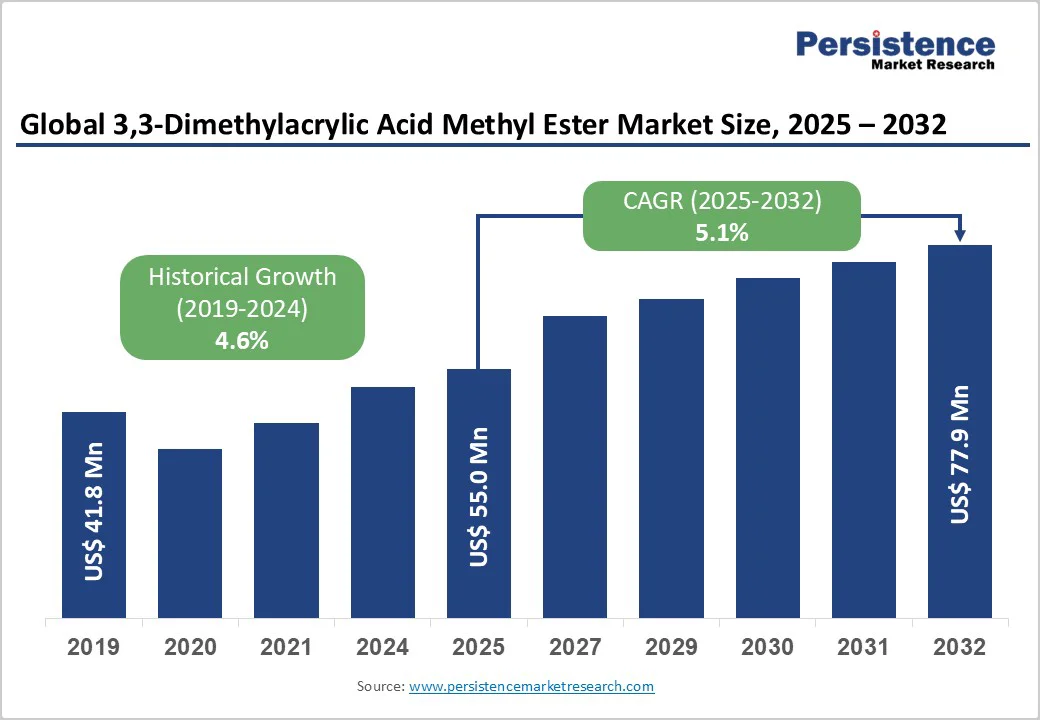
The global 3,3-dimethylacrylic acid methyl ester market size is likely to be valued at US$ 55.0 million in 2025, and is projected to reach US$ 77.9 million by 2032, growing at a CAGR of 5.1% during the forecast period 2025 - 2032.
This growth is propelled by a surging demand for high-purity intermediates in pharmaceutical and agrochemical synthesis, coupled with rising adoption in specialty polymers and coatings driven by stringent environmental regulations and expanding production capacities in Asia Pacific.
Increasing R&D investments and technological advancements in esterification processes further bolster market expansion by improving yield, purity, and cost efficiency.
Key Industry Highlights
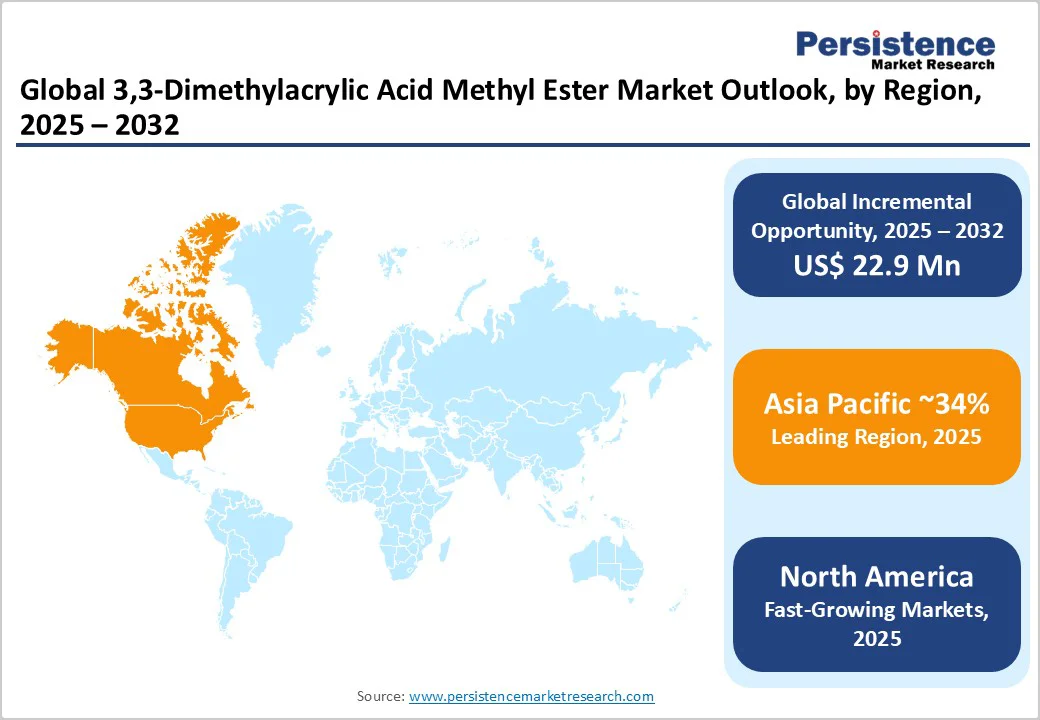
- Leading region: North America is expected to dominate in 2025 due to robust pharmaceutical clusters, strict regulatory oversight, and high investments in innovation.
- Fastest-growing Regional Market: Asia Pacific is set to be the fastest-growing regional market through 2032, propelled by cost advantages, government incentives, and expanding fine chemical clusters in China and India.
- Dominant Grade: Industrial grade will command the highest share in 2025, on account of large-scale deployment for polymer and resin production.
- Fastest-growing segment: Polymer & Resin Monomers segment, driven by rising demand for specialty UV-curable coatings and additive manufacturing resins.
- Key market opportunity: Expansion into UV-curable and high-performance coatings offers high-margin potential for ester intermediates.
| Key Insights | Details |
|---|---|
| 3,3-Dimethylacrylic Acid Methyl Ester Market Size (2025E) | US$ 55.0 Mn |
| Market Value Forecast (2032F) | US$ 77.9 Mn |
| Projected Growth CAGR (2025 - 2032) | 5.1% |
| Historical Market Growth (2019-2024) | 4.6% |
Market Factors - Growth, Barriers, and Opportunity Analysis
Rising Pharmaceutical R&D Investment
The pharmaceutical sector’s global R&D expenditure exceeded US$ 200 billion in 2024, reflecting an average annual growth of 6% over the past five years. This surge is fueling demand for high-purity intermediates such as 3,3-dimethylacrylic acid methyl ester, which serves as a crucial precursor in the synthesis of novel small-molecule therapeutics.
Chemical companies are increasingly focusing on pipeline diversification and complex molecule development, requiring stringent purity standards (>99%) that ester intermediates fulfill. The growing prevalence of chronic diseases and personalized medicine approaches has also expanded opportunities for ester-based intermediates in targeted drug delivery systems.
Moreover, in agrochemical production, which is being driven by increased agricultural output to meet food security demands, 3,3-dimethylacrylic acid methyl ester is used as a key building block for high-efficiency herbicides and insecticides.
Environmental regulations, such as the European Union (EU)’s Sustainable Use Directive, are prompting formulators to adopt biodegradable ester-based active ingredients, boosting ester consumption. The shift towards precision agriculture and controlled-release formulations is also stoking the demand for intermediate chemicals that offer enhanced stability and performance.
Stringent Regulatory Hurdles
Registration requirements under REACH (Registration, Evaluation, Authorisation and Restriction of Chemicals) in Europe and TSCA (Toxic Substances Control Act) in the U.S. impose extensive safety and toxicity testing.
Costs for registering a new substance can exceed US$ 1 million, and review timelines often extend beyond two years, delaying market entry. Smaller players face exorbitantly high compliance burdens, limiting their ability to introduce novel grades or expand capacity, which can slow overall market growth.
The production of 3,3-dimethylacrylic acid methyl ester relies massively on feedstock such as methanol and isobutylene. Price volatility in these commodities has led to unpredictable oscillations in manufacturing costs, with fluctuations for methanol and in crude-derived streams undermining margin stability. Producers are most likely to pass these costs onto the end-users, dampening demand prospects during high-price periods and deterring long-term capacity investments.
Expansion of Fine Chemical Clusters in Asia Pacific
Governments in China and India have pledged incentives worth billions for the development of fine chemical parks by 2027. These clusters integrate feedstock supply, manufacturing utilities, and waste treatment facilities, driving down production costs compared to standalone plants.
Lower labor and operational expenses further enhance cost competitiveness, enabling producers to capture export markets in North America and Europe by offering competitive pricing for high-purity ester intermediates.
The compatibility of 3,3-dimethylacrylic acid methyl ester with UV-curable resins and its ability to enhance adhesion and flexibility make it an attractive monomer for high-performance coatings used in automotive, aerospace, and electronics.
Regulatory shifts favor low-VOC (volatile organic compounds), high-solids formulations, where ester-based monomers help achieve compliance while delivering superior mechanical properties, opening a high-margin application segment.
Category-wise Analysis
Grade Insights
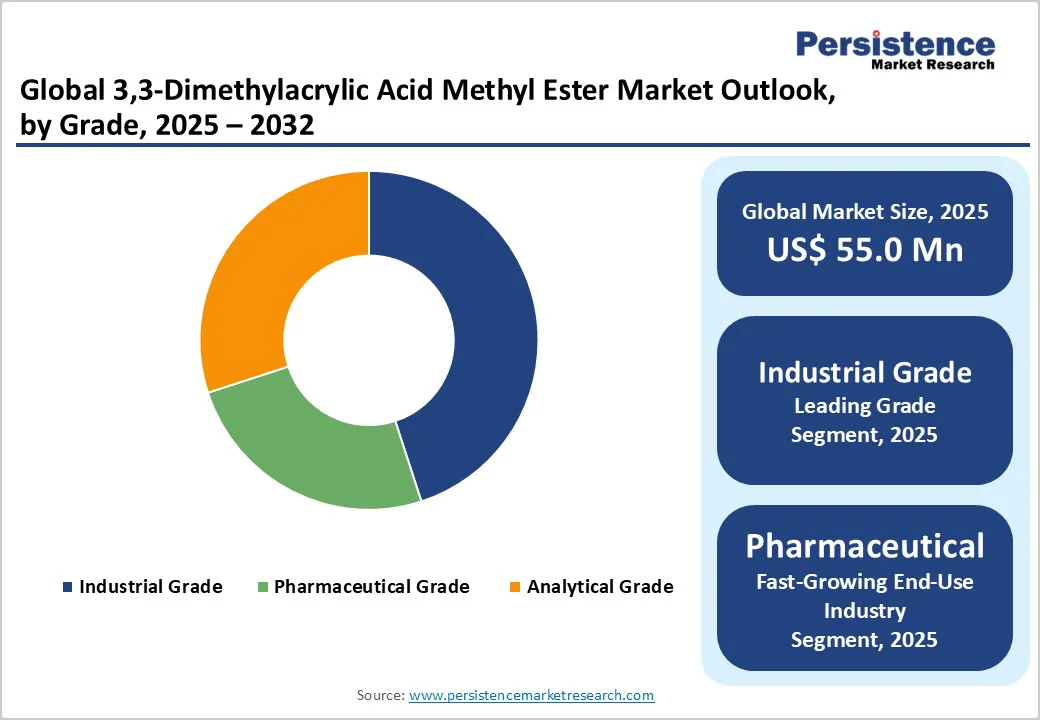
Industrial grade is anticipated to command approximately 45% of the market revenue share in 2025, primarily attributable to its extensive use in large-scale polymer and resin synthesis industries.
With a purity level of 98% or higher, industrial grade chemicals offer a cost-effective solution optimal for bulk applications such as coatings and adhesives. This grade also reduces production costs considerably, compared to the more expensive pharmaceutical-grade esters, making it the preferred choice where ultra-high purity is not critical.
On the other hand, pharmaceutical grade is set to account for approximately 35% of the market, favored for applications demanding stringent purity standards, especially in the synthesis of active pharmaceutical ingredients (APIs).
The rigorous quality control of this grade ensures compliance with medicinal regulations and safety norms. The remaining market share will be held the analytical grade, which is utilized predominantly in research, quality control, and testing environments due to its ultra-high purity exceeding 99.9%.
Manufacturing Process Insights
The transesterification process is slated to dominate production with an estimated 50% of the 3,3-dimethylacrylic acid methyl ester market revenue share in 2025, owing to its milder reaction conditions and superior conversion rates above 95%.
This process uses catalysts such as sodium methoxide and operates at lower temperatures (typically between 80 and 120°C), which results in fewer by-products and impurities. Consequently, it reduces downstream purification costs, enhancing overall production efficiency.
Direct esterification follows with about 30% share, valued for its straightforward feedstock compatibility and simpler processing requirements. The catalyst type, such as enzymatic catalysis, and production mode segments also are gaining traction. These manufacturing processes are known to improve yield, scalability, and environmental sustainability, addressing increasing industry demands for cleaner and more efficient manufacturing technologies.
Application Insights
Polymer and resin monomers are likely to form the largest application area with roughly 35% market share in 2025, spurred by the growing demand for specialty resins utilized in ultraviolet (UV) curable coatings and additive manufacturing. The necessity for high monomer purity (greater than 99%) in these applications ensures consistent polymer performance and product quality, driving this segment’s expansion.
Agrochemical intermediates represent approximately 25% of the market, supported by an industry-wide shift toward biodegradable and environmentally friendly active ingredients that meet global sustainability goals.
At the same time, pharmaceutical intermediates are enlarging their market share, reflecting ongoing growth in pharmaceutical manufacturing and the continual need for high-quality chemical building blocks. Expansion of the other remaining segments is driven by evolving consumer preferences and innovation in product formulations across diverse end markets.
Regional Insights
North America 3,3-Dimethylacrylic Acid Methyl Ester Market Trends
North America is poised to lead the 3,3-dimethylacrylic acid methyl ester market share in 2025, with the U.S. accounting for 70% of regional consumption. Major pharmaceutical clusters in New Jersey, Massachusetts, and California are propelling the demand for high-purity intermediates.
Stringent FDA regulations ensure product quality, encouraging continuous process improvements. The region saw US$ 500 million in VC funding for fine chemical startups in 2024, fostering innovation in continuous manufacturing and green chemistry. Canada contributes via specialty chemical producers in Quebec and Ontario, focusing on sustainable ester production using bio-based feedstock.
Europe 3,3-Dimethylacrylic Acid Methyl Ester Market Trends
Europe is expected to hold 25% of the global market share, with Germany, the U.K., and France as key consumption hubs. The German specialty chemical sector fuels the demand for ester intermediates in coatings and agrochemicals.
Harmonized regulations under REACH streamline market access, while the European Green Deal has accelerated investment in bio-based and circular economy initiatives. Companies are adopting renewable feedstock, such as bio-methanol derived from wood waste, to produce greener esters, aligning with sustainability mandates.
Asia Pacific 3,3-Dimethylacrylic Acid Methyl Ester Market Trends
Asia Pacific is anticipated to be the fastest-growing regional market through 2032, headlined by China’s fine chemicals industry and supported by integrated manufacturing clusters in Jiangsu and Zhejiang provinces.
Government subsidies and land incentives have been designed to reduce operating costs, enabling competitive export pricing. India’s pharmaceutical exports exceeded US$ 25 billion, signaling an enormous demand for high-purity intermediates. Southeast Asian nations, mainly Thailand, Malaysia, and Singapore, are emerging players, leveraging free trade agreements to attract ester producers seeking duty-free access to global markets.
Competitive Landscape
The global 3,3-dimethylacrylic acid methyl ester market structure is moderately consolidated, with the top five players holding 45% share. WeylChem International GmbH leads through a diversified ester portfolio and advanced process optimization. Qingdao Bangli Chemical Co., Ltd. and Shandong Xinhua Pharmaceutical Co. Ltd. follow, leveraging rapid capacity expansions and cost efficiencies.
Strategic partnerships, toll manufacturing agreements, and acquisitions characterize company strategies. R&D investments focus on novel catalysts and continuous-flow technologies to enhance yield, reduce energy consumption, and meet evolving purity requirements. Emerging business models include specialty grade customization and contract manufacturing services.
Key Industry Developments
- In October 2025, Evonik Oxeno, in collaboration with the Leibniz Institute for Catalysis (LIKAT) and Ruhr University Bochum, developed an innovative bimetallic catalyst system that enables the direct use of carbon dioxide (CO?) as a raw material in chemical manufacturing. This breakthrough replaces toxic carbon monoxide with environmentally friendly CO? and green hydrogen in the carbonylation process, converting olefins into valuable esters and acids used in products like acrylic glass and fragrances. The catalyst system, utilizing iridium, palladium, and an industrial phosphine ligand, achieves high selectivity for linear products, advancing sustainable and defossilized chemical production.
- In July 2025, researchers in France developed a novel method to recycle mixed polyester plastics by heating the waste to 270°C, using residual manufacturing catalysts to trigger chemical reactions that create copolymers more susceptible to enzymatic breakdown. This approach, which blends different polyesters rather than sorting them, significantly improves enzymatic depolymerization efficiency, boosting yields from as low as 1-20% for individual plastics to 90% for mixtures. The process overcomes challenges posed by tightly packed polymer structures and additives, offering a promising, less labor-intensive solution for recycling unsortable polyester waste.
- In January 2025, chemists at Scripps Research engineered a breakthrough catalyst system that unlocks previously inaccessible chemical sites in ketone and ester molecules, which are widely used as pharmaceutical intermediates. Traditional challenges in modifying these molecules arose from strong carbon-hydrogen bonds and poor catalyst binding. The new method uses a specially designed monoprotected amino neutral amide ligand with palladium and tetrafluoroboric acid to activate these bonds efficiently, enabling streamlined modifications such as arylation and hydroxylation. This advancement simplifies and accelerates drug synthesis, reduces chemical waste, and has broader implications for materials science, agrochemicals, and biodegradable plastics, promising greener and more precise chemical production.
Companies Covered in 3,3-Dimethylacrylic Acid Methyl Ester Market
- WeylChem International GmbH
- Qingdao Bangli Chemical Co., Ltd.
- Shandong Xinhua Pharmaceutical Co. Ltd.
- Synerzine, Inc.
- Aurora Fine Chemicals
- TCI Chemicals India Pvt. Ltd.
- Gansu Zeyou New Materials Co., Ltd.
- Innopharm Chem
- HANGZHOU LONGSHINE BIO-TECH CO., LTD
- Spectrum Chemical Mfg. Corp.
- Hefei TNJ Chemical Industry Co., Ltd.
- Vortex Product Limited
- Hunan Huateng Pharmaceutical Co., Ltd.
- Dayang Chem (Hangzhou) Co., Ltd.
Frequently Asked Questions
The global 3,3-dimethylacrylic acid methyl ester market is projected to reach US$ 55.0 million in 2025
Rising pharmaceutical R&D expenditure and stringent regulatory approvals are the primary demand drivers.
The market is poised to witness a CAGR of 5.1% from 2025 to 2032.
Expansion in UV-curable coatings and specialty adhesives presents significant growth potential.
Leading market players include WeylChem International GmbH, Qingdao Bangli Chemical Co., Ltd., and Shandong Xinhua Pharmaceutical Co. Ltd.


