




- Specialty & Fine Chemicals
- Trimethylsilyl Phosphate Market
Trimethylsilyl Phosphate Market Size, Share, and Growth Forecast 2026 – 2033
Global Trimethylsilyl Phosphate Market by Product Type (Bis(trimethylsilyl) Phosphate Tris(trimethylsilyl) Phosphate), Application (Lithium ion batteries, Catalyst, Electrolyte, and Others), and Regional Analysis

Trimethylsilyl Phosphate Market Size and Share Analysis
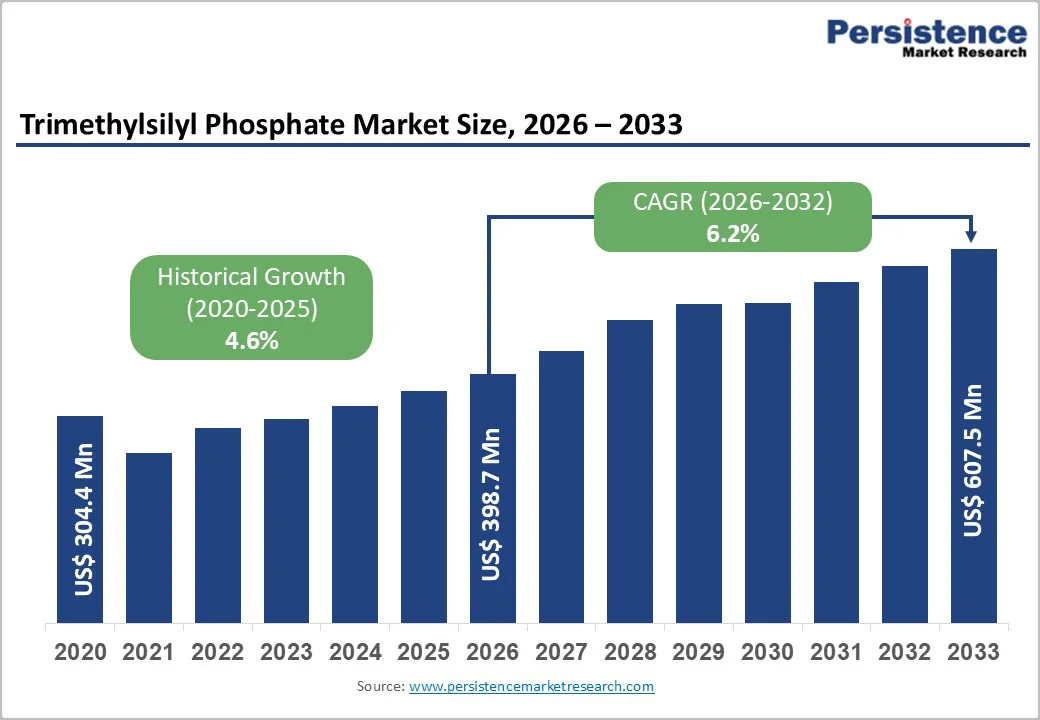
The global trimethylsilyl phosphate Market size was valued at US$ 398.7 Mn in 2026 and is projected to reach US$ 607.5 Mn by 2033, growing at a CAGR of 6.2% between 2026 and 2033.
The market expansion is driven by exponential growth in electric vehicle manufacturing and battery demand requiring advanced electrolyte additives for improved performance and cycle life, escalating research into next-generation lithium-ion battery chemistry emphasizing high-voltage cathode materials and enhanced anode stabilization, and accelerating adoption of trimethylsilyl phosphate's hydrogen fluoride scavenging capabilities addressing critical electrolyte decomposition challenges.
Key Market Highlights
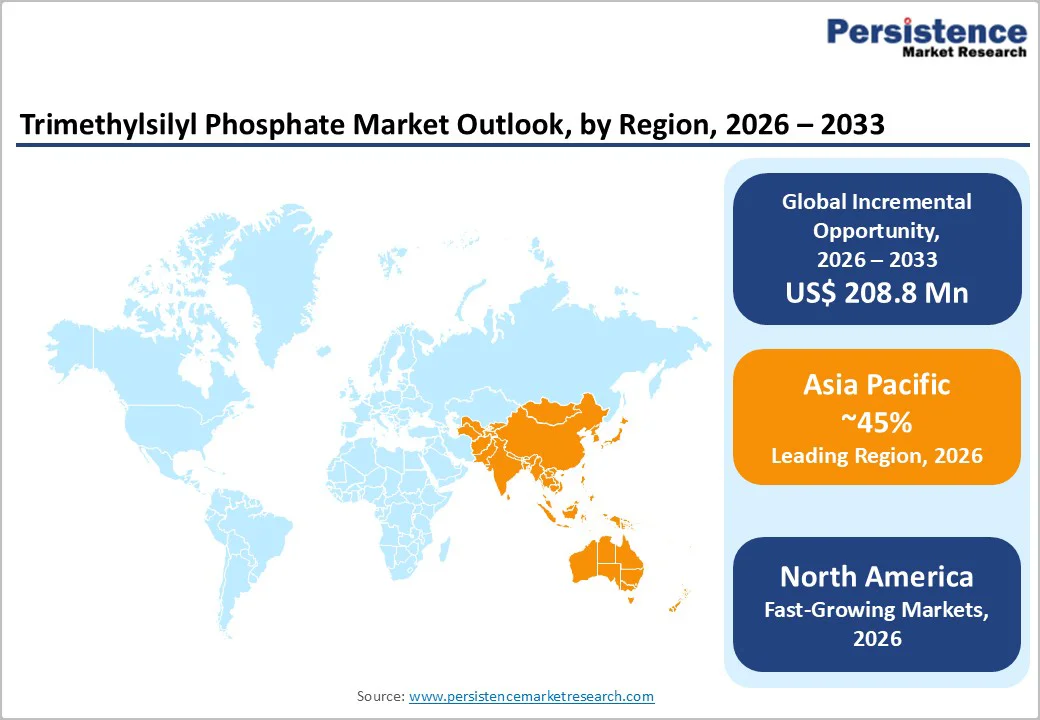
- Leading Region: Asia Pacific dominates the global trimethylsilyl phosphate market with commanding 45% market share, driven by China's battery manufacturing dominance representing 40% of global lithium-ion battery production, Japanese chemical manufacturing excellence, and emerging battery manufacturing expansion across India and Southeast Asia supporting sustained regional growth.
- Fastest Growing Country: China and India regions experience the fastest growth within Asia Pacific, with growth rates exceeding 8% CAGR through 2033, propelled by EV production expansion, government manufacturing incentives, expanding battery research capabilities, and emerging chemistry development supporting regional demand acceleration exceeding global average growth.
- Dominant Product Type: Tris(trimethylsilyl) phosphate (TMSP) dominates the product type category, commanding approximately 70% market share, driven by superior HF scavenging capabilities, established commercialization pathways, extensive academic literature support, and demonstrated performance advantages in lithium-ion battery electrolyte formulations requiring advanced interface protection.
- Growing Application: Lithium-ion battery applications represent the fastest-growing application segment, experiencing growth rates exceeding 7-8% CAGR through 2033, propelled by EV production acceleration, battery chemistry optimization focus, high-voltage cathode material development, and emerging all-solid-state battery research requiring advanced electrolyte additives.
- Key Market Opportunity: Emerging all-solid-state battery development and sodium-ion chemistry expansion represent exceptional growth opportunities, with next-generation battery systems requiring specialized electrolyte additives addressing unique performance requirements, creating incremental demand for trimethylsilyl phosphate application expansion beyond traditional lithium-ion battery electrolyte markets.
| Report Attribute | Details |
|---|---|
|
Global Trimethylsilyl Phosphate Market Size (2026E) |
US$ 398.7 Mn |
|
Market Value Forecast (2033F) |
US$ 607.5 Mn |
|
Projected Growth CAGR(2026-2033) |
6.2% |
|
Historical Market Growth (2020-2025) |
4.8% |
Market Dynamics
Market Growth Drivers
Escalating Electric Vehicle Production and Lithium-Ion Battery Demand
Electric vehicle adoption is accelerating globally, with automotive manufacturers committing to comprehensive electrification of product portfolios and governments implementing aggressive emissions reduction mandates requiring widespread vehicle electrification. Global EV production growth directly correlates to increasing lithium-ion battery manufacturing, driving unprecedented demand for specialized electrolyte additives enhancing battery performance and cycle life. Each lithium-ion battery pack incorporates multiple electrolyte formulation components including trimethylsilyl phosphate serving as multifunctional additive improving battery reliability, thermal stability, and operational longevity.
EV production growth at 10-15% CAGR globally through 2033 is establishing structural demand drivers for specialized chemical components supporting battery industry expansion. The transition toward high-voltage cathode materials including nickel-rich compositions (NMC811, LNMO) requires advanced electrolyte management strategies where trimethylsilyl phosphate demonstrates superior performance through HF scavenging capabilities preventing cathode degradation and transition metal ion dissolution. Battery manufacturers' investments in capacity expansion and chemistry optimization are creating sustained demand momentum for trimethylsilyl phosphate throughout the forecast period.
Advanced Battery Chemistry Research and High-Energy-Density Development
Contemporary lithium-ion battery research increasingly emphasizes development of next-generation chemistries supporting higher energy density requirements exceeding 250 Wh/kg for extended vehicle range and enhanced performance characteristics. Academic and commercial battery research organizations are systematically investigating trimethylsilyl phosphate's protective mechanisms including solid electrolyte interphase formation and HF scavenging, which directly address performance limitations in next-generation battery systems. Published research demonstrates that TMSP incorporation enables 96.8% capacity retention at 100 cycles at 45°C with improved rate performance and reduced electrode polarization through superior surface film passivation.
Emerging all-solid-state battery development and sodium-ion battery chemistry optimization are expanding trimethylsilyl phosphate's addressable market beyond traditional lithium-ion applications. University-industry partnerships and joint development initiatives are accelerating commercialization pathways for advanced electrolyte formulations incorporating trimethylsilyl phosphate. Regulatory emphasis on battery safety, environmental performance, and recycling is driving manufacturers to adopt specialized additives improving battery sustainability and end-of-life performance characteristics.
Market Restraints
High Production Costs and Chemical Instability in Electrolyte Solutions
Trimethylsilyl phosphate production involves complex synthetic methodologies requiring specialized equipment, precise temperature control, and advanced technical expertise, creating substantial cost barriers limiting market penetration in price-sensitive applications. The synthesis requires reacting hexamethyldisilazane with phosphates at 80-160°C for 2-5 hours, followed by distillation and purification processes increasing manufacturing complexity and operational expenses.
Chemical instability of trimethylsilyl phosphate in solution presents significant technical challenges, as published research indicates limited shelf-life of fresh electrolyte formulations containing TMSP, potentially compromising battery performance if storage duration extends beyond specified timelines. Quality control and analytical testing requirements for battery-grade trimethylsilyl phosphate impose additional costs and technical burdens on manufacturers, limiting production scaling and commercial viability in cost-constrained market segments.
Supply Chain Concentration and Manufacturing Bottlenecks
Trimethylsilyl phosphate production is heavily concentrated in Asia Pacific region, particularly China and Japan, creating geographical supply vulnerabilities and logistics cost premiums for North American and European battery manufacturers. Limited manufacturing capacity relative to projected demand growth creates supply constraints potentially delaying battery production timelines and limiting new entrant access to specialized electrolyte components.
Established suppliers including Sigma-Aldrich (Merck), TCI America, and Tokyo Chemical Industry maintain dominant distribution positions, creating high barriers to entry for emerging suppliers and limiting competitive pressure driving cost reductions. Technical certifications and quality approvals required for battery-grade chemical components extend commercialization timelines and constrain new product development.
Market Opportunities
Next-Generation Battery Chemistry Development and Emerging Energy Storage Applications
Emerging battery technologies including all-solid-state batteries, lithium-metal batteries, and multi-valent ion chemistries are expected to generate substantial incremental demand for specialized electrolyte additives addressing unique performance requirements in advanced systems. Sodium-ion battery development, currently transitioning from laboratory to commercial production, represents significant growth opportunity as researchers investigate trimethylsilyl phosphate's effectiveness as multifunctional additive for sodium-ion chemistry. Grid-scale energy storage systems supporting renewable energy integration require long-duration battery technologies with enhanced cycle life and thermal stability where trimethylsilyl phosphate's protective mechanisms deliver measurable performance advantages.
Global energy storage deployment is projected to grow at 15% CAGR through 2033, creating substantial incremental market opportunity for specialized electrolyte components. Academic research collaborations and joint development partnerships between chemical suppliers and battery manufacturers are accelerating commercialization timelines for next-generation formulations incorporating trimethylsilyl phosphate. Government subsidies supporting domestic battery manufacturing and supply chain resilience initiatives are creating favorable conditions for specialty chemical supplier expansion across North America and Europe.
Pharmaceutical and Advanced Chemical Synthesis Applications Expansion
Trimethylsilyl phosphate serves as valuable reagent in organic synthesis and pharmaceutical development, with applications extending beyond battery chemistry into advanced intermediate synthesis and custom pharmaceutical manufacturing. The compound's reactivity characteristics enable preparation of complex phosphorus-containing molecules valuable in pharmaceutical development and agrochemical formulation. Contract research organizations and pharmaceutical manufacturers are increasing trimethylsilyl phosphate consumption for development of novel active pharmaceutical ingredients and specialized chemical intermediates.
Custom synthesis services leveraging trimethylsilyl phosphate's reactivity are emerging as high-margin business opportunities for specialty chemical suppliers. Growing pharmaceutical research investment in emerging economies including India and China is expected to drive increased trimethylsilyl phosphate demand across non-battery applications. Expanding chemical synthesis research in academic and industrial settings creates continuous incremental demand for specialized reagents including trimethylsilyl phosphate.
Category-wise Insights
Product Type Analysis
Tris(trimethylsilyl) phosphate (TMSP) commands market dominance, accounting for approximately 70% of trimethylsilyl phosphate market share, driven by superior performance characteristics and extensive commercialization across lithium-ion battery applications. TMSP's effectiveness as bifunctional additive combining HF scavenging with solid electrolyte interphase formation positions it as the preferred choice for battery manufacturers optimizing electrolyte formulations. The compound's ability to scavenge hydrogen fluoride generated through electrolyte decomposition significantly improves cycle life and operational reliability across diverse cathode chemistries.
Published research demonstrates TMSP's effectiveness at 0.5 wt% concentration, enabling manufacturers to achieve specified performance targets with minimal additive consumption. Extensive academic literature and technical publications supporting TMSP efficacy have established it as the standard benchmark for electrolyte additive development. Boiling point of 236°C and flash point of 24°C enable practical laboratory handling and manufacturing integration. The market's consolidation around TMSP reflects manufacturers' confidence in established performance characteristics and regulatory compliance pathways.
Application Analysis
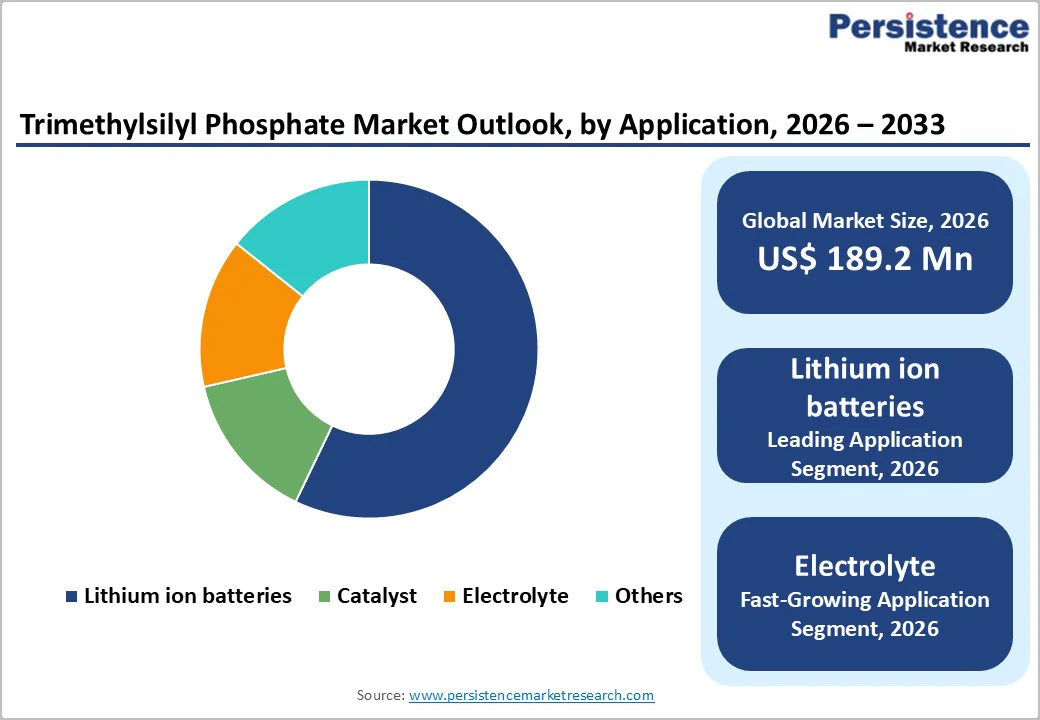
Lithium-ion batteries represent the dominant application segment for trimethylsilyl phosphate, accounting for approximately 65% of total market consumption, driven by relentless industry focus on battery performance optimization and cycle life enhancement. Electrolyte formulation represents the primary application pathway, where TMSP improves solid electrolyte interphase (SEI) stability on graphite anodes and cathode electrolyte interphase (CEI) protection on high-voltage cathode materials including LNMO and NMC811 compositions. The compound's HF scavenging capability prevents transition metal ion dissolution from cathode materials, directly addressing performance degradation mechanisms limiting cycle life at elevated operating temperatures. Battery manufacturers standardizing trimethylsilyl phosphate incorporation across product portfolios are creating established demand baseline supporting market growth.
High-voltage battery development (4.6V+ operating windows) increasingly relies on trimethylsilyl phosphate's protective mechanisms addressing oxidative decomposition challenges. Emerging high-energy-density battery systems incorporating silicon-graphite anodes and nickel-rich cathodes demonstrate exceptional performance improvements with TMSP incorporation. The segment's dominance reflects battery industry prioritization of cycle life and thermal stability improvements justifying premium chemical component costs.
Regional Insights
North America Trimethylsilyl Phosphate Trends
North America represents a significant trimethylsilyl phosphate market, commanding approximately 25% of global demand, anchored by the United States which maintains leadership through world-class battery research institutions, major EV manufacturing facilities, and government commitment to transportation electrification. U.S. battery manufacturing investment exceeding USD 20+ billion announced through 2030 is establishing North American production capacity supporting accelerated trimethylsilyl phosphate consumption growth. American battery manufacturers including Tesla, GM, Ford, and emerging startups are implementing advanced electrolyte formulations incorporating trimethylsilyl phosphate to achieve competitive performance advantages.
University research partnerships at MIT, Stanford, and CalTech are advancing fundamental understanding of TMSP mechanisms and developing next-generation formulations. Government programs supporting domestic battery supply chain development and manufacturing incentives are encouraging chemical supplier expansion and production capacity establishment in North America. IRA (Inflation Reduction Act) provisions supporting electric vehicle manufacturing and battery development are creating favorable regulatory conditions for specialized chemical component suppliers.
Europe Trimethylsilyl Phosphate Trends
Europe represents a significant trimethylsilyl phosphate market, commanding approximately 20% of global demand, with Germany maintaining technology and manufacturing leadership through world-renowned chemical and pharmaceutical expertise. German battery research institutions and chemical manufacturers are advancing trimethylsilyl phosphate applications in next-generation battery systems. Merck KGaA, headquartered in Darmstadt Germany, distributes trimethylsilyl phosphate globally through its Sigma-Aldrich brand, establishing European distribution dominance and technical support capabilities.
Nordic battery manufacturing expansion, particularly in Sweden and Norway, is driving incremental trimethylsilyl phosphate demand for advanced electrolyte formulation. European Union sustainability mandates and battery regulation directives are accelerating manufacturer investments in performance optimization supporting trimethylsilyl phosphate adoption. Switzerland, UK, and France represent steady demand contributors through pharmaceutical research and specialty chemical synthesis applications.
Asia Pacific Trimethylsilyl Phosphate Trends
Asia Pacific represents the fastest-growing regional market for trimethylsilyl phosphate, experiencing growth rates substantially exceeding developed market expansion, with 45% of global demand and projected CAGR exceeding 8% through 2033. China dominates regional production and consumption, leveraging extensive lithium-ion battery manufacturing capacity and positioning as global EV production epicenter. Chinese battery manufacturers including CATL, BYD, and Sunwoda are implementing trimethylsilyl phosphate formulations across product portfolios as standard practice. Shanghai Jizhi Biochemical Technology and regional chemical manufacturers are scaling production capacity to support domestic battery industry expansion.
Japan maintains steady trimethylsilyl phosphate demand through established battery chemistry expertise and premium product positioning. Tokyo Chemical Industry and Tokyo Kasei Kogyo provide regional supply and technical support. India's emerging battery manufacturing sector is beginning to incorporate advanced electrolyte formulations, creating incremental demand growth opportunities. Government EV adoption targets and manufacturing incentives across Asia Pacific are establishing structural demand drivers supporting continued regional market expansion.
Competitive Landscape for the Trimethylsilyl Phosphate Market
The trimethylsilyl phosphate market exhibits a moderately concentrated competitive structure dominated by established specialty chemical manufacturers and global life science suppliers with comprehensive distribution networks and technical support capabilities. Tier 1 companies including Sigma-Aldrich (Merck), Tokyo Chemical Industry, TCI America, and Gelest collectively command approximately 60-70% market share through established brand recognition, extensive product portfolios, and global customer relationships. Sigma-Aldrich/Merck KGaA, the market leader, maintains dominance through comprehensive chemical catalog, technical literature support, and quality assurance certifications.
Tier 2 manufacturers and regional suppliers including Shanghai Jizhi Biochemical, Nanjing Chemical Reagent, and Shanghai Chuqing New Materials manage approximately 20-30% market share, differentiating through cost competitiveness and local manufacturing advantages. Competitive strategies emphasize supply chain development, production capacity expansion, and customer technical support. Emerging suppliers are investing in advanced synthesis methodologies and quality improvement initiatives to capture growing market opportunities. Vertical integration trends with battery manufacturers are enabling specialized suppliers to establish long-term supply relationships and achieve manufacturing scale economies.
Key Market Development
In 2025, Research in Journal of Materials Chemistry A showed that adding TMSP to liquid electrolytes undergoing in situ polymerization enhances cathode electrolyte interphase (CEI) formation and ionic conductivity in gel-solid polymer electrolytes. Increasing TMSP concentration from 1 to 5 wt % improved electrochemical stability and cycling performance of LiNi?.??Mn?.??Al?.??O?-based cells, supporting broader use of TMSP in advanced electrolyte systems.
Companies Covered in Trimethylsilyl Phosphate Market
- Shanghai Jizhi Biochemical Technology Co., Ltd.
- Finetech Industries Limited
- TCI America Inc.
- Tokyo Chemical Industry
- Leap Chem Co., Ltd.
- Nanjing Chemical Reagent Co., Ltd.
- Shanghai Chuqing New Materials Technology Co., Ltd.
- Sigma-Aldrich
- Gelest Inc.
- Alfa Aesar
- Santa Cruz Biotechnology
- ABCR GmbH
- Tokyo Kasei Kogyo Co., Ltd.
- Spectrum Chemical
- Merck KGaA
Frequently Asked Questions
The global Trimethylsilyl Phosphate Market is projected to reach US$ 607.5 million by 2033, expanding from US$ 398.7 million in 2026 at a CAGR of 6.2%, driven by electric vehicle production growth, advanced lithium-ion battery chemistry development, and expanding adoption of trimethylsilyl phosphate's hydrogen fluoride scavenging and solid electrolyte interphase formation capabilities.
Market demand growth is driven by multiple converging factors including escalating electric vehicle manufacturing requiring advanced lithium-ion batteries with enhanced cycle life; expanding research into high-voltage cathode materials necessitating superior electrolyte additives; trimethylsilyl phosphate's proven effectiveness in preventing transition metal ion dissolution and improving thermal stability; emerging battery chemistry development including sodium-ion and all-solid-state systems requiring specialized electrolyte components.
Lithium-ion batteries represent the dominant application segment, commanding approximately 65% market share, driven by EV production acceleration, battery chemistry optimization focus, and trimethylsilyl phosphate's superior performance in protecting high-voltage cathode materials and stabilizing graphite anodes through HF scavenging and SEI formation mechanisms.
Asia Pacific commands market leadership with approximately 45% global trimethylsilyl phosphate demand, anchored by China's dominance in lithium-ion battery manufacturing representing 40% of global battery production, combined with Japanese chemical manufacturing excellence and emerging battery development expansion across India supporting sustained regional market leadership.
Major market opportunities include all-solid-state battery development requiring specialized electrolyte additives; sodium-ion chemistry commercialization expanding trimethylsilyl phosphate applications beyond lithium-ion batteries; pharmaceutical and advanced chemical synthesis applications leveraging TMSP's reactivity; grid-scale energy storage systems supporting renewable integration; and next-generation battery chemistry research accelerating commercialization timelines for advanced formulations.
Leading market players include Sigma-Aldrich/Merck KGaA commanding global market leadership through comprehensive distribution and technical support; Tokyo Chemical Industry offering specialized formulations and regional expertise; TCI America providing premium products for battery research; Gelest Inc. leveraging silicon chemistry expertise and advanced material development; Shanghai Jizhi Biochemical Technology serving Asia Pacific manufacturing sector; and regional suppliers including Nanjing Chemical Reagent and Shanghai Chuqing New Materials providing cost-competitive alternatives.


