




- Specialty & Fine Chemicals
- Methyl Acrylate Market
Methyl Acrylate Market Size, Share, and Growth Forecast, 2026 - 2033
Methyl Acrylate Market by Product Type (Industrial, Pharmaceutical), Purity Grade (Less Than or Equal To 99%, Greater Than 99%), Application (Surface Coatings, Others), End-user (Paint and Coating, Automobile, Others), and Regional Analysis for 2026 – 2033

Methyl Acrylate Market Size and Trends Analysis
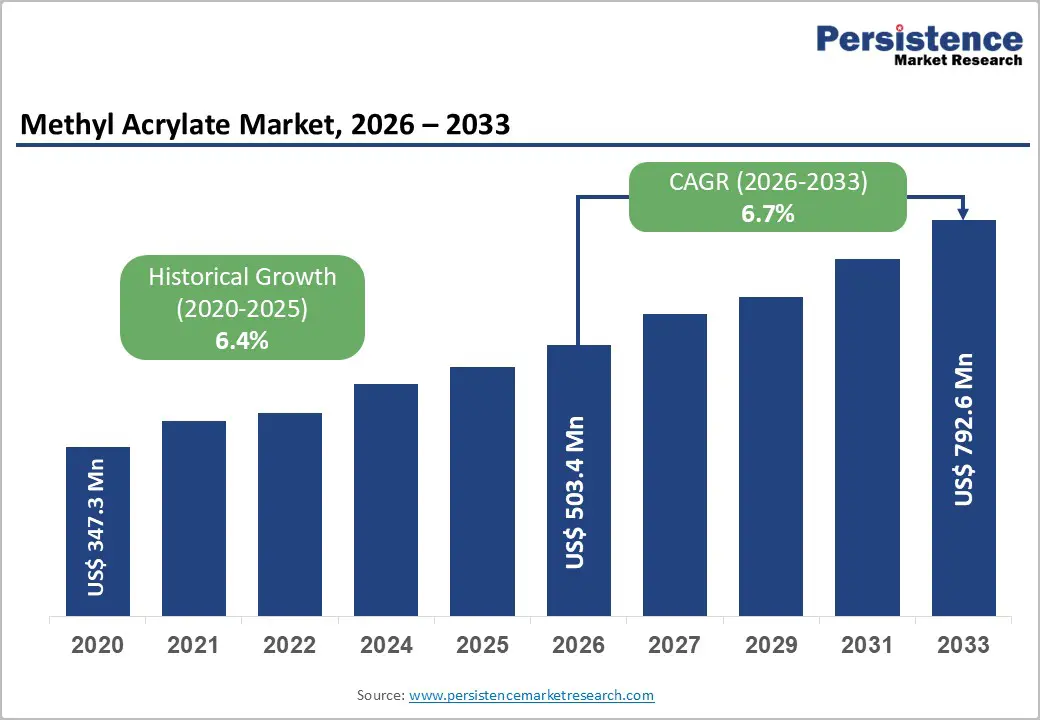
The global methyl acrylate market size is likely to be valued at US$503.4 million in 2026, and is expected to reach US$792.6 million by 2033, growing at a CAGR of 6.7% during the forecast period from 2026 to 2033, driven by the increasing prevalence of high-performance coatings, rising demand for adhesives in construction and automotive, and advancements in high-purity methyl acrylate production.
The growing demand for versatile and durable methyl acrylate, particularly in surface coatings and chemical synthesis, is driving its wider adoption across various applications. The development of high-purity grades (greater than 99%) is further enhancing its appeal by providing superior quality and reactivity. The growing recognition of methyl acrylate as essential in polymer manufacturing in emerging economies is a key driver of market growth.
Key Industry Highlights:
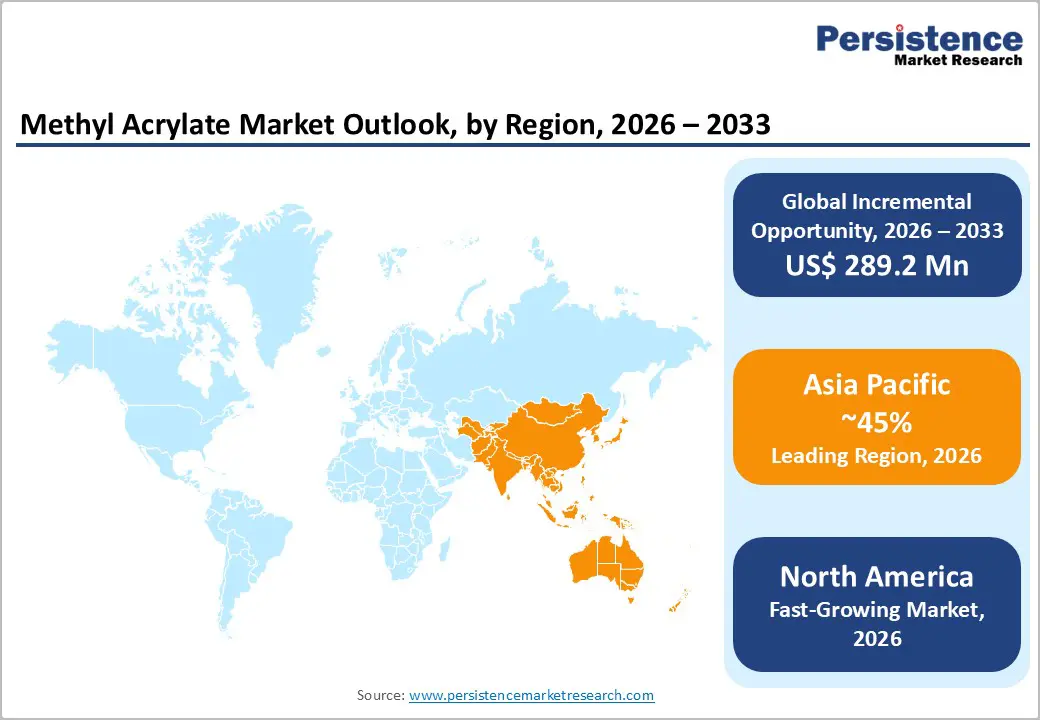
- Leading Region: Asia Pacific, anticipated to account for a 45% market share in 2026, driven by rapid industrialization, high coatings demand, and strong production in China and India.
- Fastest-growing Region: North America is the fastest-growing region, driven by the region’s advanced coatings infrastructure, strong research and development capabilities, and high public awareness of performance benefits.
- Dominant Product Type: Industrial, to hold approximately 85% of the market share, as it serves bulk applications in coatings and adhesives.
- Leading Purity Grade: Greater than 99%, to account for over 60% of the market revenue, due to premium performance in sensitive formulations.
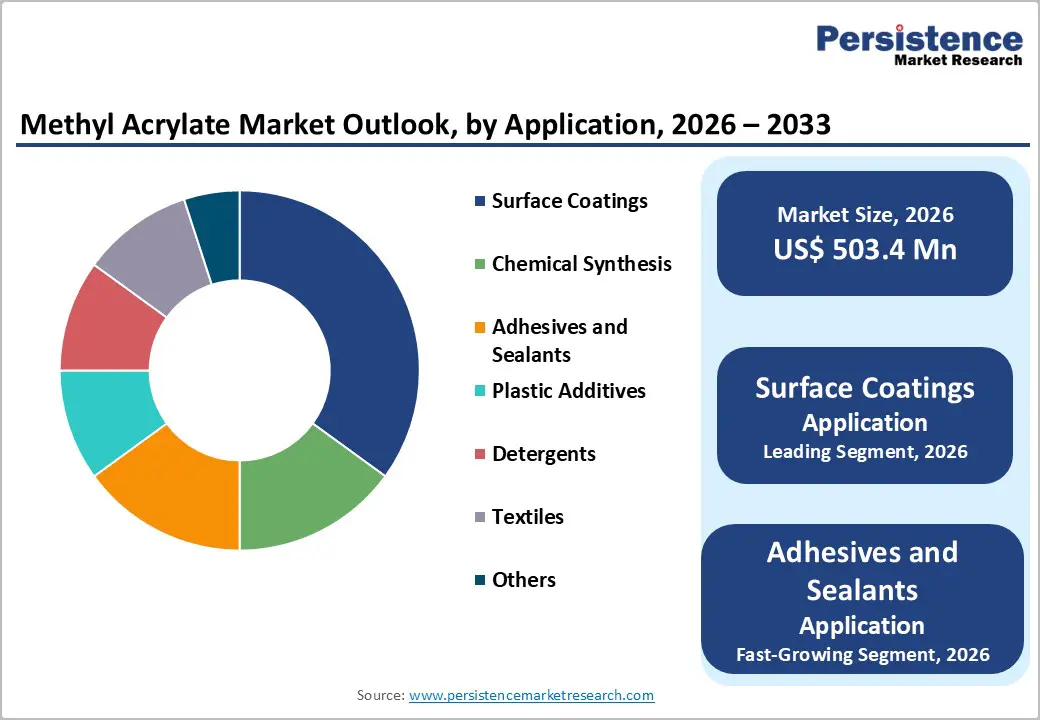
- Leading Application: Surface coatings, to contribute nearly 40% of the market revenue, due to acrylic paint and varnish demand.
- Leading End-user: Paint and coating, to account for approximately 35% revenue share, due to weather-resistant and aesthetic needs.
| Report Attribute | Details |
|---|---|
|
Methyl Acrylate Market Size (2026E) |
US$503.4 Mn |
|
Market Value Forecast (2033F) |
US$792.6 Mn |
|
Projected Growth (CAGR 2026 to 2033) |
6.7% |
|
Historical Market Growth (CAGR 2020 to 2025) |
6.4% |
Market Factors – Growth, Barriers, and Opportunity Analysis
Increasing Demand for High-Performance Coatings
The growing demand for high-performance coatings is driven by the increasing need for materials that can endure extreme conditions while offering long-term durability and cost efficiency. Sectors such as automotive, aerospace, construction, energy, and marine are placing greater emphasis on coatings that provide superior resistance to corrosion, heat, chemicals, abrasion, and UV exposure. Unlike traditional coatings, high-performance formulations are designed to preserve both structural integrity and appearance over extended service lifecycles, minimizing maintenance needs and reducing total ownership costs.
Technological advancements have played a key role in this growth, including innovations in resin chemistry, nano-additives, and hybrid coating systems. These improvements have led to enhanced adhesion, faster curing times, and better protective properties. Stricter environmental regulations are also driving the shift toward low-VOC, water-based, and sustainable coatings that meet performance standards without compromising regulatory compliance. The expansion of infrastructure in emerging economies further fuels demand, as large-scale projects require coatings that can protect assets in challenging climatic and operational conditions.
Stringent Environmental and Safety Regulations
Stringent environmental and safety regulations pose a significant challenge for chemical markets, especially for substances that present health, fire, or environmental hazards. Regulatory bodies worldwide are continuously tightening standards concerning emissions, hazardous material handling, worker exposure, and waste management. While these regulations aim to reduce environmental impact and safeguard human health, they also increase the complexity of compliance for manufacturers.
Producers are required to invest in advanced pollution-control technologies, secure storage infrastructure, and continuous monitoring systems to meet regulatory requirements. This results in higher capital expenditures and ongoing operational costs. Moreover, extensive documentation, testing, and certification processes can delay approval timelines, slow down product launches, and limit flexibility in responding to market demands. Safety regulations impose strict protocols for the transportation, labeling, and handling of flammable or toxic substances. Companies must also implement employee training programs and emergency response systems, further adding to administrative and compliance burdens.
Developments in High-Purity and Sustainable Delivery Platforms
Advancements in high-purity and sustainable methyl acrylate delivery platforms are reshaping the global chemical industry by tackling two major challenges: impurity control and environmental impact. High-purity platforms, designed to achieve assay levels above 99.9%, reduce the need for post-processing and enable direct use in sensitive applications. Innovations such as catalytic dehydrogenation, membrane separation, bio-based methods, and recycling streams are significantly improving product quality, reducing waste, and lowering compliance costs in industries like coatings and pharmaceuticals.
Developments in sustainable platforms, including renewable feedstocks, low-carbon production methods, green catalysis, and closed-loop systems, are driving more eco-friendly manufacturing. These approaches help minimize reliance on fossil fuels, a key defense against tightening regulations in the industry. These platforms also eliminate emissions, improve yield, and offer solvent-free versatility, making them ideal for large-scale paint applications. Emerging technologies like enzymatic synthesis, bio-adhesive polymerization, and VLP-based purification further enhance sustainability and responsiveness.
Category-wise Analysis
Product Type Insights
The industrial segment is anticipated to dominate the market, accounting for approximately 85% of the revenue share in 2026. Its dominance is driven by large-volume use, cost-effectiveness, and versatility, making it preferred for coatings and adhesives. The segment provides reliable reactivity, ensures scalability, and contributes to affordability, making it suitable for large-scale chemical processes. Mitsubishi Chemical Group launched a new line of methyl acrylate based adhesives and coatings specifically engineered for use in automotive and industrial applications, including large scale surface coatings and bonding systems.
This development underscores how industrial users are leveraging methyl acrylate’s chemical properties, such as strong adhesion, reactivity with other monomers, and compatibility with polymer formulations, to meet high volume demand in major sectors such as automotive manufacturing and commercial coatings. The pharmaceutical sector is the fastest-growing segment, driven by its need for high-purity materials and increasing use in drug synthesis. Its premium quality makes it perfect for targeted medical applications, minimizing impurities.
Ongoing advancements in purification processes are further enhancing its appeal, fueling rapid adoption in North America and Europe, where the demand for pharma-grade monomers is rising. NINGBO INNO PHARMCHEM Co., Ltd., a specialty chemical supplier, provides high-purity methyl acrylate that meets rigorous pharmaceutical intermediate standards, making it an ideal building block for multi-step drug synthesis, where precise reactivity and low impurity levels are essential.
Purity Grade Insights
The methyl acrylate segment with purity greater than 99% is expected to lead the market, holding around 60% of the share in 2026, driven by its superior quality, extensive premium applications, and strong global demand for high-performance formulations. This dominance is set to continue as brands expand their specialty product lines. The increasing adoption of ≤99% purity grades and expanded campaigns for bulk products highlight a growing focus on cost-effective alternatives.
GJ Chemical, a well-established distributor and supplier, offers bulk methyl acrylate (MA) at industrial-grade purity and competitive pricing for high-volume applications such as adhesives, surface coatings, textiles, plastics, elastomers, and sealants. Their approach is centered on providing large quantities of methyl acrylate monomer to manufacturers that don’t require ultra-high purity, making it an attractive option for cost-conscious industrial processes where performance must be balanced with scalability and affordability.
The ≤99% purity segment is likely to be the fastest-growing, driven by the increasing demand for cost-sensitive solutions and its expanding use in industrial bulk applications. The shift toward more affordable platforms, along with higher volumes, is accelerating adoption. Advances in standard refining and ongoing development of bulk blends entering production trials are driving this growth. Rotterdam Chemicals’ focus on flexible bulk logistics and stabilized industrial-grade products demonstrates how ≤99% purity methyl acrylate is being widely adopted for mainstream industrial uses, offering a cost-effective alternative to ultra-high-purity grades in large-scale production.
Application Insights
The surface coatings segment is expected to dominate the market, contributing nearly 40% of revenue by 2026. This leadership is due to its pivotal role in acrylic paints, large-scale formulation programs, and managing a broad spectrum of products that require durable finishes. The sector benefits from strong integration, skilled chemists, and the ability to produce high-volume or weather-resistant blends, which drive greater consumption. Surface coatings are also at the forefront of high-purity rollouts and the development of emerging blended formulations.
Axalta Coating Systems Ltd., a global leader in industrial and automotive coatings, is expanding its portfolio of acrylic surface coating solutions tailored for high-volume industrial applications. Adhesives and sealants represent the fastest-growing segment, driven by their strong bonding capabilities and expanding role in the construction industry. These products provide convenient, quick, and accessible adhesion, appealing to users who prioritize strong, low-VOC solutions.
The growth is further fueled by increased outreach programs, a focus on infrastructure, and the broader availability of both routine and premium acrylates, accelerating adoption in both urban and semi-urban areas. In 2023, Henkel AG & Co. KGaA, a leading global manufacturer of adhesives and sealants, introduced a bio-based construction adhesive designed specifically for the building sector. This new product contains over 60% renewable content and is formulated to meet the rising demand for eco-friendly and low-VOC solutions in both residential and commercial construction projects.
End-user Insights
The paint and coatings segment is expected to lead the market, accounting for around 35% of the revenue share by 2026, driven by the high demand for acrylic emulsions and the growing global focus on decorative and protective coatings. Regular renovation schedules, weather requirements, and widespread access to retail outlets drive consistent demand. Rising focus on the automobile and construction further strengthens paint leadership. AkzoNobel N.V., a major global paints and coatings company known for brands such as Dulux, has a significant presence in both decorative paints and protective coatings markets.
AkzoNobel’s acrylic based decorative paint products are widely used in residential and commercial construction, where regular renovations and weather resistant finishes are key drivers of demand. The automobile segment is the fastest-growing sector, fueled by the increasing demand for lightweight coatings, the need to combat corrosion, and the rising adoption of acrylic finishes. Enhanced aesthetics, customized grades, and improved adhesion for EV components are driving rapid growth.
The expanding use of packaging and cosmetics in high-tech industries further accelerates market expansion. Axalta has introduced innovative corrosion-resistant, high-performance coating systems specifically designed for the unique requirements of modern electric vehicles (EVs) and lightweight materials aimed at boosting efficiency and reducing vehicle weight. These coatings provide excellent adhesion, superior corrosion protection, and durable finishes for body panels, battery housings, and structural components made from aluminum and composite materials, which are increasingly used in EVs to reduce weight and extend the driving range.
Regional Insights
North America Methyl Acrylate Market Trends
North America is projected to be the fastest-growing region in the methyl acrylate market from 2026 to 2033. This growth is fueled by the region's advanced coatings infrastructure, robust research and development capabilities, and a high level of public awareness regarding the performance benefits of methyl acrylate. The U.S. and Canada offer well-developed processing systems that support formulation programs, ensuring widespread availability of methyl acrylate in industries such as paint and coatings, automotive, and packaging.
The rising demand for high-purity, convenient, and easy-to-use forms is further driving adoption, as these formats enhance durability and address challenges associated with alternative materials. Innovations in methyl acrylate technology, such as stable high-purity grades, improved adhesive delivery, and targeted functional enhancements, are attracting significant investment. Both public and private sectors are heavily investing in these advancements.
Government initiatives and sustainability campaigns are promoting its use to mitigate VOC emissions, corrosion risks, and other environmental concerns, ensuring ongoing market demand. The growing emphasis on pharmaceutical-grade and specialty applications, particularly in cosmetics, is broadening the scope of methyl acrylate's uses.
Europe Methyl Acrylate Market Trends
Europe is experiencing steady growth in the methyl acrylate market, driven by increasing awareness of its quality benefits, strong coatings systems, and government-led sustainability initiatives. Countries like Germany, France, and the U.K. have well-established chemical frameworks that facilitate the regular use and encourage the adoption of innovative acrylate delivery methods, including methyl acrylate. These high-performance formulations are particularly attractive to the paint industry, environmentally conscious businesses, and the automotive sector, as they improve durability and coverage.
Advancements in methyl acrylate technology, such as higher purity levels, application-specific delivery methods, and improved low-VOC grades, are further enhancing the market's potential. European authorities are increasingly supporting research and trials focused on both routine and specialized applications of acrylates, which boosts market confidence.
The region’s growing focus on eco-friendly and convenient solutions aligns with its commitment to preventive protection and emission reduction. Public awareness campaigns and promotional efforts are expanding the reach of these products in both urban and rural areas, while suppliers continue to invest in catalytic processes and new variants to improve efficacy.
Asia Pacific Methyl Acrylate Market Trends
Asia Pacific is expected to hold over 45% of the methyl acrylate market share by 2026, driven by increasing industrial awareness, growing government initiatives, and the expansion of application programs throughout the region. Countries, including India, China, Japan, and various Southeast Asian nations, are actively promoting acrylate campaigns to support construction growth and meet the rising demand in the automotive sector. Methyl acrylate is particularly well-suited to these regions due to its flexibility, scalability, and effectiveness in large-scale coating projects, both in urban and rural areas.
Technological advancements are improving the stability, efficiency, and ease of processing of methyl acrylate, enabling it to perform well under challenging production conditions while minimizing impurity risks. These innovations are crucial for expanding accessibility to remote facilities and improving overall performance. The increasing demand for paints and coatings, adhesives, and packaging applications is driving market expansion.
Public-private partnerships, increased chemical investments, and rising funding for production research and manufacturing capacity are further fueling growth. The convenience of methyl acrylate, along with its improved reactivity and lower defect risks, makes it a preferred option for a wide range of applications.
Competitive Landscape
The global methyl acrylate market features competition between established chemical giants and emerging regional producers. In North America and Europe, BASF SE and Dow lead through strong R&D, distribution networks, and industry ties, bolstered by innovative grades and supply programs. In Asia Pacific, Wanhua Chemical Group advances with localized solutions, enhancing accessibility.
High-purity delivery boosts performance, cuts impurity risks, and enables mass integrations across regions. Strategic partnerships, collaborations, and acquisitions merge expertise, expand capacities, and speed commercialization. Sustainable formulations solve environmental issues, aiding penetration in green-focused areas.
Key Industry Developments
- In March 2025, Röhm is expected to start production at its new plant in Bay City, Texas, using its patented LiMA technology.
- In August 2024, LG Chem announced the adoption of an advanced polymerization technique that increased methyl acrylate yield by 15%. This innovation is intended to enhance production efficiency and reduce operational costs, serving high-demand sectors such as automotive and packaging that rely on high-quality, large-volume methyl acrylate.
Companies Covered in Methyl Acrylate Market
- BASF SE
- Arkema S.A.
- Dow
- LG Chem
- Mitsubishi Chemical Group Corporation.
- NIPPON SHOKUBAI CO., LTD.
- Evonik Industries
- Sibur
- Wanhua Chemical Group
- Shanghai Huayi Acrylic Acid Co., Ltd.
Frequently Asked Questions
The global methyl acrylate market is projected to reach US$503.4 million in 2026.
The rising prevalence of high-performance coatings and demand for adhesives are key drivers.
The methyl acrylate market is poised to witness a CAGR of 6.7% from 2026 to 2033.
Advancements in high-purity and sustainable delivery platforms are the key opportunities.
BASF SE, Dow, Arkema S.A., LG Chem, and Mitsubishi Chemical Group Corporation are the key players.


