




- Industrial Machinery
- Industrial Sieves Market
Industrial Sieves Market Size, Share, and Growth Forecast 2026 - 2033
Industrial Sieves Market by Product type (Vibrating Sieves, Centrifugal Sieves, Rotary Sieves and Others), by Sieves Size (Coarse Sieves, Medium Sieves and Others), and End- user (Pharmaceutical, Food and Beverage, Chemical and Others) Regional Analysis for 2026 – 2033

Industrial Sieves Market Size and Share Analysis
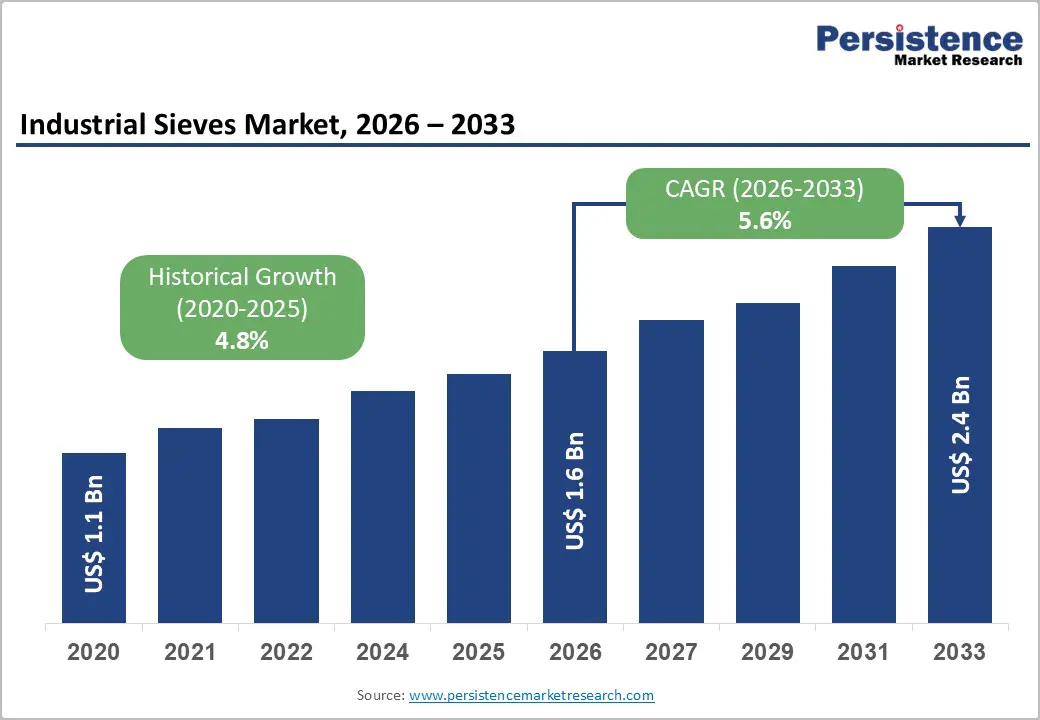
The global industrial sieves market size was valued at US$ 1.6 Bn in 2026 and is projected to reach US$ 2.4 Bn by 2033, growing at a CAGR of 5.6% between 2026 and 2033.
The market expansion is primarily driven by accelerating demand from pharmaceutical manufacturing facilities that require stringent particle separation and quality control, coupled with rising industrialization in emerging economies, particularly in the Asia-Pacific region. Additionally, technological advancements in automated sieving equipment, integration of IoT and AI-driven monitoring systems, and stringent regulatory compliance requirements in food processing and chemical industries are positively influencing market growth.
Key Market Highlights
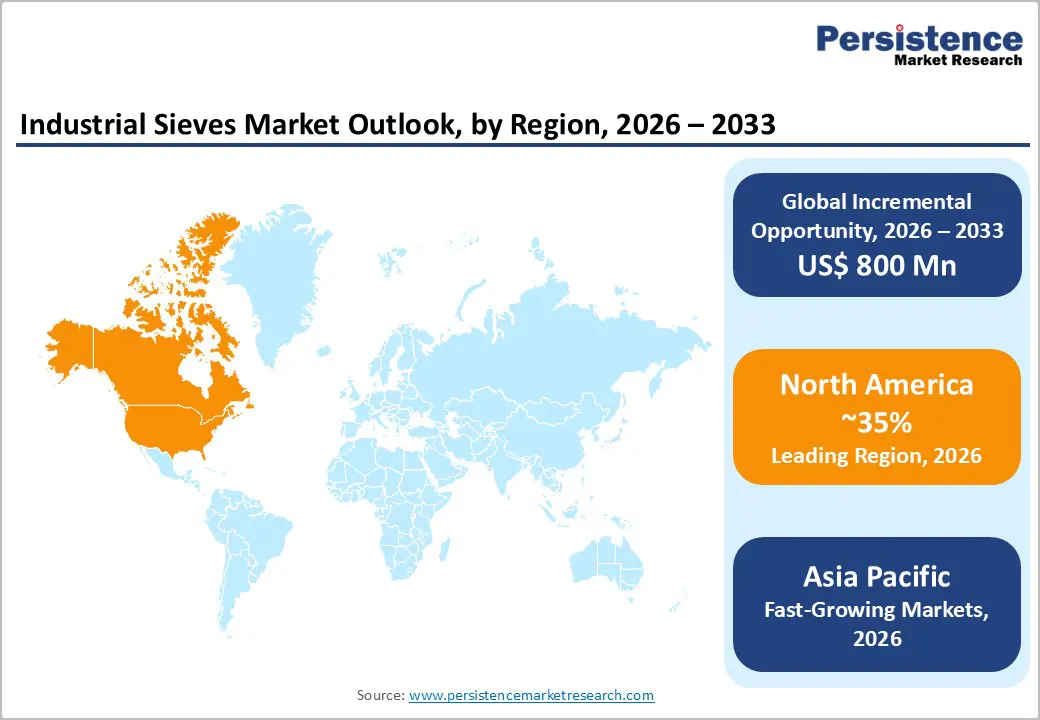
- Leading Region: North America dominates the industrial sieves market through its established pharmaceutical and chemical manufacturing sectors, stringent regulatory frameworks mandating high-quality equipment, and substantial investments in advanced sieving technologies that ensure regulatory compliance and product quality across diverse industrial applications.
- Fastest Growing Region: Asia-Pacific emerges as the fastest-growing region, driven by unprecedented pharmaceutical manufacturing expansion in China and India, rising food processing demand, government initiatives promoting manufacturing infrastructure development, and accelerating adoption of automation technologies supporting competitive advantage.
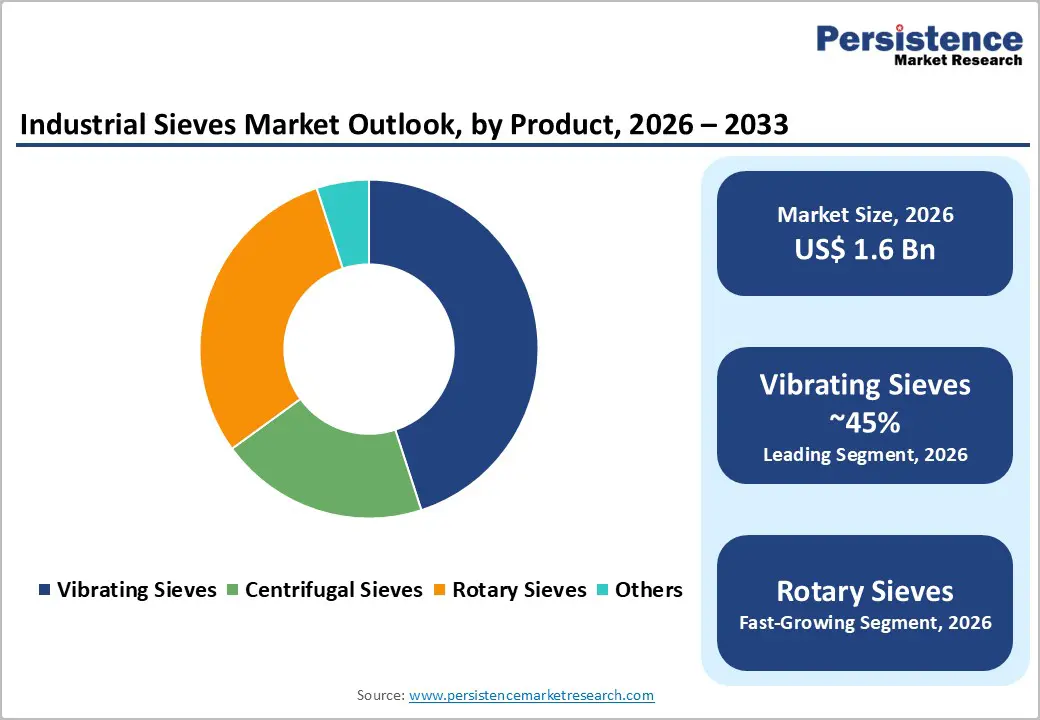
- Dominant Segment from Any Category: Vibrating sieves represent the dominant product type segment, commanding approximately 45% market share due to superior separation efficiency, widespread applicability across the pharmaceutical and food processing industries, and technological advantages in preventing particle clogging.
- Fastest Growing Segment from Any Category: Rotary sieves represent the fastest-growing product type segment, driven by increasing demand from mining operations, agricultural processing facilities, and large-scale chemical manufacturing operations requiring processing of moisture-laden materials at elevated throughput rates.
- Key Market Opportunity: Biopharmaceutical manufacturing expansion presents a significant market opportunity as the rising commercialization of cell therapies, gene therapies, and advanced therapeutics demands specialized ultra-precision-sieving equipment meeting unprecedented sterility and contamination-control standards.
| Report Attribute | Details |
|---|---|
|
Industrial Sieves Market Size (2026E) |
US$ 1.56 Bn |
|
Market Value Forecast (2033F) |
US$ 2.4 Bn |
|
Projected Growth (CAGR 2026 to 2033) |
5.6% |
|
Historical Market Growth (CAGR 2020 to 2024) |
4.8% |
Market Dynamics
Market Growth Drivers
Expanding Pharmaceutical and Biopharmaceutical Manufacturing
The pharmaceutical sector's rapid expansion, particularly in Asia-Pacific regions, where countries such as China and India are experiencing double-digit growth in biopharmaceutical manufacturing, is driving demand for industrial sieves. According to pharmaceutical industry data, the global pharmaceutical filtration market reached US$ 13.4 billion in 2024 and is projected to grow to US$ 21.75 billion by 2030 at a CAGR of 8.7%, directly correlating with increased adoption of sieves to ensure product purity and regulatory compliance. The demand for precise particle size distribution in active pharmaceutical ingredients and excipients necessitates advanced sieving solutions, while stringent FDA and cGMP regulations mandate specialized equipment for particle separation and contamination removal. Additionally, the rise of complex biologics, biosimilars, and advanced therapies amplifies the need for high-performance sieving systems capable of handling sensitive materials without compromising product integrity.
Automation and Smart Manufacturing Integration
The industrial sector's shift toward automation and Industry 4.0 technologies is propelling the adoption of intelligent sieving equipment equipped with real-time monitoring capabilities. Manufacturing facilities increasingly integrate IoT-enabled sieving devices that provide predictive maintenance alerts, reduce operational downtime, and minimize human intervention, thereby enhancing throughput and cost efficiency. Ultrasonic and advanced vibration technologies are preventing clogging phenomena and improving separation efficiency for ultra-fine particles, particularly in the industrial garnet market, where particle uniformity directly impacts product quality. Furthermore, implementing AI-driven process optimization algorithms enables manufacturers to dynamically adjust sieve parameters based on material characteristics, resulting in superior separation performance and reduced waste generation across pharmaceutical, food processing, and chemical manufacturing operations.
Market Restraints
High Capital Investment and Equipment Maintenance Costs
The acquisition and installation of advanced industrial sieving equipment requires substantial capital expenditure, posing a significant barrier, particularly for small and medium-sized enterprises operating in cost-sensitive markets. Beyond initial procurement costs, regular maintenance, calibration, and compliance verification in accordance with stringent standards such as ISO 3310 and ASTM E11 impose ongoing operational expenses that accumulate over the equipment lifecycle. The complexity of sieve certification and mesh verification procedures, combined with the need to periodically replace wear-prone components, creates persistent cost burdens that constrain market growth in price-sensitive regions and among budget-constrained manufacturers facing margin pressures.
Stringent Regulatory Compliance and Validation Requirements
Regulatory agencies globally enforce rigorous process validation, equipment qualification, and documentation requirements for sieving operations, particularly in pharmaceutical and food processing industries. Manufacturers must adhere to FDA cGMP standards, EU GMP directives, and sector-specific regulations that mandate formal equipment validation protocols, incurring significant time and financial resources. Additionally, the complexity of process scale-up, filter validation under different operating conditions, and the risk of filter contamination necessitate specialized expertise and validation studies, creating operational bottlenecks that limit rapid equipment deployment and market growth acceleration.
Market Opportunities
Biopharmaceutical and Advanced Therapy Development Expansion
The accelerating commercialization of cell and gene therapies, mRNA-based vaccines, and recombinant protein therapeutics represents a transformative growth opportunity for advanced sieving solutions. These cutting-edge pharmaceutical products require unprecedented levels of particle precision, contamination control, and sterility assurance, driving demand for specialized equipment capable of handling ultra-sensitive biological materials. Market data indicates that the biopharmaceutical sector is expanding at rates exceeding 20% annually in emerging markets, while China's biosimilars market alone is projected to reach US$ 12 billion by 2025, necessitating substantial investments in manufacturing infrastructure, including advanced sieving equipment. The shift toward personalized medicine and small-volume, high-value therapeutic production creates niche opportunities for manufacturers developing customized sieving solutions that address unique separation challenges inherent in novel drug modalities.
Emerging Market Expansion and Sustainable Solutions
Rapid industrialization across India, Southeast Asia, and Latin America is generating unprecedented demand for manufacturing infrastructure and particle separation technologies in the pharmaceutical, chemical, and food processing sectors. India's National Manufacturing Policy targets expanding the manufacturing sector's contribution to GDP to 25% by 2025, necessitating substantial equipment investments, including advanced sieving systems. Simultaneously, growing environmental consciousness and regulatory emphasis on sustainability are creating market demand for eco-friendly sieving solutions manufactured from recyclable materials with minimal energy consumption. The integration of single-use and modular sieve designs, combined with sustainable manufacturing practices, presents a significant opportunity to attract environmentally conscious clients and differentiate products in increasingly competitive global markets.
Category-wise Insights
Product Type Analysis
Vibrating sieves command the dominant market position within the industrial sieves market, accounting for approximately 45% market share due to their widespread applicability across pharmaceutical, food and beverage, and chemical manufacturing sectors. The superiority of vibrating sieve technology derives from its effectiveness in processing powder and fine-particle materials, where high-frequency vibration facilitates superior particle separation, minimizes clogging, and enables continuous operation at elevated throughput rates. The vibrating machine market alone reached USD 1.5 billion in 2024 and is projected to achieve USD 2.5 billion by 2033, growing at 6.5% CAGR, reflecting robust demand from manufacturers prioritizing efficiency and product consistency. Rotary sieves represent the second-largest segment, with approximately 30% market share, particularly valued in agricultural and mining applications requiring larger volumes with higher moisture content, and they command significantly higher individual equipment values, driving revenue concentration in industrial-scale operations.
Sieves Size Analysis
Medium sieves dominate the industrial sieves market by size classification, representing approximately 52% of total market demand, owing to their versatile applicability across a range of manufacturing processes that require moderate-scale particle separation and classification. These sieves accommodate the largest spectrum of industrial applications, from pharmaceutical powder grading to food ingredient processing and chemical material classification, making them essential equipment in standard manufacturing facilities. Coarse sieves, accounting for approximately 35% market share, serve bulk material separation requirements in mining, agricultural processing, and initial-stage chemical processing operations where large particle differentiation is prioritized. The substantial demand for medium-sized sieves reflects market dynamics where standardization in equipment specifications facilitates cost-effective procurement and operational flexibility, enabling manufacturers to adapt rapidly to evolving production requirements without substantial capital re-investment in specialized equipment.
End-user Analysis
The pharmaceutical sector is the dominant end-user segment, accounting for approximately 38% of total industrial sieve market demand, driven by stringent regulatory requirements mandating precise particle size distribution for active pharmaceutical ingredients, excipients, and finished dosage forms. The pharmaceutical industry's commitment to quality assurance, contamination prevention, and regulatory compliance ensures consistent demand for advanced sieving solutions despite economic cycles. The food and beverage industry is the second-largest segment, with a 32% market share, where sieves ensure product consistency, remove foreign contaminants, and comply with stringent food safety standards such as FSSAI regulations in India and FDA guidelines in North America. Manufacturers in this sector increasingly invest in advanced separation technologies to achieve premium product positioning and ensure consumer safety, particularly in processed foods, spices, and beverage ingredients, where particle uniformity directly influences consumer perception and regulatory compliance.
Regional Insights
North America Industrial Sieves Trends
North America maintains significant market relevance as a mature and technologically advanced region with established pharmaceutical, chemical, and food processing industries generating consistent demand for premium-quality sieving equipment. The region's regulatory environment, dominated by stringent FDA, EPA, and industry-specific guidelines, incentivizes manufacturers to invest in high-performance sieving solutions ensuring regulatory compliance and product quality. The United States pharmaceutical filtration market segment, valued at substantial proportions of the US$ 13.4 billion global pharmaceutical filtration market in 2024, directly correlates with elevated demand for particle separation equipment across drug manufacturing facilities.
The region's innovation ecosystem, characterized by substantial investments in research and development, emerging biopharmaceutical manufacturing capabilities, and continuous advancement in automation technologies, drives adoption of next generation sieving equipment featuring AI integration and predictive maintenance capabilities. Additionally, North America's advanced manufacturing sector, serving diverse industrial applications from aerospace composites to electronics manufacturing, demands precision sieving solutions that meet exacting quality specifications.
Europe
Europe represents a highly regulated and technology-focused market region with strength in pharmaceutical manufacturing, chemical processing, and precision industrial applications. Key manufacturing hubs in Germany, the United Kingdom, France, and Spain maintain substantial pharmaceutical and specialty chemical production capacity, driving persistent demand for advanced sieving equipment compliant with EU GMP directives and harmonized European standards. The region's commitment to sustainability and circular economy principles increasingly shapes product development priorities, with manufacturers incorporating eco-friendly materials, energy-efficient designs, and regenerable sieve solutions into product portfolios.
European manufacturers demonstrate particularly strong performance in developing specialized sieving equipment for complex applications, including ultrasonic sieving for nano-scale particles and automated systems for demanding chemical separation processes. The region's mature regulatory framework, characterized by strict compliance requirements and extensive documentation protocols, creates barriers to entry for non-compliant suppliers while supporting premium valuations for certified, high-quality equipment. Growing focus on reducing operational costs while maintaining quality standards drives increased adoption of smart sieving technologies providing real-time monitoring and predictive maintenance capabilities, positioning Europe as a leader in technology integration within the global industrial sieves market.
Asia-Pacific
Asia-Pacific emerges as the fastest-growing regional market, driven by unprecedented expansion in pharmaceutical manufacturing capacity across China, India, and Southeast Asian countries, responding to global demand for cost-effective drug production and emerging local market opportunities. China's pharmaceutical industry experienced robust growth with manufacturing facilities increasingly adopting advanced separation technologies, while the country's molecular sieve market alone is projected to grow at 5.7% CAGR through 2033, reflecting broader demand for industrial separation equipment. India's pharmaceutical sector, dominant in global generic drug production, is investing substantially in manufacturing infrastructure upgrades including advanced sieving systems to enhance product quality and achieve competitive advantages in international markets.
The region's competitive manufacturing cost structures, combined with expanding domestic pharmaceutical and chemical markets, create favorable conditions for rapid market expansion. Asia-Pacific's rising disposable incomes, expanding food processing industries, and increasing consumer demand for high-quality food products drive substantial investments in particle separation equipment by food manufacturers seeking premium positioning. The region demonstrates accelerating adoption of automation and smart manufacturing technologies, with manufacturers incorporating IoT and AI capabilities into sieving equipment, positioning the region at the forefront of technology integration within the global market. Government initiatives promoting pharmaceutical manufacturing expansion, such as India's production-linked incentive schemes and China's advanced manufacturing programs, further accelerate market growth through sustained capital investments in manufacturing infrastructure including specialized sieving equipment.
Competitive Landscape
Market Structure Analysis
The industrial sieves market demonstrates a moderately consolidated competitive structure with Henkel AG & Co. KGaA commanding approximately 13% global adhesives and sealants market share, establishing itself as the dominant market leader through extensive product portfolios, global distribution networks, and substantial research and development capabilities. The competitive landscape features specialized manufacturers focusing on niche applications such as pharmaceutical-grade sieves, ultrasonic separation equipment, and customized solutions addressing specific industrial requirements.
Market consolidation through strategic acquisitions has intensified, with companies expanding product portfolios and geographic reach through targeted M&A activities, exemplified by Avery Dennison's USD 390 million acquisition of Meridian's flooring adhesives division, reflecting industry-wide emphasis on portfolio diversification and complementary technology integration.
Key Market Developments
- In January 2025, Wacker Chemie AG commissioned two new specialty silicone production facilities in Tsukuba, Japan, and Jincheon, South Korea, representing a multi-million euro investment to strengthen regional presence and serve rising automotive and construction sector demand.
- In June 2025, Civita established new filtration manufacturing lines in Pensacola, Florida, expanding filter membrane production capacity in North America by 20% to accommodate surging pharmaceutical and biopharmaceutical manufacturing demand.
Companies Covered in Industrial Sieves Market
- Russell Finex
- SiccaDania
- Gough Engineering
- Elcan Industries
- Newark Wire
- Farleygreene
- Cleveland Vibrator
- VibraScreener
- Virto-Cuccolini
- Isımsan
- Others Key Players
Frequently Asked Questions
The global Industrial Sieves Market is projected to reach about US$ 2.4 Bn by 2033, up from approximately US$ 1.6 Bn in 2026, reflecting a forecast CAGR of 5.6% and historical growth of 4.3%
The industrial sieves market is primarily driven by expanding pharmaceutical and biopharmaceutical manufacturing requiring stringent particle separation, increasing automation adoption integrating IoT and AI technologies, rising regulatory compliance requirements in food and pharmaceutical industries.
Vibrating sieves dominate the industrial sieves market, commanding approximately 45% market share through superior separation efficiency, widespread applicability across pharmaceutical and food processing sectors, technological advantages in clogging prevention, and continuous high-throughput operational capabilities.
North America currently leads the industrial sieves market through established pharmaceutical and chemical manufacturing sectors, stringent FDA and regulatory compliance requirements, substantial investments in advanced equipment technologies, and mature distribution networks supporting sustained market growth and premium product positioning.
Key market players include Henkel AG & Co. KGaA commanding 13% global market share, 3M Company leveraging 90+ years filtration expertise, Pidilite Industries dominating India's 70% adhesives market share, Wacker Chemie AG, Sika AG, and Huntsman Corporation, with aggressive expansion strategies and continuous product innovation.


