




- HVAC
- Industrial Atomizer Market
Industrial Atomizer Market Size, Share, and Growth Forecast 2026 - 2033
Industrial Atomizer Market by Atomizer Type (Rotary Atomizer, Nozzle Atomizer, Ultrasonic Atomizer, Pressure Atomizer, Two Fluid Atomizer), by Application (Spray Drying, Coating, Humidification, Granulation, Combustion, Cooling), by End-Use Industry (Food & Beverages, Pharmaceuticals, Chemicals, Ceramics, Metallurgy, Energy & Power, Water Treatment, Others), by Regional Analysis, 2026-2033

Industrial Atomizer Market Size and Trend Analysis
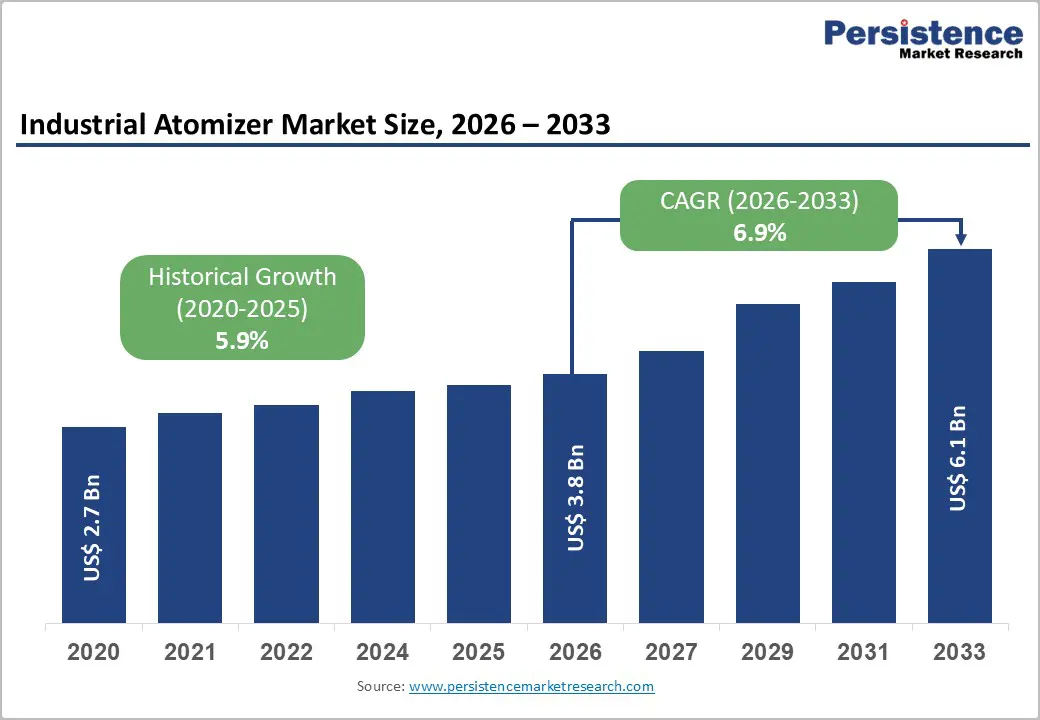
The global industrial atomizer market size is expected to be valued at US$ 3.8 billion in 2026 and projected to reach US$ 6.1 billion by 2033, growing at a CAGR of 6.9% between 2026 and 2033.
Market expansion is fundamentally driven by escalating demand for precision atomization technologies across pharmaceutical powder production, food ingredient processing, and advanced coating applications. The rising global consumption of powdered formulations in the pharmaceuticals and food processing sectors has substantially increased demand for industrial atomization systems that offer precise particle size control and uniform droplet distribution. Technological advancements in atomizer design, including ultrasonic and pressure-based systems incorporating IoT monitoring and predictive maintenance capabilities, have fundamentally enhanced operational efficiency and product quality consistency across diverse industrial applications.
Key Market Highlights
- Leading Region: North America leads the global industrial atomizer market with approximately 31% share in 2025, supported by a mature pharmaceutical manufacturing infrastructure, advanced adoption of food processing equipment, and substantial investments in equipment modernization.
- Fastest Growing Region: Asia Pacific is the fastest-growing region, expected to post approximately 8.3% CAGR through 2033, driven by rapid pharmaceutical expansion, the growing food processing sector, and manufacturing infrastructure development.
- Dominant Segment from Atomizer Type: Rotary Atomizer dominates with roughly 39% share in 2025, reflecting widespread adoption for spray drying applications and cost-effectiveness across diverse industrial sectors.
- Fastest Growing Segment from Application: Coating is the fastest-growing segment, with an estimated 8.2% CAGR through 2033, fueled by automotive paint application, electronic component coating, and advanced material manufacturing requirements.
- Key Market Opportunity: Advanced ultrasonic atomization technology development for specialized applications offers significant opportunity for establishing premium market positioning in precision coating and advanced material production sectors.
| Key Insights | Details |
|---|---|
| Industrial Atomizer Market Size (2026E) | US$ 3.8 billion |
| Market Value Forecast (2033F) | US$ 6.1 billion |
| Projected Growth (CAGR 2026 to 2033) | 6.9% |
| Historical Market Growth (CAGR 2020 to 2025) | 5.9% |
Market Dynamics
Market Growth Drivers
Escalating Demand for Processed Food and Beverage Powder Products
The exponential growth in global demand for powdered food and beverage formulations represents the most significant market growth driver for industrial atomizer adoption. According to industry analysis, spray drying utilizing precision atomizers has become essential for producing essential food ingredients including milk powders, instant coffee, tea extracts, and natural flavorings addressing consumer preferences for convenient, shelf-stable products. The global dairy industry increasingly depends on spray drying technology for milk powder production, with atomizers critical to converting liquid milk into fine powder particles while maintaining nutritional properties.
Growing consumer interest in functional foods, nutritional supplements, and fortified powdered beverages has substantially amplified spray drying demand across food processing sectors. The Food and Agriculture Organization reports that global demand for processed food ingredients continues accelerating, driven by urbanization and changing consumer lifestyle patterns favoring convenient powder-based products. Industrial atomizers enable precise control over particle size distribution, directly impacting final product quality and consumer satisfaction across the food and beverage industries.
Integration of Smart Technologies and Industry 4.0 Adoption in Manufacturing Facilities
The rapid advancement of intelligent atomization systems incorporating IoT connectivity, artificial intelligence monitoring, and predictive maintenance capabilities represents a transformational growth driver for the industrial atomizer market. Modern manufacturing facilities increasingly deploy smart atomization systems tracking critical metrics including rotational speed, vibration patterns, and nozzle performance enabling predictive maintenance preventing catastrophic failures.
According to Dürr Group’s financial reporting, the Application Technology division registered 7.1% sales growth in 2024, confirming escalating investment in sophisticated spray equipment incorporating smart monitoring features. The integration of automated control systems with real-time analytics enables manufacturers to optimize spray parameters, reduce material waste, ensure consistent product quality, and minimize operational disruptions. Industry 4.0 adoption across pharmaceutical, chemical, and advanced material manufacturing is driving demand for atomizers offering seamless integration with production management systems and data analytics platforms supporting operational transparency and continuous improvement.
Market Restraints
High Capital Investment and Complex System Integration Requirements
Industrial atomizer system deployment requires substantial capital investment for specialized equipment, installation infrastructure, and technical expertise, creating barriers to entry for smaller manufacturers. Comprehensive spray drying systems incorporating precision atomizers, hot air distribution networks, powder collection mechanisms, and environmental control systems require capital expenditures often exceeding millions of dollars. The complexity of system integration with existing production infrastructure, regulatory compliance requirements, and product formulation-specific customization necessitates specialized engineering expertise.
Smaller manufacturers and emerging businesses struggle to justify substantial investments for limited production volumes, constraining market accessibility. The requirement for highly skilled technicians and engineers to design, install, calibrate, and maintain sophisticated atomization systems creates labor constraints particularly in developing economies with limited technical workforce availability.
Raw Material Price Volatility and Supply Chain Constraints
Industrial atomizer manufacturers depend on specialized materials including precision-engineered metals, ceramic components, and electronic control systems subject to significant price volatility and intermittent supply constraints. Disruptions in supply chains for critical components including piezoelectric transducers for ultrasonic atomizers and precision-machined metallic components have elevated procurement complexity and manufacturing lead times.
Supply constraints exacerbated by semiconductor shortages and geopolitical trade tensions have increased component costs and extended delivery timelines. Manufacturers must maintain substantial inventories of critical components to manage supply uncertainties, elevating working capital requirements and financial risk for smaller market participants. The transition toward advanced materials offering enhanced durability and chemical resistance requires investment in alternative sourcing strategies and quality assurance protocols.
Market Opportunities
Development of Ultrasonic and Advanced Atomization Technologies for Specialized Applications
Significant growth opportunities exist for manufacturers developing advanced ultrasonic and innovative atomization technologies optimized for specialized applications including thin-film coatings, medical device manufacturing, and advanced material production. According to industry research, ultrasonic atomization represents one of the fastest-growing atomizer categories driven by applications requiring precise micron-scale droplet control and minimal material waste.
Sono-Tek and emerging manufacturers have demonstrated that ultrasonic atomizers offer exceptional performance advantages including non-clogging operation, low-velocity fine mist generation, and compatibility with complex substrate geometries. The pharmaceutical industry increasingly demands ultrasonic atomizers for precise drug formulation, with applications in controlled-release medication development and complex excipient production. Manufacturers investing in ultrasonic technology advancement, nozzle design optimization, and application-specific system development can establish competitive differentiation and capture premium market segments requiring advanced precision atomization capabilities.
Expansion into Emerging Markets and Development of Cost-Effective Solutions
Substantial growth opportunities exist for atomizer manufacturers expanding distribution into emerging markets across Asia-Pacific, Latin America, and Middle East and Africa regions, demonstrating rapidly growing pharmaceutical, food processing, and chemical manufacturing sectors. According to regional market analysis, China and India demonstrate exceptional growth potential, with expanding spray-drying adoption across the pharmaceutical powder production, food ingredient processing, and chemical manufacturing industries.
Manufacturers developing cost-effective atomizer solutions optimized for emerging market requirements, including simplified operation, reduced maintenance demands, and lower capital investment, can establish strong market positions serving price-sensitive customer segments. The pharmaceutical industry expansion across developing economies, driven by generic drug manufacturing and increasing healthcare investments, creates sustained demand for affordable, reliable atomization systems. Strategic partnerships with regional equipment distributors, local engineering firms, and government-supported manufacturing initiatives can facilitate market penetration while establishing competitive advantages in high-growth emerging economies.
Category-wise Insights
Atomizer Type Analysis
Within atomizer type category, Rotary Atomizer dominates the market with approximately 39% market share in 2025, driven by widespread adoption across spray drying applications for food, pharmaceutical, and chemical powder production. Rotary atomizers utilizing high-speed rotating discs offer exceptional performance for converting bulk liquids into fine powder particles with precise particle size control. The mature technology, established reliability across decades of industrial application, and cost-effectiveness compared to advanced systems support rotary atomizer dominance across diverse industrial segments. Major pharmaceutical and food processing manufacturers extensively utilize rotary atomizers for production of milk powders, instant coffee, pharmaceutical excipients, and specialty chemicals.
The fastest-growing atomizer type segment is Ultrasonic Atomizer, projected to expand at approximately 8.7% CAGR through 2033, driven by increasing applications in precision coating, medical device manufacturing, thin-film deposition, and advanced material production requiring micron-scale droplet uniformity and minimal overspray.
Application Analysis
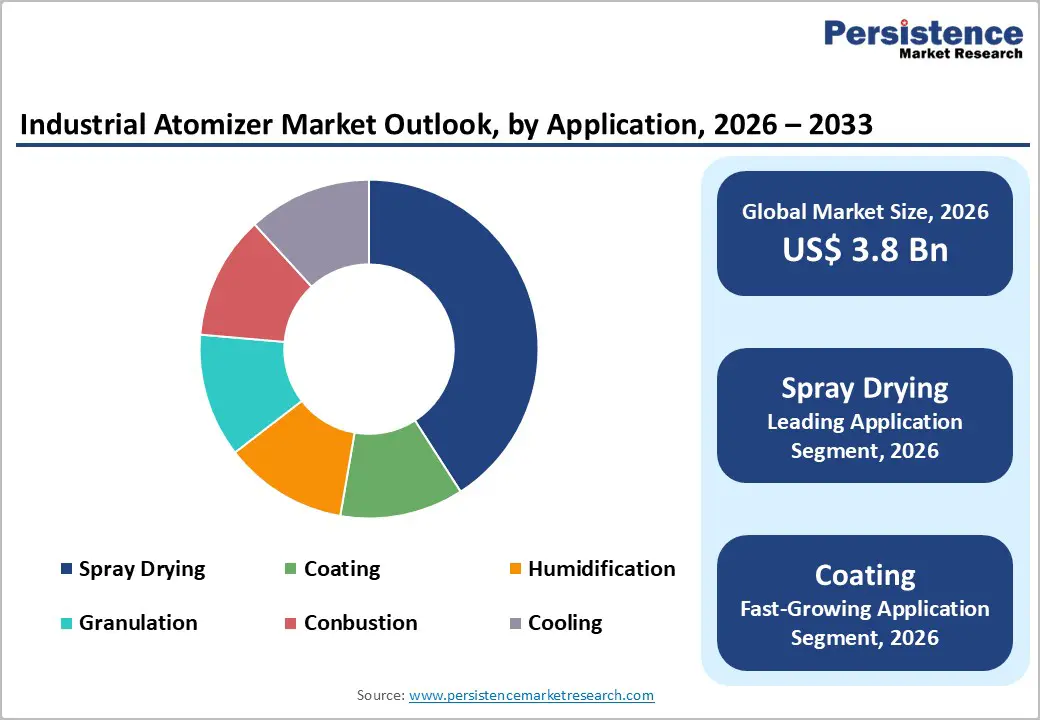
By application, Spray Drying represents the leading segment, commanding approximately 43% market share in 2025, reflecting the critical importance of atomizers in converting liquid solutions, suspensions, and emulsions into powdered formulations. Spray drying utilizing precision atomizers has become industry-standard technology for producing food ingredients, pharmaceutical powders, and specialty chemicals. The ability of spray drying to handle heat-sensitive materials while maintaining product quality and nutritional integrity supports sustained demand across pharmaceutical and food processing industries.
The fastest-growing application segment is Coating, expected to expand at approximately 8.2% CAGR through 2033, driven by expanding applications in automotive paint application, electronic component coating, medical device surface treatment, and advanced material manufacturing requiring precise droplet control and uniform coating deposition.
End-Use Industry Analysis
By end-use industry, Pharmaceuticals commands the leading position with approximately 38% market share in 2025, reflecting the critical importance of precision atomizers for powder production in pharmaceutical manufacturing, including antibiotics, vitamins, enzymes, and complex drug formulations. Pharmaceutical manufacturers demand atomizers offering exceptional control over particle size, moisture content, and powder properties, directly impacting drug efficacy and bioavailability.
The fastest-growing end-use segment is Chemicals, projected to expand at approximately 7.9% CAGR through 2033, driven by expanding applications in chemical powder production, polymer synthesis, catalyst manufacturing, and advanced materials production that require precise atomization and control over reaction conditions. The chemical industry’s emphasis on process optimization, yield improvement, and sustainable manufacturing practices increasingly drives adoption of advanced atomization technologies supporting operational excellence.
Regional Insights
North America Industrial Atomizer Market Trends and Insights
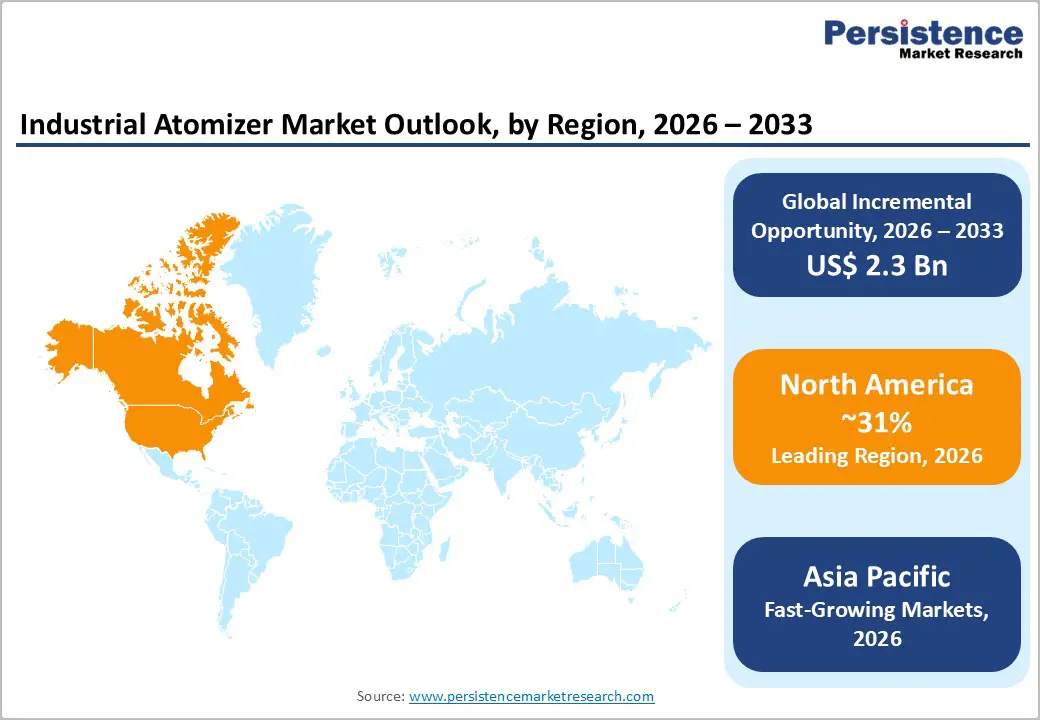
North America commands approximately 31% global market share in 2025, supported by mature pharmaceutical manufacturing infrastructure, advanced food processing technology adoption, and substantial investments in equipment modernization and automation. The United States dominates the region with extensive pharmaceutical manufacturing capacity, advanced spray drying infrastructure, and continuous innovation in atomization technologies. Major manufacturers including Spraying Systems Co., Graco Inc., and SAMES KREMLIN maintain significant North American operations supporting product development and market leadership.
North American pharmaceutical manufacturers increasingly adopt advanced atomization systems incorporating smart monitoring and predictive maintenance capabilities supporting operational efficiency. Environmental regulations promoting solvent recovery and emissions reduction drive adoption of advanced atomizer designs minimizing material waste and environmental impact. According to industry sources, Spraying Systems Co. demonstrated supercritical fluid atomization capabilities for advanced material manufacturing in June 2025, highlighting innovation ecosystem strength in precision atomization technologies supporting next-generation applications.
Europe Industrial Atomizer Market Trends and Insights
Europe represents a significant market, commanding approximately 27% global share in 2025, characterized by emphasis on precision engineering, sustainability focus, and stringent regulatory standards governing manufacturing processes and equipment design. Germany, the United Kingdom, France, and Spain host major equipment manufacturers and pharmaceutical companies driving demand for advanced atomization systems. European manufacturers including Dürr AG leverage advanced technology capabilities and established customer relationships supporting market leadership across the region.
The European Union’s regulatory emphasis on environmental protection, waste reduction, and sustainable manufacturing practices drives adoption of advanced atomizers minimizing material waste and operational emissions. According to GEA Group’s September 2024 announcement, the introduction of CONTA dual block valve technology enhanced spray drying safety and efficiency for powder production applications. Europe’s strong engineering tradition and emphasis on precision manufacturing support premium positioning for high-performance atomization systems across diverse industrial applications.
Asia Pacific Industrial Atomizer Market Trends and Insights
Asia Pacific emerges as the fastest-growing regional market, projected to expand at approximately 8.3% CAGR through 2033, driven by rapid expansion of the pharmaceutical industry, development of the food processing sector, and increasing investments in manufacturing infrastructure. China and India represent the largest regional markets with substantial pharmaceutical manufacturing capacity and expanding spray drying adoption. According to regional analysis, pharmaceutical powder production in China has grown substantially, with spray drying becoming essential technology for antibiotic and excipient production.
The region’s manufacturing advantages, including cost-effective production, skilled labor availability, and established supply chain infrastructure, position Asia-Pacific as a center for industrial atomizer manufacturing and export. Government emphasis on pharmaceutical manufacturing excellence and chemical industry development across China, India, and Southeast Asia supports substantial investment in spray drying infrastructure. The rapid expansion of food processing industries across the region, driven by urbanization and changing consumer preferences, creates sustained opportunities for atomizer manufacturers offering cost-effective solutions meeting regional requirements and quality standards.
Competitive Landscape
Market Structure Analysis
The global industrial atomizer market exhibits moderate consolidation, with major multinational manufacturers including Spraying Systems Co., Nordson Corporation, Graco Inc., GEA Group, and Dürr AG dominating through integrated manufacturing capabilities, extensive distribution networks, and substantial research and development resources. These market leaders leverage scale advantages, established customer relationships across diverse industrial segments, and technical expertise supporting continued market leadership.
Specialized manufacturers including SAMES KREMLIN, Exel Industries, and Lechler, Inc. compete through regional focus, application specialization, and customized solutions. Competitive strategies emphasize technology advancement in ultrasonic atomization development, IoT integration capabilities, and smart monitoring system development. Key differentiators include atomization precision, technology reliability, customization flexibility, and technical service support capabilities supporting competitive positioning.
Key Market Developments
- October 2024: ABB introduces RB 1000i-S paint atomizer for automotive shops, boosting transfer efficiency by up to 10%, reducing paint waste by 30%, and CO2 emissions. Enables annual savings of 50,000 liters of paint, worth $500,000 per factory.
- December 2024: SECO/WARWICK Retech division secured a major order for an advanced atomizer furnace from a leading multinational metals company, for U.S. installation. It produces high-quality metal powders for aerospace, medical, and defense, with energy-efficient, zero-emission all-electric process and inert gas recycling.
Companies Covered in Industrial Atomizer Market
- Spraying Systems Co.
- Nordson Corporation
- Graco Inc.
- GEA Group AG
- SAMES KREMLIN
- Carlisle Fluid Technologies
- Exel Industries
- BETE Fog Nozzle, Inc.
- Lechler, Inc.
- CMT Atomizers S.R.L.
- Mekem Engineering Ltd.
- PNR Italia Srl
- AM Atomizers Technology S.R.L.
- ABB Ltd.
- Dürr AG
- Sono-Tek Corporation
- Akashi Corporation
Frequently Asked Questions
The market is projected to reach approximately US$ 3.8 billion in 2026.
Demand is driven by rising processed food and pharmaceutical powder production and increasing adoption of smart atomization technologies.
North America leads the market with around 31% share, supported by advanced pharmaceutical and food processing infrastructure.
Advanced ultrasonic atomization for specialized industrial and medical applications represents the most attractive opportunity.
Major players include Spraying Systems, Nordson, Graco, GEA Group, Dürr, and SAMES KREMLIN.


