




- Food Ingredients & Additives
- Food Stabilizers Market
Food Stabilizers Market Size, Share, Growth, and Regional Forecast, 2026 to 2033
Food Stabilizers Market by Product Type (Hydrocolloids, Starch & Derivatives, Emulsifiers, Others), Nature (Plant-based, Animal-derived, Seaweed-derived, Microbial), End-user (Bakery & Confectionery, Dairy & Frozen Desserts, Beverages, Meat & Poultry Products, Sauces, Dressings & Condiments, Others), and Regional Analysis, 2026 - 2033

Food Stabilizers Market Share and Trends Analysis
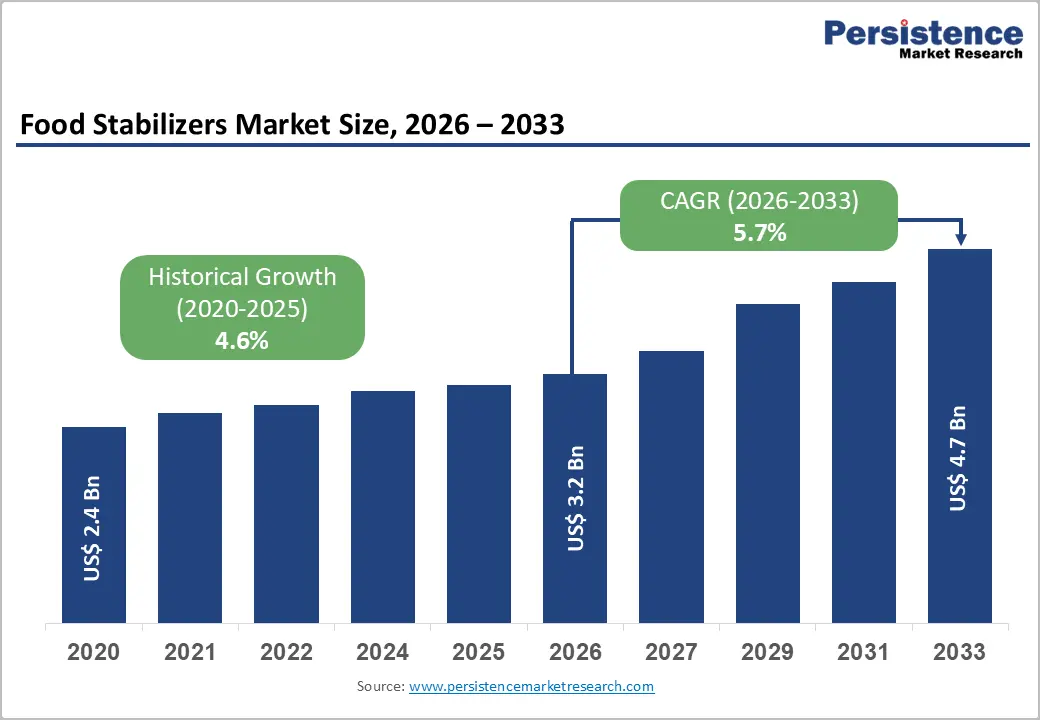
The global food stabilizers market size is expected to be valued at US$ 3.2 billion in 2026 and projected to reach US$ 4.7 billion by 2033, growing at a CAGR of 5.7% between 2026 and 2033.
Key Industry Highlights
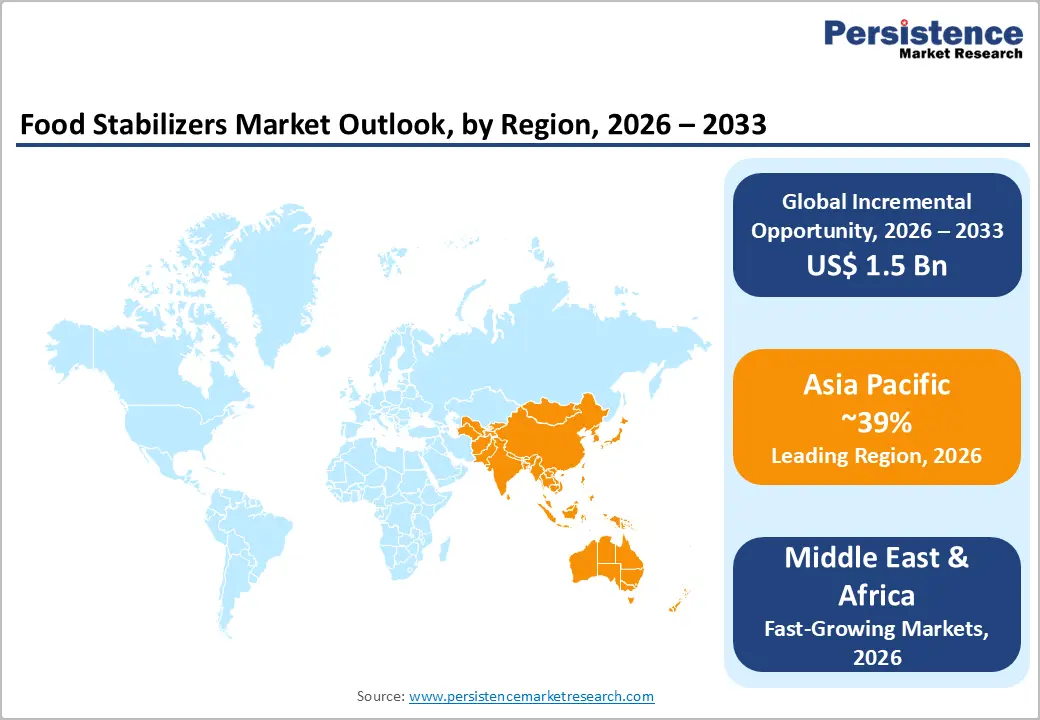
- Leading Region: Asia Pacific, holding approximately 39% market share, driven by rapid food processing expansion, rising packaged food consumption, and strong adoption of stabilizers across dairy, sauces, bakery, and ready-to-eat foods in India, China, Japan, and South Korea
- Fastest-Growing Region: Middle East & Africa, expected to grow at a CAGR of 8.3%, supported by expanding food manufacturing, food service growth, urbanization, and rising demand for heat-stable and shelf-life-extending stabilizers
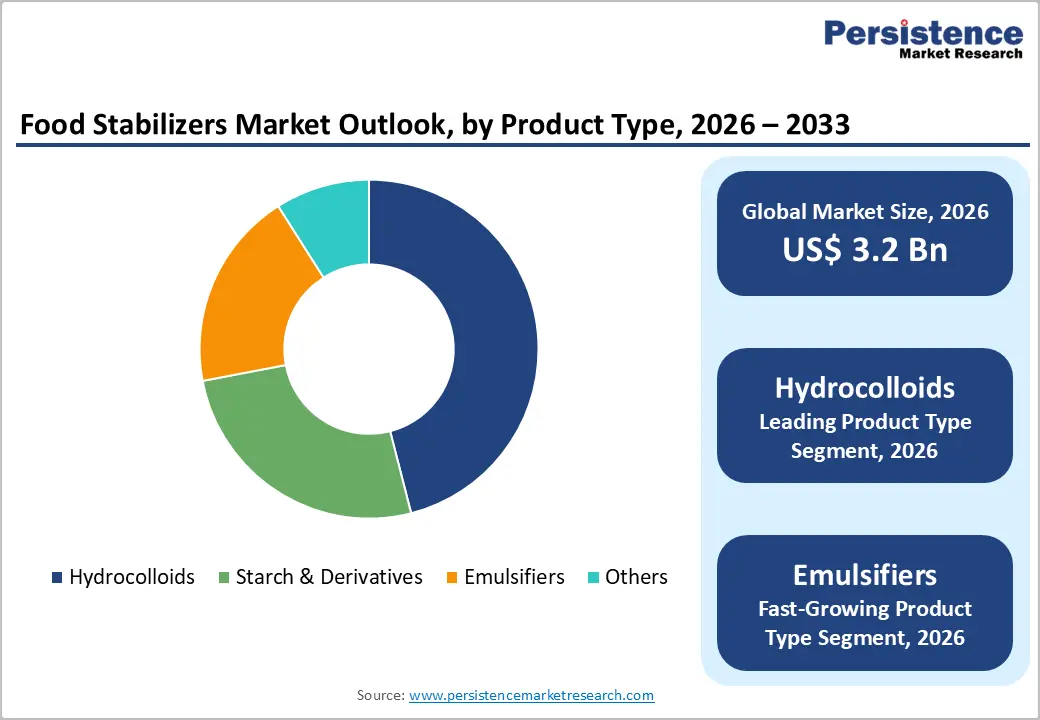
- Dominant Product Type Segment: Hydrocolloids, accounting for around 46% market share as of 2025, favored for versatility, low usage levels, clean-label compatibility, and wide application across beverages, dairy, bakery, and sauces
- Market Drivers: Growth of processed and convenience foods, increasing demand for texture control, moisture retention, visual appeal, and shelf-life stability across frozen, chilled, and ambient food categories
- Opportunities: Innovation in multifunctional stabilizer blends, enabling shorter ingredient lists, improved processing efficiency, enhanced texture performance, and faster product development for plant-based and processed foods
- Key Developments: In November 2025, Palsgaard showcased sustainable emulsifier solutions at Gulfood Manufacturing 2025 in Dubai; in May 2025, Indovinya expanded its Food-Grade Kosher & Halal Sorbitan® ester portfolio for bakery, confectionery, dairy, oils, and beverages
| Key Insights | Details |
|---|---|
| Global Food Stabilizers Market Size (2026E) | US$ 3.2 Bn |
| Market Value Forecast (2033F) | US$ 4.7 Bn |
| Projected Growth (CAGR 2026 to 2033) | 5.7% |
| Historical Market Growth (CAGR 2020 to 2025) | 4.6% |
Market Dynamics
Driver - Growth of processed and convenience foods increases demand for texture, shelf-life, and stability solutions
Modern eating habits are evolving rapidly as busy lifestyles push consumers toward processed and convenience foods that promise consistency and long shelf life. Food stabilizers play a critical role in maintaining texture, moisture retention, and visual appeal across ready meals, sauces, dairy desserts, and beverages. As products travel longer supply chains and face temperature fluctuations, stabilizers help prevent phase separation, syneresis and texture degradation, ensuring reliable quality from production to consumption. This demand intensifies as brands expand frozen, chilled, and ambient product portfolios. Manufacturers rely on stabilizers to deliver uniform mouthfeel and extended freshness without frequent reformulation. The global rise in packaged foods, driven by urbanization and retail expansion, directly elevates the need for advanced stabilization solutions that support scalability, efficiency, and consumer satisfaction across food categories.
Restraints - Regulatory scrutiny and labeling requirements limit ingredient choices across regions
Navigating the global food stabilizers market has become increasingly complex due to evolving regulatory frameworks. Authorities across regions impose strict approval processes, usage limits, and labeling rules that restrict the selection of stabilizing agents. These requirements vary widely, creating formulation challenges for manufacturers serving multiple markets. Ingredient approvals in one region may face restrictions elsewhere, slowing innovation cycles.
Heightened consumer scrutiny around ingredient transparency further intensifies pressure on stabilizer selection. Clean-label expectations push brands to avoid unfamiliar names, even when technically compliant. Reformulation efforts raise development costs and delay product launches. For smaller producers, regulatory compliance becomes a significant barrier to entry. As oversight tightens, regulatory complexity remains a persistent restraint on market flexibility and ingredient innovation.
Opportunity - Innovation in multifunctional stabilizer blends reduces ingredient lists while improving performance
A new wave of innovation is redefining how food stabilizers deliver value. Multifunctional stabilizer blends combine thickening, emulsification, and moisture control within single systems, reducing formulation complexity. These blends support cleaner labels while enhancing texture stability and processing efficiency. Food manufacturers benefit from simplified ingredient lists and improved performance consistency across diverse applications.
Startups and established suppliers are investing in tailored stabilizer systems designed for specific product formats such as plant-based dairy, beverages, and bakery fillings. These solutions optimize performance under varying pH, temperature, and processing conditions. As brands seek efficiency without compromising quality, multifunctional blends present a strong opportunity to differentiate through formulation expertise, reduced costs, and faster product development cycles.
Category-wise Analysis
By Product Type Insights
Hydrocolloids holds approx. 46% market share as of 2025, reflecting their unmatched versatility across food applications. Ingredients such as xanthan gum, guar gum, pectin, and carrageenan deliver thickening, gelling, and stabilization functions essential for sauces, dairy, bakery, and beverages. Their ability to perform at low inclusion rates makes them cost-efficient and widely adopted.
Dominance is reinforced by hydrocolloids’ compatibility with clean-label trends and diverse processing conditions. They help control viscosity, suspend particles, and enhance mouthfeel without altering flavor. Food developers favor hydrocolloids for predictable performance and formulation flexibility. As processed food volumes grow globally, hydrocolloids remain foundational to texture and stability management across mainstream and premium products.
By Source Insights
Microbial food stabilizer is projected to achieve a CAGR of 8.2% during the forecast period as fermentation-based ingredients gain strategic importance in modern food formulation. Derived from controlled microbial processes, these stabilizers deliver consistent viscosity, high purity, and reliable functionality across beverages, sauces, and dairy alternatives. Manufacturers value their performance stability under wide pH ranges, heat treatment, and shear stress, supporting scalable industrial production. Fermentation production offers stable yields, reducing dependence on agricultural variability.
This trajectory is further supported by clean-label positioning, vegan suitability, and acceptance across regulatory frameworks. Microbial stabilizers such as xanthan and gellan gums enable particle suspension, mouthfeel enhancement, and shelf-life extension with low dosage levels. Food brands adopt these ingredients to simplify formulations while maintaining texture precision. As demand rises for ready-to-drink and plant-based foods, microbial sources emerge as stabilizers meeting performance needs.
Region-wise Insights
Asia Pacific Food Stabilizers Market Trends
Asia Pacific holds approximately 39% market share in the global Food Stabilizers Market, driven by rapid food processing expansion. In India, rising demand for packaged dairy, sauces, and bakery products increases stabilizer usage for texture and shelf stability. Local manufacturers adopt stabilizers to support large-scale production and longer distribution cycles.
China’s focus on ready-to-eat meals and beverages boosts demand for advanced stabilization systems. Japan emphasizes precision texture control in premium foods, while South Korea integrates stabilizers into convenience meals and functional beverages. Strong manufacturing growth, evolving diets, and retail expansion position Asia Pacific as a central hub for stabilizer innovation and consumption.
Middle East & Africa Food Stabilizers Market Trends
Middle East & Africa Food Stabilizers Market is expected to grow at a CAGR of 8.3%, supported by expanding food processing activities. In GCC countries, demand rises for stabilizers in dairy desserts, sauces, and beverages designed for extended shelf life under high temperatures. Foodservice growth further accelerates stabilizer adoption.
Egypt’s packaged food sector increasingly relies on stabilizers to improve product consistency and reduce spoilage. Across African countries, urbanization and modern retail expansion boost consumption of processed foods. Manufacturers adopt stabilizers to enhance quality while managing cost efficiency. These trends position the region as an emerging growth market for stabilizer suppliers.
Competitive Landscape
The global food stabilizers market shows a moderately consolidated structure, led by multinational ingredient suppliers alongside specialized regional players. Leading companies focus on clean-label solutions, application-specific systems, and consistent performance to strengthen B2B partnerships. Certifications related to food safety, halal, kosher, and sustainability support global market access.
Competition centers on product innovation, sustainability initiatives, and tailored solutions for plant-based foods and beverages. Suppliers explore export opportunities in developing markets while adapting to government regulations on additives and labeling. As regulatory expectations rise, competitive advantage increasingly depends on technical expertise, compliance readiness, and value-added stabilizer systems.
Key Developments:
- In November 2025, Palsgaard, a global specialist in emulsifiers and stabilizers, highlighted the benefits of its sustainable emulsifier solutions at Gulfood Manufacturing 2025 at the Dubai World Trade Centre.
- In May 2025, Indovinya strengthened its food ingredients portfolio by expanding its Food-Grade Kosher & Halal Sorbitan® ester offerings for the food industry.
- In March 2025, Cargill inaugurated a new corn milling facility in Gwalior, Madhya Pradesh, established by Indian manufacturer Saatvik Agro Processors.
Companies Covered in Food Stabilizers Market
- Cargill, Incorporated
- Kerry Group plc
- Ingredion Incorporated
- Tate & Lyle PLC
- Ashland
- Palsgaard
- BASF SE
- ADM
- DuPont
- dsm-firmenich
- Givaudan
- Others
Frequently Asked Questions
The global food stabilizers market is projected to be valued at US$ 3.2 Bn in 2026.
Growth of processed and convenience foods is a key driver for the global food stabilizers market.
The global food stabilizers market is poised to witness a CAGR of 5.7% between 2026 and 2033.
Innovation in multifunctional stabilizer blends is a key opportunity.
Major players in the global food stabilizers market include Cargill, Incorporated, Kerry Group plc, Ingredion Incorporated, Tate & Lyle PLC, Ashland, Palsgaard, BASF SE, and others.


