




- Specialty & Fine Chemicals
- Food Grade Phosphoric Acid Market
Food Grade Phosphoric Acid Market Size, Share, and Growth Forecast, 2026 - 2033
Food Grade Phosphoric Acid Market By Product Form (Liquid, Solid, Others), Applications (Food & Beverages, Pharmaceuticals, Animal Feed, Others), and Regional Analysis for 2026 - 2033

Food Grade Phosphoric Acid Market Size and Trends Analysis
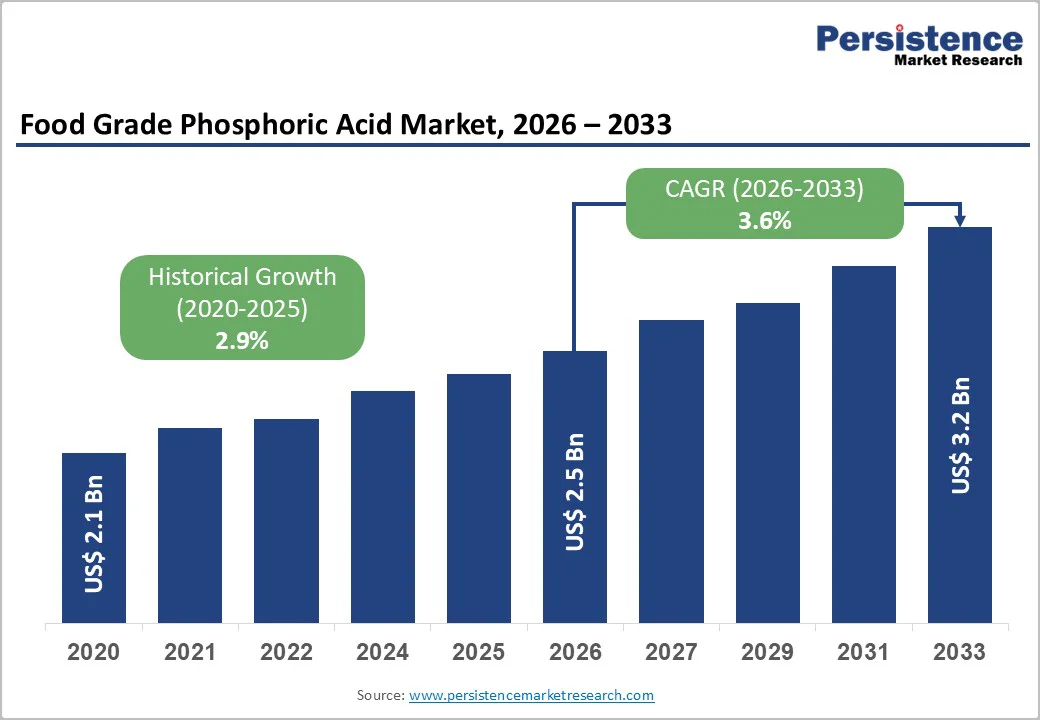
The global food grade phosphoric acid market size is likely to be valued at US$2.5 billion in 2026, and is expected to reach US$3.2 billion by 2033, growing at a CAGR of 3.6% during the forecast period from 2026 to 2033, driven by the increasing prevalence of processed food consumption, rising demand for acidity regulators in beverages, and advancements in purification technologies.
Growing demand for clean-label additives in pharmaceuticals and animal feed, along with advances in stable liquid and solid formulations and rising awareness of food safety and nutritional benefits in emerging regions, is driving increased adoption of food-grade phosphoric acid across applications.
Key Industry Highlights:
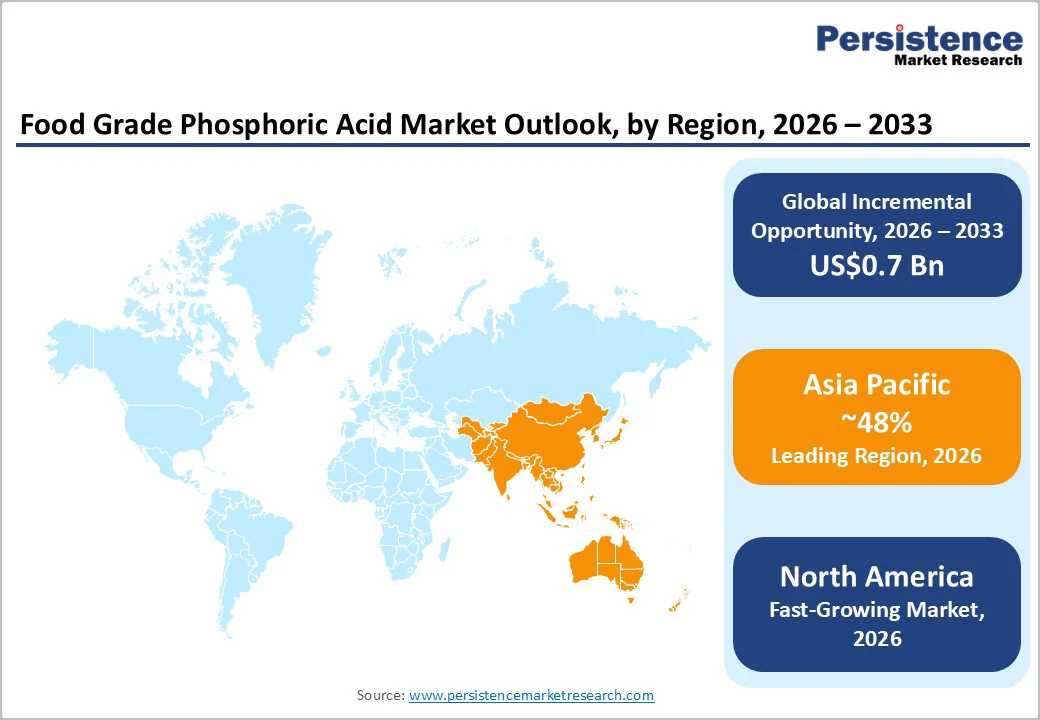
- Leading Region: Asia Pacific, anticipated to account for a 48% market share in 2026, driven by booming food processing, high beverage production, and strong supply chains in China and India.
- Fastest-growing Region: North America is likely to be the fastest-growing region, due to rising consumption of functional beverages, carbonated drinks, and fortified foods, which is driving higher demand for food-grade phosphoric acid.
- Dominant Product Form: The liquid segment, to hold approximately 70% of the market share in 2026, as it provides easy mixing and precise dosing in large-scale food manufacturing.
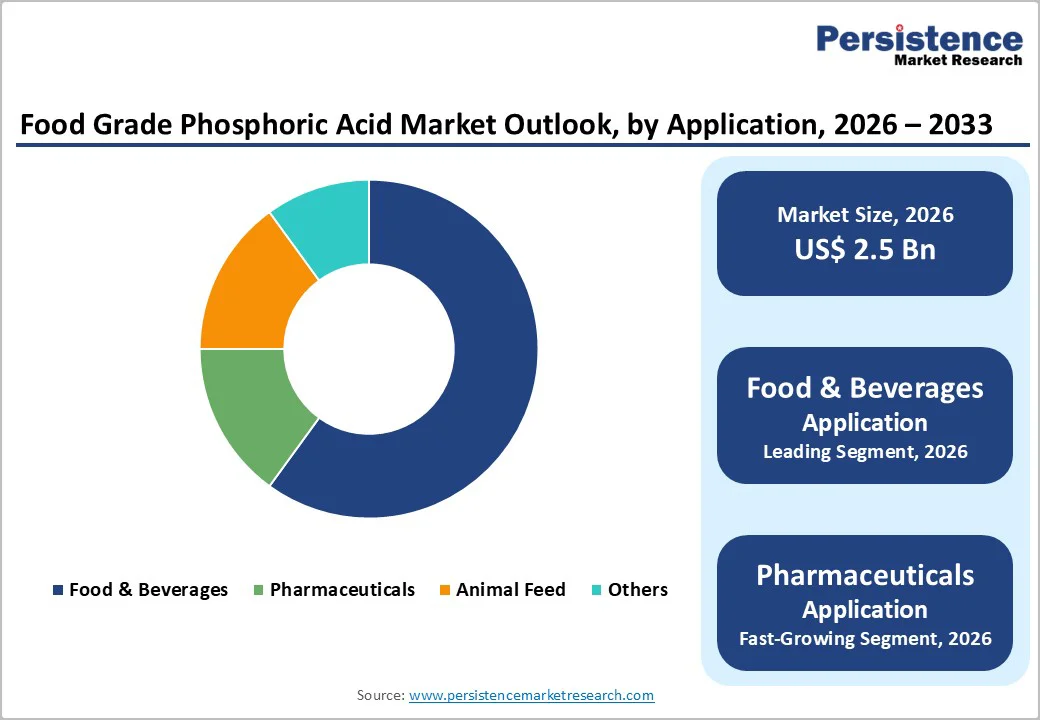
- Leading Application: The food & beverages are expected to account for over 60% of the market revenue, due to their role in carbonation, preservation, and flavor enhancement.
| Key Insights | Details |
|---|---|
|
Food Grade Phosphoric Acid Market Size (2026E) |
US$2.5 Bn |
|
Market Value Forecast (2033F) |
US$3.2 Bn |
|
Projected Growth (CAGR 2026 to 2033) |
3.6% |
|
Historical Market Growth (CAGR 2020 to 2025) |
2.9% |
Market Factors - Growth, Barriers, and Opportunity Analysis
Rising Prevalence of Processed Food Consumption and Demand for Acidity Regulators
The rising preference for processed food consumption is quickly becoming a major opportunity for acid suppliers, driven by growing consumer demand for convenient, shelf-stable products and enhanced flavors. Traditional preservatives often create off-tastes, especially in beverages and baked goods, leading to shorter shelf lives and lower appeal. Food grade phosphoric acid technologies, including liquid concentrates, solid crystals, pH buffers, chelating agents, and purified variants, address these concerns by offering a colorless, odorless alternative. These formats simplify formulation, reduce the need for multiple additives, and are particularly effective during mass production or global distribution where consistency is critical.
Food grade phosphoric acid significantly lowers the risk of microbial growth, oxidation, and nutrient loss, which remain major concerns in food settings. They also support improved solubility and easier storage, especially for liquid and solid forms, making them ideal for high-volume or remote facilities. As global health organizations push for broader food safety coverage and user-friendly ingredients, demand continues to expand across food & beverages, pharmaceuticals, and animal feed.
High Development and Purification Costs
High development and purification costs present a significant barrier for companies advancing next-generation food grade phosphoric acid and novel additive systems. Developing innovative grades such as ultra-pure liquids, solid powders, or chelated forms requires extensive research, specialized filtration, and advanced crystallization technologies that are far more expensive than industrial phosphoric acid. Purity is an even greater challenge: many refined variants, trace-metal-reduced lots, and stabilizer-enhanced products are sensitive to contaminants, temperature, and pH, requiring rigorous optimization to ensure they remain compliant throughout storage and blending. Achieving food-safety certification often involves costly microbial trials, sophisticated spectroscopic testing, and the use of high-grade ion exchangers, which significantly increase R&D expenditures.
Meeting stringent regulatory expectations for heavy metal limits, microbial counts, and batch purity requires multiple validation studies under various conditions and across several production batches. This adds both time and financial burden to development timelines. Scaling up manufacturing requires controlled cleanrooms, specialized evaporators, and quality-assurance systems, further driving up overall costs. For smaller processors, these challenges can limit grade expansion or delay commercialization.
Advancements in Clean-Label and Chelated Delivery Platforms
Advancements in clean-label and chelated food grade phosphoric acid delivery platforms are transforming the global ingredient landscape by addressing two major challenges, additive scrutiny and bioavailability barriers. Clean-label acids are engineered to achieve 99.9% purity, reducing reliance on synthetic aids and enabling transparent labeling in beverages. Innovations, such as wet-process refinements, membrane filtration, solvent extraction, and crystallization optimization, significantly improve clarity and reduce impurities, lowering compliance costs for manufacturers and regulatory bodies.
Progress in chelated platforms, including mineral-bound liquids, solid effervescent, buffered powders, and nutrient-enhanced forms, supports more effective pH control by stimulating metal ion stability, the food’s first line of defense against spoilage and oxidation. These formats eliminate off-flavors, enhance shelf life, and allow precise dosing without trained chemists, making them highly suitable for mass formulation programs. New technologies such as nano-encapsulation, bio-derived chelators, and VLP-based stabilizers further enhance absorption and preservation response.
Category-wise Analysis
Product Form Insights
Liquid is anticipated to dominate the market, accounting for approximately 70% of the market share in 2026. Its dominance is driven by superior solubility, ease of handling, and scalability, making it preferred for beverage carbonation. Liquid forms provide uniform dispersion, ensure efficacy, and contribute to consistency, making them suitable for large-scale food campaigns. For example, Nutrien Ltd., a major phosphoric acid supplier, provides high-purity liquid food-grade phosphoric acid specifically formulated for beverage manufacturers to ensure seamless dispersion and batch consistency, validating the preference for liquid forms in high-volume operations.
Solid represents the fastest-growing segment, due to its stability and expanding use in pharmaceuticals. Its concentrated profile makes it ideal for tablet compression, reducing bulk. Continuous innovations in crystalline solids are further strengthening their purity, driving rapid adoption across North America and Europe, where demand for compact, high-potency additives is accelerating.
Application Insights
The food & beverages segment is anticipated to lead the market, holding approximately 60% of the share in 2026, driven by persistent flavor needs, large processing programs, and strong global demand for preservatives. Their dominance continues as brands expand their use for colas, jams, and cheeses. Rising adoption of chelated forms and expanded animal feed campaigns highlight the growing focus on enhancement. For example, The Coca-Cola Company has historically used phosphoric acid in many of its carbonated beverages (cola, soft drinks) to provide acidity, flavor “sharpness,” and preservation.
Pharmaceuticals are the fastest-growing segment, due to strong momentum in drug formulations and expanding inclusion of buffering agents in tablets. The growing shift toward clean-label, bioavailable platforms, along with better solubility, accelerates the adoption. Advancements in solid chelates and the continued progress of liquid stabilizers entering stability trials drive market growth. For example, Merck KGaA (MilliporeSigma) supplies pharmaceutical-grade phosphoric acid used specifically as a buffering agent in oral solid dosage forms, including tablets, to control pH and enhance stability during formulation.
Regional Insights
North America Food Grade Phosphoric Acid Market Trends
North America is likely to be the fastest-growing market, driven by the region’s advanced food processing infrastructure, strong research and development capabilities, and high public awareness of additive benefits. Processing systems in the U.S. and Canada provide extensive support for formulation programs, ensuring wide accessibility of food-grade phosphoric acid across beverages, pharma, and feed populations. Increasing demand for liquid, convenient, and easy-to-dose forms is further accelerating adoption, as these formats improve efficiency and reduce barriers associated with powders.
Innovation in food grade phosphoric acid technology, including stable purities, improved chelation delivery, and targeted metal reduction, is attracting significant investment from both public and private sectors. Government initiatives and safety campaigns continue to promote use against spoilage, oxidation, and emerging clean-label threats, creating sustained market demand. The growing focus on solid forms and animal feed, particularly for nutrition and pharma, is expanding the target applications for food grade phosphoric acid.
Europe Food Grade Phosphoric Acid Market Trends
Europe is driven by increasing awareness of quality benefits, strong processing systems, and government-led safety programs. Countries such as Germany, France, and the U.K. have well-established food frameworks that support routine acidification and encourage the adoption of innovative acid delivery methods, including food grade phosphoric acid. These pure formulations are particularly appealing for beverage populations, irritant-averse consumers, and pharma users, improving compliance and coverage rates.
Technological advancements in food grade phosphoric acid development, such as enhanced stability, chelate-targeted delivery, and improved organic forms, are further boosting market potential. European authorities are increasingly supporting research and trials for acids against both routine and specialized needs, strengthening market confidence. The growing emphasis on convenient, self-dosing options is aligned with the region’s focus on preventive formulation and reducing waste. Public awareness campaigns and promotion drives are expanding reach in both urban and rural areas, while suppliers are investing in filtration and novel purities to increase efficacy.
Asia Pacific Food Grade Phosphoric Acid Market Trends
Asia Pacific is projected to account for 48% of the share in 2026, driven by rising processing awareness, increasing government initiatives, and expanding application programs across the region. Countries such as India, China, Japan, and Southeast Asian nations are actively promoting food campaigns to address beverage demands and emerging pharma needs. Food grade phosphoric acid is particularly attractive in these regions due to its soluble administration, ease of scaling, and suitability for large-scale production drives in both urban and rural populations.
Technological advancements are supporting the development of stable, effective, and easy-to-blend food grade phosphoric acid, which can withstand challenging storage conditions and minimize impurity dependence. These innovations are critical for reaching remote facilities and improving overall quality coverage. Growing demand for food & beverages, animal feed, and others is contributing to market expansion. Public-private partnerships, increased processing expenditure, and rising investment in purification research and manufacturing capacity are further accelerating growth. The convenience of acid delivery, combined with improved purity and reduced risk of contamination, positions food grade phosphoric acid as a preferred choice.
Competitive Landscape
The global food grade phosphoric acid market features competition between established chemical leaders and emerging purifiers. In North America and Europe, OCP and Mosaic lead through strong R&D, distribution networks, and food ties, bolstered by innovative grades and processing programs. In Asia Pacific, Prayon advances with localized solutions, enhancing accessibility.
Purity-enhanced delivery boosts compliance, cuts impurity risks, and enables mass campaigns across regions. Strategic partnerships, collaborations, and acquisitions merge expertise, expand capacities, and speed commercialization. Clean formulations solve safety issues, aiding penetration in regulated areas.
Key Industry Developments
- In late 2023, Gujarat Alkalies and Chemicals Limited (GACL) commenced production and dispatches of food grade phosphoric acid and purified phosphoric acid. The company also commissioned a large new Caustic Evaporation Unit (CEU).
- In January 2023, Prayon strengthened its position in high-purity phosphoric acid by acquiring Febex from Arkema, expanding its portfolio to include high-purity food-grade and beverage-grade phosphoric acid applications. This acquisition enhanced Prayon’s capabilities in specialty phosphorus derivatives and supported growth across regulated end-use markets requiring stringent quality standards.
Companies Covered in Food Grade Phosphoric Acid Market
- OCP
- Mosaic
- Brenntag AG
- Prayon SA
- Guangxi Qinzhou Capital Success Chemical Co., Ltd
- Grasim Industries Limited
- Spectrum Chemical Manufacturing Corp.
Frequently Asked Questions
The global food grade phosphoric acid market is projected to reach US$2.5 billion in 2026.
The rising prevalence of processed food consumption and demand for acidity regulators are key drivers.
The food grade phosphoric acid market is poised to witness a CAGR of 3.6% from 2026 to 2033.
Advancements in clean-label and chelated delivery platforms are key opportunities.
OCP, Mosaic, Brenntag AG, Prayon SA, and Grasim Industries Limited are the key players.


