




- Specialty & Fine Chemicals
- Ether Carboxylates Market
Ether Carboxylates Market Size, Share, and Growth Forecast, 2026 - 2033
Ether Carboxylates Market By Product Type (Monoether Carboxylates, Polyether Carboxylates), Application (Detergents and Cleaners, Personal Care, Industrial Application, Pharmaceuticals, Others), End-user (Household, Industrial, Institutional, Others), and Regional Analysis for 2026 - 2033

Ether Carboxylates Market Size and Trends Analysis
The global ether carboxylates market size is likely to be valued at US$1.5 billion in 2026, and is expected to reach US$2.7 billion by 2033, growing at a CAGR of 8.7% during the forecast period from 2026 to 2033, driven by the increasing prevalence of eco-friendly surfactants in detergents, rising demand for mild cleansing agents in personal care, and advancements in anionic polymer technologies.
The demand for high-foaming, biodegradable compounds in household cleaners has driven the adoption of ether carboxylates across demographics. Innovations in monoether and polyether types support versatility and sustainability, with growing use in industrial formulations, especially pharmaceuticals, fueling market growth.
Key Industry Highlights:
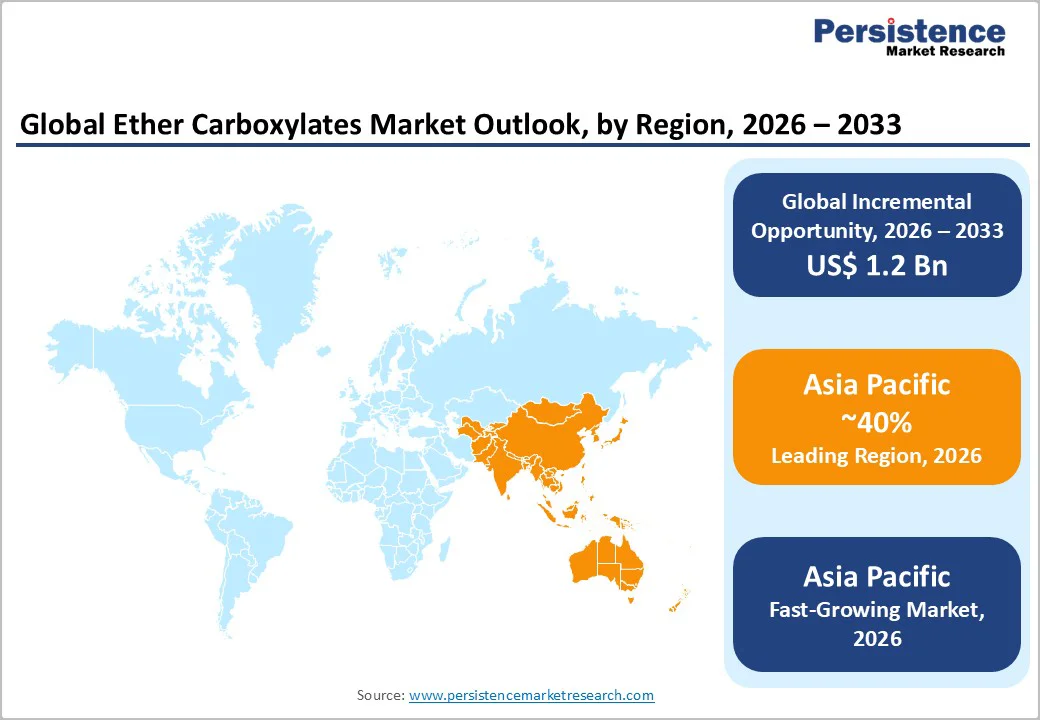
- Leading Region: Asia Pacific is expected to dominate, with a 40% market share in 2026, driven by massive detergent production, high prevalence of personal care, and strong R&D activities in China.
- Dominant Product Type: Polyether carboxylates, to hold approximately 55% of the market share in 2026, due to superior foaming properties.
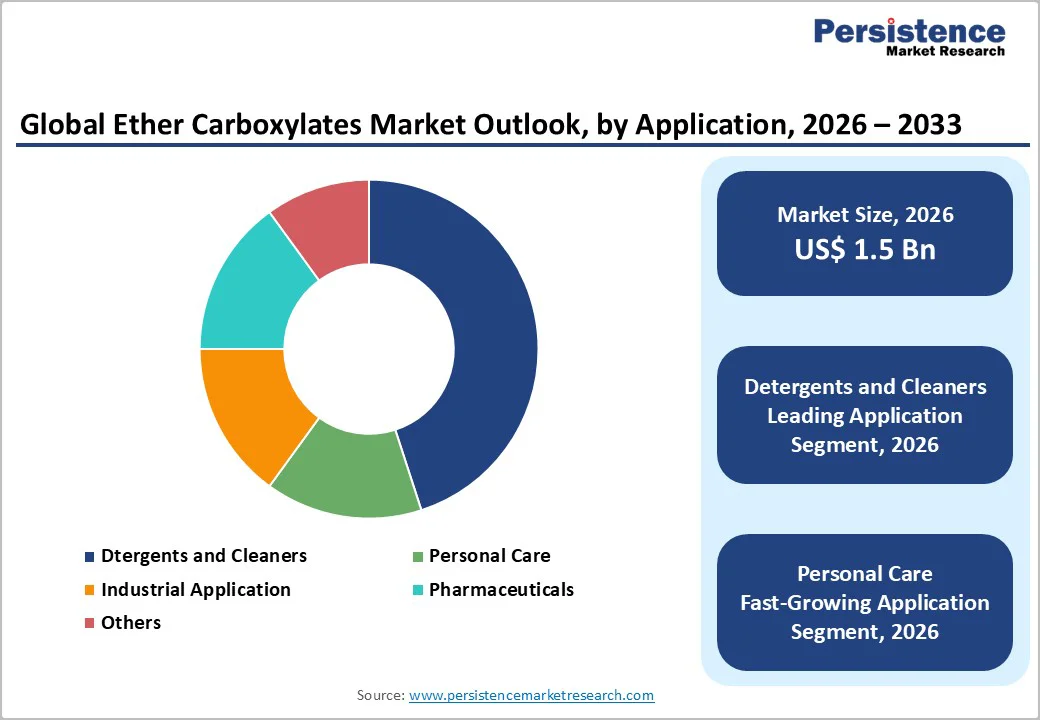
- Leading Application: Detergents and cleaners, to account for over 45% of the market revenue in 2026, driven by household demand.
- Leading End-user: Household, to contribute nearly 40% of the market revenue, due to cleaning products.
- Key Market Driver: Rising consumer preference for eco-friendly and high-performance surfactants is accelerating the adoption of ether carboxylates in detergents and personal care.
- Market Opportunity: Expansion in industrial and pharmaceutical applications creates strong opportunities for customized, high-purity ether carboxylate variants.
| Key Insights | Details |
|---|---|
| Ether Carboxylates Market Size (2026E) | US$1.5 Bn |
| Market Value Forecast (2033F) | US$2.7 Bn |
| Projected Growth (CAGR 2026 to 2033) | 8.7% |
| Historical Market Growth (CAGR 2020 to 2025) | 8.3% |

Market Factors - Growth, Barriers, and Opportunity Analysis
Rising Prevalence of Eco-Friendly Surfactants in Detergents and Demand for Mild Cleansing Agents in Personal Care
The growing preference for eco-friendly surfactants in detergents and the rising demand for mild cleansing agents in personal care are key drivers strengthening the ether carboxylates market. Consumers are increasingly conscious of environmental impact, pushing brands to adopt biodegradable, low-toxicity ingredients that align with sustainability goals.
Ether carboxylates offer an attractive profile with efficient cleaning performance, compatibility with concentrated detergent formats, and reduced environmental footprint, making them a preferred choice for next-generation home-care formulations. Companies are integrating these surfactants into liquid detergents, laundry gels, and surface cleaners to meet regulatory standards and consumer expectations for greener products.
In the personal care sector, the shift toward gentle, sulfate-free, and skin-friendly formulations is accelerating adoption. Ether carboxylates provide mildness, good foaming characteristics, and strong compatibility with conditioning agents, enabling their use in shampoos, face washes, body cleansers, and sensitive-skin products. The trend is further reinforced by growing demand for natural-inspired, dermatologically safe, and clean-label beauty products.
High Development and Raw Material Costs
High development and raw material costs remain significant restraints for the ether carboxylates market, influencing pricing strategies, profitability, and competitive positioning. The development of advanced formulations, particularly high-purity, bio-based, or multifunctional variants, requires substantial investment in R&D, specialized equipment, and stringent quality-control processes.
These factors increase overall production costs and extend the time-to-market for new product launches. For companies operating in tightly regulated sectors such as personal care and pharmaceuticals, additional costs arise from compliance testing, certification, and safety evaluations.
Raw material costs also represent a major challenge. Many feedstocks used in ether carboxylate production, including ethylene oxide derivatives and specialty alcohols, experience price volatility due to fluctuations in crude oil markets, global supply-chain disruptions, and variability in petrochemical output.
For manufacturers shifting toward bio-based inputs, sourcing sustainable raw materials further increases procurement costs due to limited availability and higher processing expenses.
Advancements in Bio-Based Ether Carboxylates and Multifunctional Formulations
Advancements in bio-based ether carboxylates and multifunctional formulations are reshaping the competitive landscape, creating new growth avenues for manufacturers and end-use industries. The shift toward sustainability is driving companies to invest in bio-derived raw materials, enabling the development of surfactants with lower carbon footprints, improved biodegradability, and enhanced regulatory compliance.
These innovations support corporate ESG goals while strengthening brand positioning in markets such as home care, personal care, and industrial cleaning.
Multifunctional formulations represent another major advancement, offering improved performance by combining cleaning, wetting, dispersing, and conditioning properties within a single ingredient. This reduces formulation complexity, lowers production costs, and allows brands to deliver high-efficiency products with added consumer value.
Such formulations are gaining traction across sectors that demand high-performance, cost-effective, and sustainable solutions. Ongoing R&D efforts are improving molecular structures to enhance stability, compatibility with diverse ingredients, and performance under varying pH and temperature conditions. These advancements are especially relevant for premium detergents, skincare products, and industrial process aids.
Category-wise Analysis
Product Type Insights
Polyether carboxylates are anticipated to dominate the market, accounting for approximately 55% of the market share in 2026. Its dominance is driven by foaming excellence, mildness, and versatility, making it preferred for household.
Polyether carboxylates, such as those from Clariant AG, provide rich lather, ensuring user satisfaction. Its scalability and performance make it preferred for manufacturers. For example, many high-foam liquid hand soaps use polyether carboxylates to achieve a soft, creamy lather while remaining gentle on the skin.
Monoether carboxylates are likely to be the fastest-growing, as their precision and controlled performance suit specialized applications, especially in pharmaceuticals and high-value formulations. Demand rises in regions such as North America and Europe, where industries prioritize high-purity, reliable ingredients for targeted functions.
Ongoing innovation in purity enhancement and tailored molecular structures further strengthens the adoption across advanced manufacturing environments. For example, certain pharmaceutical gel formulations use monoether carboxylates as mild, stable emulsifiers to ensure consistent texture and improved drug delivery performance.
Application Insights
Detergents and cleaners lead the market, holding approximately 45% of the share in 2026, due to their extensive use in household and industrial cleaning, with strong demand for effective grease and stain removal. Their compatibility with liquid formulations increases accessibility and frequent use.
High consumption volume in daily cleaning routines and expanding hygiene awareness further reinforce their dominant market share. For example, liquid dishwashing products often use ether carboxylates to improve grease-cutting efficiency while maintaining mildness for frequent hand contact.
Personal care is likely to be the fastest-growing segment, as consumers increasingly prefer gentle, mild, and skin-friendly formulations in shampoos, body washes, and facial products. Ether carboxylates offer conditioning benefits, good foam quality, and high safety, making them ideal for sensitive-skin and sulfate-free trends.
Rising demand for premium, clean-label, and dermatologically safe products is accelerating their adoption in the personal care sector. For example, many sulfate-free shampoos now incorporate ether carboxylates to deliver effective cleansing without stripping natural oils, enhancing both scalp comfort and hair softness.
End-user Insights
The household segment is expected to dominate the market, contributing nearly 40% of revenue in 2026, as ether carboxylates are widely used in high-volume products such as laundry detergents and dishwashing liquids. Their strong cleaning performance, mildness, and compatibility with daily-use formulations make them a consumer favorite.
With frequent household consumption and recurring demand, this segment generates the highest revenue share and maintains its dominance. For example, many concentrated liquid laundry detergents use ether carboxylates as primary surfactants to improve stain removal while reducing skin irritation, ensuring both efficiency and consumer comfort.
The industrial segment is the fastest-growing segment, and manufacturers increasingly rely on ether carboxylates as efficient process aids that enhance cleaning, emulsification, and stability in production environments. Their versatility across textiles, coatings, chemicals, and metalworking significantly boosts adoption.
As global manufacturing activity expands, industries continue to seek high-performance, cost-effective, and more environmentally safe surfactants, thereby accelerating demand in this segment. For example, in textile processing, ether carboxylates are used as low-foaming wetting agents to improve fabric penetration and dye uniformity, supporting higher efficiency and consistent product quality.
Regional Insights
North America Ether Carboxylates Market Trends
North America is projected to account for nearly 25% of the global ether carboxylates market in 2026, driven by consistent demand from personal care, household cleaning, and industrial segments.
In this region, consumers often seek high-performance surfactants that deliver strong cleaning power, mildness for skin care products, and compatibility with diverse formulations, making ether carboxylates a preferred choice. Manufacturers emphasize product quality, consistency, and compliance with safety standards to meet consumer expectations and regulatory requirements.
Environmental awareness and increasing interest in “green chemistry” influence purchasing decisions across North America. Many companies are investing in manufacturing processes that reduce waste and energy use, and producing surfactants with improved biodegradability and lower environmental impact.
This shift supports the gradual replacement of older, harsher surfactants with ether carboxylates that strike a balance between performance and sustainability. Firms focus on improving product purity, refining molecular structures to enhance performance (e.g., foam control, stability, mildness), and customizing surfactants for applications ranging from laundry detergents and dish soaps to personal-care items such as shampoos and body washes.
Europe Ether Carboxylates Market Trends
Growth in Europe is driven by increasing demand for sustainable and eco-friendly surfactants. European consumers and industries are showing a strong preference for biodegradable, low-toxicity, and skin-friendly formulations, particularly in personal care, home care, and cleaning products.
This trend encourages manufacturers to develop products that balance performance with environmental safety. Regulatory frameworks in Europe play a major role in shaping the market. Strict chemical safety and environmental standards motivate companies to adopt greener production methods and replace traditional surfactants with ether carboxylates.
Innovation in formulation and production techniques is also key, as companies seek to improve product efficiency, reduce energy consumption, and minimize waste during manufacturing. In addition to regulatory and sustainability factors, market growth is influenced by rising consumer awareness about chemical safety and demand for high-performance household and personal care products.
Specialty applications, including mild surfactants for sensitive skin products and eco-friendly industrial cleaners, are gaining traction.
Asia Pacific Ether Carboxylates Market Trends
Asia Pacific is likely to be the dominant and fastest-growing market, accounting for approximately 40% of the market share in 2026, driven by a surge in detergent consumption and expanding applications across China and India. In China, the industry is experiencing rapid expansion, with major players such as Nippon Shokubai investing in cost-effective and high-performance solutions to cater to rising domestic demand.
India’s growing number of households, coupled with the prevalence of manufacturing and industrial activities, is driving strong demand for affordable surfactants and specialty chemicals. The increasing presence of regional producers, along with supportive initiatives and investments, is further accelerating market growth in the region.
Beyond detergents, the adoption of polyether-based carboxylates and their applications in personal care, home care, and industrial sectors are creating additional opportunities for manufacturers. Companies are leveraging localized production and tailored solutions to meet specific regional requirements, enhancing market penetration.
Sustainability trends and the focus on environmentally friendly surfactants are further shaping the competitive landscape. The Asia Pacific market is positioned for robust growth, driven by rising consumption, industrial expansion, and innovation in product offerings.
Competitive Landscape
The global ether carboxylates market is highly competitive, with both multinational chemical giants and specialized manufacturers shaping the landscape. In developed regions such as North America and Europe, companies such as BASF SE and Huntsman Corporation maintain strong dominance due to their advanced R&D capabilities, diversified product portfolios, and established distribution networks.
Their focus on performance-driven formulations and sustainable chemistries further strengthens their market hold. In the Asia Pacific region, KAO Corporation stands out by leveraging localized manufacturing, cost-effective solutions, and customized product offerings tailored to regional consumer needs.
Companies are increasingly prioritizing bio-based innovations, driven by growing demand for environmentally friendly surfactants from home care, personal care, and industrial sectors. This shift toward green chemistry is enabling players to differentiate themselves and capture emerging opportunities.
Strategic collaborations, partnershmergers, and acquisitions are becoming common as companies aim to expand their global footprint, enhance production capabilities, and accelerate technology development. Investments in sustainable production techniques, energy-efficient processes, and circular solutions are further intensifying competition, positioning eco-innovation as a central pillar of long-term market leadership.
Key Industry Developments
- In February 2024, Thermax Limited signed a license and technical assistance agreement with South Korea's Flowtech Co Ltd. to acquire technology for manufacturing poly carboxylate ether (PCE) products, strengthening its construction chemicals business.
Companies Covered in Ether Carboxylates Market
- BASF SE
- Huntsman Corporation
- KAO Corporation
- Nippon Shokubai
- Biesterfeld
- New Japan Chemical
- Clariant AG
- Stepan Company
- Zschimmer & Schwarz
- Innospec
- Pilot Chemical
- Sika AG
- Arkema
Frequently Asked Questions
The global ether carboxylates market is projected to reach US$1.5 billion in 2026.
The rising prevalence of eco-friendly surfactants in detergents and demand for mild cleansing agents in personal care are key drivers.
The ether carboxylates market is poised to witness a CAGR of 8.7% from 2026 to 2033.
Advancements in bio-based ether carboxylates and multifunctional formulations are key opportunities.
BASF SE, Huntsman Corporation, KAO Corporation, Nippon Shokubai, and Clariant AG are the key players.


