




- Automotive
- Engine Tuner Market
Engine Tuner Market Size, Share, and Growth Forecast, 2026 – 2033
Engine Tuner Market by Product Type (Hardware Tuners, Software Tuners, Hybrid Tuners), Fuel Type (Gasoline, Diesel), Application (Performance Enhancement, Fuel Efficiency Optimization, Diagnostic), and Regional Analysis for 2026-2033

Engine Tuner Market Share and Trends Analysis
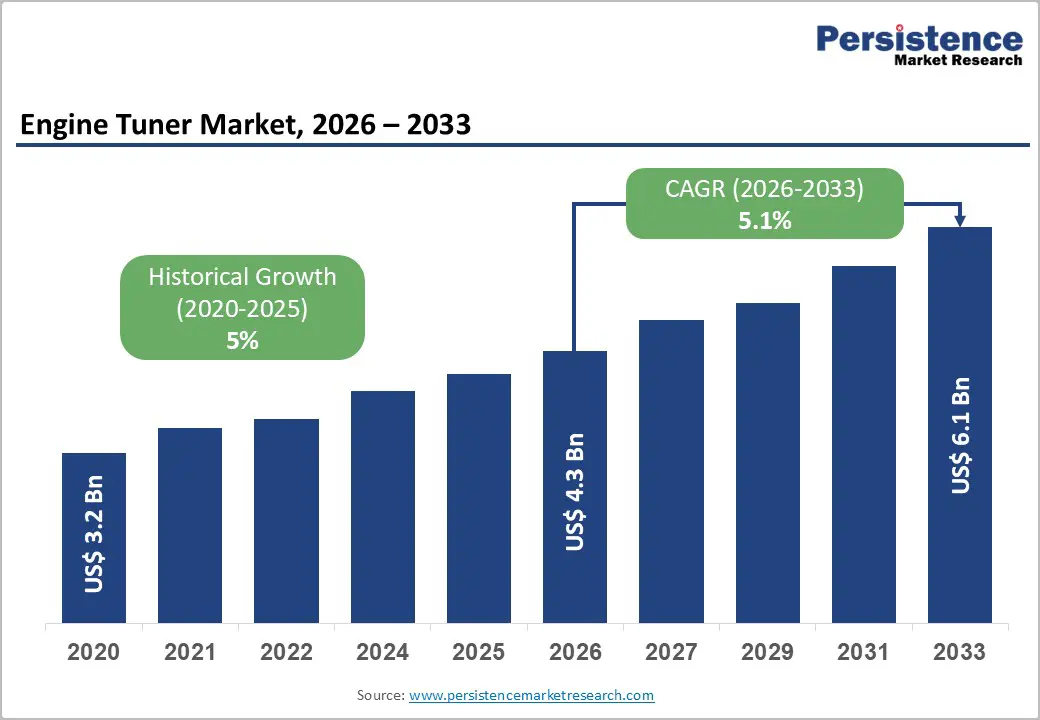
The global engine tuner market size is likely to be valued at US$ 4.3 billion in 2026, and is projected to reach US$ 6.1 billion by 2033, growing at a CAGR of 5.1% during the forecast period 2026−2033. The growth trajectory of the market reflects sustained demand for vehicle performance optimization, fuel economy enhancement, and digital diagnostics integration across passenger and commercial vehicle categories. Expansion of global vehicle parc, combined with increasing average vehicle age, has strengthened demand for aftermarket electronic control unit recalibration and plug-in tuning modules. Regulatory pressure from bodies such as the U.S. Environmental Protection Agency (EPA) and the European Environment Agency (EEA) has deepened the focus on emission efficiency, indirectly stimulating the adoption of calibrated engine management systems that optimize combustion parameters within compliance thresholds.
Technological integration across automotive electronics, including advanced sensors, onboard diagnostics systems, and cloud-based performance analytics, has enabled scalable software-driven tuning solutions with improved reliability and traceability. Rising consumer awareness regarding fuel efficiency, torque optimization, and fleet operating cost reduction has reinforced demand across individual vehicle owners and commercial fleet operators.
Key Industry Highlights
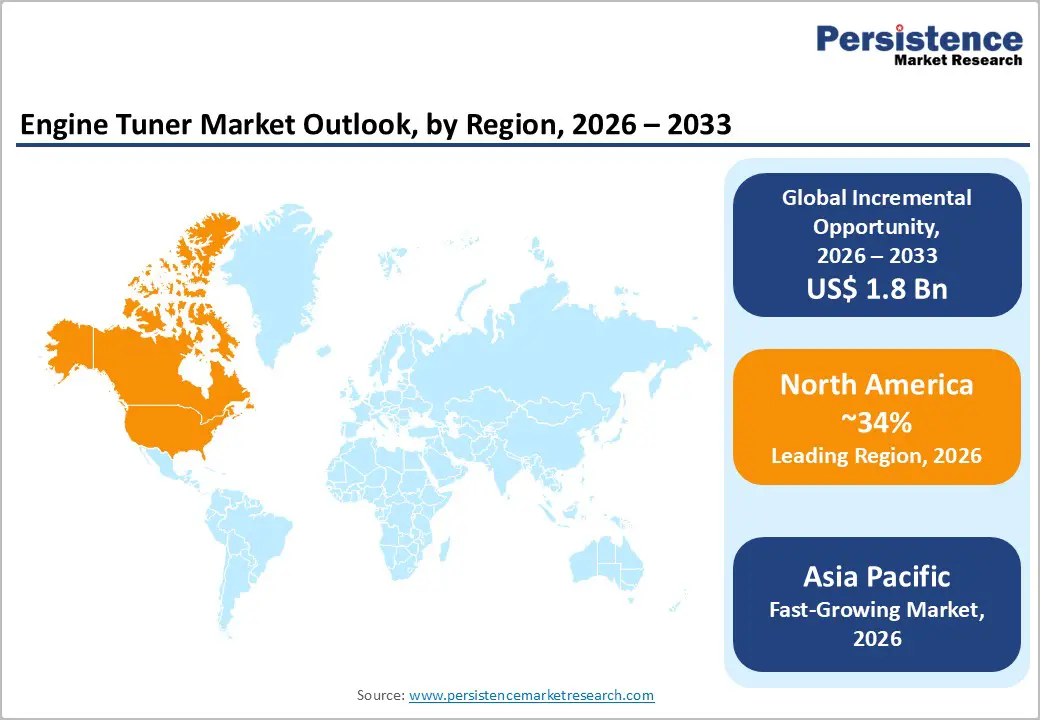
- Dominant Region: North America is projected to lead with about 34% share, supported by a mature aftermarket ecosystem and advanced dyno-validation infrastructure.
- Fastest-growing Regional Market: The Asia Pacific market is projected to record the fastest 2026-2033 growth, driven by expanding electronically controlled vehicle fleets and strong domestic automotive electronics manufacturing.
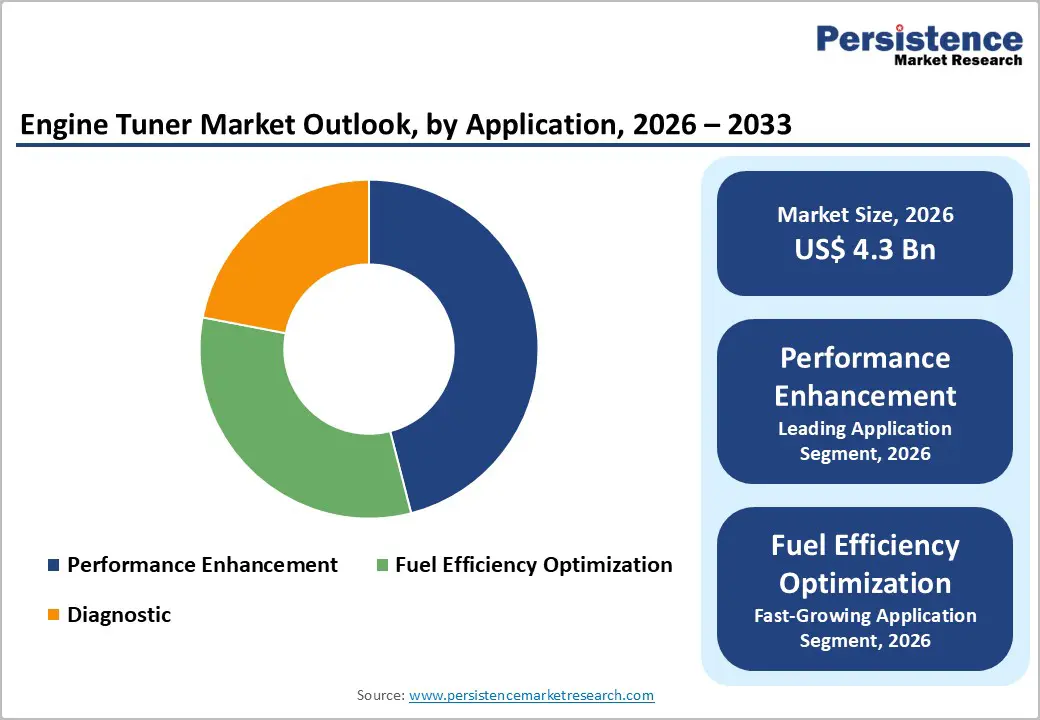
- Leading Application: Performance enhancement is forecasted to lead with about 46% share in 2026, owing to widespread motorsport influence and growing need for measurable acceleration and torque gains.
- Fastest-growing Application: Fuel efficiency optimization is expected to grow the fastest from 2026 to 2033, propelled by rising fuel cost sensitivity, fleet sustainability targets, and advanced combustion recalibration techniques.
| Report Attribute | Details |
|---|---|
|
Engine Tuner Market Size (2026E) |
US$ 4.3 Bn |
|
Market Value Forecast (2033F) |
US$ 6.1 Bn |
|
Projected Growth (CAGR 2026 to 2033) |
5.1% |
|
Historical Market Growth (CAGR 2020 to 2025) |
5% |
Market Factors – Growth, Barriers, and Opportunity Analysis
Increasing Demand for Enhanced Vehicle Performance
Performance optimization represents a decisive purchasing parameter across passenger and light commercial vehicle categories, driven by preference for higher torque delivery, sharper throttle response, and improved acceleration dynamics. Original equipment manufacturers calibrate engines conservatively to comply with diverse fuel standards, climatic variations, and emission thresholds, leaving measurable headroom for recalibration through software-based intervention. Engine control unit (ECU) remapping enables refinement of ignition timing, turbo boost pressure, and air–fuel ratios, unlocking latent output within existing mechanical configurations. This technical flexibility appeals to performance-focused consumers, urban drivers seeking responsive mobility, and commercial operators targeting efficiency improvements.
Government data indicates a strong and expanding base of electronically controlled vehicles suitable for recalibration. According to the Ministry of Road Transport and Highways (MoRTH), total registered motor vehicles in India crossed 354 million in 2025. A large registered vehicle population enlarges the installed base of ECU-managed powertrains, directly increasing the potential customer pool for software-driven performance enhancement solutions. Rising penetration of turbocharged petrol and diesel platforms strengthens responsiveness to calibration adjustments, improving measurable output gains per tuning intervention.
Growth of Automotive Aftermarket Ecosystem
Expansion of the automotive aftermarket ecosystem strengthens demand for engine tuning solutions through wider availability of performance components, calibration tools, and specialized service networks. Independent workshops, performance garages, and digital diagnostic platforms are scaling operations across urban and semi-urban regions, improving technical accessibility for vehicle recalibration. Increasing vehicle parc age supports sustained maintenance and upgrade cycles, creating recurring modification requirements beyond original equipment manufacturer service channels. According to the U.S. Bureau of Transportation Statistics, the U.S. recorded 284 million registered vehicles in 2025, reflecting a substantial base requiring maintenance, upgrades, and performance optimization.
Rising consumer engagement in personalization, performance enhancement, and fuel optimization is reinforcing demand within independent service environments. Digital platforms, automotive forums, and motorsport communities are influencing purchasing decisions toward programmable tuning devices and ECU recalibration services. Improvements in on-board diagnostics (OBD) interfaces and cloud-based flashing tools are enabling workshops to deliver faster and more precise adjustments. Supply chain maturity across performance parts distributors ensures consistent availability of turbochargers, exhaust systems, air intake kits, and fuel system components that require recalibrated engine mapping. Integration of advanced diagnostic software with workshop management systems is elevating service efficiency and repeat business generation.
Strict Emission and Regulatory Compliance Standards
Tightened vehicle emission frameworks across major automotive economies have materially increased compliance complexity for performance-oriented engine modifications. Regulatory authorities such as the U.S. EPA and the European Commission (EC) mandate certified emission performance levels that vehicles must meet throughout defined durability periods. These standards are embedded within type-approval systems, conformity-of-production requirements, and in-use compliance surveillance programs published on official government portals. Engine calibration parameters are integral to emission control strategies, including air–fuel ratios, ignition timing, exhaust gas recirculation, and after-treatment management. Alteration of these parameters through tuning activities can disrupt certified emission profiles, creating regulatory non-conformity under environmental statutes.
Modern enforcement mechanisms further intensify this restraint. Governments deploy on-board diagnostics monitoring, real driving emissions testing protocols, and digital compliance audits to detect deviations from certified configurations. Vehicles identified with unauthorized emission-related modifications may face registration denial, monetary penalties, mandatory restoration to original specifications, or liability under anti-tampering provisions. Regulatory language in environmental protection laws explicitly prohibits modification of emission control devices or software logic that influences pollutant output. These provisions restrict the commercial viability of aggressive performance tuning in jurisdictions with strict enforcement culture. As environmental governance frameworks increasingly align with decarbonization commitments and urban air-quality mandates, regulatory scrutiny remains structurally high.
Potential Engine Damage and Reliability Concerns
Engine recalibration alters factory-set parameters such as air–fuel ratio, ignition timing, turbocharger boost pressure, and transmission shift mapping. These adjustments increase thermal load, cylinder pressure, and drivetrain stress beyond original equipment manufacturer design tolerances. Modern powertrains integrate tightly calibrated systems covering exhaust after-treatment, cooling architecture, and electronic control logic. Even minor deviations can disrupt emission control systems, trigger diagnostic fault codes, or accelerate wear of pistons, valves, clutches, and turbo assemblies. Calibration errors or use of non-validated software may result in detonation, overheating, lubrication breakdown, or premature component fatigue.
Enforcement oversight by the U.S. EPA under the Clean Air Act framework highlights the compliance sensitivity surrounding aftermarket calibration changes. Government guidance emphasizes that tampering with certified emission control systems can violate federal law and trigger civil penalties. Such regulatory positioning increases operational risk for tuning service providers and software developers. Insurance underwriting standards, warranty policies, and fleet maintenance protocols reflect this heightened exposure to compliance violations and durability concerns.
Development of Hybrid and Electric Vehicle Tuning Solutions
The growth of electrified powertrain vehicles supported by national policy frameworks significantly reshapes performance-enhancement opportunities in the broader automotive landscape. In 2025, the Government of India’s Faster Adoption and Manufacturing of (Hybrid &) Electric Vehicles (FAME) program incentivized over 1.6 million electric vehicles (EVs) across two-wheelers, three-wheelers, four-wheelers and buses, demonstrating strong policy support for electrified mobility transition. This adoption creates a substantial installed base of electrified vehicles, increasing the addressable universe for advanced powertrain optimization beyond conventional internal combustion systems.
The performance characteristics of hybrid and electric vehicles differ fundamentally from traditional engines, relying heavily on software-defined control systems for battery management, torque delivery and regenerative braking dynamics. These digitally centric powertrain elements provide multiple tuning vectors such as battery thermal strategy calibration, electric motor torque mapping, and hybrid energy-flow optimization. Enhancing these systems can deliver measurable improvements in acceleration response, energy efficiency, and operational range without the mechanical limitations of internal combustion upgrades.
Growth of E-Commerce Distribution Channels
Digital commerce infrastructure strengthens distribution efficiency for performance calibration devices, tuning modules, and software-based upgrades through direct manufacturer-to-consumer engagement. Online platforms provide centralized access to technical specifications, compatibility tools, firmware libraries, and installation documentation, enabling informed purchasing decisions without physical retail dependency. Integrated logistics networks, secure digital payment systems, and automated inventory management improve transaction speed and supply chain visibility.
Scalable digital delivery of encrypted calibration files, remote diagnostics support, and subscription-based software updates enhances recurring revenue potential and long-term customer engagement. Cloud-enabled platforms allow rapid deployment of performance upgrades without physical hardware modifications in certain applications, improving operational efficiency for workshops and individual users. Data intelligence derived from online transactions provides actionable insight into vehicle segment demand patterns, regional modification preferences, and upgrade cycles, supporting strategic product development and targeted marketing alignment. Reduced reliance on intermediary distributors improves margin control while maintaining technical support accessibility through virtual channels.
Category-wise Analysis
Product Type Insights
Hardware tuners are anticipated to secure around 48% of the engine tuner market share in 2026, reflecting widespread adoption of plug-and-play performance modules compatible with gasoline and diesel vehicles. Hardware-based solutions provide tangible installation interfaces that simplify integration with existing engine systems through pre-configured chips, control boxes, and inline modules. This physical configuration supports standardized installation procedures, minimizing calibration variability across vehicle models. Automotive workshops value predictable performance outputs and reduced diagnostic complexity during deployment. Retail consumers perceive hardware modules as stable, durable upgrades that can be removed or reinstalled when required.
Software tuners is expected to be the fastest-growing segment during the 2026-2033 forecast period, propelled by increasing vehicle digitalization and secure ECU reprogramming tools. Software-driven calibration platforms enable direct modification of engine parameters through encrypted interfaces, eliminating the need for external hardware components in many applications. Integration with cloud-based vehicle libraries enhances update frequency and model coverage. Workshops benefit from centralized dashboards, automated diagnostics mapping, and subscription-based licensing structures that provide recurring technical updates. Digital deployment reduces physical inventory requirements and shortens service turnaround time.
Application Insights
Performance enhancement is likely to be the leading segment with a projected 46% of the engine tuner market revenue share in 2026 due to strong automotive enthusiast engagement and motorsport influence across North America and Europe. Demand is concentrated among passenger vehicle owners seeking measurable acceleration gains, torque optimization, and improved drivability across varied terrain conditions. Professional workshops position calibrated upgrades as precision-engineered solutions supported by dyno testing and standardized validation protocols. Integration with digital performance benchmarking applications enables before-and-after comparisons, strengthening technical transparency and customer confidence. Social media communities and track-day culture further stimulate referral-driven demand, reinforcing premium pricing structures and sustained adoption across performance-oriented consumer clusters.
Fuel efficiency optimization are anticipated to be the fastest-growing segment from 2026 to 2033, fueled by rising fuel cost sensitivity and corporate fleet sustainability targets. Engine recalibration techniques prioritize combustion timing refinement, air–fuel ratio balance, and torque curve smoothing to reduce fuel consumption under real-world driving cycles. Commercial fleet operators evaluate return on investment through structured fuel usage analytics and lifecycle cost modeling. Integration with telematics systems supports continuous monitoring of mileage efficiency, idle time reduction, and driver behavior metrics. Certified automotive service centers facilitate standardized deployment and compliance documentation, strengthening trust among cost-focused individual owners and logistics enterprises seeking controlled operational expenditure management.
Regional Insights
North America Engine Tuner Market Trends
By 2026, North America is expected to lead with an estimated 34% of the engine tuner market value, supported by a well-established automotive aftermarket infrastructure, high penetration of electronically controlled engines, and sustained consumer investment in performance upgrades. A large installed base of turbocharged gasoline vehicles and heavy-duty pickup trucks generates consistent demand for torque recalibration, towing performance enhancement, and throttle response refinement. Mature dyno-testing facilities and standardized electronic control unit flashing procedures enhance calibration accuracy and service credibility. Strong discretionary spending capacity supports premium pricing models for advanced tuning hardware and encrypted software solutions, reinforcing revenue concentration within organized performance networks.
Market leadership is further strengthened by integrated distribution ecosystems linking manufacturers, authorized dealers, and specialized workshops through efficient supply chains. Clear regulatory segmentation between compliant on-road applications and controlled off-road usage enables structured commercialization of certified tuning products. High adoption of digital diagnostics and secure firmware deployment tools improves scalability across vehicle platforms. Commercial fleet participation in torque management and fuel optimization programs contributes incremental demand beyond enthusiast-driven upgrades.
Europe Engine Tuner Market Trends
Europe represents a structurally advanced automotive environment characterized by high penetration of turbocharged gasoline and diesel engines, creating favorable technical conditions for precision ECU recalibration. Strong engineering heritage across Germany, Italy, and the United Kingdom supports demand for performance refinement focused on torque optimization, throttle mapping accuracy, and drivetrain responsiveness rather than extreme horsepower escalation. Stringent emission compliance frameworks encourage development of calibrated tuning solutions aligned with Euro 6 and evolving regulatory standards, prompting integration of emission-aware software strategies. A dense network of certified automotive workshops, chassis dynamometer facilities, and performance validation centers enhances installation credibility and measurable output benchmarking.
Commercial dynamics are influenced by a large premium vehicle parc equipped with advanced driver assistance systems and encrypted onboard diagnostics architectures, increasing reliance on specialized flashing tools and cybersecurity-aligned firmware solutions. Electrification transition across hybrid powertrains stimulates innovation in torque delivery optimization and energy management recalibration. Organized motorsport ecosystems, including circuit racing and rally events, sustain performance culture engagement while reinforcing technical sophistication standards. Cross-border trade integration within the European Union supports streamlined distribution of hardware modules and digital calibration files.
Asia Pacific Engine Tuner Market Trends
Asia Pacific is forecasted to be the fastest-growing market for engine tuners between 2026 and 2033, fueled by rapid expansion of electronically controlled vehicle fleets, rising urban disposable income, and increasing adoption of performance customization across emerging automotive economies. Accelerating production of turbocharged compact engines across China, India, Japan, and Southeast Asia enhances technical compatibility for electronic control unit recalibration solutions. Expanding middle-income vehicle ownership strengthens discretionary expenditure on torque optimization and drivability refinement. Strong domestic automotive electronics manufacturing ecosystems improve component accessibility and cost efficiency, supporting competitive pricing structures and faster product availability across both metropolitan and secondary cities.
Growth trajectory is further reinforced by digital-first consumer behavior and widespread adoption of e-commerce channels for encrypted tuning software distribution and plug-in modules. Organized multi-brand service networks are scaling calibration capabilities, enhancing installation standardization and technical credibility. High-utilization sectors such as logistics and mobility services evaluate engine recalibration to manage fuel consumption and operational efficiency under dense urban traffic cycles. Rising engagement in regional motorsport communities and online performance benchmarking platforms stimulates aspirational modification demand. Increasing availability of secure flashing tools aligned with locally produced vehicle architectures strengthens scalability, supporting sustained expansion across evolving automotive ecosystems.
Competitive Landscape
The global engine tuner market exhibits a moderately fragmented structure, with numerous regional and niche providers complementing global participants. Competitive positioning is largely defined by proprietary calibration algorithms, encrypted ECU flashing protocols, and multi-vehicle compatibility libraries. Technology depth in diagnostic mapping, real-time parameter monitoring, and secure firmware deployment creates differentiation barriers that limit commoditization. Hardware manufacturers focus on plug-and-play modules engineered for stable voltage management and seamless integration with onboard systems. Software-centric firms prioritize scalable digital platforms supported by subscription-based access to continuously updated vehicle databases. Intellectual property protection and cybersecurity resilience further shape long-term competitive sustainability in digitally controlled engine ecosystems.
Key participants such as Cobb Tuning, Magic Motorsports, Hypertech, Alientech, AEM Electronics, Flashtec, and Diablo Sport compete through targeted specialization and brand-driven technical credibility. Some firms concentrate on high-performance enthusiast platforms supported by dyno-tested calibration templates, while others emphasize professional-grade tuning tools for workshops requiring advanced diagnostic depth. Product ecosystems frequently integrate handheld programmers, cloud-linked software suites, and data logging interfaces to create bundled value propositions. Distribution strategies combine authorized dealer networks with direct digital sales channels, balancing technical oversight and margin control.
Key Industry Developments
- In September 2025, COBB Tuning introduced new calibrations for 2021–2023 Ford F-150 Raptor models that enable performance tuning directly through the on-board diagnostics (OBD-II) port using its Accessport device, eliminating the need to remove and ship the powertrain control module (PCM).
- In August 2025, ZF advanced software-defined vehicle development by introducing an SDV chassis “tuner” approach that enables automakers to customize ride and handling characteristics through software rather than hardware changes, allowing suppliers to create new revenue streams and differentiation opportunities.
- In June 2025, automotive engineers revealed Toyota’s new G20E 2.0-liter four-cylinder turbo engine is easily capable of exceeding 600 hp with appropriate components, signaling significant future potential for high-output tuning and aftermarket calibration demand.
Companies Covered in Engine Tuner Market
- Cobb Tuning
- Magic Motorsports
- Hypertech Inc.
- Alientech SRL
- AEM Electronics
- Flashtec SA
- Diablo Sport
- Derive Systems
- Mountune
- EFI Live
- Edge Products
- Roo Systems
Frequently Asked Questions
The global engine tuner market is projected to reach US$ 4.3 billion in 2026.
Rising demand for improved horsepower, torque optimization, fuel efficiency enhancement, and vehicle customization is driving the market.
The market is poised to witness a CAGR of 5.1% from 2026 to 2033.
Expansion of software-based ECU recalibration, growth in emerging automotive economies, fleet fuel-efficiency optimization demand, and increasing digital distribution channels represent key market opportunities.
Some of the key market players include Cobb Tuning, Magic Motorsports, Hypertech Inc., Alientech SRL, AEM Electronics, Flashtec SA, and Diablo Sport.


