




- Technology
- Digital Platforms Market
Digital Platforms Market Size, Share, and Growth Forecast, 2026 - 2033
Digital Platforms Market by Social Media Platforms, Content Streaming Platforms, Online Learning Platforms, Health and Wellness Platforms, and Regional Analysis for 2026 - 2033

Digital Platforms Market Size and Trends Analysis
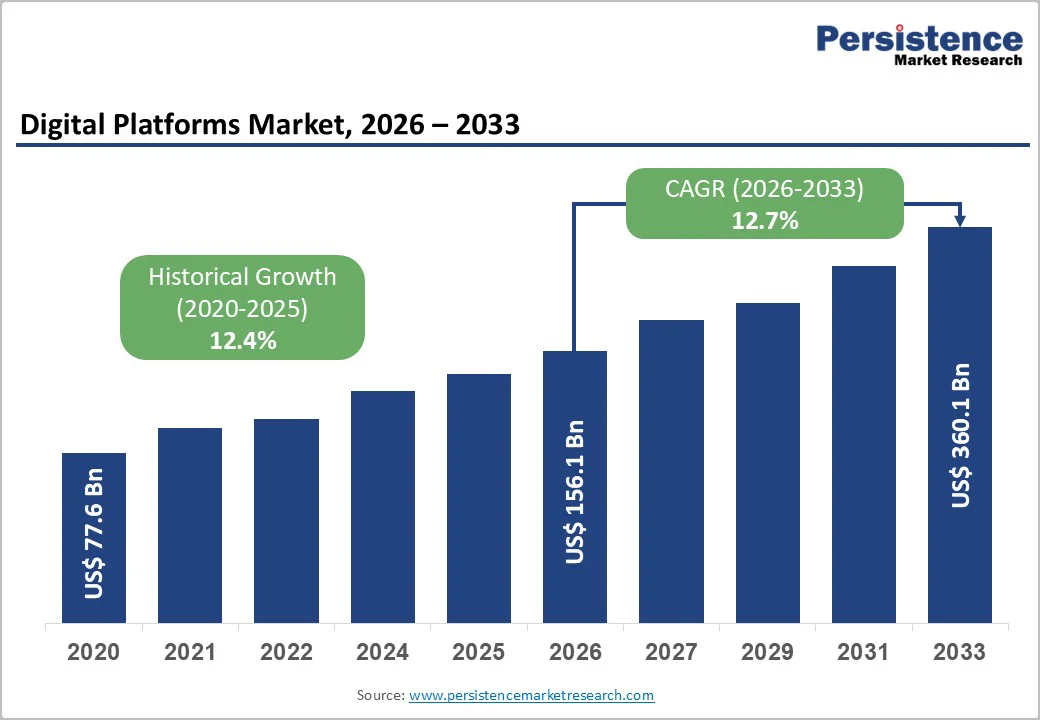
The global digital platforms market size is likely to be valued at US$156.1 billion in 2026. It is expected to reach US$360.1 billion by 2033, growing at a CAGR of 12.7% during the forecast period from 2026 to 2033, driven by the increasing prevalence of remote work and digital socialization, rising demand for on-demand content and learning in post-pandemic recovery, and advancements in AI-driven personalization.
Rising demand for user-centric digital platforms in social media and health & wellness, supported by improved streaming and scalable MOOCs (Massive Open Online Courses), is driving adoption, while their growing role in connectivity and well-being in low-resource regions is fueling market growth.
Key Industry Highlights:
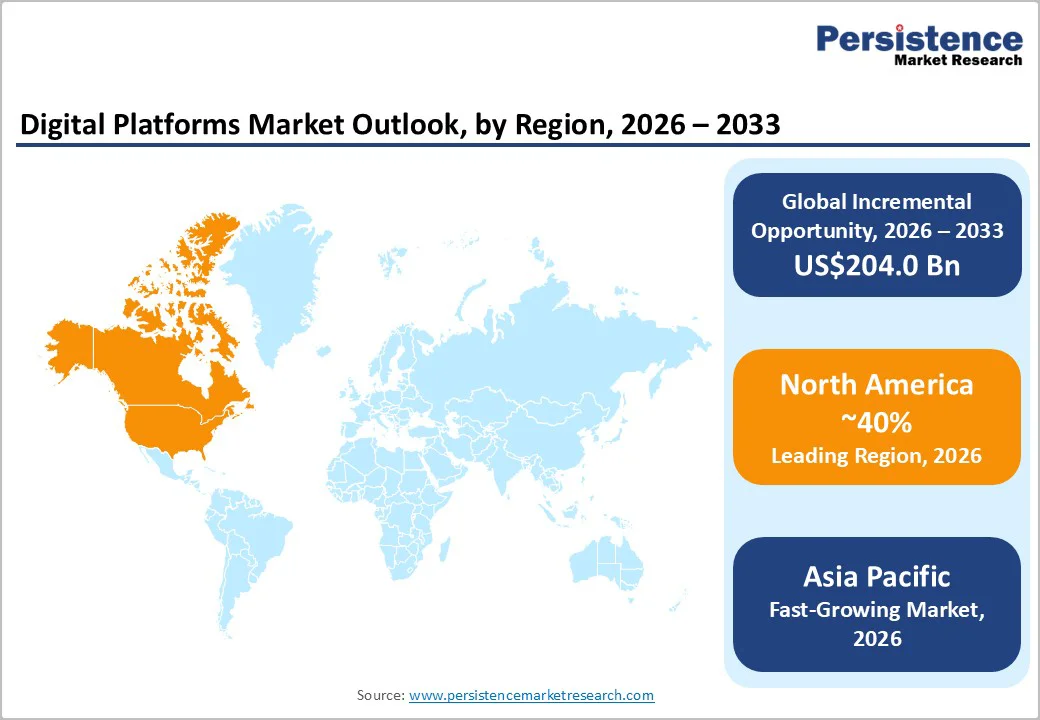
- Leading Region: North America, anticipated to account for a 40% market share in 2026, driven by advanced tech ecosystems, high internet penetration, and strong innovation in content streaming and online learning in the U.S.
- Fastest-growing Region: Asia Pacific, fueled by massive user bases, rising smartphone adoption, and growing investments in health apps and e-learning in India and China.
- Dominant Social Media Platforms: Personal networking is expected to account for approximately 35% of market share, driven by strong community-based engagement that closely mirrors real-world interactions.
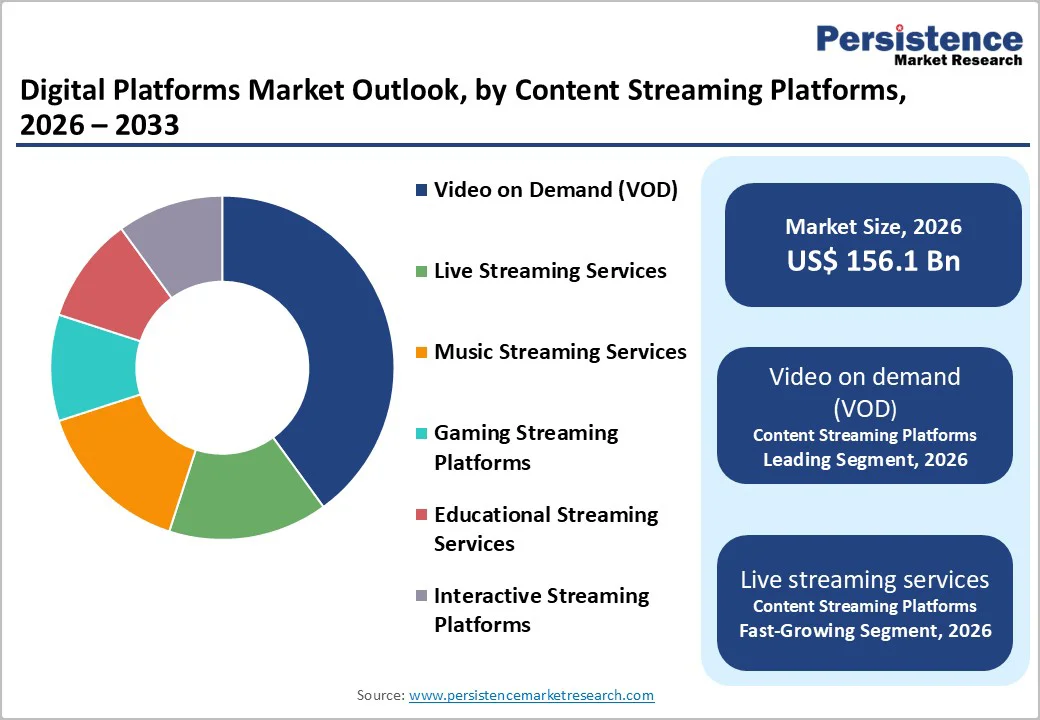
- Leading Content Streaming Platforms: Video on Demand (VOD), anticipated to lead with over 45% of the market revenue, due to binge-watching trends, original content booms, and widespread subscription models.
- Leading Online Learning Platforms: Massive Open Online Courses (MOOCs), expected to account for nearly 40% of the market revenue, due to affordable access, skill-building focus, and capacity for global enrollment.
- Leading Health and Wellness Platforms: Fitness-tracking applications are expected to hold approximately 30% of the share, driven by users requiring real-time metrics as part of daily routines, ensuring consistent demand.
| Key Insights | Details |
|---|---|
|
Digital Platforms Market Size (2026E) |
US$156.1 Bn |
|
Market Value Forecast (2033F) |
US$360.1 Bn |
|
Projected Growth (CAGR 2026 to 2033) |
12.7% |
|
Historical Market Growth (CAGR 2020 to 2025) |
12.4% |
Market Factors - Growth, Barriers, and Opportunity Analysis
Rapid Growth in Internet & Smartphone Penetration
The rapid growth of internet connectivity and smartphone adoption is a key driver of digital platform expansion globally. Affordable devices, declining data costs, and ongoing improvements in mobile networks have enabled billions of people to access digital services for the first time. Smartphones now serve as all-in-one gateways, providing access to apps, social media, streaming, digital payments, and cloud tools from virtually anywhere. According to the Ministry of Electronics & IT, India’s 4G network now covers roughly 95% of the population, with internet connections reaching around 970 million, a 285% increase in mobile connections since 2014. This widespread connectivity has significantly expanded the digital user base, fueling growth in mobile apps, streaming, payments, and other online services.
As internet penetration spreads across urban and rural areas, digital platforms benefit from an ever-growing audience. Increased screen time and mobile-first behavior boost engagement with on-demand services like video streaming, online learning, food delivery, and e-commerce. For businesses, this connectivity enables direct customer engagement, real-time data collection, and scalable service delivery without heavy physical infrastructure, driving faster platform adoption, stronger network effects, and sustained revenue growth.
Stringent Regulatory & Compliance Requirements
Stringent regulatory and compliance requirements pose a significant challenge for digital platforms, as governments worldwide increasingly tighten oversight on data protection, competition, and online behavior. Handling vast amounts of personal, financial, and behavioral data, these platforms are subject to complex regulations covering privacy, cybersecurity, consumer protection, taxation, and content moderation. Meeting these requirements often necessitates substantial investments in legal teams, compliance systems, data localization infrastructure, and continuous monitoring processes.
For platforms operating across multiple countries, regulatory fragmentation adds further complexity, as rules vary by region and are frequently updated. Such compliance obligations can slow innovation, delay product launches, and raise operational costs, especially for small and mid-sized platforms that lack the resources of larger technology firms. The risks of non-compliance are also significant, including hefty fines, reputational damage, service restrictions, or even market bans.
Increased Adoption of Subscription and Freemium Models
The rise of subscription and freemium business models presents a major opportunity for digital platforms, as these approaches link revenue to ongoing value delivery and enhance user engagement. Instead of depending on one-time purchases, platforms now generate recurring income by offering access to services, content, or features over time. Subscription models provide predictable revenue streams and promote long-term customer relationships. At the same time, freemium strategies attract large user bases by offering basic features for free and monetizing only heavy or premium users.
Trends highlight this shift at scale. The global subscription economy, including digital content, software-as-a-service (SaaS), e-commerce memberships, and other recurring models, continues to grow as more industries adopt subscription-based strategies focused on long-term engagement. This growth reflects both platform expansion and evolving consumer preferences for access rather than ownership, as well as demand for continuous updates, flexibility, and personalized experiences.
Category-wise Analysis
Social Media Platforms Insights
Personal networking is projected to dominate the market, accounting for roughly 35% of market share by 2026, thanks to its reliable, relationship-driven approach. These platforms, centered around friend lists and feeds, engage users instantly when connections are formed, promoting consistent interaction without heavy reliance on algorithms. Their seamless integration into daily routines also supports widespread adoption for both personal and professional use. Facebook remains the world’s largest personal networking platform, with over 3 billion monthly active users as of 2024, highlighting how platforms that facilitate direct connections, content sharing, and ongoing engagement continue to lead social interaction compared to other digital platform types.
Content creation platforms are the fastest-growing segment, fueled by their ability to generate continuous content through user-driven tools. These platforms act as creative engines, allowing ideas to flow into new posts whenever inspiration strikes. User-generated content platforms such as TikTok, YouTube, Instagram, and others empower users to create and publish content repeatedly through intuitive tools, ranging from short-form videos to livestreams and image posts. Their rapid growth is driven by low barriers to entry and immediate access to large audiences, enabling creators to produce multiple content cycles and respond dynamically to trends and audience engagement.
Content Streaming Platforms Insights
Video-on-demand (VOD) is expected to lead the market, capturing over 45% of the share by 2026, thanks to its on-demand access and controlled viewing experience. These services, equipped with extensive content libraries, allow users to stream episodes instantly, filling viewing gaps without reliance on fixed schedules. Their seamless integration with smart TVs also drives widespread adoption across entertainment and educational applications. Many leading pay-TV networks now offer stand-alone apps compatible with smart TVs and streaming devices, with VOD services generally accessible on both TVs and mobile devices.
Live streaming services, on the other hand, are the fastest-growing segment, fueled by real-time engagement and increasing use in events. These broadcasts act as interactive channels, enabling viewer interactions to flow directly into chats and other live features. The continuous nature of live streaming supports multiple event cycles, making it ideal for broadcasters responding to fluctuating audiences. Live streaming has become a key technological enabler throughout the event lifecycle, from discovery and engagement to monetization, allowing audiences to interact with broadcasts and digital content in real time.
Online Learning Platforms Insights
Massive open online courses (MOOCs) are projected to dominate the market, capturing around 40% of the share by 2026, driven by the growing demand for accessible, scalable education in remote learning. These courses often experience high enrollment, making dropout management both common and costly. MOOCs enhance engagement by dynamically adapting content to learners’ needs, reducing abandonment rates and lowering platform expenses. Coursera, one of the largest MOOC platforms globally, reported over 175 million registered learners as of 2025, highlighting the broad reach and scale of MOOCs compared to traditional classroom formats. This vast learner base reflects the high demand for accessible education, with courses spanning computer science, business, personal development, and data science.
Professional development and certification represent the fastest-growing segment, fueled by increasing career mobility, demand for credentialed skills, and the push toward lifelong learning. Professionals are increasingly using advanced platforms to close skill gaps and enhance their resumes. MOOCs help prevent skill obsolescence by offering up-to-date training and targeted learning paths. For instance, corporate training programs can automatically fill micro-gaps with bite-sized videos, reducing retraining costs and boosting overall proficiency.
Health and Wellness Platforms Insights
Fitness tracking applications are expected to hold a dominant 30% market share by 2026, driven by strong demand for personalized, data-driven health routines. These apps rely on continuous user input, making motivation management a frequent challenge. Fitness platforms enhance adherence by automatically adjusting goals, reducing dropout rates, and subscription costs. Peloton, a leading connected fitness platform, leverages data-driven personalization to tailor workout routines based on users’ past activity, goals, and preferences. Instead of offering one-size-fits-all programs, Peloton’s algorithms analyze historical performance and engagement to recommend weekly workouts and dynamically adjust plans as users progress.
Telemedicine services, meanwhile, represent the fastest-growing segment, fueled by increasing accessibility, demand for remote consultations, and the move toward integrated care. Patients are increasingly using advanced platforms that lower barriers to visits and improve continuity of care. Telemedicine helps prevent gaps, such as missed follow-ups, by automatically scheduling virtual check-ins, thereby enhancing overall health outcomes. Research published in JAMIA Open found that telemedicine appointments were significantly more likely to be completed than in-person visits, with virtual consultations increasing the odds of appointment completion by 64% compared with traditional care. This highlights telemedicine’s role in improving care continuity and reducing gaps caused by missed follow-ups.
Regional Insights
North America Digital Platforms Market Trends
North America is projected to dominate the market, capturing a 40% share by 2026, driven by strong technological innovation, high internet penetration, and early adoption of digital ecosystems. The U.S. and Canada are prioritizing enhanced platform performance as demand grows across social media, streaming, e-learning, and wellness applications. With a large share of global data consumption driven by connected users, operators are increasingly leveraging AI-driven platforms to deliver consistent, personalized experiences across consumer and enterprise markets.
The region’s focus on digital transformation, especially in education, healthcare, entertainment, and professional services, is further accelerating adoption. Enterprises are deploying connected tools, collaborative apps, and cloud-based services, all of which rely on seamless, low-latency platforms provided by modern digital ecosystems. Affordable subscription models and localized solutions are also encouraging uptake among medium-sized businesses. Government-led digital inclusion initiatives support platform upgrades as part of broader connectivity efforts. Vendors are responding by offering customized features, privacy-compliant designs, and integrations with emerging technologies such as AR/VR to capture the region’s rapidly growing demand.
Europe Digital Platforms Market Trends
Robust digital single market initiatives, rising smartphone penetration, and increasing demand for high-quality platform experiences support Europe’s digital growth. Countries such as Germany, the U.K., France, and the Nordics are prioritizing advanced connectivity to meet the needs of dense urban populations and modern enterprise operations. With a significant portion of mobile data usage occurring on platforms, operators are implementing AI-enhanced solutions to improve social engagement, streaming quality, learning accessibility, and wellness tracking across offices, public spaces, and homes. An example is the Dataspace4Health project, a collaboration among healthcare providers and research institutions, which aims to create a secure, interoperable health data ecosystem aligned with Gaia-X principles to enable compliant health data sharing and innovation in Luxembourg and, potentially, across Europe.
Europe’s strong emphasis on GDPR-compliant personalization, data sovereignty, and connected manufacturing further drives the need for reliable platform performance. Enterprises are increasingly adopting integrated ecosystems to enhance productivity, real-time collaboration, and operational efficiency. The region’s focus on sustainability and inclusivity promotes the deployment of energy-efficient, multilingual platform solutions. Supportive regulatory frameworks, combined with collaboration between tech operators and content providers, are accelerating platform upgrades. Additionally, many European enterprises are investing in private cloud platforms, further fueling the adoption of user-centric digital tools.
Asia Pacific Digital Platforms Market Trends
Asia Pacific is expected to be the fastest-growing market for digital platforms, driven by rapid urbanization, expanding digital infrastructure, and aggressive connectivity initiatives across major economies. Countries such as China, India, Japan, and South Korea are heavily investing in platform ecosystems to support rising data consumption and the widespread use of smart devices. High-density environments—including commercial complexes, transport hubs, hospitals, and educational institutions—are increasingly demanding reliable, scalable platforms, fueling adoption of AI-powered social, streaming, learning, and wellness solutions. Alternative payment methods, particularly mobile and digital wallets, are becoming the dominant tools for e-commerce in the region, with China leading in 2023, where such payments accounted for nearly two-thirds of total e-commerce transaction value.
The region’s strong adoption of super apps, e-commerce integration, and industrial IoT further drives the need for seamless, low-latency connectivity. Enterprises are increasingly deploying advanced platforms to boost productivity, real-time engagement, and operational efficiency. Affordable deployment options and localized solutions are also encouraging uptake among medium-sized businesses. Government-led digital economy initiatives are prompting mobile operators to enhance platform capabilities as part of broader 5G and broadband expansion plans. Vendors in the region are responding with mobile-first designs, customized features, and the integration of emerging technologies, such as AI chatbots, to capture the rapidly growing demand.
Competitive Landscape
The global digital platforms market is highly competitive, shaped by a blend of major tech giants and specialized solution providers. In developed regions such as North America and Europe, companies such as IBM and Oracle play a dominant role due to their strong R&D capabilities, extensive cloud portfolios, and well-established enterprise partnerships. Their ability to deliver integrated, scalable platforms for social, streaming, learning, and wellness gives them a significant competitive advantage.
In the Asia Pacific region, companies such as SAP are gaining traction by offering localized, cost-effective solutions tailored to dense user environments and varied industry needs. Faster digitalization and ambitious connectivity plans across China, India, and Southeast Asia further strengthen regional opportunities. Competition continues to intensify as players focus on AI innovation, user privacy, and massive scale to meet rising platform demand. Strategic partnerships, mergers and acquisitions, and integration of IoT-driven features are becoming key differentiators.
Key Industry Developments
- In December 2025, Orange Poland, in collaboration with Singapore-based insurtech bolttech, launched “Insure with Orange”, a digital insurance comparison platform. Positioned as the first telecom-led insurance comparison service in Poland, the platform enables Orange customers to compare and purchase insurance from multiple trusted providers in a single, streamlined interface. This initiative reflects Orange Poland’s strategic focus on expanding its digital service offerings, enhancing customer engagement, and leveraging partnerships to enter the insurtech space.
- In December 2025, Helios Investment Partners acquired three Moroccan technology companies, Maroc Datacentre (MDC), Munisys, and Medasys, and launched 3MDC, a platform focused on local digital infrastructure. Helios, together with CDG Invest subsidiary Fipar-Holding, provided the financial backing for the venture, creating a unified entity to strengthen Morocco’s digital ecosystem.
Companies Covered in Digital Platforms Market
- IBM
- Oracle
- NetSuite
- Adobe Systems
- Accenture
- Magento
- Cloudcraze Software
- SAP
- Apttus
- Others
Frequently Asked Questions
The global digital platforms market is projected to reach US$156.1 billion in 2026.
The rising prevalence of remote work and digital socialization, and demand for on-demand content are key drivers.
The digital platforms market is poised to witness a CAGR of 12.7% from 2026 to 2033.
Advancements in AI-driven and interactive delivery platforms are the key opportunities.
IBM, Oracle, Adobe Systems, Accenture, and SAP are the key players.


