




- Hardware & Software IT Services
- Business Rules Management System (BRMS) Market
Business Rules Management System (BRMS) Market Size, Share, and Growth Forecast, 2026-2033
Business Rules Management System (BRMS) Market by Component (Software, Solutions), Application (User-friendly Interface, Supporting Rules Monitoring & Reporting, Providing Rule Repository, Supporting Natural Language, Others), End-Use Industry (Financial Services, Insurance, Healthcare, Retail, Manufacturing, Logistics, Others), and Regional Forecast for 2026-2033

Business Rules Management System (BRMS) Market Share and Trends Analysis
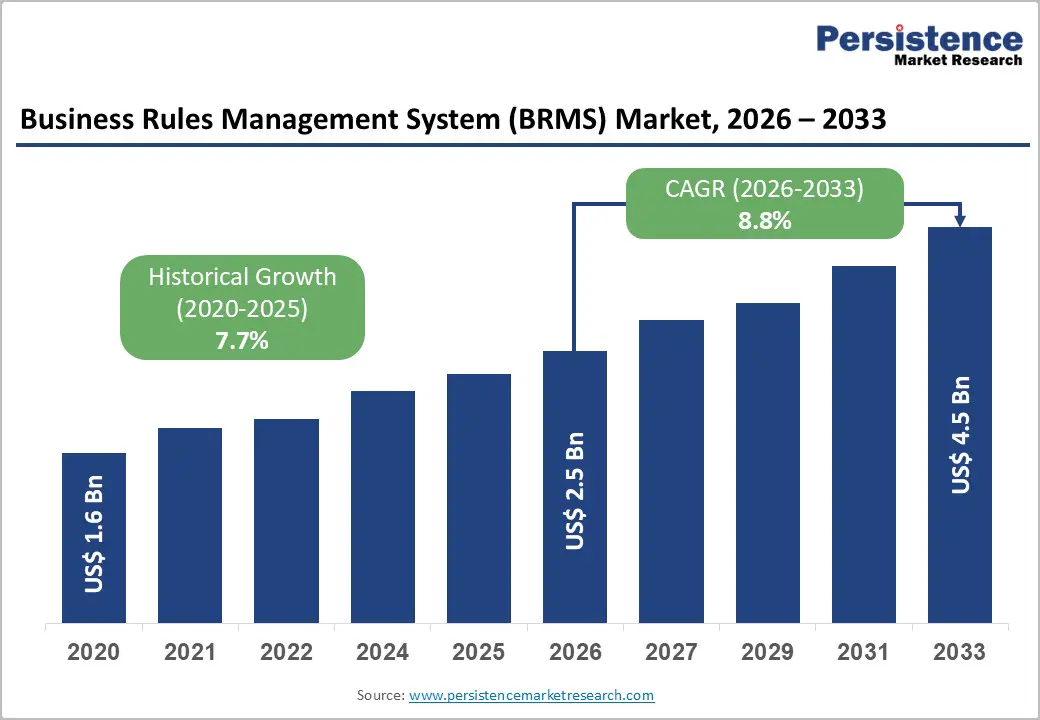
The global business rules management system (BRMS) market size is likely to be valued at US$ 2.5 billion in 2026, and is projected to reach US$ 4.5 billion by 2033, growing at a CAGR of 8.8% during the forecast period of 2026–2033. The primary drivers of this expansion are growing demand among enterprises for automated decision-making, regulatory compliance enforcement, and low-code rule configuration in complex operational environments. Widening adoption of AI-assisted decision engines, process automation, and cloud-based governance platforms is accelerating BRMS deployment, particularly in highly regulated sectors such as banking, insurance, and healthcare. The market demonstrates steady maturity, with growth fueled by digital transformation mandates, compliance automation, and enterprise modernization initiatives. Organizations are increasingly integrating BRMS platforms to standardize business rules, reduce manual oversight, and improve operational efficiency. As regulatory requirements become more stringent and digital transformation accelerates, the BRMS market is well-positioned to support ongoing innovation and adoption across global industries.
Key Industry Highlights
- Dominant Component Type: Software solutions are expected to dominate with around 72% revenue share in 2026, supported by enterprise preference for integrated rule authoring, execution, governance, and compliance management capabilities.
- Dominant Application: Rules monitoring and reporting are projected to lead with an estimated 36% share in 2026, while natural language rule authoring is expected to grow the fastest at 11.2% CAGR during 2026–2033, driven by AI-enabled low-code adoption.
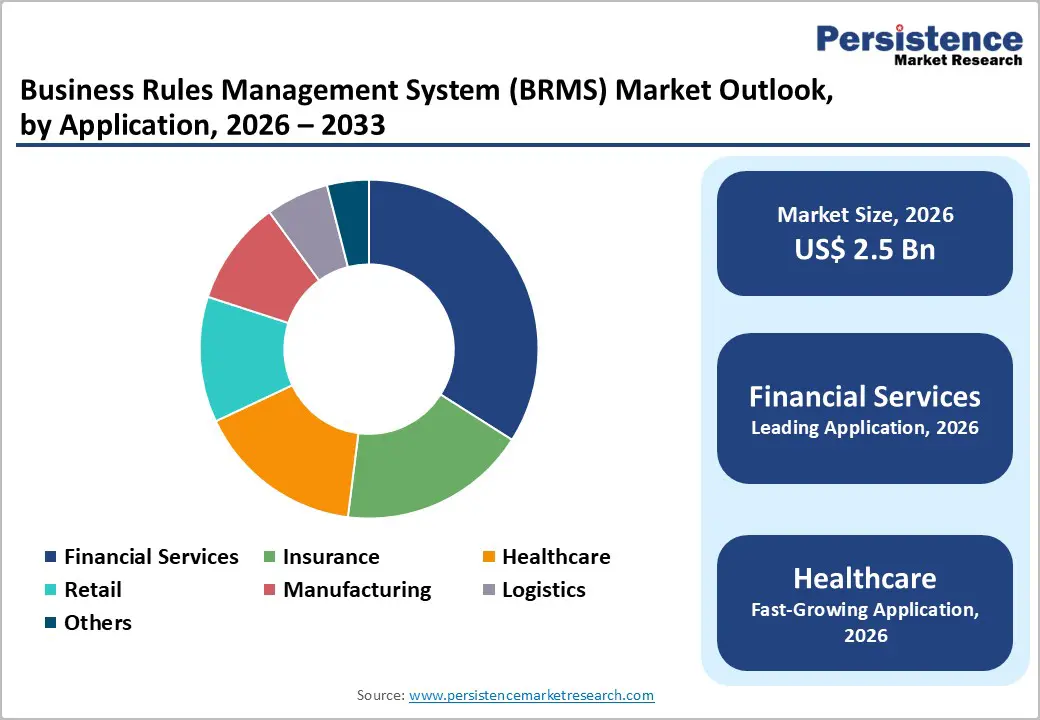
- Leading End-Use Industry: Financial services are anticipated to account for about 34% of the revenue share in 2026, owing to the extensive use of BRMS in credit decisions, fraud detection, and regulatory automation.
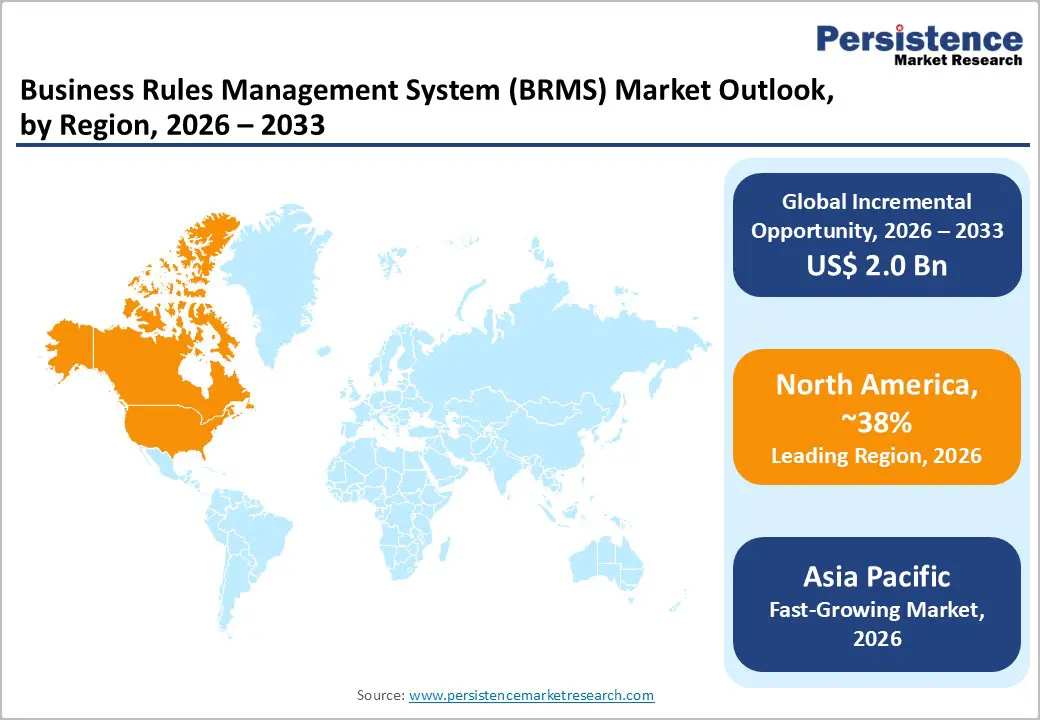
- Regional Leadership: North America is expected to lead with approximately 38% share in 2026, while Asia Pacific is projected to be the fastest-growing market at 9.5% CAGR through 2033, driven by banking digitization and enterprise automation investments.
- May 2025: Saudi Arabia intensified Vision 2030 investments by pushing financial institutions to adopt automated risk, fraud, and compliance platforms aligned with Saudi Central Bank regulations and the Personal Data Protection Law.
| Key Insights | Details |
|---|---|
|
Business Rules Management System Size (2026E) |
US$ 2.5 Bn |
|
Market Value Forecast (2033F) |
US$ 4.5 Bn |
|
Projected Growth (CAGR 2026 to 2033) |
8.8% |
|
Historical Market Growth (CAGR 2020 to 2025) |
7.7% |
Market Factors – Growth, Barriers, and Opportunity Analysis
Regulatory-led Operational Resilience and Decision Governance Modernization
The growing regulatory pressure across financial services, healthcare, and insurance is accelerating the adoption of structured decision governance systems. The increasing frequency of policy updates, tighter audit requirements, and heightened focus on operational resilience have made traditional, hard-coded business logic difficult to manage. Business rules management systems enable organizations to centralize, version, and audit decision rules independently of core applications, improving compliance consistency and governance transparency. The European Central Bank (ECB), for instance, has strengthened its supervisory expectations on digital risk management following the enforcement of the Digital Operational Resilience Act (DORA), prompting systemically important banks to modernize their governance, reporting, and rule-based decision-making frameworks.
Enterprises are also advancing digital transformation initiatives that combine low-code platforms with AI-driven decision models. BRMS plays a critical role by providing deterministic and explainable decision layers that support regulatory scrutiny while integrating seamlessly with analytics and automation tools. This approach enables faster policy updates, reduces dependency on development teams, and improves decision accountability. For example, in October 2025, Tata AIA Life Insurance launched the Underwriting Rule Engine (URE), a generative AI-powered platform combining machine learning and big data analytics to instantly analyze applicant data against rules for real-time risk assessment and policy approval. The inclusion of rule-based decision engines in banking modernization and operational resilience programs reflects sustained institutional investment in BRMS as a foundational technology for compliant, scalable, and resilient enterprise operations.
Cost-Intensive Integration and Limited Decision Modeling Expertise
Business Rules Management System adoption is constrained by the high cost and complexity of enterprise-wide implementation, particularly in legacy IT environments. According to enterprise IT cost benchmarks, initial BRMS implementations range between US$ 250,000 and US$ 1 million for large organizations. For small and mid-sized enterprises, these upfront costs, combined with customization, integration, and training requirements, create significant adoption barriers. Integration with enterprise resource planning (ERP), customer relationship management (CRM), and core transaction systems often requires extensive reengineering, and in highly customized environments, return on investment (ROI) realization can be delayed by 12–18 months, slowing decision modernization initiatives.
Apart from cost challenges, effective BRMS deployment depends on access to skilled professionals capable of decision modeling, rule governance, and lifecycle management. The shortage of such expertise continues to limit full platform utilization, especially in emerging markets and public-sector implementations. A national digital governance modernization initiative in India identified decision-modeling capability gaps as a key constraint during rule-based system rollout, leading to new investments in workforce upskilling and low-code adoption programs. While leading software vendors are expanding training ecosystems and simplified rule-authoring tools, talent availability remains a critical factor influencing adoption pace and operational effectiveness.
Cloud- and AI-Driven Expansion of Decision Governance Platforms
Large-scale investments in AI and cloud infrastructure are creating a strong enabling environment for the adoption of Business Rules Management Systems across enterprises and public-sector organizations. The rapid expansion of hyperscale data centers improves access to secure, scalable, and compliant cloud environments required for rule-based decision governance. Microsoft has reiterated its commitment to global AI infrastructure with plans to invest approximately US$ 80 billion in AI-enabled data centers during its fiscal year, underscoring long-term confidence in cloud-based enterprise platforms that support automated and auditable decision systems.
Asia Pacific is emerging as a key growth region as government-led digitalization efforts increasingly align with large-scale private investment in cloud and AI infrastructure. Major tech companies have been planning long-term investment in AI-enabled cloud infrastructure across the region, reinforcing confidence in scalable and sovereign cloud platforms for enterprise and public-sector use. The multiple governments across Asia Pacific have embedded rule-based automation into digital public infrastructure and financial modernization initiatives, strengthening demand for auditable and policy-driven decision systems. These developments collectively support sustained adoption of BRMS as a foundational technology for compliant and scalable decision governance.
Category-wise Insights
Component Insights
The software segment is likely to continue its dominance in 2026, accounting for approximately 72% of the business rules management system market revenue share in 2026. Enterprises favor platforms that integrate rule authoring, execution, versioning, and governance to manage complex operational logic consistently across functions. For instance, the TD Bank Group implemented 75 AI use cases, including automation for transaction monitoring and financial crime, highlighting a strong focus on decision automation and operational efficiency. Integrated BRMS platforms support these initiatives by centralizing rule execution and governance, ensuring consistent enforcement across business units and digital channels. This reduces operational risk, enhances compliance oversight, and strengthens audit readiness, making software solutions indispensable for regulated enterprises.
Cloud native business rules management solutions are poised to be the fastest growing, expanding at a 2026-2033 CAGR above 10%, driven by scalability, faster deployment, and lower total cost of ownership compared with on-premises platforms. For instance, the strategic collaboration between Pegasystems and Amazon Web Services (AWS) focuses on using AWS cloud services and generative AI to modernize legacy applications and support scalable, cloud native decision engines, accelerating enterprise adoption of cloud-ready governance tooling. Financial institutions and healthcare organizations are using such collaborations to implement automated rule execution and real-time compliance workflows within secure cloud environments. Public and private sector cloud modernization programs in multiple regions are reinforcing confidence in cloud-first deployments. These developments position cloud native BRMS as a key enabler of agile, scalable, and compliant enterprise decision governance.
Application Insights
Rules monitoring and reporting applications are expected to lead in 2026, holding around 36% of the BRMS market revenue shar due to stringent audit and compliance requirements across industries. Enterprises rely on advanced dashboards and monitoring modules to track rule performance, exceptions, and policy deviations in real time, ensuring transparency and traceability. For example, ACTICO’s decision management platform was recognized as a leading solution for AML transaction monitoring and compliance reporting, highlighting how rule performance insights directly support regulated operations and risk management. These capabilities are especially critical for organizations handling financial, health, and regulated customer data, where audit readiness and operational transparency are top priorities. Robust monitoring also enables faster identification of rule conflicts and exception conditions, strengthening operational control frameworks and reducing manual oversight burden.
Supporting natural language rule authoring is anticipated to be the fastest growing application area, expanding at a CAGR of nearly 11% during the 2026-2033 forecast period, reflecting the shift toward empowering business users with intuitive rule configuration tools. Natural language and generative AI assisted interfaces allow non technical business stakeholders to define, modify, and manage decision logic with minimal IT intervention, reducing bottlenecks and accelerating rule updates. Pegasystems introduced new enhancements in its Pega Infinity ’25 platform that leverage AI to support natural language-based design and low-code decisioning workflows, enabling business and operations teams to translate policy requirements into executable rule structures. Such investments in AI augmented rule authoring accelerate deployment cycles, reduce developer dependency, and broaden BRMS adoption across human resources (HR), procurement, and customer engagement functions where business logic evolves rapidly.
End Use Industry Insights
Financial services are expected to remain the dominant end use industry, accounting for around 34% of the total BRMS demand in 2026 due to heavy reliance on automated decisioning for credit approval, fraud detection, and compliance. A prominent example of this is the adoption of business rules engines (BREs) by several Indian banks and non-banking financial companies (NBFCs) to automate credit assessments, risk evaluation, and real-time compliance with Reserve Bank of India (RBI) guidelines, streamlining loan processing, reducing manual errors, and accelerating decision-making across core banking operations. Regulatory pressures, evolving digital lending norms, and increased demand for personalized financial products are driving broad BRMS deployment, enabling financial institutions to embed real time policy updates and audit trails across channels. BRMS platforms support consistent enforcement of policy logic across business units, improving operational resilience and regulatory readiness.
Healthcare is projected to be the fastest-growing end-use industry for BRMS, expanding at a CAGR of 10% from 2026 to 2033, as providers and payers adopt automated platforms for clinical support, operations, and administrative workflows. A U.S. startup Counterforce Health, deployed AI-based software to streamline insurance claim appeal processes, significantly reducing preparation time and improving success rates compared with manual methods. Beyond claims, healthcare organizations are increasingly integrating AI- and rule-based systems into clinical decision support, prior authorizations, coding, and alerts. Surveys indicate over half of health systems used AI for administrative automation. These implementations demonstrate how BRMS enhances operational efficiency, maintains compliance, and standardizes decision-making across clinical and payer operations.
Regional Insights
North America Business Rules Management System (BRMS) Market Trends
North America is projected to hold about 38% of the business rules management system market share in 2026, with the United States leading due to early adoption of decision automation, mature regulatory frameworks, and a well-developed vendor ecosystem. Regulatory agencies such as the Federal Financial Institutions Examination Council (FFIEC) and Health Insurance Portability and Accountability Act (HIPAA) enforce strict compliance standards, compelling enterprises in banking, insurance, and healthcare to adopt auditable and automated rule management systems. Companies are increasingly implementing BRMS platforms to standardize decision-making across various products, channels, and business units, ensuring consistency and reducing operational risk.
Investment in AI-driven governance tools and cloud modernization continues to accelerate BRMS adoption in the region. For example, Bank of Montreal (BMO) has integrated rule-based decision engines across its retail and corporate banking operations, improving loan processing, fraud detection, and compliance workflows. North American enterprises benefit from high IT spending, advanced Software as a Service (SaaS) ecosystems, and cloud-ready infrastructure, which facilitate rapid deployment of rule-based platforms. The market is highly competitive, with vendors focusing on AI integration, low-code management, and real-time monitoring. The combination of regulatory pressure, mature IT infrastructure, and proactive digital investments reinforces North America’s leadership in the BRMS market.
Europe Business Rules Management System (BRMS) Market Trends
Europe maintains a well-established business rules management system (BRMS) market, with Germany, the U.K., and France leading due to regulatory compliance and digital transformation initiatives. Enterprises in the region prioritize transparency, explainability, and audit-ready rule management, especially in highly regulated sectors such as banking, insurance, and healthcare. Regulations such as the General Data Protection Regulation (GDPR) and cross-border financial directives drive demand for robust monitoring, reporting, and decision governance. Organizations are increasingly adopting centralized BRMS platforms to streamline compliance, ensure consistent rule enforcement, and reduce manual oversight in core business processes.
Several European financial institutions have accelerated BRMS deployment to meet requirements under the Digital Operational Resilience Act (DORA), modernizing governance, reporting, and operational control frameworks. Investments in cloud-based rule engines and AI-enabled decision automation support real-time updates, low-code rule management, and improved operational resilience. Enterprises also use BRMS to harmonize policies for cross-border operations while maintaining regulatory compliance. Ongoing digital transformation funding, emphasis on transparency, and growing adoption of AI-driven governance tools position Europe as a strategically important market for global BRMS vendors.
Asia Pacific Business Rules Management System (BRMS) Market Trends
Asia Pacific is expected to be the fastest-growing regional market for business rules management systems, with a projected 2026-2033 CAGR of 9.5%. This growth is driven by digitalization in banking, fintech, manufacturing, and government services, particularly in China, India, and ASEAN countries. Large-scale digital public infrastructure programs and the modernization of banking and insurance operations are accelerating adoption. Enterprises increasingly depend on cloud-native BRMS solutions to manage compliance, operational rules, and business workflows efficiently, while governments are embedding rule-based automation into national digital strategies to improve service delivery and transparency.
Microsoft’s $17.5 billion investment in India from 2026 to 2029 for AI and cloud infrastructure, including new data centers in Hyderabad, Chennai, and Pune, supports national AI and digital governance priorities, directly enabling cloud-based BRMS adoption in both public and private sectors. Regional enterprises use these platforms for scalable, low-code rule management, automated decision-making, and compliance workflows. The combination of lower-cost cloud deployments, government-backed digitization initiatives, and a rapidly expanding fintech ecosystem positions Asia Pacific as a key driver of global BRMS market expansion.
Competitive Landscape
The global business rules management system market structure is moderately consolidated, with major vendors such as IBM, FICO, Red Hat, Pegasystems, and Oracle holding a significant share of global revenues. These industry leaders leverage strong enterprise relationships, extensive consulting networks, and integrated software platforms that combine rule engines, process automation, and AI/machine learning (ML) capabilities. They consistently invest in research and development to maintain technological leadership in decision automation, predictive analytics, cloud deployment, and low-code/no-code integration.
At the same time, regional and niche competitors such as Progress Corticon, InRule, OpenRules, and Drools focus on specialized industries, small and medium enterprises (SMEs), and specific geographic markets. High implementation complexity, regulatory compliance requirements, and integration challenges with legacy systems create barriers for new entrants. However, ongoing trends such as digital transformation, cloud adoption, AI-enhanced decision management, and low-code development are enabling software-centric companies and startups to enter the market through SaaS and cloud-based BRMS solutions.
Key Industry Developments
- In December 2025, GeeTest introduced its no-code/low-code BRE featuring visual drag-and-drop flowchart configuration, real-time dynamic updates without downtime, automated code generation (Java/Python/PHP), and ZEN-powered components for risk management across finance, e-commerce, and gaming. The platform decouples business logic from code, enabling non-technical teams to build, test, and deploy precise, automated decision-making systems rapidly.
- In November 2025, Circle Asia partnered with Scienaptic AI to enhance credit card underwriting via its AI-powered BRE, automating rule computations for straight-through processing (STP), lender matchmaking, multi-lender policy management, and scalable approvals across Southeast Asia. The low-code platform optimizes data ingestion, provides real-time insights, and supports Vietnam launch/Asia expansion while improving decision accuracy and financial inclusion for underserved borrowers.
- In August 2025, CARD91 launched an AI-powered UPI Credit Scoring Engine, a behavioral BRE that analyzes real-time UPI transaction patterns to generate 0-100 behavioral scores for thin-file/new-to-credit customers, enabling banks/NBFCs/fintechs to improve approval rates, reduce defaults, and drive financial inclusion. Key features include customizable eligibility filters, real-time/bulk scoring, automated risk segmentation, configurable approval matrices, and bureau benchmarking for credit cards, loans, and other products.
Companies Covered in Business Rules Management System (BRMS) Market
- IBM Corporation
- FICO
- Oracle Corporation
- SAP SE
- Pegasystems
- Red Hat
- TIBCO Software
- Software AG
- OpenText
- Experian
- ACTICO Group
- Decisions LLC
Frequently Asked Questions
The global business rules management system (BRMS) market is projected to reach USD 2.3 billion in 2026.
Growth is fueled by business process automation, AI-enabled decision support, cloud adoption, low-code/no-code platforms, and regulatory compliance needs across industries.
The market is poised to witness a CAGR of 8.8% from 2026 to 2033.
Opportunities lie in AI/ML-enhanced decision management, cloud and SaaS deployment, SME adoption, and integration with analytics platforms, with natural-language rule creation also allowing business users to participate without IT intervention.
IBM, FICO, Red Hat, Pegasystems, Oracle, InRule, Progress Corticon, OpenRules, Drools are the major players dominating the market.


