




- Communication Infrastructure & Services
- Cloud Business Email Market
Cloud Business Email Marketing Market Size, Share, and Growth Forecast, 2026 - 2033
Cloud Business Email Marketing Market by OS Environment (Windows, Linux, Others), Deployment (Public Cloud, Others), Organization Size (Large Enterprises, SMEs), Vertical Industry (BFSI, Retail & Consumer, Healthcare, Others), and Regional Analysis 2026 - 2033

Cloud Business Email Marketing Market Size and Trends Analysis
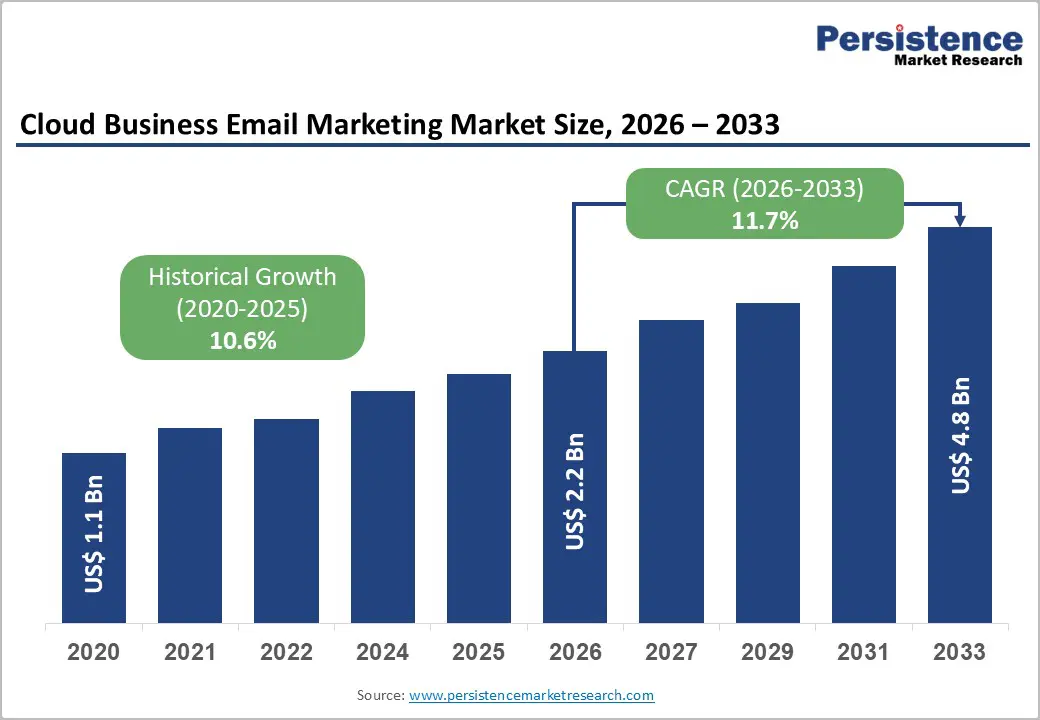
The global cloud business email marketing market size is likely to be valued at US$2.2 billion in 2026 and is expected to reach US$4.8 billion by 2033, growing at a CAGR of 11.7% during the forecast period from 2026 to 2033, driven by the widespread adoption of hybrid work models, the increasing need for advanced threat protection against phishing and ransomware, and the integration of Generative AI to enhance productivity.
Scalable security solutions help mitigate cyber threats, while AI-driven innovations improve operational efficiency. The market is shifting from basic communication tools to intelligent, secure, and compliant platforms, especially in industries with stringent regulatory requirements.
Key Industry Highlights:
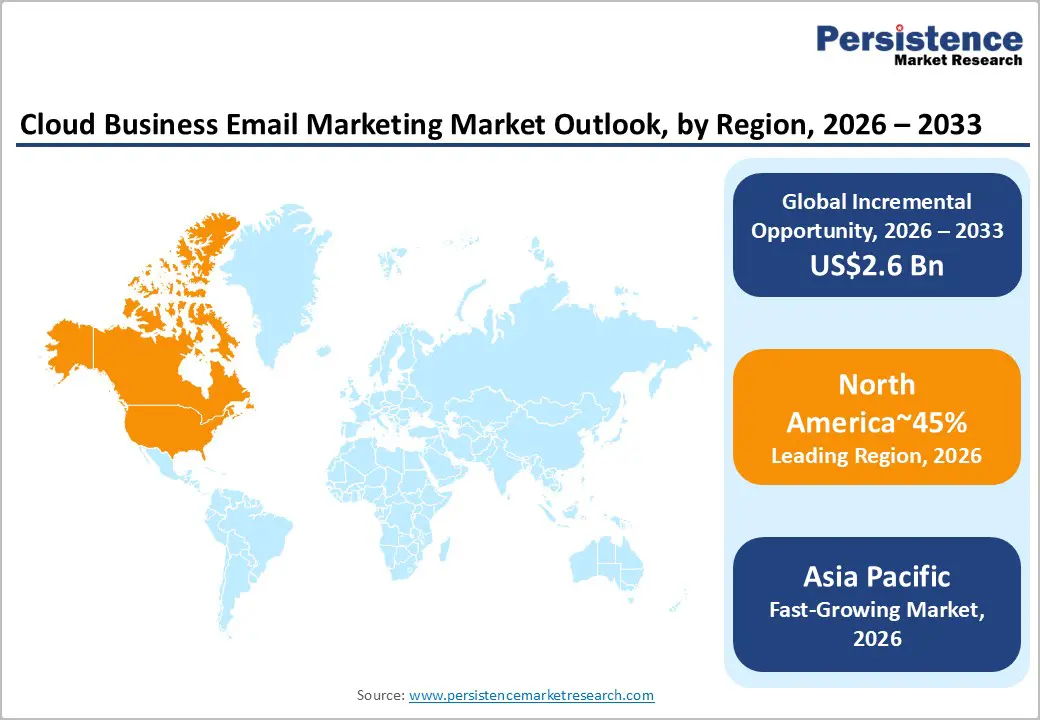
- Leading Region: North America is expected to lead with approximately 45% share, driven by mature IT infrastructure, early cloud adoption, and widespread enterprise deployment.
- Fastest-growing Region: Asia Pacific is projected to be the fastest-growing, supported by expanding digital adoption, SME cloud migration, and government-led IT modernization initiatives.
- Leading OS Environment: Windows to lead with around 55% share, reflecting enterprise standardization and widespread compatibility.
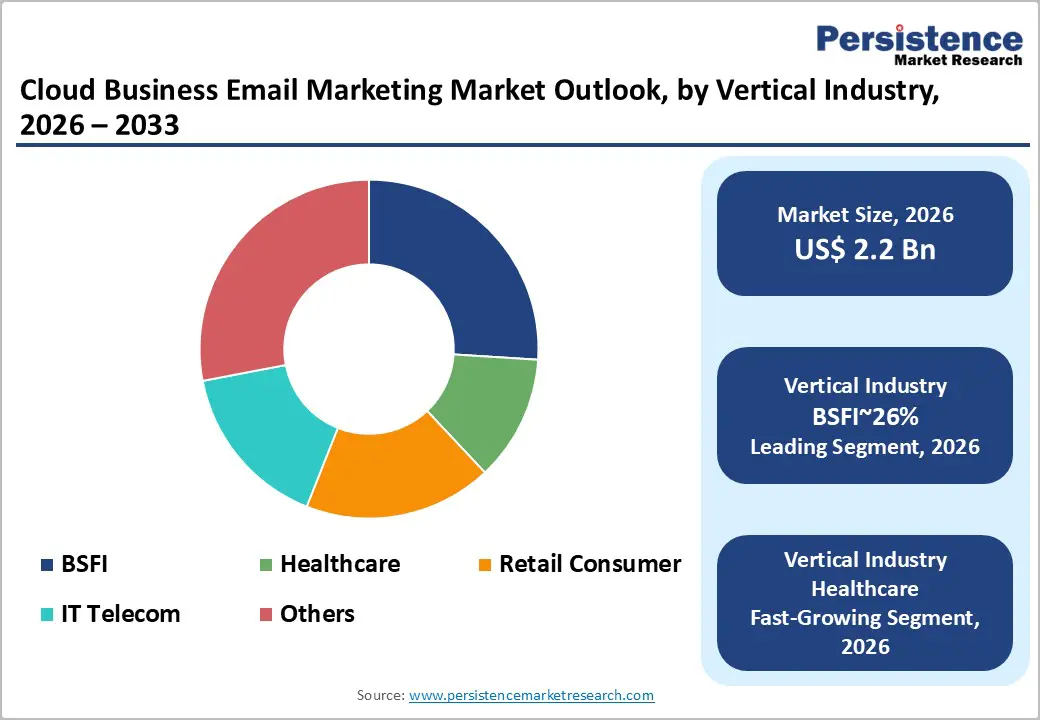
- Leading Vertical: BFSI to dominate with about 26% share, underpinned by high-security standards and extensive digital correspondence needs.
| Key Insights | Details |
|---|---|
|
Cloud Business Email Marketing Market Size (2026E) |
US$2.2 Bn |
|
Market Value Forecast (2033F) |
US$4.8 Bn |
|
Projected Growth (CAGR 2026 to 2033) |
11.7% |
|
Historical Market Growth (CAGR 2020 to 2025) |
10.6% |
Market Factors - Growth, Barriers, and Opportunity Analysis
Growth Analysis - Rapid Integration of Generative AI and Automation
The adoption of Artificial Intelligence (AI) and Machine Learning (ML) within cloud-based email business marketing platforms is structurally reshaping market dynamics by extending functionality from basic communication to intelligent content generation, summarization, and automated workflow management. Enterprises are increasingly demanding email solutions that embed cognitive capabilities to enhance productivity, streamline operational overhead, and reduce human intervention in routine communications. This technological shift aligns with broader digital transformation initiatives, driving higher reliance on cloud-native architectures, scalable compute infrastructure, and integrated data analytics for contextual message optimization. Regulatory considerations around data privacy and AI model transparency also influence platform design, requiring robust governance and compliance frameworks while preserving system performance and automation accuracy.
From a market impact perspective, this evolution compels providers to transition from standard mailbox offerings toward AI-enabled workspaces, creating differentiated service tiers with higher monetization potential. Enhanced automation reduces labor intensity and accelerates campaign execution, thereby increasing average revenue per user (ARPU) and influencing value-chain economics across hosting, API integration, and analytics services. The proliferation of AI-driven features strengthens competitive positioning and establishes a structural dependency of enterprise clients on advanced, cloud-based business email ecosystems.
Transition to Hybrid and Remote Work Models
The structural shift toward hybrid and remote work arrangements is redefining enterprise communication requirements, mandating seamless, device-agnostic access to email and collaboration tools. Dependence on legacy on-premise servers is increasingly incompatible with globally distributed operations, where continuity, uptime, and scalability are critical. The platforms provide centralized management, high-availability architectures, and geographically redundant data centers, ensuring reliable service delivery across diverse work environments. This transition also intersects with cybersecurity protocols, compliance mandates, and cross-border data residency regulations, compelling providers to optimize infrastructure while maintaining strict governance. Organizations adopting flexible work models demand integrated features such as mobile optimization, automated synchronization, and AI-assisted productivity tools, further embedding cloud email into enterprise workflows.
From a market impact standpoint, this shift accelerates the retirement of legacy Exchange servers and mainframe-based email systems, driving large-scale migration toward public and hybrid cloud deployments. Demand for resilient, scalable, and globally accessible cloud email services strengthens vendor positioning, reshapes value-chain economics, and increases reliance on service-level agreements (SLAs) and infrastructure-as-a-service provisioning to support uninterrupted enterprise communication.
Barrier Analysis - Legacy Migration Costs and Technical Debt
Enterprises operating on longstanding mainframe or Unix-based email systems face structural barriers in migrating to cloud-based platforms due to the complexity and risk inherent in handling decades of archived communications. Preserving metadata integrity, preventing data loss during transfers, and ensuring compatibility with legacy workflows require intricate technical planning and specialized tools. Workforce retraining and process adaptation introduce operational overhead and extend project timelines, creating a high adoption threshold for large-scale migrations. These factors are compounded by embedded technical debt, where legacy systems remain critical to business continuity yet are increasingly incompatible with modern cloud architectures.
From a market impact perspective, the complexity and cost associated with transitioning legacy environments materially decelerate adoption rates in the Unix/Mainframe/Others segment, which continues to account for a notable portion of enterprise OS deployments. This prolongs reliance on on-premise infrastructure, limits uptake of AI-driven and cloud-native functionalities, and constrains value-chain monetization through subscription services, premium feature tiers, and infrastructure scaling, thereby affecting overall market penetration and vendor growth strategies.
Data Sovereignty and Compliance Complexities
Stringent regulatory frameworks, including GDPR in Europe, CCPA in California, and localized data localization mandates in jurisdictions such as India and China, impose structural constraints on cloud-based email platform deployment. Multinational enterprises encounter significant challenges in standardizing solutions when laws mandate that sensitive email data remain within specific geographic boundaries. These requirements necessitate complex architecture designs, including regional data centers, encryption protocols, and access controls, which increase operational overhead and integration complexity across global IT ecosystems. The need to reconcile regulatory compliance with seamless cross-border collaboration directly impacts platform scalability, vendor interoperability, and technology adoption strategies.
From a market impact perspective, non-compliance carries material financial and reputational risks, including penalties, compelling cautious adoption of public cloud solutions, and encouraging private or hybrid cloud implementations in restrictive regions. This dynamic slows migration from legacy on-premise infrastructure, influences procurement decisions, and imposes additional costs across data governance, audit, and legal compliance functions. Collectively, regulatory complexity constrains market penetration and shapes vendor investment in region-specific infrastructure and compliance tooling.
Opportunity Analysis - Specialized Vertical-Specific Email Solutions
The demand for industry-specific cloud email platforms is rising, driven by sectoral compliance requirements and operational specialization. Verticals such as healthcare and financial services necessitate built-in capabilities for regulatory adherence, including HIPAA-compliant encryption, FINRA-aligned archiving, and audit-ready logging. Embedding these compliance tools into the core platform reduces operational friction, minimizes regulatory risk, and ensures secure handling of sensitive data within standardized workflows. Technology evolution in encryption, access controls, and automated compliance monitoring further reinforces the structural necessity for vertical-tailored solutions, while regulatory pressures continue to increase the cost of non-compliance across critical sectors.
From a market impact perspective, vendors offering pre-configured “Email + Compliance” packages can capture high-value enterprise accounts and establish differentiated positioning relative to generic cloud email providers. This trend is particularly significant in the healthcare segment, which is forecasted for rapid growth, creating opportunities for premium pricing, longer contract durations, and embedded value across IT and compliance service chains. Vertical specialization enhances adoption velocity, strengthens retention, and structurally shifts the competitive landscape toward compliance-centric platform strategies.
AI-Enhanced Features
The integration of AI-driven capabilities, including predictive analytics and threat detection, is emerging as a structurally significant growth vector within cloud-based email marketing platforms. Advanced automation and machine learning enable real-time risk identification, content optimization, and workflow intelligence, addressing unmet needs in high-compliance sectors. The technology evolution enhances platform resilience, reduces operational intervention, and aligns with increasingly stringent regulatory and cybersecurity standards, particularly in data-sensitive verticals. These capabilities also influence value-chain economics by embedding advanced analytics, threat intelligence, and automated monitoring into the core service, creating differentiated technological thresholds for adoption.
From a market impact perspective, AI-enabled functionalities are particularly relevant for the healthcare vertical, where rapid uptake is projected through integrated suites addressing both productivity and compliance demands. This trend unlocks access to previously untapped market segments, structurally increases platform stickiness, and supports premium monetization through specialized AI tiers. Overall, AI-enhanced features expand functional depth, accelerate adoption across regulated industries, and reinforce the strategic significance of intelligent cloud email ecosystems.
Category-wise Analysis
O.S. Environment Insights
The Windows segment is expected to lead, accounting for approximately 55% share, driven by the entrenched presence of Microsoft Exchange and Active Directory across enterprise IT environments. The deep ecosystem integration ensures seamless authentication, directory services, and workflow continuity, reinforcing Windows as the default migration path from legacy on-premise Microsoft stacks. Adoption remains anchored by operational reliability, standardized management, and compatibility with high-volume enterprise workflows, particularly in BFSI and large corporates. Ongoing platform evolution, including AI-enabled email analytics, cloud-native management tools, and automation of user provisioning, further reinforces replacement cycles and utilization intensity. Vendors such as Microsoft 365, Google Workspace (for hybrid compatibility), and IBM Notes integrations are expanding cloud ecosystem offerings to embed enterprise workflows and long-term service contracts. This combination of mature infrastructure, ecosystem lock-in, and predictable demand sustains Windows’ dominance within structured deployment models.
Linux is expected to be the fastest-growing segment, driven by unmet needs for cost-efficient, secure, and flexible email server solutions among SMEs and cost-conscious organizations in developing regions. Open-source mail servers such as Zimbra and Exim deployed on cloud instances capitalize on lower licensing fees, scalability, and enhanced security architectures, attracting tech-savvy adopters seeking to avoid vendor lock-in. Growth is catalyzed by cloud automation, containerization, and AI-assisted mail routing, which improve deployment speed, operational efficiency, and system resilience. Companies, including Red Hat, Canonical, and Zimbra, are scaling cloud-ready Linux platforms to capture early-cycle demand and embed switching costs. As organizational familiarity with Linux-based administration increases and integration with hybrid IT stacks improves, this segment is expected to outpace overall market growth over the forecast period.
Vertical Industry Insights
The BFSI segment is expected to lead, accounting for approximately 26% share, underpinned by the sector’s entrenched reliance on email for transaction confirmations, formal communication, and audit trail maintenance. Adoption remains anchored by secure, high-throughput cloud email tiers capable of handling large volumes of sensitive financial data while supporting compliance frameworks such as GLBA and PCI. Providers and enterprises prioritize operational advantages like standardized workflows, high availability, and encryption across distributed offices and hybrid environments. Ongoing platform evolution, including AI-enabled fraud detection, automated compliance monitoring, and integrated analytics, continues to reinforce utilization intensity and replacement cycles. Vendors such as Microsoft 365, Google Workspace, and IBM Notes are expanding tailored enterprise offerings to embed BFSI workflows and long-term service agreements.
The healthcare segment is expected to be the fastest-growing segment, driven by accelerated digitization of patient records, the rise of telehealth, and the need to replace legacy fax- and paper-based workflows. HIPAA-compliant secure messaging and seamless integration with Electronic Health Record (EHR) systems address critical unmet needs in patient data protection and operational efficiency. Growth is catalyzed by cloud-native platforms, AI-assisted automation, and interoperability tools that enhance message routing, record management, and compliance verification. Companies, including Microsoft, Zimbra, and specialized healthcare-focused vendors, are scaling vertical-specific suites to capture early-cycle adoption and embed switching costs.
Regional Insights
North America Cloud Business Email Marketing Market Trends
North America is expected to remain the leading market, accounting for approximately 45%, supported by deep enterprise penetration, mature digital infrastructure, and a robust innovation ecosystem anchored by hyper-scalers such as Microsoft, Google, and Amazon Web Services. Market demand is structurally driven by widespread adoption of AI-enhanced productivity suites, hybrid work models, and SME digitalization through pay-as-you-go cloud offerings. Technology trends such as integrated threat protection, hyper-personalization, Zero-Trust architectures, and omni-cloud management further consolidate North America’s dominance, while vendor concentration and platform leadership maintain structural advantages across deployment models, enterprise workflows, and high-value subscriptions. Industrial consolidation, as seen in Rackspace acquisitions and Google-Cisco partnerships, reinforces ecosystem depth and accelerates the modernization of cloud communication infrastructure.
The U.S serves as the regional anchor, positioned to drive North America’s market momentum, and the U.S. enterprises are projected to lead adoption of MFA enforcement, AI-assisted productivity, and hybrid cloud strategies, particularly within financial services, integrating “Exchange Online” for compliance and efficiency gains. Vendors, including Microsoft, Google, AWS, and Oracle, are expected to scale platform enhancements, embed AI-driven automation, and expand managed email offerings to capture high-value enterprise accounts, reinforcing structural dominance and sustaining long-term regional leadership.
Europe Cloud Business Email Marketing Market Trends
Europe is expected to remain a mature and structurally stable market, supported by high enterprise adoption, compliance-driven infrastructure, and a strong emphasis on digital sovereignty. Market demand is structurally anchored in GDPR-aligned encrypted email services, hybrid cloud deployments, and workflow continuity across multinational enterprises. Technology evolution, including localized encryption, AI-assisted email filtering, and green cloud initiatives, reinforces platform utilization, while regulatory harmonization drives predictable investment in privacy-focused email solutions. Industrial dynamics such as the expansion of sovereign clouds, energy-efficient data centers, and FinOps adoption sustain replacement cycles and optimize lifecycle monetization, maintaining structural stability across the European market landscape.
Germany serves as the regional anchor, positioned to drive Europe’s market momentum through its leadership in industrial digitization and hybrid cloud adoption. German enterprises are projected to expand usage of localized cloud infrastructures while integrating AI-enhanced productivity tools, particularly in manufacturing and finance sectors. Sovereignty mandates and the EU Data Act shape platform deployment, ensuring interoperability and migration flexibility. Proton Mail (Switzerland) and Open-Xchange are primary choices for privacy-first entities.
Asia Pacific Cloud Business Email Marketing Market Trends
Asia Pacific is expected to register the fastest growth trajectory, driven by rapid digitization, SME expansion, and mobile-first workforce adoption. Market demand is structurally anchored in government-led digital initiatives such as India’s Digital India program, China’s domestic cloud infrastructure push, and ASEAN manufacturing-driven communication needs. Technology evolution, including lightweight mobile-optimized clients, AI-assisted local processing, and sovereign cloud deployments, enables scalable adoption across high-volume and cost-sensitive enterprises. Vendor investment in regional data centers, hybrid architectures, and localized AI-enhanced productivity suites addresses latency, data residency, and security concerns, while competition between global hyper-scalers and homegrown providers fosters innovation and price optimization.
Industrial scaling, combined with expanding internet penetration and government-backed digital skilling programs, reinforces APAC’s acceleration relative to mature markets and supports widespread cloud email adoption across diverse sectors. India serves as the regional anchor, positioned to drive Asia Pacific’s market momentum through extensive SME adoption, sovereign cloud infrastructure, and alignment with European-style data adequacy standards. Regulatory mandates under the Digital Personal Data Protection (DPDP) Act and emerging bilateral tech agreements encourage migration to localized, compliant cloud platforms. Vendors such as Zoho Mail, Lark, Microsoft 365, and Alibaba Cloud are projected to expand AI-enabled, privacy-first suites while embedding sovereign cloud architectures and mobile-optimized workflows.
Competitive Landscape
The global cloud business email marketing market is moderately consolidated at the top, while remaining fragmented across the long tail, with leadership concentrated among Microsoft, Google, and Amazon Web Services. Microsoft and Google dominate the public cloud deployment segment by bundling cloud email with their productivity suites, setting functional and technological standards for enterprise adoption. Leading players influence procurement decisions through integrated workflows, AI-enhanced features, and embedded security frameworks, while specialized security vendors and region-specific providers such as Zoho and Tencent capture high-compliance and cost-sensitive segments. Competitive positioning reflects horizontal differentiation across broad enterprise deployments and vertical specialization in regulated or privacy-focused industries. Industrial dynamics include strategic M&A, platform evolution, and expansion of hybrid and sovereign cloud offerings, while service-led models and ecosystem consolidation reinforce switching costs.
Key Industry Highlights:
- In January 2026, Zoho launched Zia Agent Studio, integrating "Privacy-First" Agentic AI across Zoho Mail and its broader Workplace suite. This innovation allows high-security sectors to deploy autonomous "digital employees" to handle sensitive communications, using in-house SLMs hosted on Zoho’s sovereign data centers.
- In January 2026, AWS introduced an independent European Sovereign Cloud region in Germany. This infrastructure is "physically and logically separate," enabling regulated industries like healthcare and finance to store all customer data and metadata within the EU, managed exclusively by EU residents.
- In January 2026, Google Cloud launched a new "Sovereign Cloud" region in Thailand, aimed at supporting public sector digital mandates, marking a first for the Southeast Asian nation.
- In May 2025, Microsoft enforced new mandatory email authentication requirements for bulk senders. This move represents a significant reduction in spoofing and phishing, ensuring a more secure and verified email environment for active and past communications.
Companies Covered in Cloud Business Email Market
- Microsoft
- Amazon Web Services
- Zoho
- Cisco Systems
- Proofpoint
- Mimecast
- Proton Mail
- OpenText
- Fortinet
- Barracuda Networks
- Trend Micro
- Rackspace Technology
- IBM
- Fujitsu
- NEC
Frequently Asked Questions
The global cloud business email marketing market is projected to be valued at US$2.2 billion in 2026 and is expected to reach US$4.8 billion by 2033, driven by universal hybrid work adoption, advanced threat protection requirements, and the integration of generative AI for productivity enhancement.
AI capabilities are transforming email from a basic communication tool into intelligent workspaces featuring content generation, summarization, and automated workflow management. This evolution increases average revenue per user (ARPU) through differentiated service tiers and embeds cognitive functionality as a core enterprise expectation, shifting competitive positioning toward platform intelligence rather than connectivity.
The cloud business email marketing Market is forecast to grow at a CAGR of 11.7% from 2026 to 2033, reflecting sustained enterprise migration from legacy on-premise systems and increasing demand for AI-enhanced, secure communication platforms.
North America is the leading regional market, accounting for approximately 45% share, supported by a mature IT infrastructure, early cloud adoption, and the concentration of hyper-scalers like Microsoft and Google. Asia Pacific is the fastest-growing region, driven by rapid SME digitization, government-led IT modernization initiatives, and mobile-first workforce expansion.


