




- Media & Entertainment
- Business Transcription Market
Business Transcription Market Size, Share, and Growth Forecast 2026 - 2033
Business Transcription Market by Component (Software, Services), by Enterprise Size (Small Enterprises, Medium-sized Enterprises, Large Enterprises), by Transcription Type (Verbatim, Intelligent, Edited, Phonetic), Industry (BFSI, Healthcare, Legal, Media & Entertainment, Education, Others), by Regional Analysis, 2026 - 2033

Business Transcription Market Size and Trend Analysis
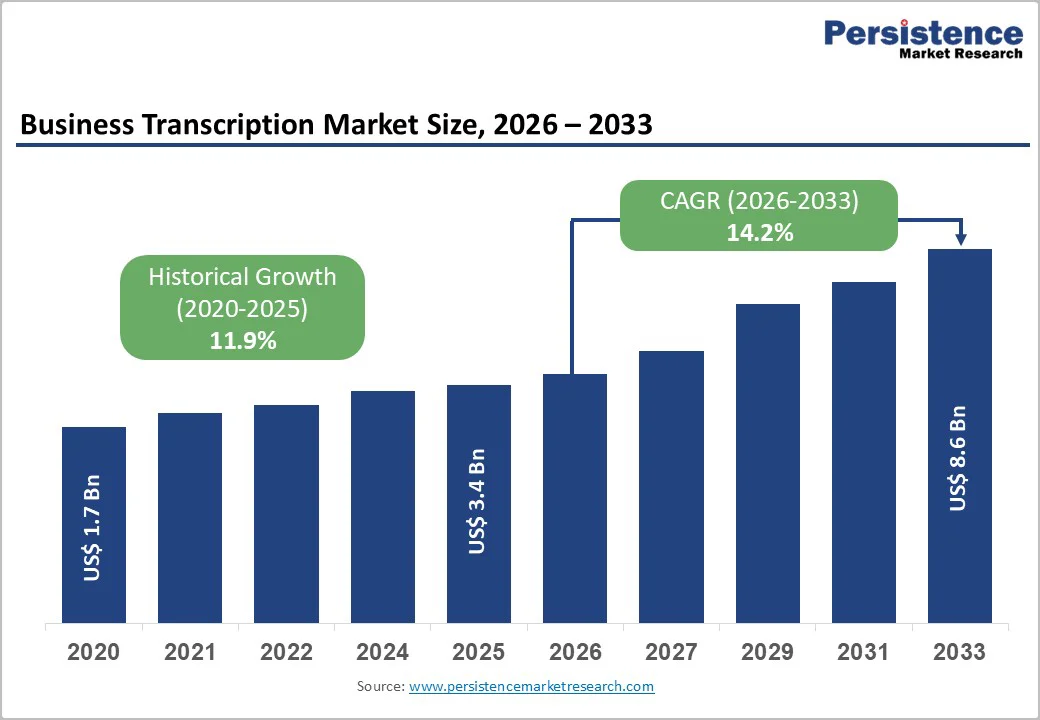
The global business transcription market size is linked to be valued at US$ 3.4 billion in 2026 and projected to reach US$ 8.6 billion by 2033, growing at a CAGR of 14.2% between 2026 and 2033. The market is primarily driven by the accelerated adoption of artificial intelligence and machine learning technologies that enhance transcription accuracy and reduce operational costs.
Rising demand for digital documentation across regulated industries, including healthcare and legal sectors, combined with the global shift toward remote work and cloud-based collaboration tools, is creating unprecedented demand for transcription solutions. Additionally, enterprises are increasingly investing in transcription services to reduce administrative burdens, improve workflow efficiency, and ensure compliance with regulatory requirements such as HIPAA and GDPR.
Key Market Highlights
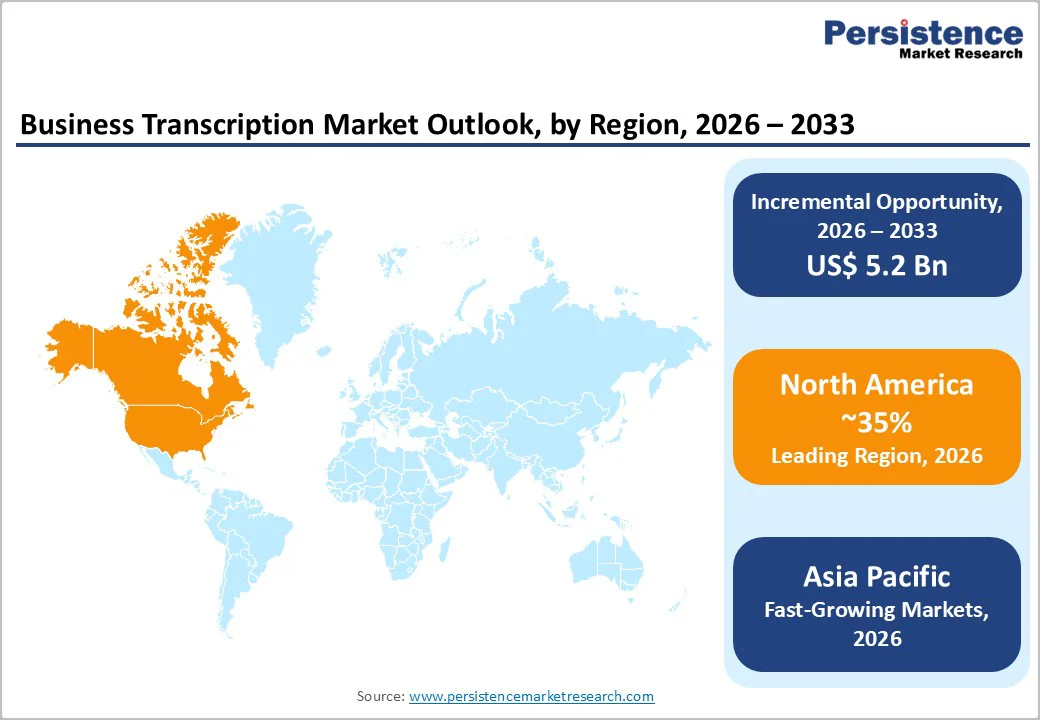
- Leading Region: North America maintains the leading regional position with approximately 35% global market share in 2025, driven by mature healthcare infrastructure, stringent regulatory requirements, and widespread adoption of advanced AI-powered transcription technologies.
- Fastest Growing Region: Asia-Pacific emerges as the fastest-growing regional market, projected to expand at a CAGR of 16% from 2025 to 2032, fueled by rapid healthcare digitalization in China and India, expanding manufacturing sectors, cost-competitive outsourcing advantages, and increasing regulatory compliance requirements.
- Dominant Segment: The software component captures approximately 74.6% of the business transcription market, driven by cloud-based scalability, real-time processing capabilities, seamless enterprise system integration, and reduced capital expenditure requirements through flexible subscription models.
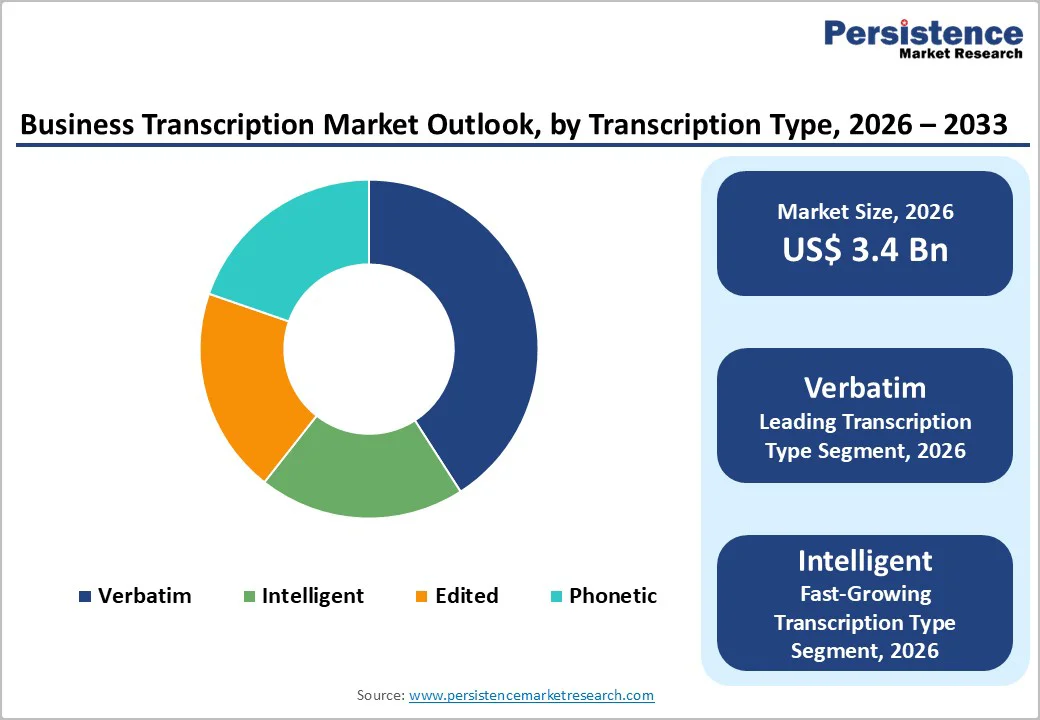
- Fastest Growing Segment: Intelligent transcription type represents the fastest-growing segment with a CAGR of 18% from 2025 to 2032, balancing accuracy with readability and enabling faster business analysis compared to full verbatim transcription.
- Key Opportunity: The convergence of telemedicine expansion, EHR adoption, and ambient clinical intelligence represents a substantial market opportunity.
| Key Insights | Details |
|---|---|
| Business Transcription Market Size (2026E) | US$ 3.4 Bn |
| Market Value Forecast (2033F) | US$ 8.6 Bn |
| Projected Growth CAGR (2026 - 2033) | 14.2% |
| Historical Market Growth (2020 - 2025) | 11.9% |
Market Dynamics
Market Growth Drivers
Rapid Adoption of Artificial Intelligence and Automation Technologies
The integration of AI-powered speech recognition and natural language processing (NLP) technologies is fundamentally transforming the business transcription landscape. The AI transcription software market is projected to grow at a CAGR of 15.2% from 2026 to 2033, significantly outpacing traditional transcription services. Advanced AI algorithms now achieve accuracy rates exceeding 90%, enabling enterprises to automate documentation processes while maintaining compliance with industry standards. The software segment currently captures approximately 74.6% of the global AI transcription market, driven by widespread adoption of both cloud-based and on-premises solutions that offer scalability, real-time processing, and seamless integration with existing enterprise tools such as CRMs, video conferencing platforms, and EHR systems. This technological advancement is particularly beneficial for labor-intensive industries, as it significantly reduces transcription turnaround times from days to hours, enabling organizations to redirect resources toward higher-value activities.
Rising Demand for Remote Work Collaboration and Virtual Meeting Solutions
The global workforce’s unprecedented shift toward remote and hybrid work models has created explosive demand for transcription solutions integrated with collaboration platforms. Studies indicate that over 70% of employers have adopted remote work policies, with this percentage expected to continue growing. The AI meeting transcription market is projected to expand rapidly, representing a remarkable CAGR of 25% through 2033. Major platforms, including Microsoft Teams, Google Meet, and Zoom have integrated native transcription features, with Microsoft Teams offering live transcription support in 50 languages and Google Meet supporting over 65 languages. These integrations address critical business needs for real-time documentation, accessibility compliance, and meeting accountability. Research demonstrates that organizations implementing AI-powered transcription tools experience productivity gains of up to 30% and reduce note-taking time by approximately 50%, making these solutions increasingly indispensable for knowledge workers across all sectors.
Market Restraints
Persistent Workforce Shortage and Talent Transition Challenges
Despite technological advancement, the transcription industry faces significant human capital constraints that limit growth potential. According to the U.S. Bureau of Labor Statistics, employment of medical transcriptionists is projected to decline by 5% from 2024 to 2034, despite an estimated 7,400 annual job openings annually throughout the decade. This paradox reflects a fundamental problem: experienced transcriptionists are retiring or transitioning to other healthcare roles, while younger workers increasingly prefer technology-focused careers over traditional transcription positions. The shortage is particularly acute in specialized domains such as medical and legal transcription, where practitioners require extensive domain knowledge and regulatory compliance expertise. This talent erosion creates capacity constraints for service providers, increases labor costs, and limits the ability of transcription companies to scale operations and meet surging market demand for high-quality, human-reviewed transcriptions.
Growing Data Privacy Regulations and Cybersecurity Compliance Burden
The proliferation of stringent data protection regulations has substantially increased compliance costs and operational complexity for transcription service providers. The General Data Protection Regulation (GDPR) in Europe and HIPAA in the United States impose strict requirements on data collection, storage, processing, and transmission of sensitive information. Organizations must now implement comprehensive security frameworks, including end-to-end encryption, secure file transfer systems, and rigorous access controls. Recent regulatory developments, including HHS’s December 2024 Notice of Proposed Rulemaking to revise and strengthen the HIPAA Security Rule, signal even more stringent cybersecurity requirements ahead. Failure to comply with these regulations results in substantial financial penalties, with organizations facing hefty fines for non-compliance and potential reputational damage from data breaches. These mounting regulatory demands disproportionately burden small and mid-sized transcription providers, creating barriers to market entry and consolidating market power among well-resourced competitors with sophisticated security infrastructure and compliance capabilities.
Market Opportunities
Integration with Telemedicine Platforms and Healthcare Digital Transformation
The rapid expansion of telemedicine and electronic health records (EHRs) represents a substantial growth opportunity for transcription service providers. Telemedicine adoption surged by 60% during the pandemic and is expected to comprise 25-30% of all medical visits in the United States by 2026. This expansion creates unprecedented demand for ambient clinical intelligence solutions that automatically transcribe patient-provider conversations during virtual consultations. Microsoft’s acquisition of Nuance Communications for USD 19.7 billion in 2021 exemplifies the strategic importance of transcription technology in healthcare digital transformation. Advanced solutions now enable automatic clinical note generation, reducing physician documentation time and addressing widespread physician burnout. Transcription providers that successfully position themselves to integrate with major EHR platforms such as Epic, Cerner, and Medidata will capture disproportionate market share in this rapidly expanding segment.
Expansion into Emerging Markets and Multilingual Transcription Services
The globalization of business operations and increasing cross-border transactions create substantial opportunities for transcription providers offering multilingual and localized solutions. Asia-Pacific is emerging as the fastest-growing regional market, driven by expanding healthcare infrastructure, rising internet penetration, and increased adoption of digital documentation practices. The region’s manufacturing advantages, combined with growing outsourcing trends, position it as a critical hub for transcription service delivery. Transcription providers that develop sophisticated multilingual capabilities, supporting transcription in diverse languages including Mandarin, Spanish, Hindi, and Arabic, can address the growing demand from multinational corporations and international organizations. Companies that establish local partnerships and develop culturally adapted solutions will capture growing demand in these underserved markets.
Category-wise Analysis
Component Insights
The software segment dominates the business transcription market, accounting for approximately legal transcription of the global AI transcription market, driven by the widespread adoption of cloud-based and on-premises transcription solutions. Software solutions offer significant competitive advantages including scalability, real-time processing capabilities, and seamless integration with existing enterprise infrastructure. Organizations increasingly prefer software-based solutions because they provide flexible deployment options, reduce capital expenditures through subscription models, and enable rapid feature updates. The software segment demonstrates particularly strong growth momentum, driven by continuous enhancements in natural language processing accuracy and AI model sophistication.
Enterprise Size Insights
Small enterprises, encompassing organizations with 1-99 employees, represent the leading segment in the business transcription market, accounting for approximately 45% market share in 2025. This dominance reflects the accessibility and affordability of modern cloud-based transcription solutions, which enable small businesses to implement enterprise-grade documentation practices without substantial capital investments. Small offices including startups, freelancers, consultants, and small-scale enterprises frequently engage with substantial volumes of audio content through client meetings, brainstorming sessions, and project discussions, creating consistent demand for transcription services. The segment’s rapid growth is fueled by decreasing costs of AI-powered transcription tools and the availability of pay-as-you-go subscription models that align with small business budget constraints. Additionally, increasing regulatory requirements for documentation and compliance across industries drive adoption among small enterprises seeking to professionalise their operations and mitigate legal and regulatory risks.
Transcription Type Insights
Intelligent transcription emerges as the fastest-growing segment within transcription type categories, demonstrating a CAGR of 18% from 2026 to 2033. Intelligent transcription, also known as intelligent verbatim transcription, balances accuracy with readability by removing filler words, false starts, and repetitions while maintaining the speaker’s core message and meaning. This transcription type offers superior value compared to full verbatim transcription for business applications, as it produces more readable documents that enable faster analysis and decision-making. Verbatim transcription, capturing every word and sound including non-verbal utterances, retains a significant market share of approximately 35% due to its essential role in legal proceedings, litigation support, and regulatory compliance scenarios where complete and unaltered documentation is mandatory. Edited transcription is gaining traction for public-facing content and professional publishing applications, while phonetic transcription remains specialized for linguistics research and speech therapy applications, representing a smaller but consistent market niche.
Industry Insights
Healthcare represents the dominant industry segment in the business transcription market, commanding approximately 40% market share in 2025, driven by regulatory requirements, patient safety considerations, and administrative burden reduction imperatives. Hospitals, clinics, and healthcare providers generate vast amounts of clinical documentation daily, and increasingly rely on transcription services to ensure accurate patient records, improve clinical workflows, and reduce physician burnout. The global medical transcription software market, valued at approximately USD 2.9 billion in 2025, is projected to reach USD 7.6 billion by 2032, growing at a CAGR of 15%.
Regional Insights
North America Business Transcription Market Trends
North America dominates the global business transcription market, commanding approximately 35% market share in 2025, driven by mature healthcare systems, robust legal frameworks, and advanced technological infrastructure. The United States specifically contributes significantly to regional growth, with the U.S. transcription market valued at approximately USD 30.42 billion in 2024 and projected to reach USD 41.93 billion by 2030, growing at a CAGR of 5.2%.
The region’s leadership stems from widespread adoption of electronic health records, stringent regulatory requirements including HIPAA compliance, and substantial healthcare expenditures supporting investments in transcription infrastructure. The U.S. medical transcription market specifically comprises approximately USD 3.3 billion in 2025, reflecting strong demand from healthcare organizations seeking to reduce administrative burden and improve clinical documentation quality.
Canada and Mexico contribute to regional growth through expanding healthcare infrastructure and increasing outsourcing adoption. The region’s leadership in AI-powered transcription technology development, with major investments from tech companies including Microsoft, Google, and Amazon, drives innovation in speech recognition and natural language processing capabilities. North America is experiencing rapid adoption of AI meeting transcription tools, with organizations increasingly implementing these solutions to enhance remote collaboration productivity. The region’s strong regulatory and institutional focus on data security, combined with mature healthcare IT infrastructure, positions it as a preferred market for premium transcription solutions offering enhanced security, compliance certifications, and advanced analytics capabilities.
Europe Business Transcription Market Trends
Europe represents the second-largest regional market characterized by stringent data privacy requirements and rapid digitalization of healthcare systems. Germany commands the largest European market share, accounting for approximately 24.8% in 2024, driven by robust healthcare infrastructure including over 1,900 hospitals and strong adoption of digital health initiatives including the Digital Healthcare Act. The United Kingdom holds a prominent position, with the National Health Service (NHS) documenting that transcription software has reduced administrative workloads by 40%, enabling clinicians to focus more on patient care. Telemedicine adoption in the UK surged by 60% during the pandemic, further boosting demand for real-time transcription tools. France is registering promising growth, fueled by emphasis on AI and natural language processing technologies, with healthcare facilities using AI-driven transcription tools demonstrating 45% improvements in documentation efficiency.
Regional growth is driven by GDPR compliance requirements, government-funded digitization initiatives such as Germany’s Hospital Future Act and the UK’s NHS Long Term Plan, and increasing focus on sustainable, paperless business operations. The region demonstrates strong demand for cloud-based transcription solutions, with cloud architectures capturing 57% of the medical transcription software market share in 2025, fueled by subscription models, elastic scaling capabilities, and simplified feature deployment.
Asia Pacific Business Transcription Market Trends
Asia-Pacific emerges as the fastest-growing regional market, projected to grow at a CAGR of 16% from 2025 to 2032, driven by rapid healthcare digitalization, expanding manufacturing sectors, and increasing outsourcing adoption. China is rapidly expanding its transcription market share, with the market projected to reach USD 1.56 billion by 2034, driven by healthcare infrastructure expansion and digital healthcare initiatives. India represents a critical hub for transcription service delivery and BPO (Business Process Outsourcing) operations, leveraging cost advantages and skilled multilingual workforce capabilities to serve global demand. Japan is experiencing steady growth through increased adoption of AI-powered transcription solutions in healthcare and legal sectors.
The region’s competitive advantages include significant cost benefits compared to developed markets, availability of multilingual workforce capabilities, and manufacturing expertise supporting business process outsourcing services. East Asia specifically is projected to account for 30% of global business transcription market value by 2033, representing substantial market consolidation in the region. Regional demand is driven by rapid economic development, expanding healthcare infrastructure, rising internet penetration facilitating cloud service adoption, and increasing regulatory requirements for documentation across industries. ASEAN countries including Singapore, Thailand, and Vietnam are emerging as secondary growth hubs, benefiting from regional proximity to India and China, growing healthcare spending, and expanding multinational corporate presence requiring transcription services for cross-border operations.
Competitive Landscape
The business transcription market reflects a moderately fragmented structure that is steadily moving toward consolidation as larger participants scale through acquisitions, technology upgrades, and integrated service portfolios. A significant portion of market value is concentrated among established providers, yet numerous mid-tier and niche firms compete by specializing in industry-specific workflows, turnaround-time options, and customized accuracy requirements. Competitive strategy increasingly centers on AI-driven automation, real-time speech technologies, and cloud-native platforms that allow vendors to support high-volume enterprise demand while reducing operational costs.
Providers differentiate by offering higher accuracy thresholds, advanced security and compliance assurance, multilingual capabilities, and seamless interoperability with enterprise ecosystems across content management, collaboration, and customer experience platforms. Business models are shifting toward subscription-based platforms, usage-linked pricing, and hybrid human-AI workflows designed to balance speed with quality. Specialized applications-particularly in healthcare, legal, and financial services-continue to drive targeted solution development and long-term client relationships.
Key Market Developments
- March 2025: 3Play Media launches a global linguist-marketplace and AI-enabled language solutions for video to help businesses comply with the European Accessibility Act.
- September 2024: Focus Forward announced strategic partnership with major cloud service provider to enhance transcription services through integration of advanced speech recognition and linguistic analytics, enabling real-time speech-to-text processing for enterprise clients.
Companies Covered in Business Transcription Market
- 3Play Media
- Tech-Synergy
- Focus Forward
- Voice Products Inc.
- RndSofttech.com
- TranscribeMe Inc.
- NCH Software
- Indoswift
- Crimson Interactive Inc.
- Digital Nirvana Inc.
- Nuance Communications Inc.
- Transcend Services Inc.
- Otter.ai
- Rev
- GoTranscript
Frequently Asked Questions
The market is expected to reach US$ 8.6 billion by 2033, up from US$ 3.4 billion in 2026.
AI adoption, remote-work expansion, and rising regulatory compliance requirements are the key growth drivers.
Intelligent transcription is the fastest-growing segment with an expected CAGR of 18%.
North America leads with about 35% market share in 2025.
Telemedicine growth and increasing EHR adoption create the biggest opportunity for transcription services.
Leading market players include 3Play Media, Digital Nirvana Inc., Crimson Interactive Inc., TranscribeMe Inc., NCH Software, Tech-Synergy, Focus Forward, etc.


