




- Automotive
- Automotive Number Plate Market
Automotive Number Plate Market Size, Share, and Growth Forecast, 2025 - 2032
Automotive Number Plate Market By Material Type (Aluminium, Plastic, Reflective Sheeting, Coatings), Vehicle (Passenger Vehicles, Two/Three Wheelers, Commercial Vehicles, Other), Distribution Channel, and Regional Analysis for 2025 – 2032

Automotive Number Plate Market Size and Trends Analysis
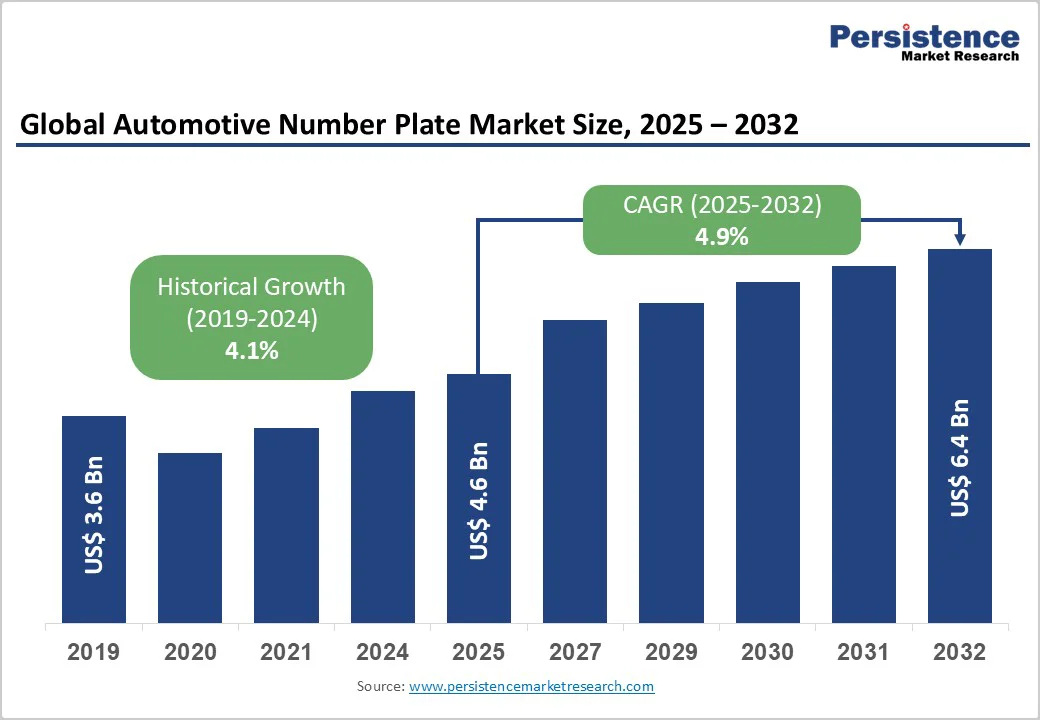
The global automotive number plate market size is likely to be valued US$4.6 Billion in 2025, expected to US$ 6.4 Billion by 2032, growing at a CAGR of 4.9% during the forecast period from 2025 to 2032, driven by increasing vehicle production, stringent regulatory requirements for standardized plates, and rising demand for personalized and aesthetically appealing number plates. The market is further propelled by innovations in lightweight materials and smart number plates with RFID technology, catering to preferences for enhanced security and compliance. The growing acceptance of automotive number plates for vehicle identification and personalization, especially in urbanizing economies, is a key growth factor.
Key Industry Highlights:
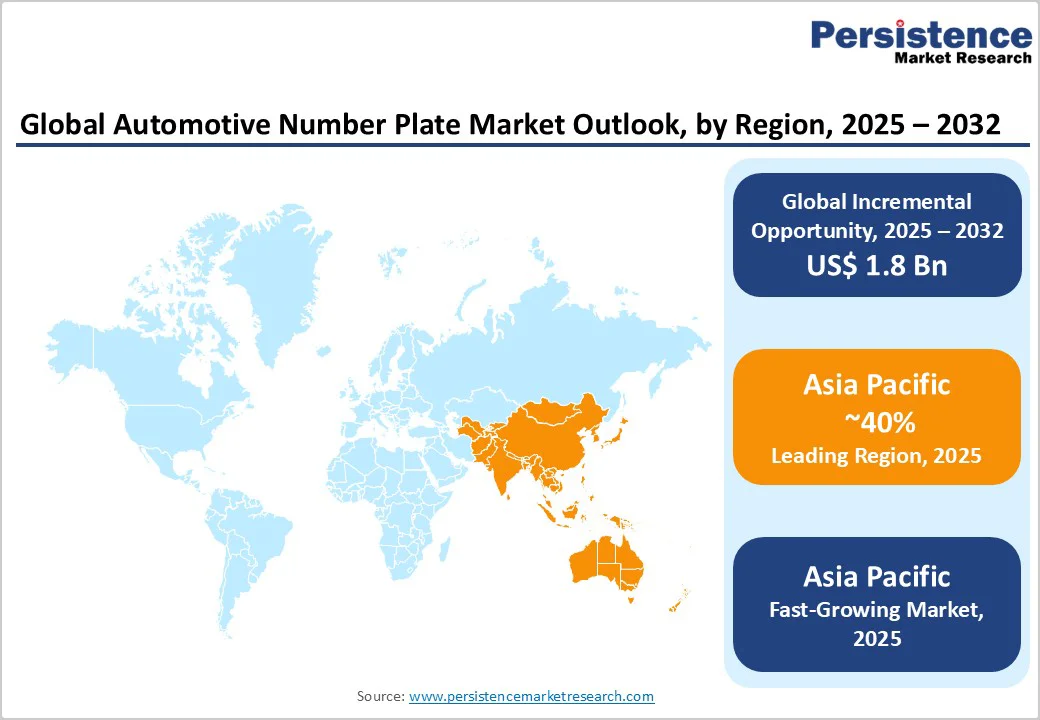
- Leading Region: Asia Pacific, commanding a 40% market share in 2025, driven by high vehicle production in China and India.
- Fastest-growing Region: Asia Pacific, fueled by urbanization and two-wheeler growth.
- Dominant Material Type: Aluminium, holding approximately 45% of the market share, due to durability and regulatory compliance.
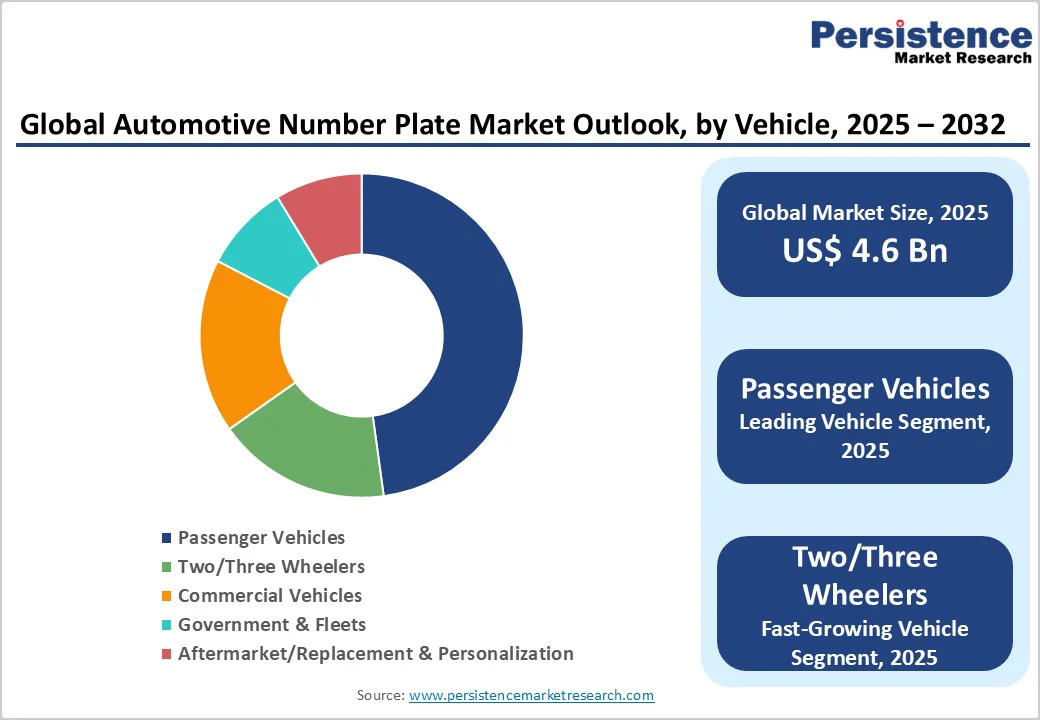
- Leading Vehicle Type: Passenger Vehicles, accounting for over 50% of market revenue, driven by high sales volumes.
- Leading Distribution Channel: OEM Fitted Plates, contributing nearly 40% of market revenue, owing to standardized production.
- Key Market Driver: Rising consumer interest in customized plate designs and specialty registrations is boosting aftermarket sales and expanding product diversity.
- Growth Opportunity: Expansion in smart number plates with tracking and anti-theft features.
| Key Insights | Details |
|---|---|
| Automotive Number Plate Market Size (2025E) | US$4.6 Bn |
| Market Value Forecast (2032F) | US$6.4 Bn |
| Projected Growth (CAGR 2025 to 2032) | 4.9% |
| Historical Market Growth (CAGR 2019 to 2024) | 4.1% |
Market Factors – Growth, Barriers, and Opportunity Analysis
Increasing Vehicle Production and Regulatory Compliance
The rising global vehicle production and stringent regulatory mandates for standardized number plates are primary drivers of the automotive number plate market. The steady rise in vehicle manufacturing, particularly in emerging economies such as China, India, and Brazil, has significantly boosted demand for standardized and durable number plates. As more vehicles enter the market, the need for efficient registration and traceability systems becomes critical for road safety and traffic management. Governments across regions are enforcing strict regulations to ensure uniformity, authenticity, and visibility in license plate designs.
Regulatory frameworks now mandate the use of tamper-proof, reflective, and traceable plates equipped with security features such as holograms, barcodes, or RFID chips to prevent duplication and fraud. Compliance with these standards not only supports law enforcement but also enhances national vehicle databases for better monitoring. Furthermore, automakers are integrating OEM-fitted plates directly into production lines to meet local legal requirements and streamline registration processes.
High Production Costs and Counterfeiting Issues
High costs of advanced materials and counterfeiting challenges pose significant restraints on market growth. The manufacturing of high-quality, durable, and tamper-resistant plates involves the use of premium materials such as aluminum and advanced reflective films, which increase production expenses. Additionally, incorporating security features such as holograms, laser etching, RFID chips, and barcodes further adds to costs. Small and mid-sized manufacturers often struggle to balance affordability with compliance to stringent regulatory standards, particularly in developing regions.
Counterfeiting remains a persistent concern, undermining road safety and law enforcement efforts. Fake or duplicated number plates are used for illegal activities such as tax evasion, smuggling, and theft, prompting authorities to enforce stricter identification systems. Combating counterfeiting requires continuous investment in advanced authentication technologies, increasing overall operational costs.
Expansion in Smart and Personalized Number Plates
Advancements in smart automotive number plates with RFID and personalization options present significant growth opportunities. Growing digitalization and the integration of advanced technologies such as RFID, GPS, and Bluetooth are driving the adoption of smart plates that enhance vehicle tracking, theft prevention, and regulatory compliance. These intelligent systems enable real-time data connectivity with vehicle databases, supporting smart city initiatives and law enforcement operations.
Rising consumer interest in vehicle personalization is fueling demand for customized and designer plates, reflecting individuality and status. Easy online ordering platforms and flexible design options have made personalization more accessible across various vehicle categories. Governments and fleet operators are also exploring smart plate systems for better monitoring, toll collection, and automated verification. Countries such as the U.S., the U.K., and the UAE have already launched pilot programs for digital plates, setting the stage for broader adoption.
Category-wise Analysis
Material Type Insights
Aluminium dominates the market, accounting for 45% of the share in 2025. Its dominance stems from excellent durability, corrosion resistance, and lightweight properties that support fuel efficiency and sustainability goals. Moreover, aluminium plates meet global safety and regulatory standards, making them the preferred choice for OEM and government-issued plates.
Reflective Sheeting is the fastest-growing segment, driven by increasing safety and nighttime visibility requirements. Governments worldwide mandate reflective materials to enhance road safety and vehicle identification. Technological advances in durable, weather-resistant coatings and high-intensity reflective films further accelerate adoption across passenger and commercial vehicles.
Vehicle Insights
Passenger Vehicles lead with 50% share, driven by high global vehicle production and growing consumer preference for personalized plate designs. Expanding car ownership, stringent registration regulations, and integration of smart and reflective plate technologies further strengthen this segment’s dominance across both developed and emerging automotive markets.
Two/Three Wheelers are the fastest-growing, fueled by rapid urbanization, rising commuter demand, and expanding delivery and ride-sharing services. Affordable mobility solutions in emerging economies such as India and Southeast Asia further accelerate vehicle registrations, boosting demand for durable, standardized, and tamper-proof number plates for this category.
Distribution Channel Insights
OEM Fitted Plates hold 40% share, supported by their integration into standardized vehicle manufacturing and registration processes. Automakers collaborate with certified suppliers to ensure compliance with regional regulations and quality standards. These plates offer high durability, security, and consistency, making them the preferred choice for new vehicle production worldwide.
Aftermarket Retailers are the fastest-growing, driven by the rising trend of vehicle personalization and customization. Consumers increasingly seek unique, stylish, and premium plate designs, fueling demand beyond standard OEM offerings. Easy online availability, quick installation, and customizable options further boost aftermarket sales across both personal and commercial vehicles.
Regional Insights
Asia Pacific Automotive Number Plate Market Trends
Asia Pacific commands around 40% share and is the fastest-growing region, driven by rapid motorization and expanding vehicle production. China leads the regional market, supported by its vast automotive manufacturing base, government regulations on vehicle registration, and rising adoption of smart and digital plate systems. India follows closely, fueled by the surge in two-wheeler and passenger car sales, increasing urbanization, and the government’s focus on standardizing vehicle identification for road safety and law enforcement.
Countries such as Japan, South Korea, and Thailand are also contributing significantly, driven by advancements in automotive technologies and the integration of RFID-enabled and tamper-proof plates. The expansion of electric vehicles and shared mobility services across major cities has created new opportunities for intelligent plate solutions compatible with connected vehicle infrastructure.
North America Automotive Number Plate Market Trends
North America accounts for 25% in 2025, driven by strong vehicle sales in the United States and growing consumer demand for personalized and specialty plates. The U.S. market benefits from state-level initiatives promoting customization, digital license plate systems, and enhanced security features to curb counterfeiting and improve traceability. Canada and Mexico also contribute to regional growth through increasing vehicle production and the adoption of standardized registration systems aligned with North American safety regulations.
Technological innovation, such as RFID and Bluetooth-enabled smart plates, is gaining traction, particularly for fleet management, logistics, and government vehicles. Interestingly, the U.K. market though part of Europe mirrors these trends with rising adoption of digital and smart number plates to enhance enforcement and compliance for public service fleets. Both regions are emphasizing regulatory modernization, sustainability, and digitalization in vehicle identification systems.
Europe Automotive Number Plate Market Trends
Europe holds about 30% market share, led by Germany and France, driven by stringent EU vehicle registration regulations and the growing adoption of high-visibility, reflective plate technologies. Germany and France lead the regional market, backed by robust automotive industries, advanced manufacturing capabilities, and strict standards for vehicle identification and traceability. EU directives mandate uniform plate designs incorporating reflective coatings, laser etching, and anti-counterfeiting features to ensure road safety and law enforcement efficiency.
The demand for durable, tamper-proof, and eco-friendly materials has also increased as governments promote sustainable production practices and recyclability. Furthermore, the region is witnessing rising adoption of digital and RFID-enabled number plates for fleet management and smart mobility integration. The presence of established number plate manufacturers and regulatory harmonization across member states continues to strengthen Europe’s position in the global market.
Competitive Landscape
The global automotive number plate market is moderately consolidated, with a mix of established players and regional manufacturers competing to meet evolving vehicle identification requirements. Leading companies focus on integrating smart technologies such as RFID tags, QR codes, and laser-etched security features to enhance traceability and compliance with stringent vehicle registration regulations. Partnerships with automotive OEMs and government authorities are becoming essential for the large-scale deployment of standardized and tamper-resistant plates.
Manufacturers are emphasizing eco-friendly materials and digital plate systems to align with sustainability goals and smart mobility initiatives. The growing adoption of connected and electric vehicles has further driven demand for intelligent number plates capable of linking with vehicle databases and real-time tracking systems. Regulatory frameworks across regions such as the EU and North America mandate advanced identification and anti-counterfeiting measures, encouraging continuous innovation.
Key Industry Developments
- In April 2024, the company announced a strategic cooperation with DKT Deutsche Kennzeichen Technik GmbH to improve production efficiency and quality specifically in the high-security registration plate segment, including manufacturing plates entirely from recycled aluminium.
- In August 2023, 3M launched a “new high-security vehicle registration number plate” product featuring enhanced anti-counterfeiting measures and advanced material technologies.
Companies Covered in Automotive Number Plate Market
- Rosmerta Technologies Limited
- Orbiz Automotivez
- Utsch Group / LicenSys
- Fuwong License Plate
- Jepson & Co Ltd
- Bestplate Ltd
- Irwin Hodson Group (WIHG)
- SPM Groupe
Frequently Asked Questions
The global automotive number plate market is projected to reach US$ 4.6 Bn in 2025, driven by rising vehicle production.
Increasing cases of vehicle theft and fraud have led to the implementation of high-security and tamper-resistant plates to ensure authenticity and traceability.
The market is poised to witness a CAGR of 4.9% from 2025 to 2032, supported by smart plate innovations.
Expansion in RFID-enabled automotive number plates offers opportunities for anti-theft and tracking solutions.
Rosmerta Technologies, Utsch Group, Jepson & Co, and Bestplate Ltd lead through innovative automotive number plate solutions.


