




- Medical Devices
- Artificial Blood Vessels Market
Artificial Blood Vessels Market Size, Share, Growth, and Regional Forecast, 2026 to 2033
Artificial Blood Vessels Market by Polymer Type (Polydioxanone, Elastomer, Polyethylene Terephthalate, Others), Application (Aortic Disease, Peripheral Artery Disease, Hemodialysis, Others), End-user, Regional Analysis, from 2026 to 2033

Artificial Blood Vessels Market Share and Trends Analysis
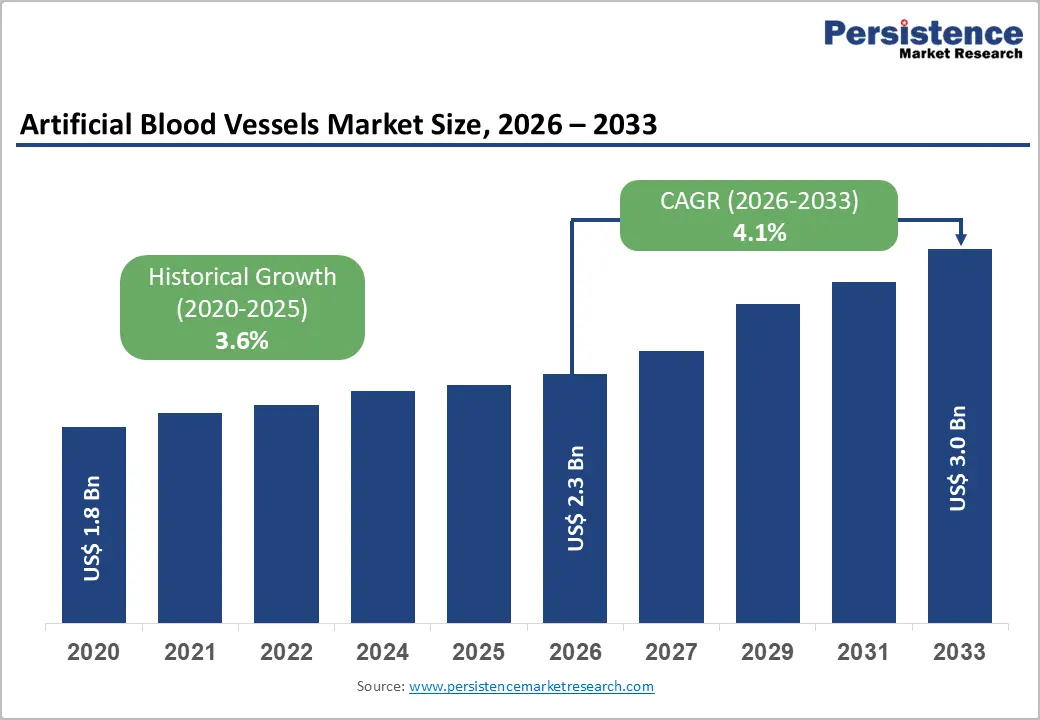
The global artificial blood vessels market size is expected to be valued at US$ 2.3 billion in 2026 and projected to reach US$ 3.0 billion by 2033, growing at a CAGR of 4.1% between 2026 and 2033.
The market is experiencing innovations in biotechnology, followed by an increasing prevalence of cardiovascular diseases. As the global population rises, demand for vascular grafts and substitutes is surging. This pushes the development of innovative solutions to enhance patient outcomes. Key trends include the development of bioengineered materials that mimic natural blood vessel properties, improving biocompatibility, and reducing complications. The rise of minimally invasive surgical techniques is propelling the adoption of synthetic blood vessels. This trend is driven by their short recovery times and low risk of infection. Ongoing research into 3D printing technologies is also anticipated to boost the customization of vascular implants. This trend will likely address individual patient needs and foster personalized medicine in vascular treatments.
Key Industry Highlights:
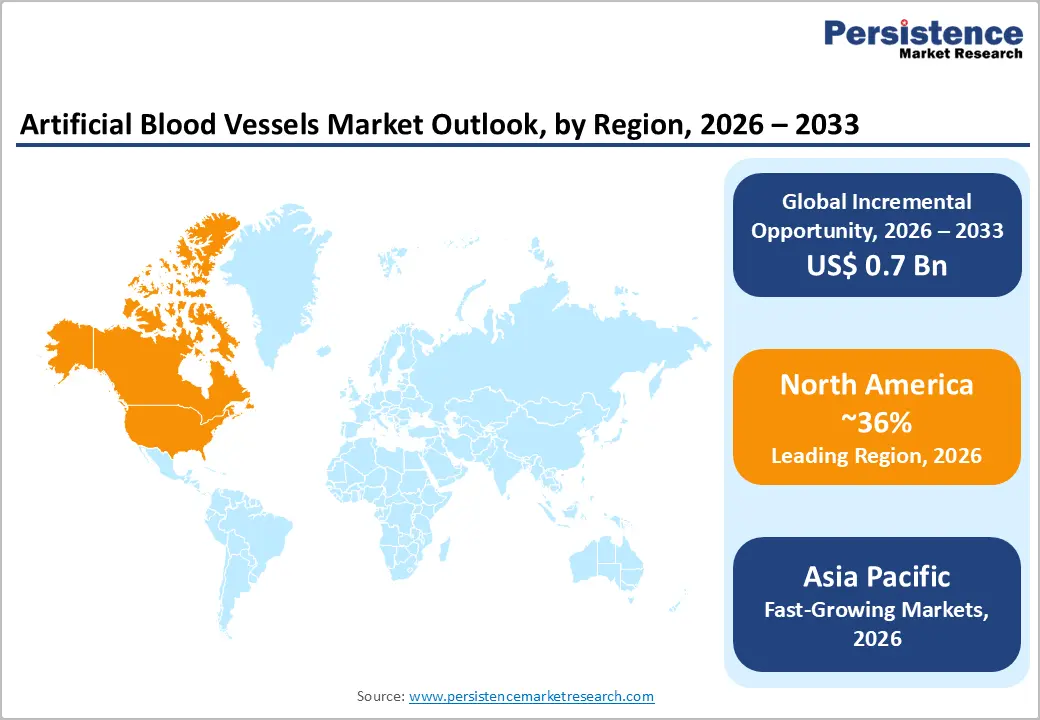
- Leading Region: North America leads due to advanced healthcare infrastructure, high cardiovascular procedure volumes, strong reimbursement systems, and early adoption of vascular implants.
- Fastest Growing Region: Asia Pacific grows fastest, driven by rising cardiovascular disease prevalence, expanding surgical capacity, healthcare investments, and growing patient awareness.
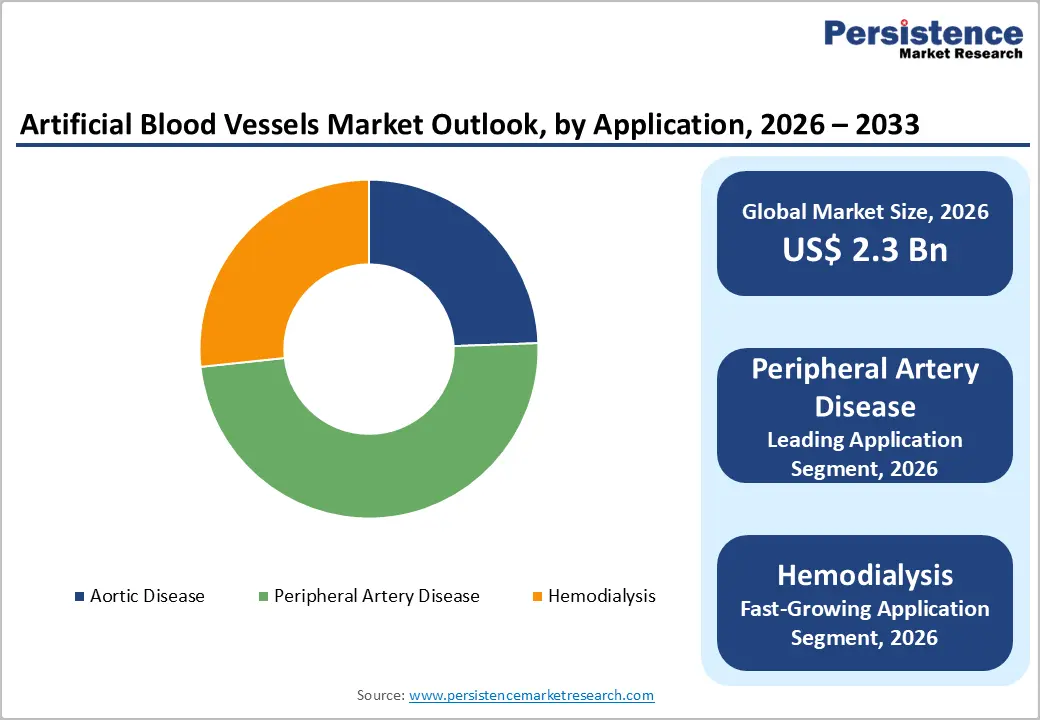
- Dominant Segment: Peripheral artery disease dominates, supported by high disease incidence, increasing minimally invasive interventions, and widespread use of vascular grafts.
- Fastest Growing Segment: Polyethylene terephthalate grows fastest, aided by innovations in bioengineered materials, improved biocompatibility, and longer graft durability.
| Key Insights | Details |
|---|---|
| Artificial Blood Vessels Market Size (2026E) | US$ 2.3 Bn |
| Market Value Forecast (2033F) | US$ 3.0 Bn |
| Projected Growth (CAGR 2026 to 2033) | 4.1% |
| Historical Market Growth (CAGR 2020 to 2025) | 3.6% |
Market Dynamics
Driver - Increasing Cases of Cardiovascular Diseases to Foster Demand
Rising incidence of cardiovascular diseases is a significant growth driver for the artificial blood vessels market. For example, as per the National Institute of Health, about 82.6 million people in the U.S. are currently living with one or more forms of cardiovascular disease (CVD). This shows the rising demand for artificial blood vessels.
Factors such as sedentary lifestyles, unhealthy eating habits, and an aging population contribute to the prevalence of conditions like atherosclerosis and coronary artery disease. As these health issues become more widespread, demand for effective treatment options, including vascular grafts and artificial blood vessels, rises.
Rising Demand for Minimally Invasive Surgical Techniques to Boost Innovations
Growing preference for minimally invasive surgical procedures is another key driver of the global market. Patients and healthcare providers alike are seeking alternatives to traditional open surgeries due to the associated risks and longer recovery times.
Artificial blood vessels facilitate minimally invasive approaches, allowing for quicker procedures with reduced postoperative complications. As surgical techniques evolve, adoption of artificial grafts becomes increasingly prevalent, leading to a surging demand.
Researchers and companies focus on developing artificial blood vessels using the latest technologies, thereby fostering market growth. For example, In July 2024, researchers from the University of Edinburgh and Heriot-Watt University developed artificial blood vessels using 3D printing technology to improve the treatment of cardiovascular diseases (CVD). These grafts are as strong as natural blood vessels and can reduce scarring, pain, and infection risks associated with human vein removal in bypass operations.
Restraints - High Costs of Production and Implementation to Decline Demand
One of the significant factors impeding the artificial blood vessels industry is the high costs associated with the production and implementation of these unique medical devices. The manufacturing processes often involve novel technologies and materials, which can lead to high prices for both healthcare providers and patients.
The financial barrier may limit accessibility, particularly in developing regions where healthcare budgets are constrained. As a result, the adoption of artificial blood vessels may be slower, hindering market growth.
Long Approval Processes Involving Strict Norms May Hinder Growth
Regulatory challenges pose another obstacle to the global market. The approval processes for medical devices can be lengthy and complex, requiring extensive clinical trials and compliance with stringent safety standards.
Evolving regulatory hurdles can delay the introduction of innovative products, limiting the market's responsiveness to emerging needs and technological developments. The variability in regulations across different regions can complicate market entry for manufacturers, further impeding growth and innovation in the artificial blood vessels business.
Opportunity - Personalized Medicine and Customization Trends to Create New Opportunities
The future of the global market holds significant opportunities through the innovation of personalized medicine. As healthcare shifts toward tailored treatment approaches, the ability to customize artificial blood vessels to meet individual patient needs is becoming increasingly feasible.
Innovations in 3D printing technology allow for the creation of bespoke vascular grafts that match a patient's anatomical specifications and biological requirements. For example, as per the National Institutes of Health (NIH), researchers are developing bioengineered vascular constructs and functional blood vessels using living cells and biocompatible materials. This is projected to revolutionize personalized regenerative medicine by treating vascular diseases at their root cause. As personalized healthcare gains traction, demand for customized vascular solutions is set to surge, driving market growth.
Emergence of 3D Printing and Bioengineered Materials to Foster Opportunities
Technological innovations in manufacturing processes are revolutionizing the global market. Innovations such as 3D printing and the development of bioengineered materials enable the production of customized vascular implants. These closely mimic the properties of natural blood vessels. These developments not only improve biocompatibility but also enhance the durability and functionality of artificial grafts.
The integration of smart materials that respond to physiological changes offers new avenues for improved patient outcomes. For example, In May 2024, researchers at the University of Hong Kong developed a new fluidic system called VasFluidics, inspired by the vascular network. VasFluidics has promising applications, especially for designing microtubule structures and bioinks. It has the potential to be combined with cell engineering for biomedical applications, such as organ-on-chip and organoids. As similar innovations continue to rise, the market is likely to witness an influx of innovative products, further driving growth.
Category-wise Analysis
By Polymer Type Insights
In the global artificial blood vessels market, Polyethylene Terephthalate (PET) remains the leading polymer type due to its superior mechanical strength, excellent biocompatibility, and high resistance to degradation, making it well-suited for long-term vascular implants and grafts. PET-based grafts are widely used in applications such as bypass surgeries, hemodialysis access, and peripheral artery disease repairs, supporting strong clinical adoption globally. The segment’s growth is further reinforced by the increasing prevalence of cardiovascular diseases, which significantly drives demand for durable synthetic vascular solutions.
According to the Centers for Disease Control and Prevention (CDC), approximately 919,032 deaths in the U.S. in 2023 were due to cardiovascular disease, maintaining it as the leading cause of death nationwide. This highlights the urgent need for effective surgical interventions and advanced vascular products like PET artificial blood vessels to manage complex cardiovascular conditions and improve patient outcomes.
By Application Insights
By application, the peripheral artery disease or PAD segment is projected to remain dominant through 2033. This growth is driven by the increasing prevalence of PAD, particularly among the aging population, and innovations in minimally invasive surgical techniques that enhance treatment options.
Government initiatives promoting awareness and screening for PAD are set to lead to early diagnoses and increased demand for artificial blood vessels. According to CDC, around 8.5 million adults in the U.S. are affected by PAD, highlighting the significant need for effective treatment solutions. Keeping this in mind, several companies are developing innovative solutions. For example, Royal Philips enrolled the first patient in the U.S. THOR IDE clinical trial. It will study an innovative combined laser atherectomy and intravascular lithotripsy catheter developed by Philips. The device integrates two critical PAD treatments into a single device, simplifying workflows and procedures.
Regional Insights
North America Artificial Blood Vessels Market Trends
North America is set to dominate the artificial blood vessels materials industry in 2025, rising at a CAGR of 5.9% during the forecast period. The region is grappling with a surging mortality rate from aortic aneurysms as well as increasing cases of peripheral and coronary artery diseases. These alarming trends are prompting higher awareness about heart health through various programs and initiatives. For example, The Centers for Disease Control and Prevention (CDC) reported that about 9,904 deaths in the U.S. in 2019 were due to aortic aneurysms, with men accounting for 59% of those fatalities.
CDC runs several programs as the aforementioned deaths could potentially be prevented with timely surgical interventions. The organization promotes the use of artificial blood vessels, underscoring the critical need for innovations in this field.
The combination of high disposable incomes, an advanced healthcare infrastructure, and the presence of leading industry players fuels product development and innovation. With these factors in play, the artificial blood vessels industry in North America is poised for notable growth from 2026 to 2033.
Asia Pacific Artificial Blood Vessels Market Trends
Asia Pacific is emerging as a high-demand region for artificial blood vessels, supported by a steady rise in cardiac procedures and cardiovascular disease burden. The market is projected to grow at around 7.5% CAGR through 2033, driven by increasing prevalence of hypertension, coronary artery disease, and lifestyle-related risk factors. Growing access to advanced healthcare facilities and improved diagnostic capabilities are further accelerating the volume of cardiovascular surgeries. India represents a major contributor, with reports from April 2023 indicating that nearly 300,000 cardiac procedures are performed annually. This expanding surgical volume directly increases the need for reliable vascular grafts, particularly for bypass surgeries, peripheral artery disease, and dialysis access.
In parallel, strong momentum in research and development is shaping long-term market growth across the region. Academic and research institutions are investing heavily in biomaterials and tissue-engineered vascular solutions to address limitations of conventional grafts. For instance, in August 2024, the Indian Institute of Science developed artificial blood vessels designed to closely mimic natural vessels, improving biocompatibility and functional performance. Such innovations are expected to support wider clinical adoption and strengthen regional manufacturing capabilities.
Competitive Landscape
The competitive landscape of the synthetic blood vessels market is characterized by rapid innovation and strategic collaborations among key players. Companies are focusing on developing cutting-edge products that enhance patient outcomes and address specific medical needs.
Japan-based Terumo Corporation, for instance, has launched several innovative products, including a new line of bioengineered vascular grafts. These are designed to improve biocompatibility and reduce the risk of complications. These innovations not only strengthen Terumo's market position but also reflect the broader trend of integrating cutting-edge technology into vascular solutions. As competition intensifies, companies are likely to invest heavily in research and development to maintain their edge in this booming market.
Key Industry Developments:
- In July 2025, researchers from Queen Mary University and the University of Konstanz identified a key chemical signal involved in red blood cell development, a finding expected to improve the efficiency of artificial blood production.
- In October 2024, KIMSHEALTH Hospital, Trivandrum, Kerala, opened a state-of-the-art electrophysiology lab with advanced 3D mapping technology. The lab aims to bridge the gap between engineering and medicine. The ENSITE X 3D omnipolar mapping system enables precise identification, mapping, and targeting of abnormal electrical activities in the blood vessels of the heart.
- In October 2024, researchers at University College London developed a 3D photoacoustic scanner to speed up vascular imaging for real-time clinical use. Technology aims to visualize microvasculature to sub-centimeter depths, which is crucial for effective clinical management of vascular abnormalities.
- In May 2024, a team of engineers at Carnegie Mellon University developed a new method to create artificial blood vessels. The new method could potentially support lab-made organs, test new medicines, and even replace damaged vessels in individuals with cardiovascular disease.
Companies Covered in Artificial Blood Vessels Market
- Braun Melsungen
- Becton
- Dickinson and Company
- Cook Medical Incorporated
- Medtronic
- LeMaitre Vascular Inc.
- Terumo Medical Corporation
- W. L. Gore and Associates
- Jotec GmbH
- Humacyte Inc.
- Techshot Inc.
- Others
Frequently Asked Questions
The global artificial blood vessels market is projected to be valued at US$ 2.3 Bn in 2026.
Rising cardiovascular disease prevalence, growing dialysis patient population, aging demographics, and increased adoption of advanced vascular surgical procedures.
The global artificial blood vessels market is expected to witness a CAGR of 4.1% between 2026 and 2033.
Expansion in emerging healthcare markets, technological advancements in biocompatible grafts, minimally invasive procedures, and rising investment in vascular infrastructure.
North America is the leading region in the global artificial blood vessels market.


