




- Medical Devices
- Artificial Cornea Implant Market
Artificial Cornea Implant Market Size, Share, and Growth Forecast, 2026 - 2033
Artificial Cornea Implant Market by Transplant Type (Hard Keratoprosthesis, Soft Keratoprosthesis, Others), Implant Type (Synthetic Implants, Biosynthetic Implants, Others), Indication, End-user, and Regional Analysis for 2026 - 2033

Artificial Cornea Implant Market Size and Trends Analysis
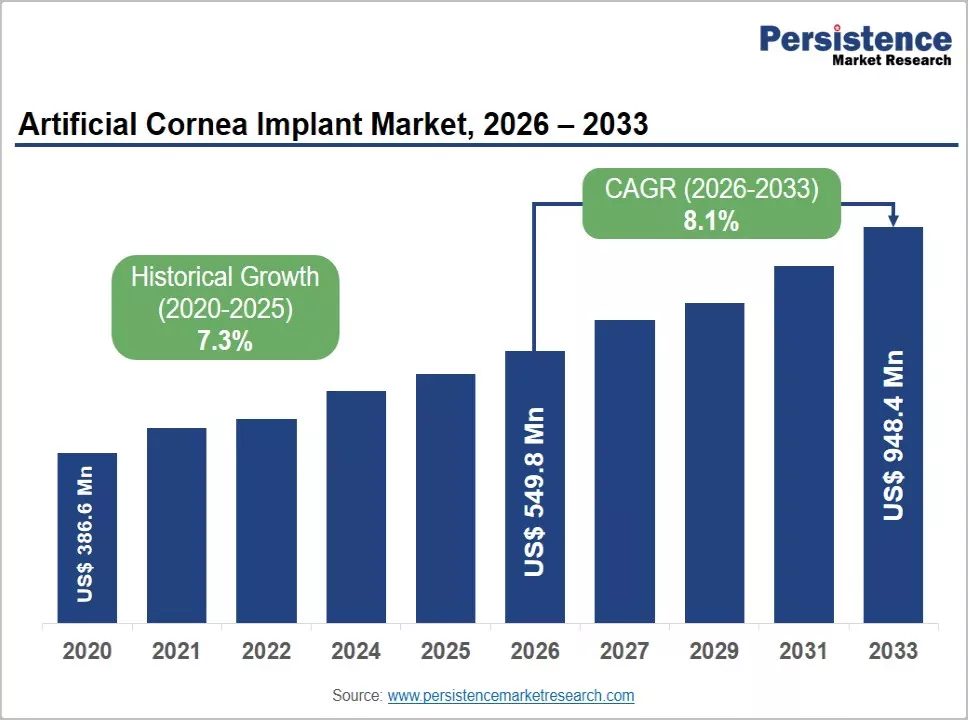
The global artificial cornea implant market size is likely to be valued at US$549.8 million in 2026 and is expected to reach US$948.4 million by 2033, growing at a CAGR of 8.1% between 2026 and 2033, driven by the burden of severe corneal disease, limitations in donor-cornea availability, and advances in synthetic and biosynthetic implant technologies.
Increasing investment in biomaterials, tissue engineering, regenerative ophthalmology, and advanced imaging is broadening the technological base of artificial cornea development. The market remains concentrated in specialized ophthalmic settings where complex corneal conditions require alternatives to conventional transplantation.
Key Industry Highlights:
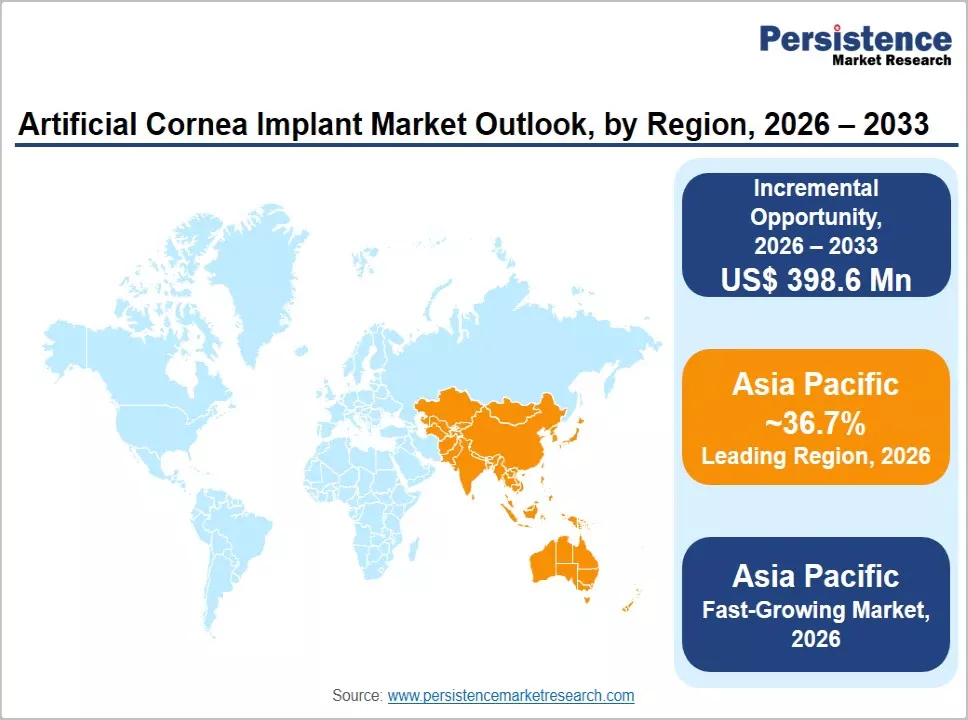
- Leading Region: Asia Pacific is projected to lead with 36.7% market share, supported by a large patient population, expanding ophthalmic infrastructure, and increasing artificial-cornea and biomaterials research.
- Fastest-growing Region: Asia Pacific is also the fastest-growing region, driven by increasing access to specialist corneal procedures, domestic medical-device manufacturing, and advances in tissue-engineered and biointegrated corneal technologies.
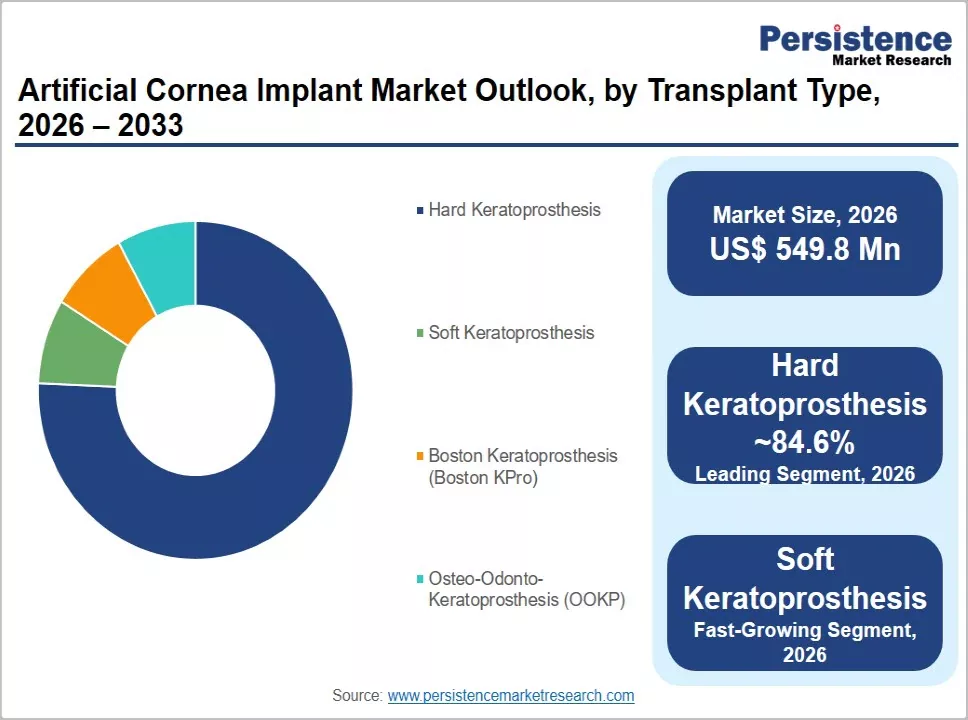
- Dominant Transplant Type: Hard Keratoprosthesis dominates with an 84.6% market share, supported by established devices such as the Boston Keratoprosthesis and long-standing clinical experience.
- Leading Implant Type: Synthetic Implants lead with a 90.2% market share, reflecting the established use of engineered materials such as PMMA and the standardized manufacturing processes associated with synthetic artificial-cornea systems.
DRO Analysis
Drivers - Rising Burden of Severe Corneal Disease and Limitations in Donor Tissue Availability
The continuing burden of corneal opacity, scarring, trauma, infection, degeneration, and other vision-threatening conditions supports demand for advanced corneal replacement technologies. Corneal opacity accounts for 3.46% of global blindness, demonstrating the contribution of corneal disease to the worldwide burden of vision loss. A population-based study in India reported avoidable blindness from corneal opacity at 17.1 per 10,000 among people aged 50 years and older, highlighting the importance of corneal disease in aging populations.
The challenge is compounded by limitations in donor-tissue availability. The combination of patient need and restricted access to suitable donor corneas creates a clinical requirement for artificial alternatives, particularly among patients with repeated graft failures or ocular conditions that reduce the probability of successful conventional transplantation.
Technological Advances in Biomaterials and Corneal Regeneration
Advances in biomaterials, hydrogel engineering, tissue engineering, and regenerative medicine are expanding the technological foundation of artificial cornea implants. Permanent keratoprostheses are established within the U.S. medical-device framework, with the FDA classifying permanent keratoprostheses as Class II ophthalmic devices under regulation 886.3400. Established rigid technologies such as the Boston Keratoprosthesis have created a clinical foundation for subsequent product development, while newer research is exploring flexible, hydrogel, collagen-based, and biointegrated structures.
Research published in 2025 demonstrated hydrogel-based artificial corneal substitutes designed to reproduce important structural characteristics of the native cornea and support epithelial regeneration and tissue integration. The market impact is a gradual shift from purely mechanical optical replacement toward implants designed to interact more effectively with biological tissue.
Restraint - High Clinical Complexity and Long-Term Postoperative Requirements
Artificial cornea implantation requires specialized surgical expertise and long-term patient monitoring, limiting adoption outside tertiary ophthalmic and corneal centers. Patients can require continued surveillance for complications involving infection, glaucoma, tissue integration, ocular-surface health, inflammation, or device exposure. These requirements increase the total cost and operational complexity of treatment compared with routine ophthalmic procedures. Regulatory requirements also increase development timelines because permanent implants require evidence demonstrating safety and performance.
In the U.S., permanent keratoprostheses are classified as Class II devices, while European manufacturers must comply with the Medical Device Regulation framework. The resulting high fixed development costs and specialized care requirements create structural barriers to broader adoption, particularly in price-sensitive healthcare systems.
Opportunities - Biosynthetic and Biointegrated Implants Create New Technology Pathways
Biosynthetic and biointegrated implants offer an opportunity to address some limitations associated with conventional synthetic structures. A 2025 randomized clinical study in India comparing biosynthetic and human-donor corneal lenticules in advanced keratoconus reported significant postoperative changes in corneal thickness in both treatment groups, with no adverse events observed during six months of follow-up. Parallel research is developing collagen-based and hydrogel-based artificial corneal structures that combine optical, mechanical, and biological characteristics.
The commercial opportunity centers on developing implants that improve tissue integration, reduce dependence on donor tissue, simplify storage and handling, and potentially expand treatment options for patients who are poorly suited to conventional transplantation.
Asia Pacific Creates Opportunities through Unmet Need and Manufacturing Capabilities
Asia Pacific combines a large population affected by corneal disease with expanding ophthalmic infrastructure, specialist surgical centers, and growing medical-device manufacturing capabilities. India has a significant burden of corneal-opacity-related visual impairment and has developed domestic manufacturing capabilities for artificial corneal devices, including AuroKPro. China is investing in biomaterials and tissue-engineering research, while Japan has developed advanced regenerative ophthalmology programs involving cell-based corneal therapies.
Regional clinical partnerships, surgeon-training programs, localized manufacturing, and specialist postoperative-care networks provide important avenues for market expansion. Manufacturers that establish relationships with leading ophthalmic hospitals can improve clinical adoption while addressing the infrastructure requirements associated with complex implantation procedures.
Category-wise Analysis
Transplant Type Insights
Hard keratoprosthesis is anticipated to account for 84.6% of the market share. The segment benefits from the established use of rigid artificial-cornea systems, particularly the Boston Keratoprosthesis (Boston KPro), which is used for patients with severe corneal disease when conventional corneal transplantation is unlikely to provide durable visual rehabilitation. Its long clinical history has supported surgeon familiarity, established implantation techniques, and a mature body of clinical evidence.
The segment also benefits from rigid optical materials such as polymethyl methacrylate (PMMA), which is used in established keratoprosthesis designs. Examples include the Boston KPro and AuroKPro, developed by Aurolab for patients with severe corneal opacity and multiple graft failures.
Soft keratoprosthesis is projected to expand, making it the fastest-growing transplant type. Growth is supported by research into flexible materials, tissue-conforming structures, and implant designs intended to improve interaction between artificial materials and the ocular surface. Emerging hydrogel and collagen-based artificial cornea concepts illustrate this shift toward softer and more biologically compatible structures. The opportunity is closely linked to advances in biomaterials and tissue engineering.
Flexible implants may help address anatomical limitations associated with rigid devices, but broader adoption will depend on clinical evidence demonstrating durability, optical performance, stability, ease of implantation, and acceptable complication rates. Continued validation of these characteristics will determine the pace of commercialization.
Implant Type Insights
Synthetic implants are anticipated to account for 90.2% of the market share in 2026. Their position reflects established polymer-based designs, predictable manufacturing, controlled material properties, and extensive clinical experience. PMMA-based implants, including the Boston KPro, remain important examples of established synthetic artificial-cornea technology.
Synthetic materials also offer manufacturing advantages because they can be produced under controlled conditions and processed through established sterilization, packaging, and distribution systems. These characteristics support use across specialized ophthalmic centers. The key development challenge is improving the biological interface between synthetic materials and ocular tissue, particularly in relation to inflammation, epithelial defects, infection, and device exposure.
Biosynthetic implants represent an emerging segment that combines synthetic engineering with biological materials and tissue-engineering principles. Research is incorporating collagen, extracellular-matrix components, and hydrogels into artificial corneal structures. For example, 2025 research demonstrated a hydrogel artificial cornea incorporating a porcine-cornea-templated structure, human extracellular matrix, and GelMA, while other studies have explored collagen-based biomimetic structures for corneal stromal replacement.
The segment's growth opportunity centers on combining the manufacturing consistency of engineered implants with improved biological compatibility. However, wider commercialization will depend on reproducible manufacturing, regulatory approval, clinical validation, and long-term evidence demonstrating safety and durable performance.
Regional Insights
North America Artificial Cornea Implant Market Trends
North America remains a major artificial cornea market, supported by advanced ophthalmology infrastructure, specialist corneal surgeons, research institutions, medical-device companies, and an established regulatory environment. The U.S. artificial corneal implants market reached US$39.1 million in 2024 and is projected to reach US$69.8 million by 2033, representing a 6.7% CAGR from 2025 to 2033. The region is also benefiting from developments in regenerative ophthalmology and tissue-integrating artificial cornea technologies.
U.S. Artificial Cornea Implant Market Trends
The U.S. represents the principal North American market, supported by advanced corneal centers and long-standing use of the Boston Keratoprosthesis. Permanent keratoprostheses are regulated by the FDA as Class II ophthalmic devices under regulation 886.3400, providing an established framework for eligible technologies. A U.S. ophthalmology registry study identified 5,220,382 patients with corneal opacity or scars over seven years, creating a substantial clinical population from which potential artificial-cornea candidates emerge.
Innovation is increasingly extending beyond conventional implants. In March 2025, Alcon acquired a majority interest in Aurion Biotech to advance AURN001, an investigational cell therapy for corneal endothelial disease. Although AURN001 is not an artificial cornea, the transaction strengthens investment in advanced corneal therapies and highlights the expanding U.S. ecosystem for technologies addressing donor-tissue limitations. CorNeat Vision's CorNeat KPro, an investigational synthetic artificial cornea designed around tissue integration, provides another example of U.S.-linked development activity and reinforces the shift toward donor-independent corneal replacement.
Canada Artificial Cornea Implant Market Trends
Canada contributes through specialist ophthalmology centers, academic research, and established healthcare infrastructure. Its proximity to the U.S. supports collaboration across clinical research, device development, and specialist training. Regional adoption is influenced by clinical evidence, surgeon expertise, reimbursement considerations, and long-term postoperative monitoring, making integrated clinical pathways important for artificial-cornea manufacturers.
Europe Artificial Cornea Implant Market Trends
Europe represents an important market for advanced corneal technologies because of specialist hospitals, academic research capabilities, established healthcare systems, and a harmonized medical-device framework. The EU Medical Device Regulation 2017/745 has been in effect since May 26, 2021, increasing emphasis on clinical evidence, safety, conformity assessment, and post-market surveillance.
Germany Artificial Cornea Implant Market Trends
Germany is a significant European market. Its broader corneal implants market generated US$10.8 million in 2022 and is projected to reach US$19.1 million by 2030, representing a 7.3% CAGR from 2023 to 2030. Germany's specialist healthcare infrastructure and medical-technology base support clinical adoption and development of advanced corneal technologies. Academic ophthalmology centers also provide an environment for evaluating biomaterials and emerging surgical techniques.
Italy Artificial Cornea Implant Market Trends
Italy is gaining visibility through next-generation artificial-cornea development. In October 2025, INTRA-KER received approval from the Italian Ministry of Health to initiate a clinical study of its hybrid artificial cornea, with an initial study planned for 30 patients. The technology combines an optical device with a biological wrap designed to integrate with host tissue. This development illustrates Europe's movement toward hybrid implants that seek to combine predictable artificial components with improved biological integration.
Asia Pacific Artificial Cornea Implant Market Trends
Asia Pacific leads the artificial cornea implant market with a 36.7% market share and is also the fastest-growing region. Growth is supported by a large patient population, corneal disease burden, expanding specialist infrastructure, and increasing medical-device and biomaterials research.
India Artificial Cornea Implant Market Trends
India represents a major growth market because of its large population and substantial burden of corneal visual impairment. Domestic manufacturing also supports regional accessibility. Aurolab's AuroKPro is designed for severe corneal opacity, including cases involving multiple graft failures or a high probability of donor-tissue transplant failure. Its availability demonstrates how local manufacturing can support treatment pathways while reducing dependence on imported artificial-cornea systems.
China Artificial Cornea Implant Market Trends
China combines a large potential patient base with expanding biomaterials and tissue-engineering research. In 2025, researchers at Shandong First Medical University and collaborating institutions developed a humanized hydrogel corneal substitute using a cornea-templated structure, human extracellular matrix, and methacrylate gelatin. Separate Chinese research also developed a collagen-based, bioadhesive artificial corneal stromal substitute. These advances are strengthening the region's focus on biologically integrated alternatives and supporting the development of next-generation artificial corneal materials.
Competitive Landscape
The global artificial cornea implant market has a specialized and relatively fragmented competitive structure, with established keratoprosthesis systems competing alongside emerging synthetic, biosynthetic, tissue-engineered, and regenerative technologies. Boston KPro remains an established reference technology, while companies such as CorNeat Vision, Aurolab, CorneaGen, EyeYon Medical, LinkoCare Life Sciences, and INTRA-KER contribute to the evolving competitive landscape. Individual company market-share percentages are not presented where consistent audited revenue data are unavailable.
Market participants are emphasizing biocompatibility, tissue integration, clinical differentiation, innovation, and geographic expansion. Established players leverage surgeon relationships, regulatory experience, and clinical evidence, while emerging companies focus on hybrid materials, tissue engineering, regenerative medicine, and biointegrated implants. Strategic relationships with specialist hospitals and research institutions remain important for clinical validation and commercialization.
Key Industry Developments:
- In November 2025, CorneaGen presented clinical experience with its CTAK procedure at the American Academy of Ophthalmology's 2025 Annual Meeting. CTAK uses customized, sterile donor-corneal tissue inlays that are laser-cut according to individual corneal tomography.
- In May 2025, CorneaGen highlighted CTAK as a customized tissue-based treatment for keratoconus, supporting broader adoption of its Corneal Tissue Addition Keratoplasty approach.
Companies Covered in Artificial Cornea Implant Market
- Massachusetts Eye and Ear
- Aurolab
- CorNeat Vision
- Addition Technology, Inc.
- EyeYon Medical Ltd.
- KeraMed, Inc.
- AJL Ophthalmic S.A.
- LinkoCare Life Sciences AB
- FCI Ophthalmics, Inc.
- Mediphacos S.A.
- CorneaGen Inc.
- Cornea Biosciences, Inc.
- HumanOptics AG
- DIOPTEX GmbH
- MicroKPro
- DORC International B.V.
Frequently Asked Questions
The global artificial cornea implant market is likely to be valued at US$549.8 million in 2026.
The global artificial cornea implant market is expected to reach US$948.4 million by 2033.
Key trends include the development of soft and flexible keratoprostheses, biosynthetic and hydrogel-based implants, tissue-engineered corneal substitutes, improved tissue integration, and hybrid artificial cornea designs.
By transplant type, hard keratoprosthesis is the leading segment, accounting for 84.6% of the market share.
The artificial cornea implant market is projected to grow at a CAGR of 8.1% between 2026 and 2033.
Major players include CorNeat Vision, Aurolab, AJL Ophthalmic, Addition Technology, and LinkoCare Life Sciences.


