




- Animal Feed & Additives
- Animal Feed Additives Market
Animal Feed Additives Market Size, Share, Growth, and Regional Forecast, 2026 to 2033
Animal Feed Additives Market by Additive Type (Amino Acids, Vitamins, Enzymes, Probiotics & Prebiotics, and Others), by Form (Dry, Liquid, and Others), by Livestock (Poultry, Swine, Ruminants, Aquaculture, and Others) by Function (Nutritional Additives, Gut Health Promoters, Growth Promoters, Feed Efficiency Enhancers, Disease Prevention, and Palatability Enhancers), and Regional Analysis from 2026 to 2033

Animal Feed Additives Market Share and Trend Analysis
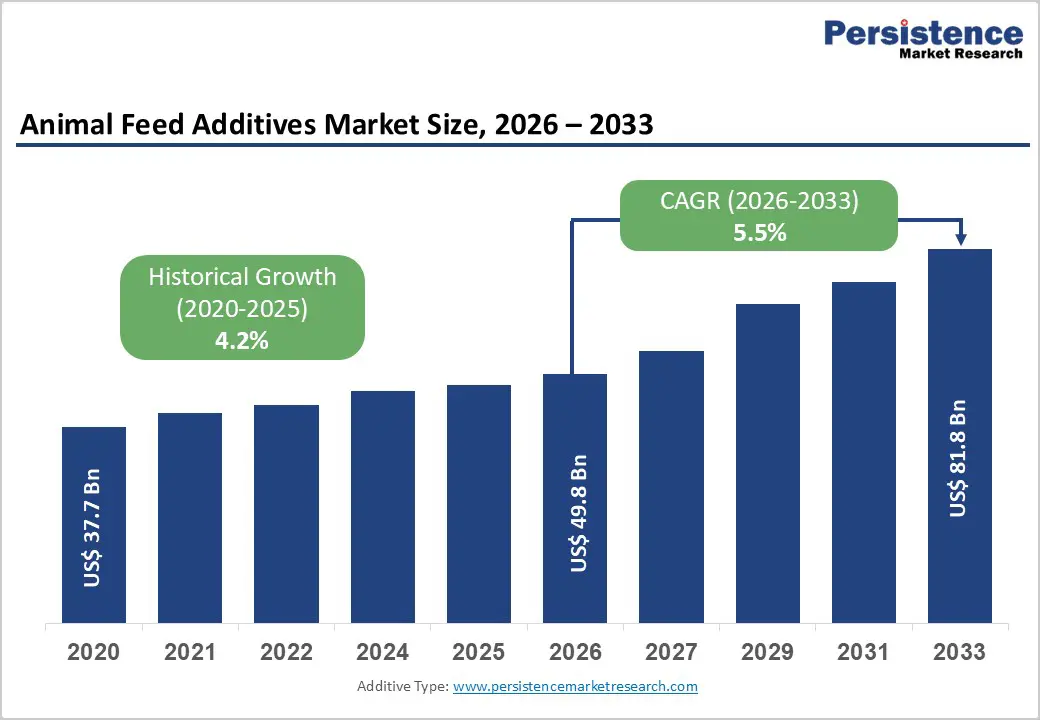
The global animal feed additives market size is estimated to grow from US$ 49.8 billion in 2026 to US$ 81.8 billion by 2033. The market is projected to record a CAGR of 5.5% during the forecast period from 2026 to 2033.
Rising global demand for high-quality animal protein is accelerating the adoption of scientifically formulated feed solutions enriched with functional additives. Feed additives such as amino acids, enzymes, and probiotics are increasingly utilized to enhance nutrient absorption, improve growth performance, and maintain animal health across intensive farming systems. With feed costs constituting a major share of production expenses, producers are prioritizing efficiency-enhancing inputs that optimize feed conversion ratios.
Additionally, the shift away from antibiotic growth promoters has strengthened demand for natural alternatives that support gut health and immunity. Advancements in biotechnology and precision nutrition are further improving additive efficacy and application specificity. Expanding commercial livestock production, particularly in emerging economies, along with increasing awareness regarding sustainable farming practices, continues to reinforce the importance of feed additives in modern animal nutrition.
Key Industry Highlights
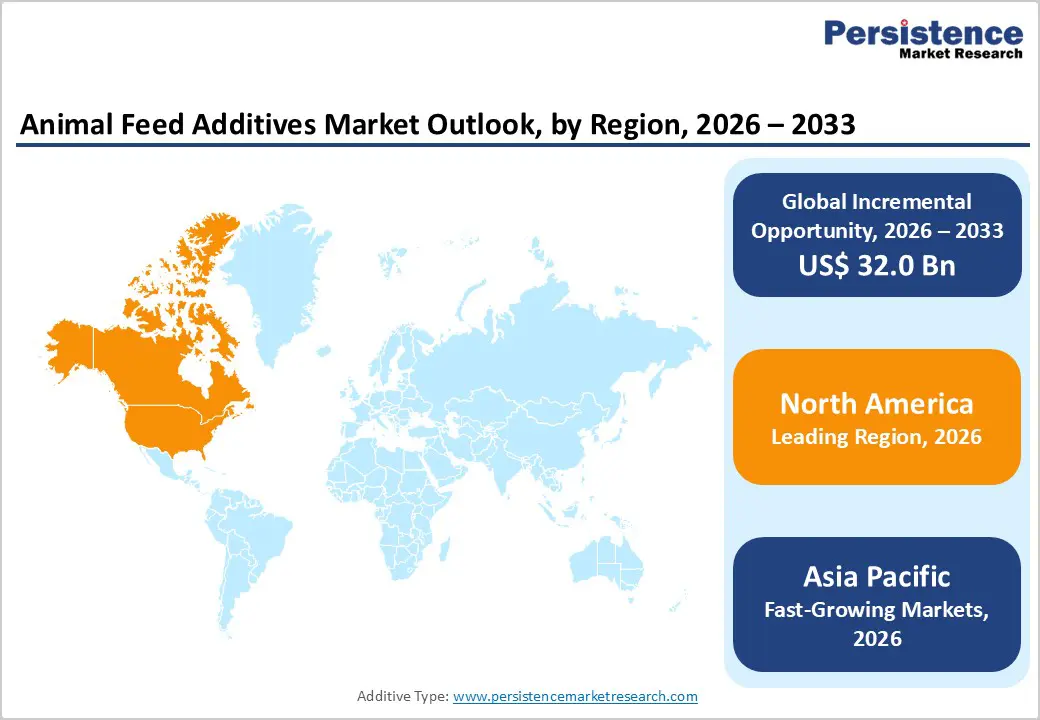
- Leading Region: North America accounts for 46.7%, supported by advanced feed production systems, high adoption of precision nutrition, strong regulatory frameworks, and widespread use of performance-enhancing additives across poultry and swine sectors.
- Fastest-Growing Region: Asia Pacific is expanding rapidly due to rising protein demand, increasing livestock commercialization, and growing adoption of compound feed and nutritional additives across developing economies.
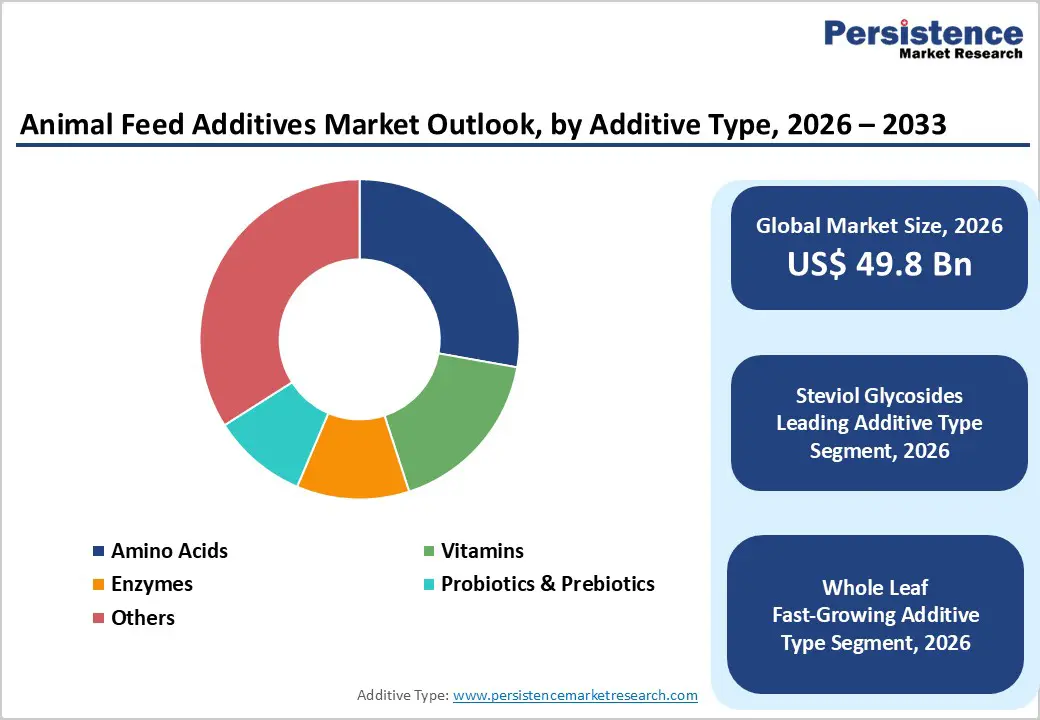
- Leading Additive Type Segment: Amino Acids, driven by their critical role in protein synthesis, improved feed efficiency, and cost optimization in large-scale livestock production.
- Fastest-Growing Additive Type Segment: Vitamins are gaining momentum as producers increasingly focus on immunity enhancement, metabolic performance, and overall animal health management.
- Leading Livestock Segment: Poultry fueled by high feed consumption, short production cycles, and strong demand for nutritionally optimized feed in industrial farming systems.
- Fastest-Growing Livestock Segment: Swine are witnessing notable growth as producers adopt advanced feed formulations to improve weight gain, health outcomes, and production efficiency.
| Key Insights | Details |
|---|---|
| Animal Feed Additives Market Size (2026E) | US$ 49.8 Bn |
| Market Value Forecast (2033F) | US$ 81.8 Bn |
| Projected Growth (CAGR 2026 to 2033) | 5.5% |
| Historical Market Growth (CAGR 2020 to 2025) | 4.2 % |
Market Dynamics
Driver - Intensification of Livestock Production and Focus on Feed Efficiency
The increasing industrialization of livestock farming is a primary force accelerating the adoption of feed additives globally. As meat, dairy, and aquaculture consumption rises, producers are under constant pressure to enhance productivity while controlling input costs. Feed additives such as amino acids, enzymes, and probiotics play a crucial role in improving feed conversion ratios, enabling animals to derive maximum nutritional value from limited feed resources. This becomes particularly important as feed costs account for a significant portion of total production expenses.
In addition, growing awareness regarding animal health and disease prevention has led to higher incorporation of functional additives that support immunity and gut health. Regulatory restrictions on antibiotic growth promoters across several regions have further intensified the shift toward alternative solutions, including phytogenics and microbial-based additives. Technological advancements in feed formulation, coupled with precision nutrition strategies, are enabling targeted nutrient delivery tailored to specific livestock requirements. Emerging economies are also witnessing rapid adoption of commercial feed practices, replacing traditional feeding methods. Collectively, these factors are reinforcing the critical role of feed additives in achieving sustainable, efficient, and scalable animal production systems.
Restraints - Raw Material Cost Fluctuations and Regulatory Complexity Across Regions
Volatility in raw material prices remains a persistent challenge, particularly for additives derived from agricultural commodities or fermentation processes. Fluctuations in the prices of corn, soybeans, and other feedstock inputs directly impact production costs for amino acids, vitamins, and enzymes. This creates pricing uncertainty for manufacturers and limits adoption among cost-sensitive livestock producers, especially in developing regions. Additionally, the production of certain additives requires sophisticated processing technologies, increasing capital and operational expenditure.
Moreover, the complex and highly fragmented regulatory landscape governing feed additives across different geographies. Approval processes for new ingredients, particularly probiotics and specialty additives, can be time-consuming and resource-intensive. Variations in permissible usage levels, labeling requirements, and safety standards further complicate market entry for global players. Compliance with stringent regulations in regions such as Europe adds to development timelines and costs. Moreover, concerns related to product stability, shelf life, and compatibility with different feed formulations can affect performance consistency. These factors collectively create operational and commercial challenges, particularly for smaller manufacturers attempting to scale in a competitive and regulated environment.
Opportunity - Rising Demand for Sustainable Nutrition and Antibiotic-Free Feed Solutions
A significant opportunity is emerging from the global transition toward sustainable and responsible animal farming practices. Increasing regulatory and consumer pressure to eliminate antibiotic growth promoters is driving demand for natural and functional alternatives such as probiotics, prebiotics, enzymes, and plant-based additives. These solutions not only enhance gut health and immunity but also contribute to improved nutrient absorption and reduced environmental impact through lower waste output. Additionally, advancements in biotechnology and microbial fermentation are enabling the development of next-generation feed additives with enhanced efficacy and targeted functionality. Precision nutrition, supported by data-driven feed formulation, is gaining traction as producers seek customized solutions tailored to species, lifecycle stage, and environmental conditions.
Furthermore, the rapid expansion of aquaculture presents another high-growth avenue, requiring specialized additives to improve feed efficiency and disease resistance in aquatic species. Emerging markets across the Asia Pacific and Latin America offer untapped potential due to increasing livestock commercialization and rising protein demand. Additionally, sustainability-focused innovations, including low-emission feed solutions and circular production models, are opening new pathways for long-term growth and differentiation.
Category-wise Analysis
By Additive Type Insights
Amino acids are projected to lead the global animal feed additives market in 2026, accounting for 27.8% of total revenue. Their dominance is attributed to their essential role in improving protein synthesis, feed conversion ratios, and overall animal productivity. Lysine, methionine, and threonine are widely incorporated in livestock diets, particularly in poultry and swine, to ensure balanced nutrition while reducing feed costs. Increasing pressure to optimize feed efficiency amid rising raw material prices has further accelerated their adoption. Additionally, amino acids support sustainable livestock production by lowering nitrogen excretion, aligning with environmental regulations. With the growing demand for high-quality meat and animal-derived products, producers are increasingly relying on precision nutrition strategies, reinforcing the segment’s leadership position globally.
By Form Insights
The dry segment is expected to hold the largest share in 2026, contributing 63.5% of total revenue. Its leadership is primarily driven by superior stability, longer shelf life, and ease of transportation compared to liquid alternatives. Dry additives are widely preferred in feed manufacturing due to their compatibility with premix formulations and uniform blending capabilities. Feed mills benefit from reduced storage complexity and lower risk of contamination, making dry formats operationally efficient. Additionally, advancements in encapsulation and granulation technologies have improved nutrient preservation and controlled release characteristics. While liquid additives are gaining traction in specific applications such as on-farm supplementation, dry formulations remain the industry standard, particularly in large-scale commercial feed production systems.
By Livestock Insights
The poultry segment is anticipated to account for 39.6% of total market revenue in 2026, making it the largest livestock category. This dominance is supported by the intensive nature of poultry farming, which relies heavily on nutritionally optimized feed for rapid growth and high productivity. Broilers and layers require precise inclusion of amino acids, enzymes, vitamins, and probiotics to maintain performance and health. The relatively short production cycle in poultry further drives consistent demand for feed additives. Additionally, rising global consumption of chicken meat and eggs, particularly in emerging economies, continues to expand the feed industry. Compared to ruminants, poultry exhibits higher feed conversion efficiency, making additive usage more economically viable and widespread across both developed and developing markets.
Region-wise Insights
North America Animal Feed Additives Market Trends
North America is projected to account for 46.7% of the global animal feed additives market value in 2026, with the United States representing the dominant contributor. The region’s strong position is underpinned by a highly industrialized livestock sector, particularly in poultry and swine production, where feed optimization is critical for profitability. Advanced feed manufacturing infrastructure and widespread adoption of precision nutrition technologies enable consistent incorporation of high-value additives such as amino acids, enzymes, and probiotics. Regulatory restrictions on antibiotic growth promoters have further accelerated the shift toward alternative solutions, including gut health enhancers and functional additives.
In addition, large integrated meat producers maintain long-term supply agreements with additive manufacturers, ensuring stable demand. Continuous innovation, supported by significant R&D investments, has led to the development of next-generation feed solutions focused on sustainability and performance. Strong quality standards and traceability requirements further reinforce the adoption of premium additives, positioning North America as a mature yet innovation-driven market.
Europe Animal Feed Additives Market Trends
Europe represents a well-established and regulation-intensive market, characterized by a strong emphasis on sustainability, animal welfare, and feed safety. Countries such as Germany, France, the Netherlands, Spain, and the United Kingdom are key contributors, supported by advanced livestock management practices. The region has been at the forefront of banning antibiotic growth promoters, which has significantly increased demand for alternatives such as probiotics, prebiotics, enzymes, and organic acids. Strict regulatory frameworks enforced by regional authorities ensure high product quality and encourage innovation in environmentally sustainable feed solutions.
Additionally, European consumers demonstrate strong preference for responsibly sourced animal products, indirectly driving demand for functional additives that enhance animal health and reduce environmental impact. The market also benefits from robust research capabilities and collaboration between feed producers and biotechnology firms. Increasing focus on reducing greenhouse gas emissions and improving nutrient utilization efficiency continues to shape product development strategies across the region.
Asia Pacific Animal Feed Additives Market Trends
Asia Pacific is expected to be the fastest-growing region, expanding at a CAGR of approximately 7.3% between 2026 and 2033. Growth is driven by rapid expansion of the livestock and aquaculture industries, supported by rising population, urbanization, and increasing protein consumption. China and India are major growth engines, with significant investments in commercial feed production and modernization of farming practices. The region is witnessing a shift from traditional feeding methods to scientifically formulated feed, boosting demand for additives such as amino acids, enzymes, and gut health promoters.
Moreover, aquaculture, in particular, is gaining momentum, requiring specialized feed formulations to enhance yield and disease resistance. Additionally, growing awareness among farmers regarding feed efficiency and cost optimization is accelerating adoption. Expansion of domestic feed manufacturing capacities, coupled with increasing presence of global additive producers, is strengthening market penetration. Favorable government initiatives aimed at improving livestock productivity further support long-term growth prospects in the region.
Competitive Landscape
The global animal feed additives market is highly competitive, with strong participation from Archer Daniels Midland Company, BASF SE, dsm-firmenich, Ajinomoto Co., Inc., Novonesis A/S, and Evonik Industries AG. These companies leverage advanced biotechnology, fermentation, and integrated supply chains to strengthen market presence while enhancing feed efficiency, animal health, and product quality across livestock and aquaculture applications. Rising demand for sustainable and antibiotic-free nutrition is accelerating innovation, with manufacturers expanding production capacities, improving traceability, ensuring regulatory compliance, and investing in R&D to develop next-generation functional feed additives.
Key Developments:
- In March 2026, Agrifirm acquired Hamlet Protein to strengthen its portfolio in young animal nutrition. The acquisition enhances its capabilities in high-quality protein solutions for early-stage livestock development. It also supports Agrifirm’s strategy to expand its global presence and deliver more specialized, performance-driven feed solutions.
- In May 2025, Avitech Nutrition launched a new Trading Division to expand into the supply of key animal feed additive ingredients, starting with vitamin blends and straight vitamins used in feed formulations, with plans to broaden its product portfolio further. Global Animal Feed Additives Market Report Scope
Companies Covered in Animal Feed Additives Market
- Archer Daniels Midland Company (ADM)
- BASF SE
- dsm-firmenich
- Ajinomoto Co., Inc.
- Novonesis A/S
- Evonik Industries AG
- Nutreco N.V.
- Kemin Industries, Inc.
- Adisseo
- Alltech, Inc.
- Cargill, Incorporated
- Novus International, Inc.
- Sumitomo Chemical Co., Ltd.
- DuPont de Nemours, Inc.
- Lallemand Inc.
- Others
Frequently Asked Questions
The global animal feed additives market is projected to be valued at US$ 49.8 Bn in 2026.
Rising global meat consumption, intensification of livestock production, and increasing focus on animal health and feed efficiency are driving the animal feed additives market.
The global animal feed additives market is poised to witness a CAGR of 5.5% between 2026 and 2033.
Growth opportunities lie in antibiotic alternatives, precision nutrition, sustainable feed solutions, and expanding aquaculture and emerging markets demand.
Archer Daniels Midland Company (ADM), BASF SE, dsm-firmenich, Ajinomoto Co., Inc., Novonesis A/S, and Evonik Industries AG are some of the key players in the animal feed additives market.


