




- Medical Devices
- Surgical Fluid Disposal Market
Surgical Fluid Disposal Market Size, Share, Growth, and Regional Forecast, 2026 - 2033
Surgical Fluid Disposal Market by Product Type (Containers, Waste bags, Tubing Sets, Others), Application (Urology, Gastroenterology, Laparoscopy, Gynecology, Other), End-user, and Regional Analysis from 2026 - 2033

Surgical Fluid Disposal Market Share and Trends Analysis
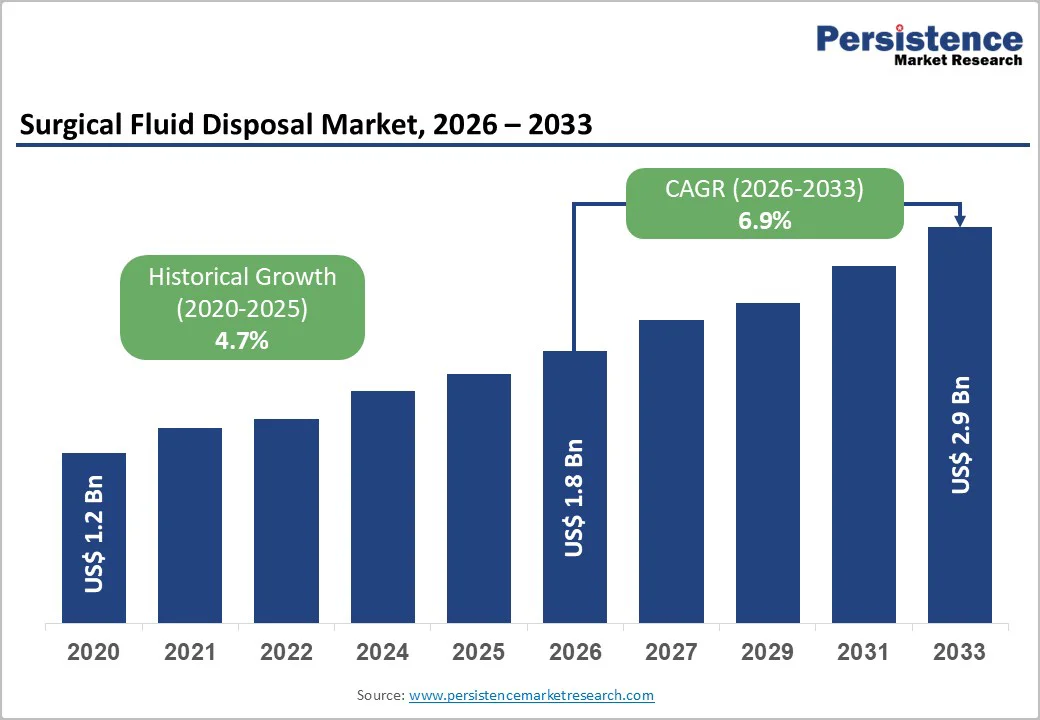
The global surgical fluid disposal market size is estimated to grow from US$1.8 billion in 2026 to US$2.9 billion by 2033. The market is projected to record a CAGR of 6.9% from 2026 to 2033. The global market is growing steadily due to rising surgical volumes, increasing adoption of minimally invasive procedures, and stricter hospital infection-control protocols.
As operating rooms generate significant biohazardous fluid waste, hospitals are prioritizing automated, closed-loop disposal systems to reduce staff exposure and improve safety. Demand is also supported by regulatory emphasis on safe handling of medical waste and the need to streamline OR workflows. Technological advancements such as mobile suction units, fluid management carts, and integrated waste collection systems are enhancing efficiency and driving market uptake. North America leads due to strong hospital infrastructure and compliance requirements.
Key Industry Highlights:
- Growing surgical procedures driven by aging populations, chronic diseases, and expanded healthcare access are significantly increasing operating-room fluid waste.
- Regulatory bodies worldwide emphasize minimizing exposure to blood-borne pathogens and biohazardous waste.
- Portable suction and mobile fluid disposal carts are gaining traction due to flexibility, mobility, and suitability for emergency rooms, outpatient centers, and multi-specialty ORs.
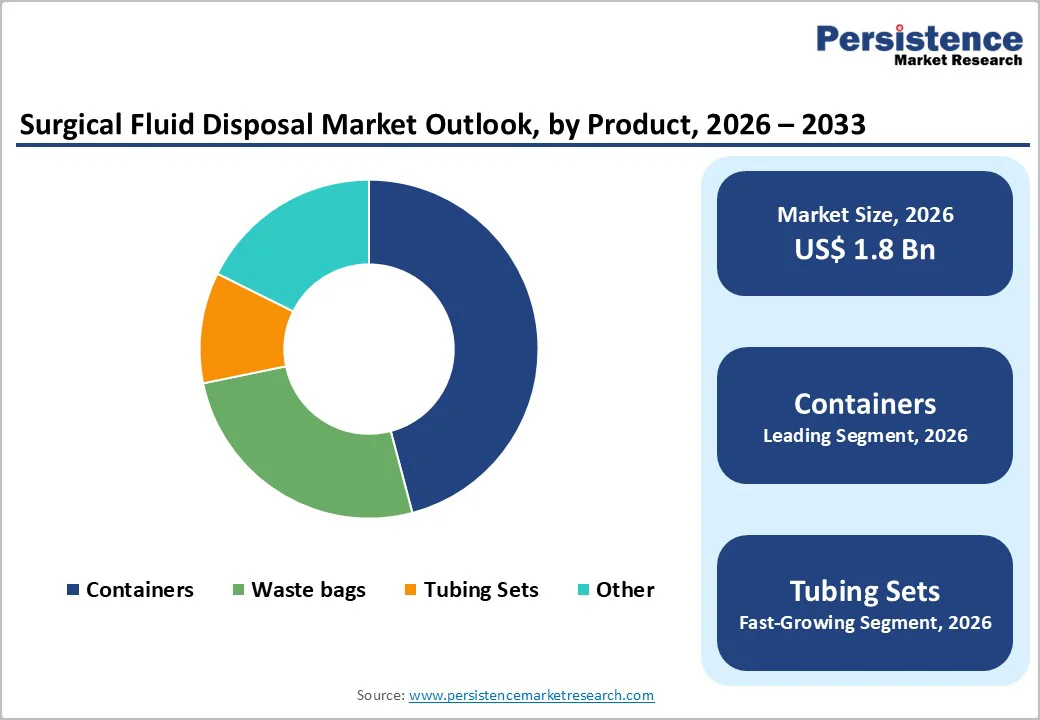
- Leading Product Type: Containers are widely used across all surgical settings, have high replacement frequency, and are essential for safe, compliant fluid waste collection.
- Leading Region: North America leads due to high surgical volumes, strict infection-control regulations, strong hospital budgets, rapid adoption of automated fluid management systems, and well-established healthcare infrastructure.
| Key Insights | Details |
|---|---|
|
Surgical Fluid Disposal Market Size (2026E) |
US$1.8 Bn |
|
Market Value Forecast (2033F) |
US$2.9 Bn |
|
Projected Growth (CAGR 2026 to 2033) |
4.7% |
|
Historical Market Growth (CAGR 2020 to 2024) |
6.9% |
Market Dynamics
Driver - Shift Toward Zero-Contact OR Waste Handling
Hospitals are increasingly transitioning toward zero-contact operating room (OR) waste handling, driven by heightened focus on staff safety and stricter infection-control policies. Traditional canister-based systems require manual lifting, opening, and disposal, exposing healthcare workers to bloodborne pathogens and splashed fluids. Modern automated, sealed surgical fluid disposal systems eliminate this risk by enabling suction, collection, measurement, and disposal without any physical contact. These units integrate closed-loop tubing, auto-seal features, and hands-free emptying mechanisms, ensuring every step remains contamination-free. This shift not only enhances clinical safety but also improves workflow efficiency, reduces labor burden, and minimizes regulatory non-compliance in high-volume surgical environments.
Restraints - Infection-Control Risks from Improper Use
Improper use of surgical fluid disposal systems remains a significant restraint, as even advanced devices depend heavily on correct handling by clinical staff. If canisters are not properly sealed, tubing is misconnected, or suction parameters are incorrectly set, this can lead to fluid leaks, aerosolization, or backflow, creating serious infection-control hazards in the operating room. Such incidents not only expose nurses and surgeons to blood-borne pathogens but also disrupt surgical workflow and increase sterilization requirements. Hospitals, particularly those with high staff turnover, struggle to maintain consistent adherence to protocols. These perceived operational risks make some facilities hesitant to transition from simple manual systems to more complex automated solutions, slowing overall market adoption despite technological advancements.
Opportunity - AI-Enabled Fluid Monitoring & Predictive Maintenance
The AI-enabled fluid monitoring and predictive maintenance opportunity represents a significant advancement in surgical fluid disposal systems. By integrating smart sensors and artificial intelligence, these systems can continuously monitor fluid levels in real time, detect potential leaks, and identify early signs of system malfunctions. Automated alerts and predictive maintenance notifications allow hospital staff to address issues before they cause disruptions, reducing downtime and ensuring uninterrupted OR operations. This technology not only enhances operational efficiency but also improves safety by minimizing staff exposure to biohazardous fluids. Additionally, AI-driven insights can help hospitals optimize inventory management, plan preventive maintenance schedules, and lower overall operational costs, making it a high-value, future-ready solution for modern surgical facilities.
Category-wise Analysis
By Product Type Insights
Containers dominate the Surgical Fluid Disposal Market due to their critical role in safely collecting and storing surgical fluids across a wide range of procedures. Unlike tubing sets or waste bags, containers serve as the primary vessel for fluid management, ensuring compliance with infection-control regulations and minimizing staff exposure to biohazardous material. They are used in virtually every operating room, from general surgery to minimally invasive procedures, which drives consistent demand. Furthermore, hospitals frequently replace containers to maintain hygiene standards and meet regulatory requirements, creating recurring revenue for manufacturers. Their compatibility with automated and closed-loop disposal systems also enhances workflow efficiency, making containers an indispensable component in modern surgical fluid management and the leading product segment in the market.
By Application Insights
Laparoscopy leads the Surgical Fluid Disposal Market because minimally invasive procedures produce substantial volumes of irrigation and bodily fluids that must be safely collected and disposed of. The global shift toward laparoscopic surgeries is driven by benefits such as shorter patient recovery times, reduced postoperative complications, and lower infection risks. Hospitals performing high volumes of these procedures prioritize automated and closed-loop fluid disposal systems to maintain safety, efficiency, and regulatory compliance. Compared to other specialties like urology, gastroenterology, or gynecology, laparoscopy involves a higher frequency of fluid-intensive procedures across multiple departments, resulting in consistently greater demand for advanced fluid management solutions and making it the dominant end-user segment.
Region-wise Insights
North America Surgical Fluid Disposal Trends
North America leads the global market due to its advanced healthcare infrastructure, high surgical volumes, and stringent infection-control regulations. Hospitals and ambulatory surgical centers in the region are increasingly adopting automated, closed-loop fluid disposal systems to enhance OR efficiency and staff safety. The area is witnessing a surge in minimally invasive and laparoscopic procedures, further driving demand for high-capacity fluid management solutions. Integration with digital OR platforms, predictive maintenance features, and AI-enabled monitoring systems is gaining traction, reflecting a focus on workflow optimization and data-driven decision-making. Additionally, sustainability initiatives are encouraging the adoption of reusable containers and eco-friendly disposables, positioning North America at the forefront of innovation in surgical fluid disposal.
Asia Pacific Surgical Fluid Disposal Market Trends
Asia is emerging rapidly due to expanding healthcare infrastructure, rising surgical volumes, and growing awareness of infection-control standards. Countries such as India, China, and Australia are investing heavily in modern hospitals and ambulatory surgical centers, driving demand for efficient fluid disposal systems. Increasing adoption of minimally invasive and laparoscopic procedures amplifies fluid management needs. Hospitals are gradually shifting from manual canisters to automated, closed-loop systems to improve safety and OR efficiency. Additionally, rising government initiatives, medical tourism, and focus on hospital hygiene standards are creating significant opportunities for market players in this high-growth region.

Competitive Landscape
The global surgical fluid disposal market competitive landscape is characterized by a mix of global medical device leaders and specialized regional players. Key companies focus on innovation, offering automated, closed-loop, and AI-enabled fluid management solutions to enhance OR efficiency and safety. Competitive strategies include product differentiation, strategic partnerships with hospitals, and expansion into emerging markets. Vendors are increasingly providing subscription-based models, consumable supply agreements, and integrated OR solutions to retain customers.
Key Industry Developments:
- In March 2025, DeRoyal, acquired Skyline Medical’s Streamway® Wall Suction Waste Fluid Management product line and related assets. This acquisition significantly expanded DeRoyal’s portfolio of advanced waste fluid management technologies, reinforcing its commitment to providing safe, efficient, and environmentally responsible solutions for healthcare providers.
Companies Covered in Surgical Fluid Disposal Market
- B. Braun Melsungen AG
- Skyline Medical, Inc.
- Baxter International, Inc.
- Cardinal health, Inc.
- Hill Rom holdings, Inc.
- CR Bard, Inc.
- Medtronic Plc
- Olympus Corporation
- Stryker Corporation
- Smith & Nephew Plc
- Others
Frequently Asked Questions
The global surgical fluid disposal market is projected to be valued at US$1.8 Bn in 2026.
Increasing global surgeries, including minimally invasive and laparoscopic procedures, generate substantial fluid waste, boosting demand for efficient disposal systems.
The global surgical fluid disposal market is poised to witness a CAGR of 6.9% between 2026 and 2033.
Smart systems that predict fill levels, detect leaks, and automate maintenance alerts.
B. Braun Melsungen AG, Skyline Medical, Inc., Baxter International, Inc., Cardinal health, Inc., Medtronic Plc, and others.


