




- Nutraceuticals & Functional Foods
- Vegan Collagen Market
Vegan Collagen Market Size, Share, Trends, Growth, and Regional Forecast, 2026 to 2033
Vegan Collagen Market by Source (Fruits, Vegetables, Algae, Others), Form (Dry, Liquid), End-user (Dietary Supplements, Cosmetics & Personal Care, Sports & Fitness Nutrition, Others), and Regional Analysis from 2026 to 2033

Vegan Collagen Market Share and Trends Analysis
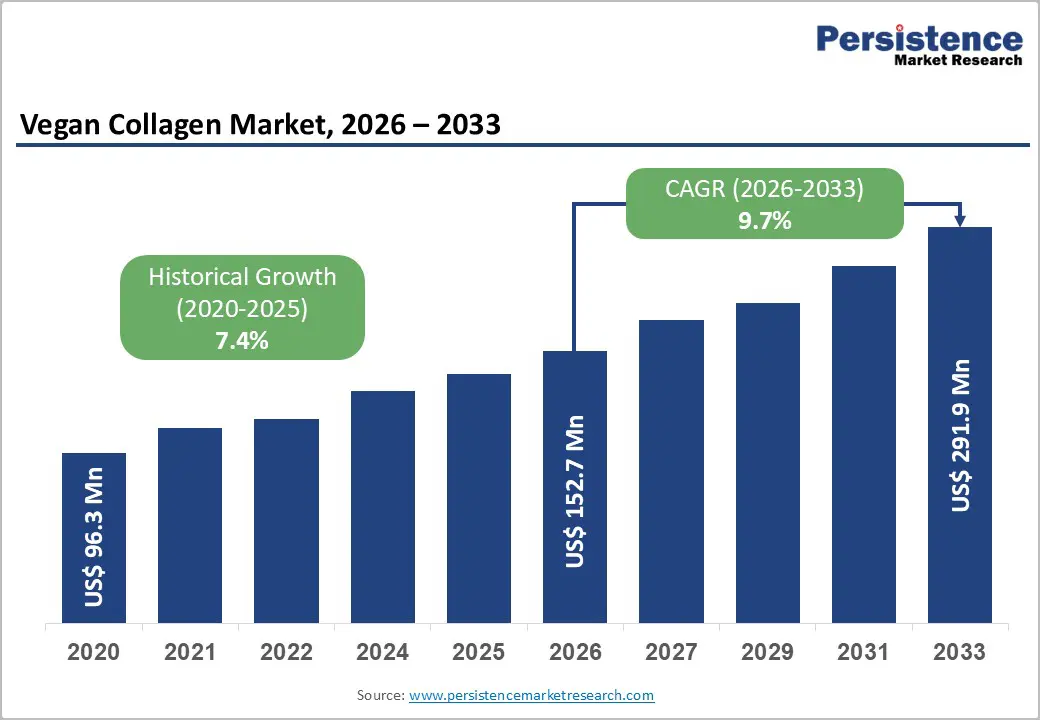
The global vegan collagen market size is estimated to grow from US$ 152.7 million in 2026 to US$ 291.9 million by 2033, projected to record a CAGR of 9.7% during the forecast period from 2026 to 2033.
The market is undergoing a transformative phase as consumers increasingly embrace plant-based, ethical, and clean-label nutrition. Rising interest in beauty-from-within, functional foods, and sustainable wellness is driving innovation, while biotechnology and algae-based sources are redefining production possibilities.
Key Industry Highlights
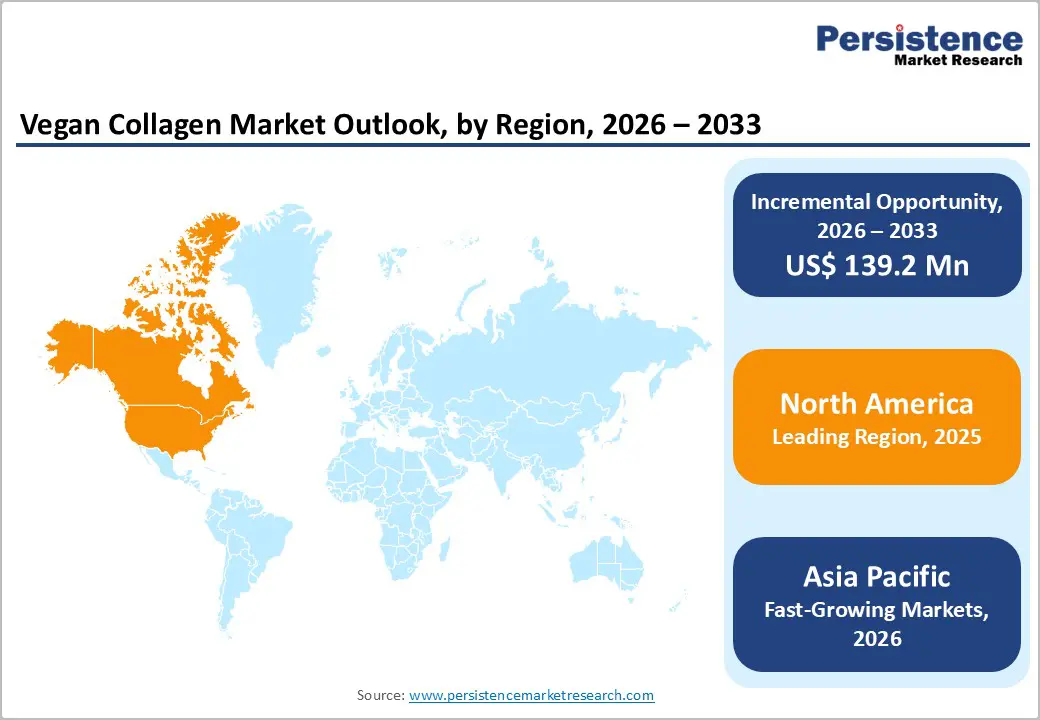
- Leading Region: North America, holding 42% market share, driven by strong demand for plant-based nutrition, functional beverages, and beauty-from-within supplements.
- Fastest-Growing Region: Asia Pacific, growing at a CAGR of 13.1%, fueled by rising health consciousness, urbanization, plant-based diet adoption, and digital wellness platforms.
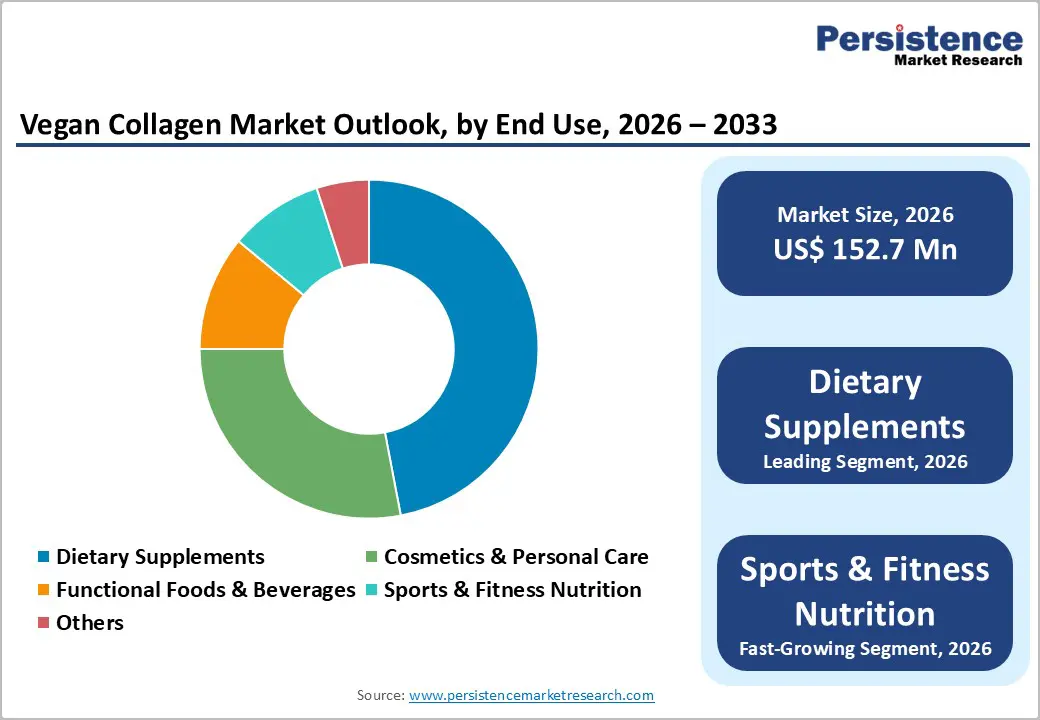
- Fastest-Growing End-user Segment: Dietary Supplements, commanding approx. 48% share, driven by convenience, precise dosing, and preventive health-focused formulations for skin, hair, and joint wellness.
- Market Drivers: Growing demand for clean beauty and nutricosmetics is encouraging product innovation in anti-aging skincare, functional beverages, and fortified foods.
- Opportunities: Partnering with beverage and snack brands enables embedding vegan collagen in everyday products, creating convenient, value-added options that enhance differentiation and consumer loyalty.
- Key Developments: In October 2025, Geltor received FDA GRAS confirmation for PrimaColl® vegan collagen polypeptide; in September 2025, Evonik launched VECOLLAN® recombinant collagen for clinical research applications.
| Key Insights | Details |
|---|---|
| Global Vegan Collagen Market Size (2026E) | US$ 152.7 Mn |
| Market Value Forecast (2033F) | US$ 291.9 Mn |
| Projected Growth (CAGR 2026 to 2033) | 9.7% |
| Historical Market Growth (CAGR 2020 to 2025) | 7.4% |
Market Dynamics
Driver - Growing Demand for Clean Beauty and Nutricosmetics is Fueling Product Innovation Across Anti-Aging Skincare
Rising consumer awareness around holistic wellness is reshaping the skincare landscape, with a strong shift toward products that combine beauty and nutrition. The growing demand for clean beauty and nutricosmetics is prompting brands to explore innovative formulations that integrate plant-based collagen, antioxidants, vitamins, and peptides. Consumers are increasingly seeking anti-aging solutions that deliver visible skin benefits while aligning with ethical, vegan, and environmentally responsible values. This trend is encouraging manufacturers to rethink traditional product lines, emphasizing transparency, ingredient traceability, and sustainability in their offerings.
As a result, the vegan collagen segment is experiencing heightened innovation in anti-aging skincare, including serums, creams, and ingestible supplements that target elasticity, hydration, and overall skin health. Collaboration with biotechnology and food science is enabling high-purity, bioavailable collagen extracts from algae, microbes, and other plant sources. The integration of clean-label, multifunctional ingredients helps brands differentiate in a crowded market and appeal to health-conscious, eco-aware consumers seeking long-term skin wellness.
Restraints - Inconsistent Labeling Standards and Certification Requirements Across Regions Create Market Entry Obstacles
Expanding into the global vegan collagen market is complicated by varying labeling standards and certification requirements across regions. Companies face uncertainty around acceptable product claims, recognized certifications, and compliant labeling practices, which can delay launches and increase regulatory costs. These disparities pose significant entry barriers, impacting both established brands and new market entrants.
Consequently, businesses must dedicate substantial resources to navigate regional regulations, secure multiple certifications, and tailor packaging and messaging to meet local compliance and consumer expectations. Such challenges can restrict market reach, slow international expansion, and make it difficult for smaller or innovative players to scale their vegan collagen products efficiently, limiting broader adoption and competitive positioning.
Opportunity - Partner with Beverage and Snack Brands to Embed Vegan Collagen in Daily Use Consumer Products
The evolving consumer preference for functional foods and beverages presents a significant opportunity for vegan collagen producers to expand beyond supplements and skincare. Partnering with beverage and snack brands allows companies to embed plant-based collagen into everyday products, creating convenient, health-focused options that appeal to busy, wellness-conscious consumers. Such collaborations can elevate brand visibility and accelerate mainstream adoption by integrating collagen into formats that fit naturally into daily routines.
For both established players and new startups, these partnerships enable co-innovation in product formulations, such as fortified smoothies, protein bars, and ready-to-drink beverages. By delivering tangible skin, hair, joint, and overall wellness benefits, vegan collagen becomes a value-added ingredient that enhances product differentiation, drives trial, and fosters long-term consumer loyalty across diverse market segments.
Category-wise Analysis
By End-user Insights
Dietary Supplements holds approx. 48% market share as of 2025, making it the dominant end-use segment in the global vegan collagen market. Consumers increasingly seek convenient, targeted, and daily solutions to support skin, hair, joint, and overall wellness, positioning dietary supplements as the preferred format. These products offer precise dosing, consistent bioavailability, and the ability to combine collagen with complementary nutrients such as vitamins, minerals, and antioxidants, enhancing efficacy and consumer appeal.
The segment’s leadership is reinforced by the growing trend of preventive health and beauty-from-within lifestyles, where individuals prioritize long-term wellness through supplementation. Daily capsules, powders, and gummies provide a simple, reliable way to incorporate vegan collagen into routines, driving repeat usage and establishing dietary supplements as the foundational channel for market growth.
Algae-derived collagen is projected to experience strong growth over the forecast period
Algae-derived collagen is projected to grow at a CAGR of 12.8% during the forecast period in the global Vegan Collagen market, driven by increasing demand for sustainable and plant-based alternatives to animal-derived collagen. Its rich amino acid profile, high bioavailability, and environmentally friendly cultivation process make it an attractive option for health-conscious and eco-aware consumers. Brands are leveraging algae-based collagen in supplements, functional foods, beverages, and beauty-from-within products, creating multiple avenues for market expansion.
Advancements in biotechnological extraction and fermentation methods are enhancing purity and consistency, enabling scalable production to meet rising global demand. Growing consumer preference for clean-label, ethical, and vegan-certified products further positions algae-derived collagen as a high-potential, future-ready segment within the market.
Region-wise Insights
North America Vegan Collagen Market Trends
North America holds approximately 42% share in the global market, reflecting strong consumer demand for plant-based, clean-label, and ethically sourced nutrition. In the United States, brands are increasingly integrating vegan collagen into functional beverages, protein bars, and beauty-from-within supplements, responding to rising interest in holistic wellness and preventive health. Skincare and nutricosmetic products featuring vegan collagen are gaining traction as consumers seek effective anti-aging and hair, skin, and nail benefits without animal-derived ingredients.
In Canada, the market is witnessing growth in fortified snacks, vegan protein powders, and ready-to-drink formulations that combine collagen with vitamins, minerals, and antioxidants. Local startups are experimenting with high-purity algae and microbial-sourced collagen, emphasizing traceability, sustainability, and bioavailability. E-commerce and D2C platforms are further accelerating adoption across urban and health-conscious demographics.
Asia Pacific Vegan Collagen Market Trends
Asia Pacific vegan collagen market is expected to reach a CAGR of 13.1%, driven by increasing health consciousness, rising disposable incomes, and a surge in plant-based diet adoption across the region. In India, urban consumers are embracing vegan collagen-infused nutraceutical powders, wellness beverages, and dietary supplements to support skin, hair, and joint health. China is witnessing innovation in high-purity algae and microbial-sourced collagen, targeting functional foods, fortified drinks, and natural colorants for the food and beverage industry.
Japan’s market trends highlight premiumization, with vegan collagen being incorporated into cosmeceuticals and beauty-from-within supplements aimed at anti-aging and skin rejuvenation. South Korea is seeing growth in convenient collagen shots, detox blends, and ready-to-consume nutrition products fueled by the beauty-through-nutrition movement. E-commerce and online wellness platforms are accelerating accessibility and consumer adoption across the region.
Competitive Landscape
The global Vegan Collagen Market exhibits a moderately fragmented competitive landscape, with leading companies focusing on innovation, strategic partnerships, and global expansion to strengthen market presence. Established players are refining extraction technologies, including fermentation and algae-based processes, to deliver high-purity, bioavailable collagen for nutraceuticals, functional foods, and beauty-from-within products. Startups are entering the market with agile, tech-driven approaches, leveraging modular production systems and precision biotechnologies to scale efficiently and meet rising demand.
R&D investments are emphasizing formulation optimization, multi-functional benefits, and enhanced stability for various applications. Companies are securing certifications such as USDA Organic, Non-GMO, and vegan compliance to build consumer trust and support clean-label positioning. Focusing on sustainable sourcing, transparent production, and high-quality standards is driving differentiation and shaping competitive dynamics globally.
Key Developments:
- In October 2025, Agronomics announced that its portfolio company Geltor received a “No Questions” letter from the U.S. FDA, confirming GRAS status for its PrimaColl® vegan collagen polypeptide. The approval strengthens Geltor’s position in biotech-driven functional ingredients as demand for animal-free collagen accelerates.
- In September 2025, Evonik introduced VECOLLAN®, a recombinant collagen designed for clinical study applications. The launch aims to advance medical research with a high-purity, sustainable collagen alternative.
- In May 2025, DR.Rashel launched India’s first 100% vegan Bio-Collagen Deep Facial Mask under its Proboost Skincare Range. The innovation targets ethical and plant-based beauty enthusiasts seeking advanced facial care solutions.
Companies Covered in Vegan Collagen Market
- Collagen Life Sciences
- Darling Ingredients
- Geltor
- Ming Chyi Biotechnology Ltd
- Evonik
- Lipoid-Kosmetik
- Corpowell
- Jellatech Inc
- Dermat India
- Others
Frequently Asked Questions
The global vegan collagen market is projected to be valued at US$ 152.7 Mn in 2026.
The global vegan collagen market is driven by the rising consumer demand for clean beauty and nutricosmetics, which is spurring innovation in anti-aging skincare products.
The global vegan collagen market is poised to witness a CAGR of 9.7% between 2026 and 2033.
A major market opportunity lies in collaborating with beverage and snack brands to incorporate vegan collagen into everyday products, offering significant growth potential for industry players.
Major players in the global Vegan Collagen market include Darling Ingredients, Geltor, Ming Chyi Biotechnology Ltd, Evonik, Lipoid-Kosmetik, Jellatech Inc, Collagen Life Sciences, and others.


