




- Hardware & Software IT Services
- Text Analytics Market
Text Analytics Market Size, Share, and Growth Forecast, 2026 – 2033
Text Analytics Market by Component (Software [On-Premises, Cloud-Based / SaaS], Services [Consulting, Support and Maintenance, Integration & Deployment, Others]), Application (Customer Experience & Sentiment Analytics, Risk, Fraud & Compliance Management, Social Media & Brand Monitoring, Digital Intelligence, Enterprise Intelligence & Decision Support, Others), Industry and Regional Analysis for 2026 – 2033

Text Analytics Market Size and Trends
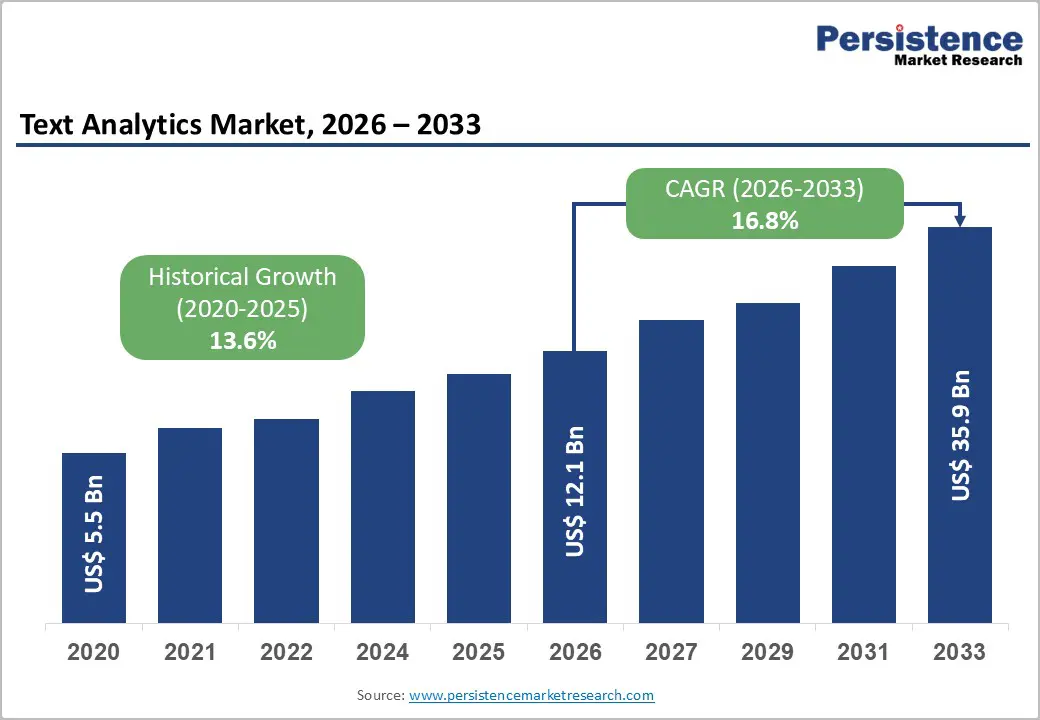
The global Text Analytics Market size is projected to rise from US$12.1 Bn in 2026 to US$35.9 Bn by 2033. It is anticipated to witness a CAGR of 16.8% during the forecast period from 2026 to 2033, driven by the exponential growth in unstructured data volumes, enterprise recognition of text analytics' strategic value in extracting actionable insights from vast customer interaction repositories, and the integration of advanced AI and machine learning technologies into text analytics platforms. The widespread adoption of natural language processing (NLP) technologies, coupled with regulatory compliance imperatives and the business imperative to transition from data-driven decision-making to autonomous action-driven intelligence, is propelling substantial market growth and vendor innovation.
Key Industry Highlights:
- Leading Component: Software dominates with over 68% market share in 2026, valued at more than US$ 8.2 Bn, driven by the need to extract insights from unstructured data such as emails, social media, and documents. Services are the fastest-growing segment due to high demand for deployment, customization, integration, and ongoing model support.
- Leading Application: Customer experience & sentiment analytics holds over 37% market share in 2026, valued at more than US$ 4.5 Bn, fueled by the need to understand real-time customer opinions, emotions, and feedback. Risk, fraud & compliance management is growing at the fastest rate, driven by increasing regulatory scrutiny and sophisticated fraud detection requirements.
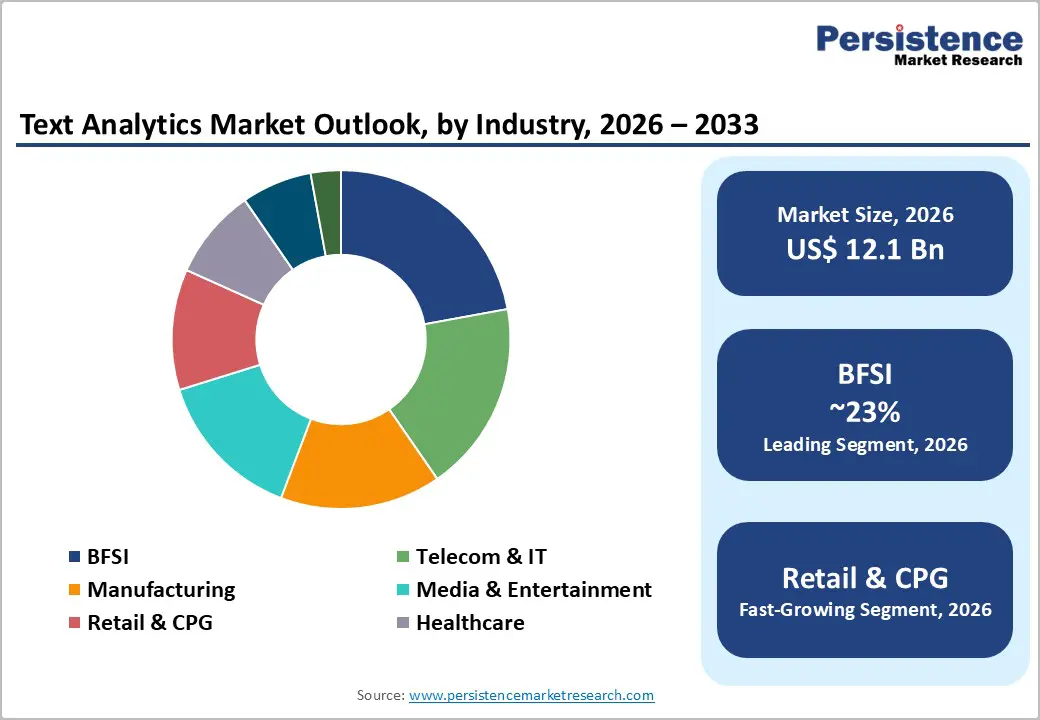
- Leading Industry: BFSI commands the largest share at over 23% in 2026, valued at more than US$ 2.8 Bn, due to high volumes of unstructured data and demand for fraud detection, risk management, and personalized offerings. Retail & CPG is the fastest-growing sector, leveraging text analytics for consumer insights, operational efficiency, and churn reduction.
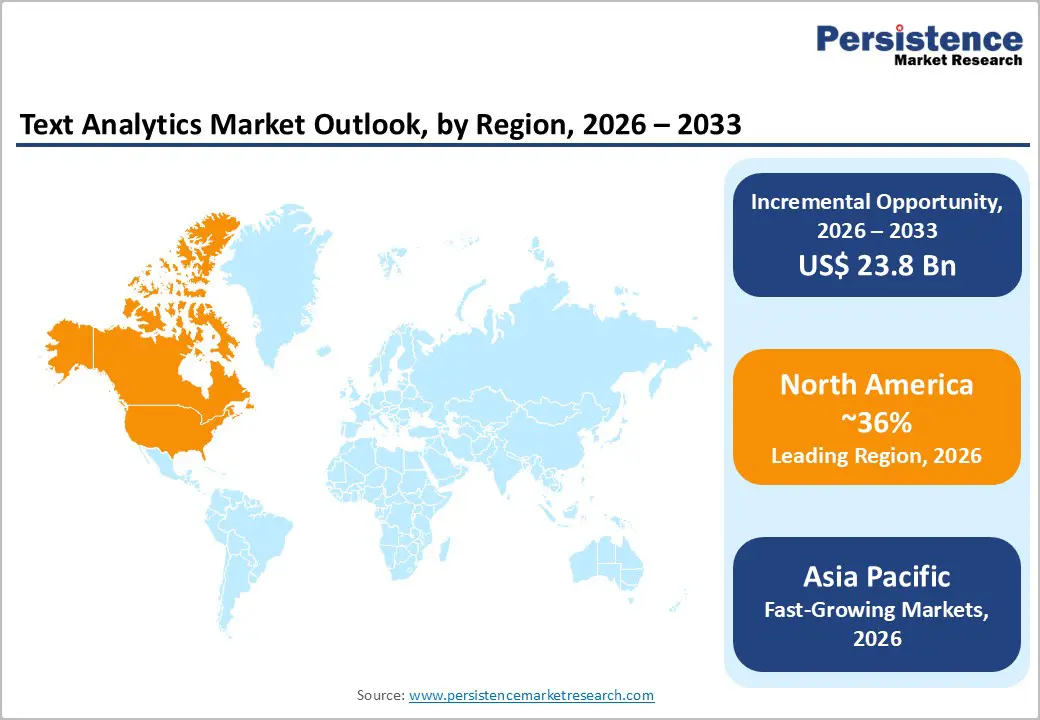
- Leading Region: North America leads with over 36% market share in 2026, valued at approximately US$ 4.4 Bn, supported by early AI adoption, cloud infrastructure, and regulatory-driven analytics. Asia Pacific is the fastest-growing region with a 21.7% CAGR, driven by digital transformation, AI adoption, e-commerce, and government initiatives. Europe holds over 24% share, driven by GDPR, data sovereignty, and ethical AI adoption.
| Global Market Attribute | Key Insights |
|---|---|
| Text Analytics Market Size (2026E) | US$12.1 Bn |
| Market Value Forecast (2033F) | US$35.9 Bn |
| Projected Growth (CAGR 2026 to 2033) | 16.8% |
| Historical Market Growth (CAGR 2020 to 2025) | 13.6% |
Market Dynamics
Driver
Exponential Growth in Unstructured Data and Enterprise Digitalization
Organizations are facing an unprecedented surge of unstructured data 80–90% of enterprise information from customer interactions, social media, emails, call center transcripts, and documents. The rise of omnichannel engagement has created an urgent need to analyze these interactions on a scale. Text analytics platforms help extract, classify, and interpret feedback, identifying themes, sentiment, and emerging issues beyond manual capabilities. Rapid enterprise AI adoption over 30% of AI use cases reached full production in 2025 highlights recognition that advanced analytics delivers measurable business value. Converting unstructured text into actionable intelligence presents transformational opportunities, driving significant investment in text analytics infrastructure and capabilities.
AI and Machine Learning Integration Enabling Advanced Cognitive Capabilities
The integration of AI, machine learning, and deep learning is transforming text analytics by enabling advanced cognitive capabilities such as context understanding, sentiment detection, sarcasm recognition, and intent analysis beyond traditional statistical methods. Natural language processing (NLP) dominates AI applications, with over 50% of NLP tools leveraging transformer-based large language models like GPT-3 and GPT-4 for human-like analytical summaries. Industries such as manufacturing and automotive have seen rapid adoption, using text analytics to analyze customer feedback, monitor quality, and optimize operations through automated analysis of logs and sensor data. The combination of AI with scalable computing infrastructure is democratizing access, allowing organizations of all sizes to extract enterprise-grade insights from unstructured textual data.
Restraint
Data Privacy, Security, and Regulatory Compliance Complexity
Organizations must comply with regulations such as GDPR, CCPA, HIPAA, and PCI-DSS, requiring robust governance, encryption, access controls, and audits, which increase complexity and cost. Data residency mandates in countries like China, India, and Russia necessitate local infrastructure, complicating global deployment. Employee privacy concerns, potential algorithmic bias, and legal scrutiny further slow adoption. The lack of universally accepted ethical standards, especially in sensitive sectors like healthcare, finance, and criminal justice, adds to organizational hesitancy in implementing advanced text analytics solutions.
Skill Gap and Implementation Complexity
Adopting enterprise-grade text analytics is challenging due to a severe shortage of expertise in data science, NLP, machine learning, and data engineering. Only a small fraction of businesses are using or testing NLP solutions, highlighting limited technical resources and confidence. Deployment across diverse enterprise environments, legacy systems, multiple clouds, and varied data sources requires significant professional services and long implementation timelines. Organizations often underestimate the effort for data preparation, including cleaning, normalization, annotation, and quality assurance. The talent scarcity drives competition for AI specialists, increasing compensation costs and constraining internal capability development.
Opportunity
Accelerating Adoption of Generative AI and Large Language Models
The rapid adoption of large language models (LLMs) like ChatGPT, GPT-4, Claude, and Gemini is transforming text analytics, allowing organizations to implement advanced platforms without deep ML expertise. Retrieval-augmented generation (RAG) and vector databases used by 60-70% of generative AI adopters enable enterprises to enhance LLMs with proprietary data for richer, context-aware insights. This convergence supports automated document analysis, intelligent summarization, predictive analytics, and autonomous decision-making. Emerging use cases include automated compliance reporting, smart customer service, churn prediction, and real-time market sentiment analysis.
?Rising Demand for Predictive and Prescriptive Analytics
Organizations are increasingly looking to move beyond descriptive insights to anticipate future trends, customer behavior, and operational challenges using unstructured data from emails, social media, and documents. Enterprises in finance, healthcare, retail, and logistics are leveraging these insights to reduce risks, optimize operations, and enhance customer experience. The ability to combine historical data with real-time textual information creates a strategic advantage, increasing the adoption of advanced text analytics platforms. As organizations seek actionable intelligence rather than raw data, the demand for predictive and prescriptive text analytics solutions is set to accelerate. This opens opportunities for vendors to offer specialized services, scalable platforms, and industry-specific analytics applications.
Category-wise Analysis
Component Analysis,
Software dominates the global market, capturing more than 68% market share in 2026 with a value exceeding US$ 8.2 Bn, as businesses increasingly need tools to extract insights from unstructured data such as emails, social media, and documents. Organizations require real-time sentiment analysis, trend detection, and automated reporting to support decision-making. Software solutions offer scalable, customizable, and easily integrable platforms that address these needs, enabling faster analysis, operational efficiency, and improved customer engagement.
Services demonstrate significant growth due to organizations increasingly needing expert support for the deployment, customization, and integration of analytics tools into complex IT environments. Many businesses lack in-house expertise to handle unstructured data, extract insights, and maintain models, creating strong demand for consulting, implementation, and managed services. Ongoing model training, performance optimization, and support for industry-specific applications drive the need for professional services over standalone software. This focus on practical implementation and continuous value delivery fuels rapid growth in services.
Application Analysis,
Customer experience & sentiment analytics hold over 37% of the market share in 2026, with a value exceeding US$ 4.5 Bn. Businesses increasingly need to understand customer opinions, emotions, and feedback in real time. Companies want to improve satisfaction, loyalty, and retention by identifying pain points, trends, and sentiment patterns across reviews, social media, and support interactions. The insights help tailor products, services, and marketing strategies to meet evolving customer expectations effectively.
Risk, fraud & compliance management is expected to grow at the highest rate due to organizations facing increasing regulatory scrutiny and sophisticated fraud schemes. Businesses need automated tools to monitor communications, detect suspicious patterns, and ensure adherence to legal and internal policies. The growing complexity of regulations across industries further drives demand for efficient, AI-driven compliance solutions.
Industry Analysis,
BFSI commands the largest market share at over 23% in 2026 with a value exceeding US$ 2.8 Bn, due to banks, insurance firms, and financial institutions generating massive volumes of unstructured data from customer interactions, transactions, emails, and social media. They need text analytics to detect fraud, assess credit risk, ensure regulatory compliance, and enhance customer experience. Real-time insights from text data also help in personalized offerings and proactive issue resolution, making it a critical tool for operational efficiency and risk management.
Retail & CPG are expected to grow at a significant rate as these sectors generate massive unstructured data from customer reviews, social media, surveys, and loyalty programs. Businesses need to quickly understand consumer sentiment, preferences, and emerging trends to optimize product offerings, pricing, and promotions. Real-time insights help improve customer engagement, enhance personalization, and reduce churn. Analyzing supply chain feedback and competitor mentions supports faster decision-making and operational efficiency.
Regional Insights
North America Text Analytics Market Trends
North America accounts for over 36% of the Text Analytics market share in 2026, reaching approximately US$ 4.4 Bn, driven by early technology adoption, strong enterprise IT investment, and advanced cloud infrastructure. The U.S. dominates, with leading providers of sophisticated AI-driven text analytics solutions. Enterprises are rapidly shifting from legacy analytics to AI platforms for predictive intelligence, autonomous decision-making, customer sentiment analysis, and regulatory compliance. Cloud-based and SaaS models are widely adopted, enabling flexible deployment and cost efficiency. A robust venture capital ecosystem fuels innovation, while regulatory mandates in healthcare, finance, and government accelerate adoption for fraud detection, risk management, and industry-specific use cases.
Asia Pacific Text Analytics Market Trends
Asia Pacific is expected to grow at the highest rate with a CAGR of 21.7%, with strong momentum in China, Japan, India, and ASEAN nations driven by digital transformation, e-commerce expansion, and AI adoption. In China, enterprises and government organizations are investing in text analytics for supplier collaboration, quality monitoring, operational efficiency, social media insights, and regulatory compliance across its vast e-commerce ecosystem. India’s financial services and IT sectors are leveraging text analytics to serve global customers with advanced analytics capabilities. ASEAN nations, particularly Singapore and Malaysia, are embracing text analytics through government digitalization initiatives and regulatory frameworks, while Southeast Asia is seeing rapid adoption fueled by social media, e-commerce, and digital payments generating vast unstructured data for insights and fraud detection.
Europe Text Analytics Market Trends
Europe is expected to hold more than 24% share by 2026, driven by GDPR and strict data protection requirements, creating strong demand for privacy-aware and compliant solutions. Germany, the UK, France, and Spain lead adoption, with German manufacturing and automotive sectors and France’s focus on technological sovereignty boosting usage. Organizations prioritize GDPR compliance, data residency assurance, and alignment with the EU AI Act, while emphasizing ethical and explainable AI. Data sovereignty concerns have increased demand for European-headquartered vendors. Adoption is strong in customer-facing operations but limited in employee monitoring due to strict privacy rules, creating market characteristics distinct from North America.
Competitive Landscape
The text analytics market is moderately consolidated, with a few large technological players dominating while several niche vendors compete in specialized segments. Companies are focusing on differentiation through advanced AI capabilities, natural language processing, and domain-specific solutions to cater to diverse enterprise needs. Strategic partnerships, acquisitions, and cloud integration are leveraged to expand market reach and enhance product offerings. Competitive pricing, continuous innovation, and robust customer support also play key roles in sustaining and growing market share.
Key Industry Developments
- In December 2025, Amazon expands its Nova AI portfolio with Nova 2 models, offering industry-leading performance in reasoning, multimodal processing, conversational AI, and code generation. The new Nova Forge service enables organizations to build custom models using their own data, while Nova Act supports highly reliable AI agents for automating multi-step workflows. These advancements enhance text analytics, content generation, and business automation capabilities.
- In July 2025, ThriveHR and Luminoso partnered to help organizations understand employee sentiment and take targeted action. Using Luminoso’s AI-powered text analytics on surveys and feedback, combined with ThriveHR’s consulting, they uncover key insights to boost engagement, reduce turnover, and improve retention. This solution enables faster, data-driven HR decisions at scale.
Companies Covered in Text Analytics Market
- IBM Corporation
- Microsoft Corporation
- Google LLC
- Amazon Web Services, Inc.
- SAP SE
- SAS Institute Inc.
- Oracle Corporation
- OpenText Corporation
- Verint Systems Inc.
- Clarabridge, Inc.
- Medallia, Inc.
- TIBCO Software Inc.
- Lexalytics, Inc.
- Luminoso Technologies, Inc.
Frequently Asked Questions
The global market is projected to be valued at US$12.1 Bn in 2026.
The exponential growth in unstructured data volumes, with enterprise data remaining unstructured, requiring sophisticated analysis capabilities, is a key driver of the market.
The market is expected to witness a CAGR of 16.8% from 2026 to 2033.
Generative AI integration with text analytics enables organizations to implement sophisticated text analytics without extensive machine learning expertise, creating strong market expansion potential.
IBM Corporation, Microsoft Corporation, Google LLC, Amazon Web Services, Inc., SAP SE, SAS Institute Inc., Oracle Corporation are among the leading key players.


