




- Pharmaceuticals
- Skin Tears Treatment Market
Skin Tears Treatment Market Size, Share, Growth, and Regional Forecast, 2025 to 2032
Skin Tears Treatment Market by Product Type (Moisture-retentive Dressings, Barrier Films, Hyaluronic Acid Wound Devices, Wound Sprays, Contact layers, and Others), by Skin Tear Type (Type 1 Skin Tear, Type 2 Skin Tear, and Type 3 Skin Tear), By End-user, and Regional Analysis from 2025 to 2032

Skin Tears Treatment Market Share and Trends Analysis
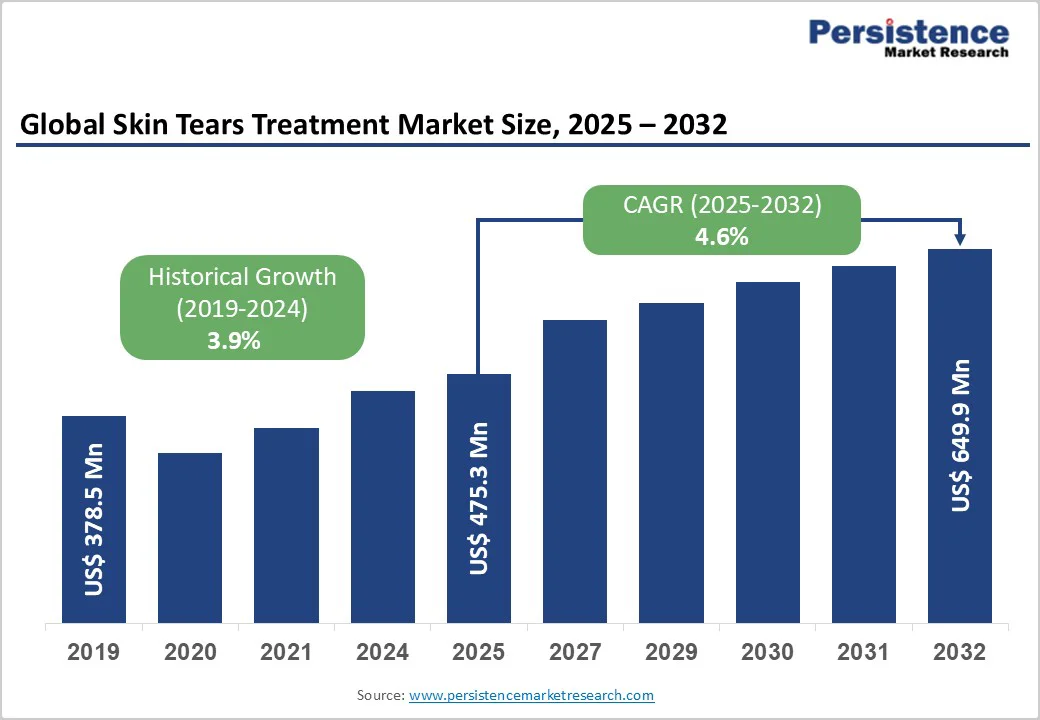
The global skin tears treatment market size is likely to value US$ 475.3 million in 2025 and projected to reach US$ 649.9 million at a CAGR of 4.6% during the forecast period from 2025 to 2032.
The global skin tears treatment market is witnessing steady growth due to the increasing prevalence of fragile and aging skin among the elderly population. Skin tears, characterized by the separation of skin layers due to thinning and dryness, are becoming more frequent as aging reduces skin elasticity, moisture, and nutrient supply. These acute wounds, commonly observed in older adults as well as in neonates and pediatric patients, often require specialized care to prevent infection and promote healing.
Key Industry Highlights
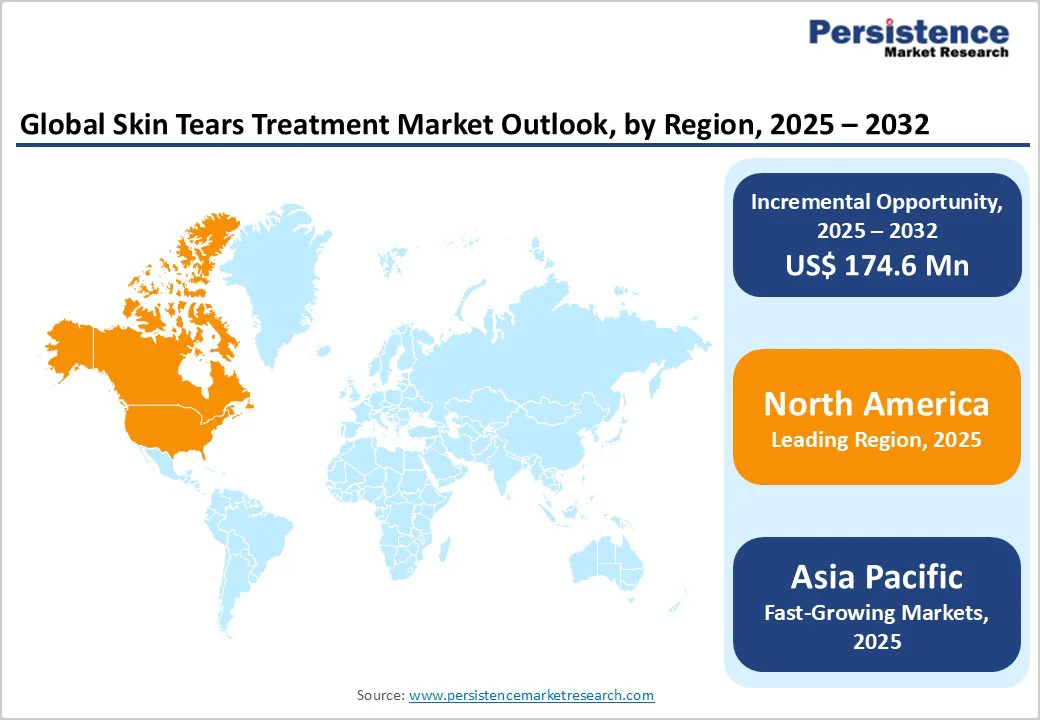
- Leading Region: North America leads the skin tears treatment market, driven by advanced healthcare facilities, strong reimbursement systems, and widespread adoption of next generation wound care products.
- Fastest Growing Region: Asia Pacific is the fastest-growing region, fueled by a rapidly aging population, rising healthcare investments, and increasing awareness about effective wound management solutions.
- Dominant Segment: Moisture-retentive Dressings category dominates, due to their proven effectiveness in maintaining optimal wound-healing environments and reducing pain during dressing changes.
- Fastest Growing Segment: Hyaluronic Acid Wound Devices represent the fastest-growing category, driven by their superior skin regeneration properties, biocompatibility, and increasing usage in treating fragile, aged skin.
| Key Insights | Details |
|---|---|
| Skin Tears Treatment Market Size (2025E) | US$ 475.3 Mn |
| Market Value Forecast (2032F) | US$ 649.9 Mn |
| Projected Growth (CAGR 2025 to 2032) | 4.6% |
| Historical Market Growth (CAGR 2019 to 2024) | 3.9% |
Market Dynamics
Driver - Technological Innovations in Moisture-Retentive Dressings and Advanced Wound Care
Rapid technological innovations in wound care have greatly advanced the management of skin tears, particularly through the introduction of moisture-retentive dressings featuring silicone-based technologies. These next-generation dressings, such as Mölnlycke’s Mepilex Up and Coloplast’s Biatain Silicone Fit, have transformed clinical practice by offering superior exudate absorption and fluid handling while minimizing trauma during dressing removal.
The use of soft silicone wound contact layers helps maintain skin integrity, reduce patient discomfort, and ensure pain-free dressing changes especially important for elderly patients with fragile skin. These dressings create an optimal moist wound environment that promotes faster tissue regeneration, reduces infection risk, and supports extended wear times of several days, decreasing dressing change frequency and care costs.
In addition, hydrogel dressings enhance autolytic debridement and cooling relief, while alginate and hydrofiber dressings provide strong hemostatic control for bleeding wounds. Clinical findings reveal that nearly 87% of patients achieve full wound closure within 90 days using antimicrobial foam dressings, underscoring the proven effectiveness of advanced wound care technologies.
Restraints - Inadequate Training and Awareness Among Healthcare Professionals
A major restraint in the skin tears treatment market is the lack of proper training and awareness among healthcare professionals, particularly in developing or resource-limited areas. Successful skin tear management depends on accurate wound assessment, correct product selection, and careful dressing application skills that require specific wound care education.
However, many nurses and general physicians have limited exposure to structured training programs or standardized classification systems like STAR (Skin Tear Audit Research). This leads to late diagnosis, poor treatment choices, and underuse of advanced dressings and therapies.
In many long-term care centers, daily wound care is handled by less experienced staff members who often receive little or no specialized instruction. As a result, patients may experience slower healing, higher infection risks, and greater discomfort. The overall lack of awareness about skin tear prevention and treatment standards remains a major barrier, restricting market growth and reducing the clinical effectiveness of available wound care innovations.
Opportunity - Rising Prevalence of Diabetes and Chronic Wounds Creating Treatment Demand
The rapidly increasing prevalence of diabetes worldwide is creating notable growth opportunities within the skin tears treatment market. According to the World Health Organization, over 422 million people across the globe live with diabetes, while data from the U.S. Centers for Disease Control and Prevention (CDC) indicates that 37.3 million Americans (11.3% of the population) have diabetes and nearly 96 million adults (38%) are in the prediabetic stage as of 2023.
Diabetes affects skin integrity through impaired keratinocyte activity, weakened collagen synthesis, and reduced immune defense, making the skin thinner, drier, and more prone to injury. Peripheral neuropathy and poor blood circulation further contribute to delayed wound healing and an increased risk of skin tears.
This rising diabetic population has heightened the demand for targeted wound management solutions, particularly advanced moisture-retentive dressings, barrier films, and hyaluronic acid-based wound devices designed for fragile or compromised skin. The growing focus on diabetic wound care management continues to expand opportunities for specialized product innovation and adoption.
Category-wise Analysis
By Product Type, Moisture-retentive Dressings Dominate the Skin Tears Treatment Market
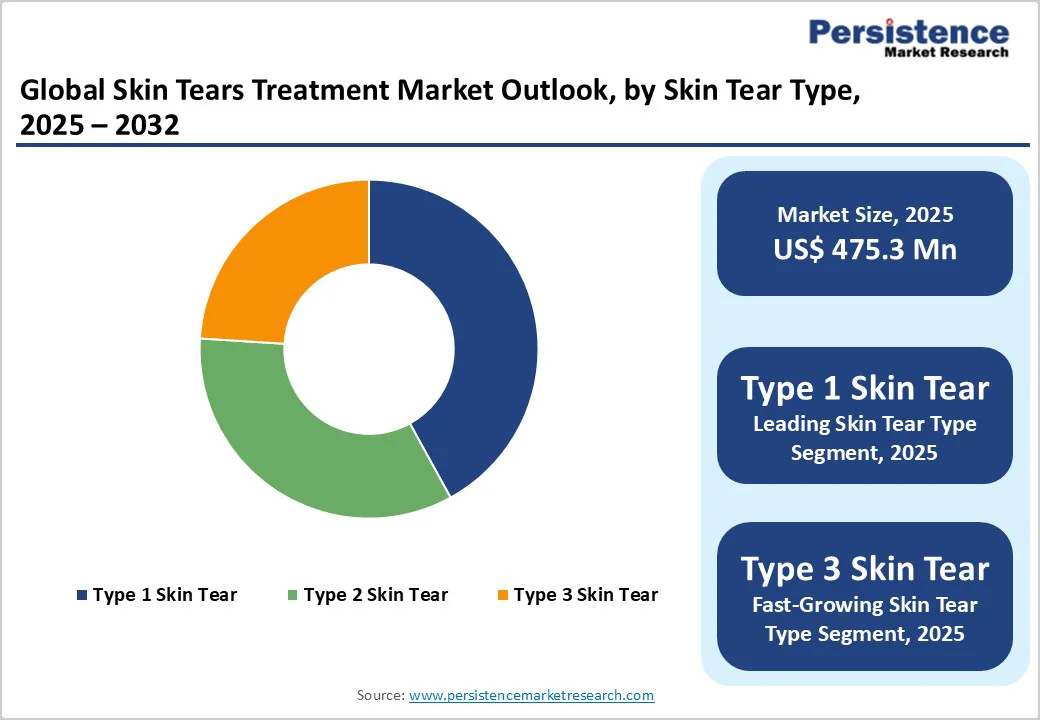
Moisture-retentive dressings hold the leading position in the global skin tears treatment market, accounting for approximately 33% of the market share in 2024. Their dominance stems from their proven ability to create a moist wound-healing environment that accelerates tissue repair and reduces infection risks.
Within this category, foam dressings represent the largest subsegment due to their excellent absorption capacity (ranging from 39.9 mL to over 100 mL per 24 hours), effective fluid retention (45.5%-70.8%), and balanced water vapor transmission that prevents skin maceration. Foam dressings integrated with silicone contact layers minimize pain during removal, protect fragile skin, and allow extended wear of up to seven days.
Hydrogel dressings also contribute significantly by donating moisture to dry wounds, promoting autolytic debridement, and offering a soothing, cooling effect that provides pain relief for several hours. Their widespread application, particularly in geriatric and long-term care facilities, reinforces the strong market presence of moisture-retentive dressings.
By End-user, Hospitals and Clinics Leads the Market
Hospitals and Clinics maintain the dominant position in the end-user segment, capturing approximately 48% market share due to their comprehensive capabilities in managing complex skin tear cases. Hospitals provide advanced facilities, state-of-the-art medical equipment, and multidisciplinary teams of trained medical staff with expertise in treating complicated wounds, including extensive skin tears associated with trauma, surgical complications, and severe comorbidities.
The availability of diverse complete wound care treatments ranging from specialized moisture-retentive dressings and barrier films to hyaluronic acid devices and advanced wound closure techniques positions hospitals as the preferred setting for high-risk skin tear management.
Higher institutional reimbursement levels and capital resources enable hospitals to invest in cutting-edge wound care technologies and maintain specialized wound care teams, cementing their market leadership.
However, the Home Care Settings segment is experiencing the fastest growth rate, driven by patient preferences for comfortable care environments, cost-effectiveness considerations, and advancements in portable wound care technologies that enable effective management outside institutional settings while reducing hospital readmissions.
Region-wise Insights
North America Skin Tears Treatment Market Trends
North America dominates the global skin tears treatment market with 38.3% share in 2024, driven by well-established healthcare infrastructure, advanced wound care adoption, and demographic factors.
The U.S. Census Bureau projects that the population age 65 and older will rise from 56.1 million in 2020 to 82.1 million by 2050, representing approximately 20% of the total population. This demographic shift places unprecedented demands on the healthcare system, particularly for skin integrity management in elderly populations.
Research conducted in western Pennsylvania long-term care facilities documents skin tear point prevalence rates of 9%, with facility-specific rates ranging from 6% to 28% among 1,253 residents, underscoring the magnitude of the clinical challenge.
The Centers for Disease Control and Prevention reports that approximately 1.5 million skin tears occur annually in the U.S. alone, with particularly high incidence in long-term care facilities where female residents experience rates of 4.6% compared to 2.1% among males.
The U.S. benefits from a robust regulatory framework that supports innovation while ensuring patient safety. Product approvals by the U.S. Food and Drug Administration for advanced wound dressings, including over 3,000 approved wound dressings and recent clearances such as the PowerHeal bioelectric bandage for over-the-counter wound management, facilitate market growth.
Leading companies, including 3M, Smith & Nephew, Medline Industries, and Mölnlycke Health Care, maintain significant research and development operations in North America, launching innovative products such as advanced foam dressings with silicone technologies and negative pressure wound therapy systems specifically designed for skin tear management.
Asia and Pacific Skin Tears Treatment Market Trends
Asia Pacific stands out as the fastest-growing region in the global skin tears treatment market, driven by a rapidly aging population, improvements in healthcare infrastructure, and growing adoption of advanced wound care solutions. The region’s demographic shift is happening at a record pace, while about 12.4% of its population was aged 60 years or older in 2016, this figure is projected to surpass 25% (or nearly 1.3 billion people) by 2050.
Countries such as China, Thailand, and Vietnam are transitioning from aging to aged societies within two decades, a much faster rate compared to Western nations like France and Sweden. China and India, with elderly populations of around 128 million and 104 million respectively, face increasing healthcare demands, particularly for chronic and acute wound management.
However, these challenges have encouraged governments to strengthen healthcare systems and support the adoption of modern wound care technologies. Additionally, strong manufacturing capabilities in China, Japan, India, and ASEAN countries enable large-scale, cost-effective production of high-quality wound care products, further reinforcing Asia Pacific’s position as the fastest-growing market for skin tear treatment solutions.
Competitive Landscape
The skin tears treatment market exhibits moderate fragmentation with a mix of established global leaders and emerging innovators competing across product segments and geographic regions. Market concentration is influenced by the presence of multinational medical device companies with comprehensive wound care portfolios alongside specialized wound care manufacturers and regional players.
Leading companies, including 3M, Smith and Nephew Plc, Mölnlycke Health Care AB, Coloplast A/S, and ConvaTec Group Plc employ aggressive research and development investments, strategic product portfolio expansions, and cross-industry collaborations to differentiate themselves and capture market share.
Key Industry Developments:
- In April 2024, Smith & Nephew launched RENASYS EDGE, an advanced negative pressure wound therapy system enhancing absorption, protection, and healing outcomes for chronic skin tears.
- In January 2024, Coloplast Corporation launched Biatain Silicone Fit in the U.S., an innovative silicone foam product designed for pressure injury prevention and advanced wound management.
Companies Covered in Skin Tears Treatment Market
- 3M
- Coloplast A/S
- ConvaTec Group Plc
- Cardinal Health Inc.
- BSN Medical GmbH (Essity AB)
- ACell Inc. (Integra LifeSciences)
- Covalon Technologies Ltd.
- Medline Industries Inc.
- Mölnlycke Health Care AB
- Smith and Nephew Plc
- ENEO Pharmaceuticals s. r. o.
- Richardson Healthcare, Inc.
- Avery Dennison Corporation
- Others
Frequently Asked Questions
The global skin tears treatment market is projected to be valued at US$ 475.3 Mn in 2025.
Increasing incidence of chronic wounds and growing adoption of advanced moisture-retentive dressings drive market growth.
The global market is poised to witness a CAGR of 4.6% between 2025 and 2032.
Expanding demand for bioactive wound care products and innovation in hyaluronic acid-based and antimicrobial dressings create growth opportunities.
Companies such 3M, Coloplast A/S, ConvaTec Group Plc, Cardinal Health Inc., BSN Medical GmbH (Essity AB), are some of the major players operating in the market.


