




- Home Appliances
- Portable Dishwasher Market
Portable Dishwasher Market Size, Trends, Share, and Growth Forecast 2026 - 2033
Portable Dishwasher Market by Product Type (Countertop, Freestanding, Built-in Convertible, Single Drawer), Capacity (5-10 Place Settings, 10-15 Place Settings, Above 15 Place Settings), Distribution Channel (Online Retail, Specialty Stores, Supermarkets & Hypermarkets, Electronics & Appliance Stores), by End-use (Residential, Commercial), and Regional Analysis, 2026 - 2033

Portable Dishwasher Market Size and Trend Analysis
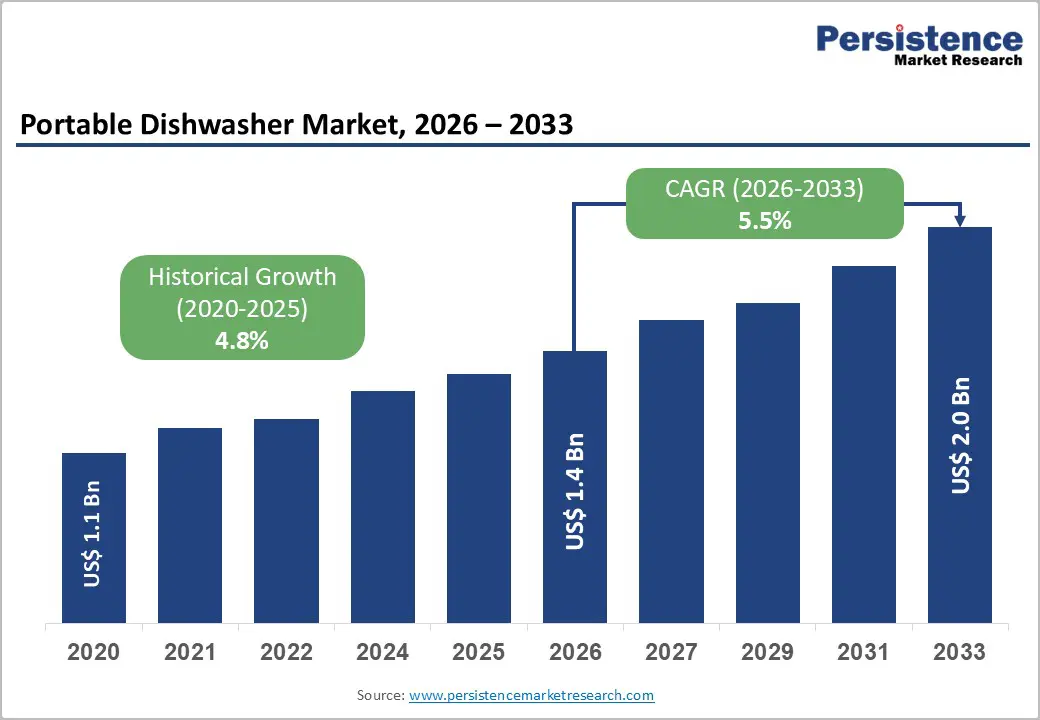
The global portable dishwasher market size is likely to be valued at US$ 1.4 billion in 2026 and is expected to reach US$ 2.0 billion by 2033, growing at a CAGR of 5.5% during the forecast period from 2026 to 2033.
This growth trajectory reflects robust consumer adoption driven by evolving urban living patterns and heightened emphasis on water conservation. The market expansion is fundamentally anchored in demographic shifts toward smaller households and rental accommodations, where permanent installations remain impractical.
Key Industry Highlights:
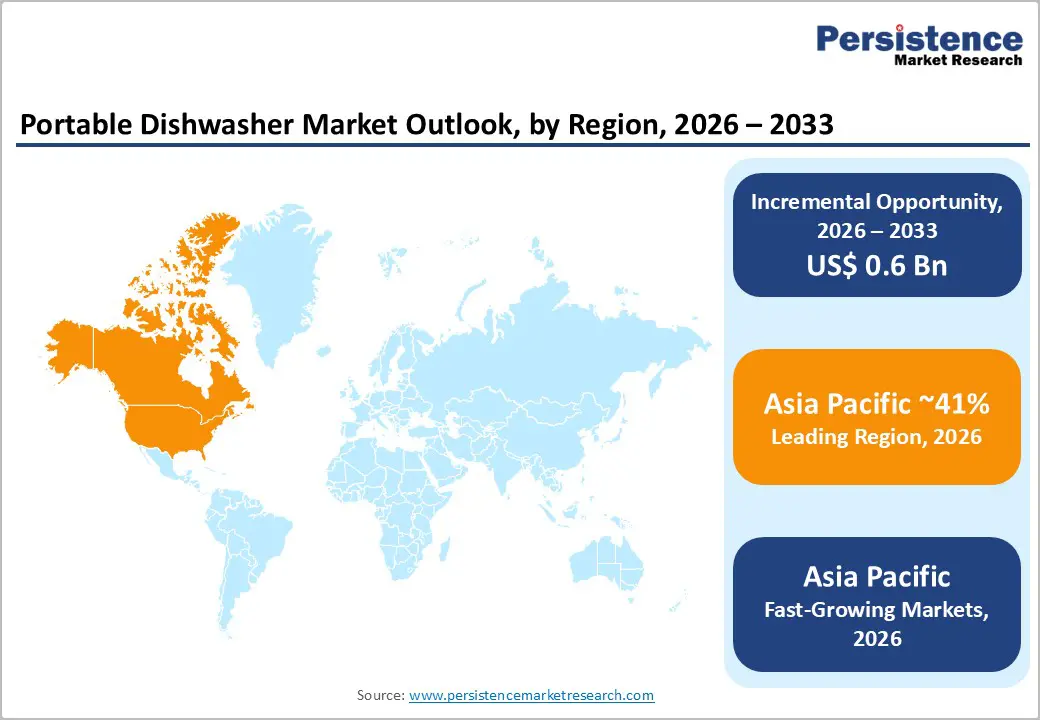
- Leading Region: North America commands 38% global market share driven by regulatory incentives and housing dynamics. Programs like EPA WaterSense offer rebates that have boosted demand in leading states.
- Fastest Growing Region: Asia Pacific surges at 12.1% CAGR as large urban populations and rising modern lifestyle preferences.
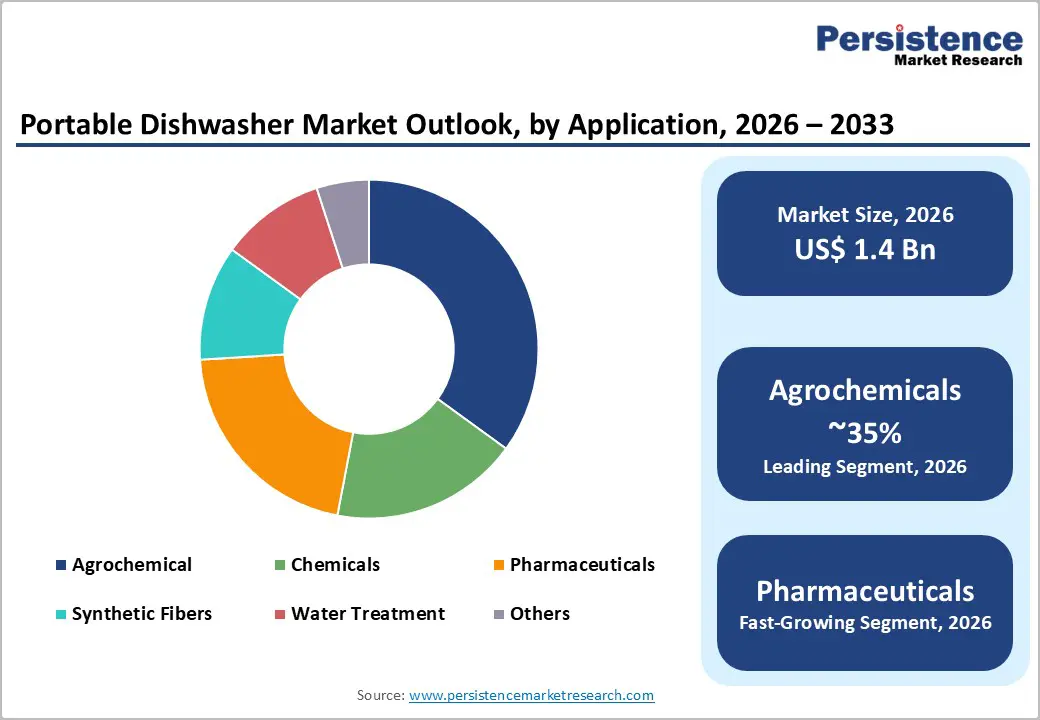
- Dominant Segment: 5-10 Place Settings capacity leads with 52% share, perfectly serving small households that comprise a majority of buyers, ideal for studio apartments.
- Fastest Growing Segment: Countertop Dishwashers is the fastest growing segment, Driven by urbanization, small apartments, rising single-person households, and increasing demand for space-saving appliances.
- Key Market Opportunity: Rapid urban growth and rising middle-class incomes in emerging markets drive strong demand for premium portable dishwashers.
| Key Insights | Details |
|---|---|
| Portable Dishwasher Market Size (2026E) | US$ 1.4 Billion |
| Market Value Forecast (2033F) | US$ 2.0 Billion |
| Projected Growth CAGR (2026 - 2033) | 5.5% |
| Historical Market Growth (2020 - 2025) | 4.8% |
Market Dynamics
Drivers - Urbanization and Compact Living Trends Significantly Boost Consumer Demand for Flexible, Space-Saving Portable Dishwashers in Modern Homes
Urbanization and the rise of compact homes across major cities continue to drive the demand for portable dishwashers. As metropolitan areas add more small-format housing, consumers increasingly prefer appliances that deliver full functionality without requiring permanent installation. U.S. Census Bureau data highlights that multifamily housing completions reached 608,000 units in 2024, the fastest pace since 1987, with nearly 70% of new households forming in urban areas where kitchens are typically under 120 square feet.
This housing trend strengthens demand for portable appliances that offer flexibility and save space. With almost half of renting households facing cost burdens, portable dishwashers provide an affordable alternative to kitchen renovations, which can exceed US$ 8,000. Similar trends appear in Europe, where Eurostat reports that 42% of urban residents live in apartments smaller than 75 square meters. Manufacturers are responding by offering models under 24 inches wide that connect directly to standard faucets, eliminating plumbing costs while still delivering 12-14 place-settings comparable to built-in models.
Tighter Global Water-use Rules and Rising Energy-Efficiency Standards Accelerate Household Adoption of Advanced Portable Dishwasher Technologies
Stricter environmental regulations across developed countries are accelerating the adoption of portable dishwashers, as consumers replace older, inefficient units. The U.S. Environmental Protection Agency has tightened Energy Star criteria, limiting annual energy consumption to 295 kWh for standard models, while the European Commission’s Ecodesign rules require water usage of no more than 4.25 gallons per cycle. These rules make many pre-2020 models obsolete.
Portable models naturally meet updated standards due to compact designs and advanced sensors that adjust water usage based on soil levels. Department of Energy shows that households can save nearly 3,870 gallons of water by replacing older units with certified portable dishwashers. This regulatory shift supports corporate sustainability goals, with companies such as Google, Amazon, and Microsoft mandating LEED Gold standards for employee housing, which encourages the integration of portable, energy-efficient appliances in relocation packages.
Restraints - Limited Load Capacity in Portable Dishwashers Restricts Suitability for Large Families with Heavier Daily Cleaning Requirements
Despite improving features, portable dishwashers continue to face capacity limitations that restrict their suitability for larger families. Most portable units offer up to 14 place settings, while premium built-in models can support 16 or more place settings along with additional racks for large cookware. U.S. Census Bureau data indicates that 28% of American households include five or more people, forming a sizable segment that often finds portable units inadequate. Complaints reported to the Better Business Bureau show that many users struggle to fit large pots and 12-inch plates at the same time. During peak periods such as holidays, dishwashing loads can increase significantly, requiring multiple cycles and reducing the perceived water-saving benefits.
Manufacturers acknowledge these constraints, noting in filings that portable models capture only 8% of the households-with-children segment, versus much higher adoption rates for built-ins. This ongoing limitation creates a structural barrier that slows the overall market expansion for portable dishwashers.
Higher Operating Noise Levels of Portable Dishwashers Create Concerns for Users Living in Open-Plan or Small Apartments
Noise remains a notable restraint for portable dishwasher adoption, particularly as open-concept home layouts become more common. Most portable models operate at 52-56 decibels, which is louder than premium built-ins that achieve 42-44 decibels through superior insulation and redesigned motor systems. Surveys by the National Kitchen and Bath Association show that 67% of renovation projects now include open layouts, yet 58% of designers report client reluctance to select portable units due to noise concerns.
This challenge is even more pronounced in European apartments, where 70% of homes do not have separate kitchens. Testing by Consumer Reports confirms that models from Danby and Sunpentown average around 54 dB, exceeding the preferred 50 dB threshold for evening use. Although brands like Bosch and LG have introduced quieter 48 dB portable models, these come with higher price points, limiting accessibility for mainstream buyers. As a result, the trade-off between noise levels and affordability continues to constrain the category’s growth.
Market Opportunities
Smart Home Integration, IoT Connectivity, and AI-Driven Features Create Strong Revenue-Generating Opportunities for Portable Dishwashers
Smart home technology presents a significant opportunity for the portable dishwasher market, offering an estimated US$ 450 million revenue potential by 2033. IoT-enabled dishwashers command higher price premiums because they provide convenience features such as remote cycle monitoring, energy optimization, and automatic detergent reordering through systems like Amazon Alexa and Google Home. Samsung’s early introduction of Wi-Fi-enabled portable models resulted in a 35% increase in satisfaction among millennial buyers.
With the online studies projecting that 75% of households will adopt smart appliances by 2030, manufacturers that integrate AI-powered soil sensors and machine learning stand to gain a competitive edge. These technologies can reduce water consumption by up to 15%. Government initiatives such as the U.S. Department of Energy’s Smart Grid Investment Grant, which allocates US$ 3.4 billion for demand-response appliance development, further support this trend by enabling portable dishwashers to run during off-peak hours, saving households an estimated US$ 85 annually on energy bills.
Rapid Urban Growth and Rising Middle-Class Incomes in Emerging Markets Drive Strong Demand for Premium Portable Dishwashers
Asia Pacific presents strong growth opportunities driven by rapid urbanization and increasing disposable incomes. The region could generate a US$ 680 million market for portable dishwashers by 2033, as nearly 350 million households transition into the middle class. India alone is set to add 416 million urban residents by 2050, with most living in apartments under 800 square feet, where portable dishwashers offer the most practical solution.
Sales in India grew by 500% in 2024, supported by brands such as LG and Haier that introduced compact, affordable models. Government housing programs such as PM Awas Yojana also encourage the use of space-efficient appliances. In Japan, where 85% of Tokyo homes fall under 70 square meters, countertop dishwashers show strong penetration among dual-income couples. Similar patterns emerge in cities like Shanghai, Jakarta, and Bangkok. As urban lifestyles evolve and consumers shift toward premium, time-saving appliances, portable dishwashers are well-positioned to capture growing demand across the region.
Category-wise Analysis
Product Type Insights
Freestanding portable dishwashers remain the leading product category, holding a 43% market share due to their balance of capacity, mobility, and installation ease. These units support 10-15 place settings and typically include casters for convenient movement, making them ideal for renters seeking a built-in feel without structural changes. Bosch leads the segment with its 800 Series models, offering 44 dB performance and advanced drying technology at competitive prices. Whirlpool’s 14-place setting models appeal to budget-conscious buyers looking for strong performance.
Standardized UL faucet adapter certifications have reduced consumer concerns about setup, contributing to growth. Retailers such as Home Depot and Lowe’s dedicate more than half of their portable dishwasher shelf space to freestanding models, reflecting strong consumer preference for full-size functionality combined with flexible installation options. This segment continues to grow as more households seek practical appliances suited for limited kitchen spaces.
Capacity Insights
Portable dishwashers with 5-10 place settings account for 52% of market share, aligning with the needs of smaller households that comprise a majority of buyers. These models offer compact designs under 18 inches wide, making them ideal for countertops or tight storage areas while maintaining water efficiency at around 3.2 gallons per cycle. Energy Star reports show that units in this category also meet stringent 270 kWh annual consumption requirements.
Brands such as Sunpentown and Danby dominate this space, offering affordable models with user-friendly controls and essential features like delay start options. As studio apartments and micro-housing developments expand-growing 34% across major U.S. metros in 2024-the demand for compact dishwashing appliances continues to rise. This capacity range is viewed as the optimal balance between performance, convenience, and efficiency for one-to-three-person households whose daily washing loads typically fall within this range.
Distribution Channel Insights
Online retail remains the fastest-growing sales channel for portable dishwashers, capturing 38.4% of overall market share. Platforms such as Amazon, Wayfair, and Best Buy enable consumers to compare models, read reviews, and access flexible return policies, easing the decision-making process for first-time buyers. Best Buy has enhanced its online experience with virtual reality showrooms that allow users to examine portable dishwashers from all angles, contributing to a 67% rise in online sales.
Google shopping ads continue to generate strong conversion rates, outperforming offline channels. Logistics partnerships with FedEx and UPS support services like White Glove delivery, increasing buyer confidence in handling larger appliances. Social media marketing has also become influential, with TikTok and Instagram driving substantial traffic through influencer-led product demonstrations. Younger consumers, who typically research multiple online sources before purchasing, are accelerating the shift toward digital channels for appliance purchases.
End-user Insights
The residential sector holds a dominant 78% share of the portable dishwasher market, driven by changes in household structure and increasing at-home meal preparation. With nearly half of food spending now occurring at home, dishwashing needs have grown significantly. Single-person households, which account for 28% of U.S. homes, show particularly strong adoption, viewing portable dishwashers as essential time-saving tools.
Renters also represent a key demographic, as many apartments lack built-in dishwashers despite high demand for in-unit cleaning solutions. Remote monitoring features available through mobile apps appeal to busy dual-income households with limited daily free time. While commercial use remains limited, boutique hotels and food truck operators are beginning to adopt portable dishwashers to reduce water consumption and improve cleaning efficiency. This sector is expected to expand gradually as diverse residential segments continue to prioritize convenience and sustainability.
Regional Insights
North America Portable Dishwasher Market Trends
The United States leads portable dishwasher adoption in North America, representing 87% of regional sales due to regulatory incentives and housing dynamics. Programs like EPA WaterSense offer rebates that have boosted demand in states such as California, Texas, and Arizona. Rising rental housing construction-where portable dishwashers offer landlords higher rent premiums without installation costs-further supports growth. Major retailers such as Best Buy have improved nationwide accessibility through expanded installation services.
Promotions during events like Amazon Prime Day have significantly increased online sales volumes. Federal housing programs now recognize portable appliances as acceptable additions under Section 8 guidelines, emphasizing their role in improving living conditions. While Canada shows slower adoption due to higher tax rates on appliances, major cities like Toronto and Vancouver share similar urban density patterns with U.S. metros and are expected to support steady, long-term demand for portable dishwashers.
Europe Portable Dishwasher Market Trends
Germany, the United Kingdom, and France account for most portable dishwasher sales in Europe, driven by environmental regulations and widespread compact living spaces. Germany leads the region with strong adoption in cities such as Berlin, where many households live in smaller rental apartments. Popular models from Bosch and Siemens incorporate advanced drying technologies that appeal to efficiency-focused European consumers.
The U.K. market continues to grow as Build-to-Rent developments expand and developers include portable dishwashers as standard amenities. France supports adoption through tax incentives for rental properties that include necessary appliances. Tourist-driven rental markets in Spain also contribute to strong demand, as portable units allow flexibility in properties where permanent renovations are restricted. Italy’s slower growth is linked to the exclusion of portable appliances from certain national energy programs. Across Europe, Scandinavian-style designs such as IKEA’s affordable models appeal to younger and budget-oriented buyers.
Asia Pacific Portable Dishwasher Market Trends
Asia Pacific is the fastest-growing region for portable dishwashers, supported by large urban populations and rising modern lifestyle preferences. China shows strong adoption among younger professionals in major cities, with brands like Haier and Midea offering affordable, app-connected models that integrate seamlessly with local digital ecosystems. Japan continues to lead in countertop dishwasher usage due to its high concentration of small apartments, particularly in Tokyo.
India’s market has grown rapidly, driven by increased affordability through local manufacturing and strong e-commerce penetration. Government programs encouraging urban housing development also indirectly support appliance demand. ASEAN markets, especially Singapore and Thailand, demonstrate solid growth due to high-rise living where permanent kitchen modifications are often restricted. Tech-savvy consumers in the region increasingly prefer smart dishwashers that support mobile control, voice integration, and energy monitoring, reinforcing the long-term growth outlook for portable dishwashers in Asia Pacific.
Competitive Landscape
The global portable dishwasher market is moderately fragmented, with companies competing across premium, mid-range, and budget segments. Leading manufacturers focus on smart features, energy efficiency, and quieter operation, while mid-tier players emphasize dependable performance at affordable prices. Budget brands leverage online marketplaces to target value-driven buyers with basic, compact models. Variations in vertical integration influence cost structures and competitive positioning. Steady R&D investment supports advancements in cleaning efficiency and space-saving designs suited for urban living. Additionally, subscription-based rental models are emerging, appealing to younger consumers who prefer flexible, low-commitment access over traditional product ownership.
Key Market Developments:
- In March 2025: Whirlpool Corporation launched the WDF330PAHB portable dishwasher with 6th Sense technology, automatically adjusting water usage based on load size, achieving 12% better efficiency than previous models and retailing at US$ 599.
- In January 2025: Samsung Electronics introduced Bespoke Jet Bot portable dishwasher integration, allowing robot vacuums to transport dirty dishes to the unit, targeting smart home enthusiasts at US$ 1,299 premium pricing.
- In September 2024: Electrolux AB partnered with IKEA to develop the Betrodd portable dishwasher line for European markets, featuring Scandinavian design and 24-month warranties, priced at €499 to capture mid-range demand.
Companies Covered in Portable Dishwasher Market
- Electrolux AB
- Samsung Electronics Co., Ltd
- Robert Bosch GmbH
- LG appliance
- Sunpentown International Inc
- Danby Products Inc
- Whirlpool Corporation
- Haier America Company LLC
- BPL Ltd
- Glen Dimplex Home Appliances Ltd
- Crosslee PLC
- Midea Group
- Panasonic Holdings Corporation
- Sharp Corporation
- Candy Appliances
- Black+Decker
- Farberware
- Costway
- AmazonBasics
- IKEA
Frequently Asked Questions
The portable dishwasher market is valued at US$ 1.4 Billion in 2026 and projected to reach US$ 2.0 Billion by 2033, growing at 5.5% CAGR during the forecast period, driven by urbanization and compact living trends.
Primary drivers include urbanization creating 71% rental housing growth, Energy Star regulations mandating ≤3.5 gallons per cycle, and small household formation where 68% of buyers are 1-3 person families seeking space-efficient solutions.
Freestanding portable dishwashers dominate with 43% market share, offering 10-15 place settings capacity, mobility via casters, and full-size performance without permanent installation, ideal for renters and small homes.
North America leads with 38% global share, driven by U.S. rental housing growth, Energy Star rebates, and e-commerce dominance where Amazon and Best Buy deliver 45% of regional sales through online channels.
Countertop Dishwashers is the fastest growing segment, Driven by urbanization, small apartments, rising single-person households, and increasing demand for space-saving appliances.
Key players include Electrolux AB, Samsung Electronics, Robert Bosch GmbH, LG, Whirlpool, Haier, Midea, Panasonic, Danby, Sunpentown, and emerging brands like Black+Decker, Farberware, and IKEA appliances.


