




- Home Appliances
- Portable Air Conditioner Market
Portable Air Conditioner Market Size, Share, and Growth Forecast 2026 - 2033
Portable Air Conditioner Market by Product Type (Single-Hose Portable AC, Dual-Hose Portable AC, Others), by Capacity (5,000 to 10,000 BTUs, 11,000 to 15,000 BTUs, 16,000 to 20,000 BTUs, 20,000 & Above BTUs), Application (Residential, Commercial), by Sales Channel (Wholesalers/Distributors, Hypermarket/Supermarkets, Specialty Stores, Multi-brand Stores, Online), and Regional Analysis 2026 - 2033

Portable Air Conditioner Market Size and Trend Analysis
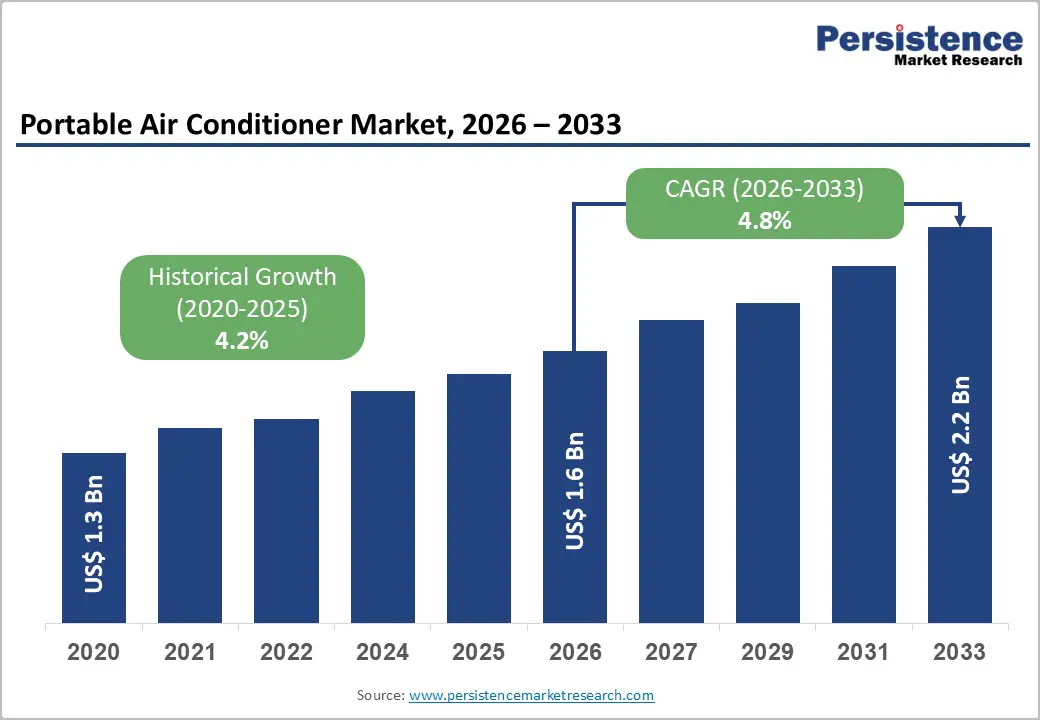
The global portable air conditioner market size is projected to reach US$ 1.6 billion in 2026 and grow to US$ 2.2 billion by 2033, registering a CAGR of 4.8%.
Rising global temperatures, climate change, and the need for flexible, cost-efficient cooling solutions are fueling demand across residential and commercial spaces. Rapid urbanization and the increasing number of renters and apartment dwellers are further supporting adoption. At the same time, advancements such as smart connectivity, inverter technology, and eco-friendly refrigerants are improving energy efficiency and performance, making portable air conditioners an appealing alternative to conventional fixed air-conditioning systems.
Key Industry Highlights:
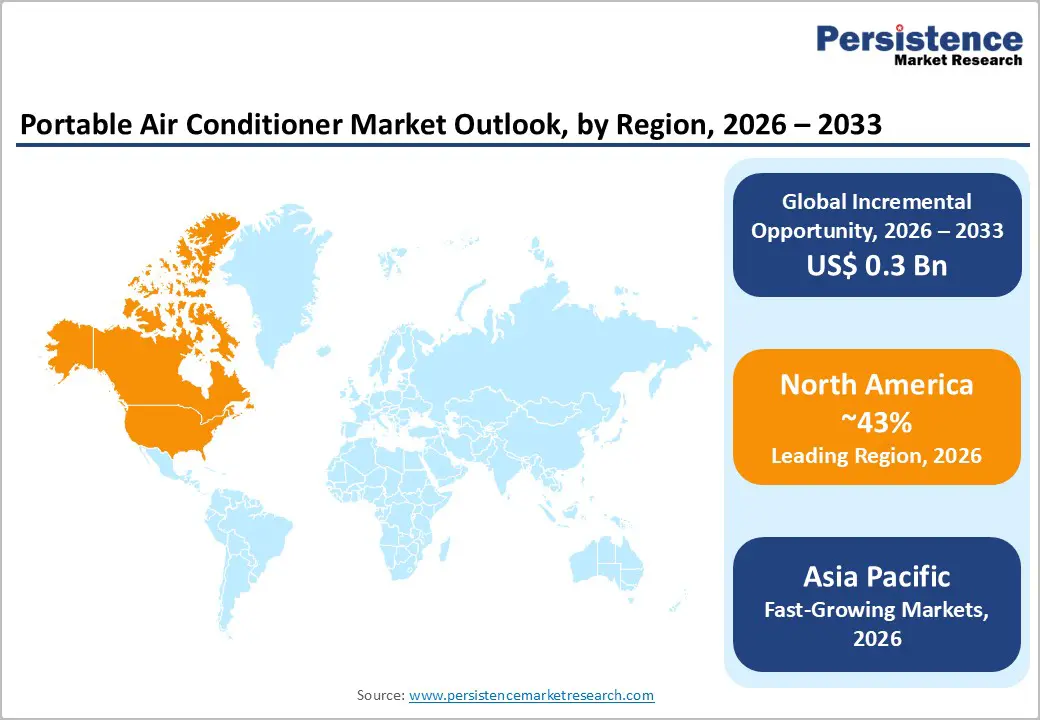
- Leading Region: North America leads the market with ~45% share, supported by heatwaves, urban density, and DOE energy-efficiency regulations.
- Fastest-Growing Region: Asia Pacific is the fastest-growing region in the portable air conditioner market, accounting for about 38% of global demand, supported by urbanization, rising incomes, and large residential construction.
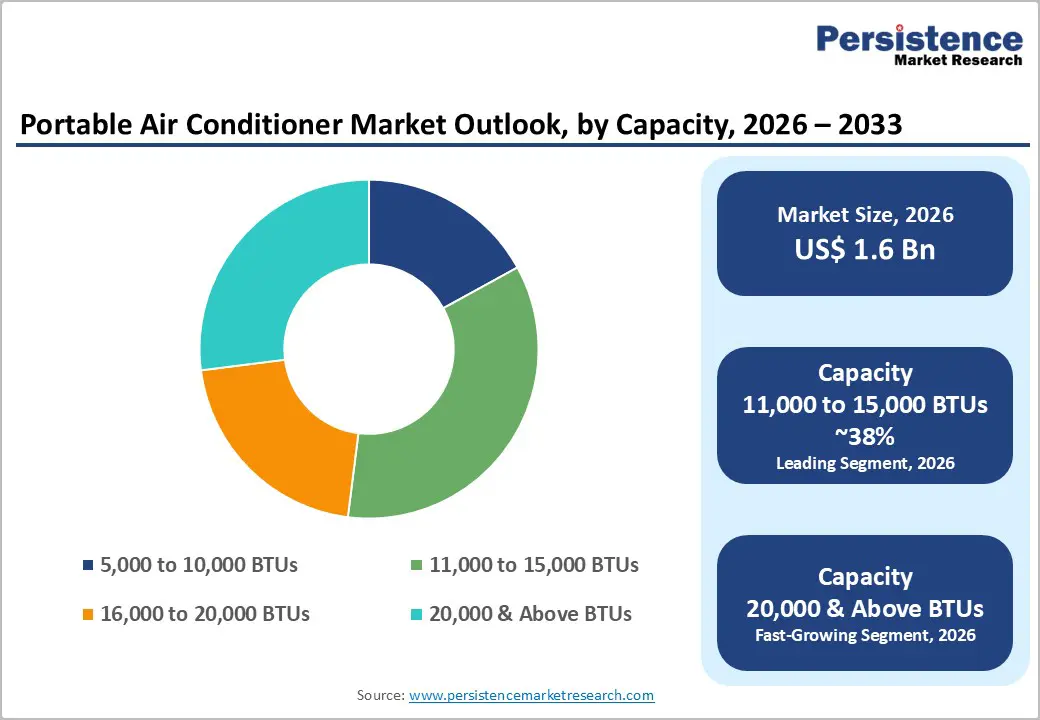
- Dominant Segment by Capacity: The 11,000-15,000 BTU segment holds ~38% market share, offering an ideal balance of cooling capacity (300-500 sq. ft.) and energy efficiency.
- Fastest Growing Segment: The 20,000 BTU+ segment is the fastest-growing capacity category, fueled by larger homes, expanding offices, and high-load environments such as server rooms.
- Key Market Opportunity: Smart portable air conditioner integration with Internet of Things technologies, artificial intelligence temperature optimization, and home automation ecosystem compatibility represents the most significant growth opportunity.
| Key Insights | Details |
|---|---|
| Portable Air Conditioner Market Size (2026E) | US$ 1.6 Billion |
| Market Value Forecast (2033F) | US$ 2.2 Billion |
| Projected Growth CAGR (2026 - 2033) | 4.8% |
| Historical Market Growth (2020 - 2025) | 4.2% |
Market Dynamics
Drivers - Rising Global Temperatures, Extreme Heatwaves, and Climate Change Pressures
Escalating heatwaves and long, uncomfortable summers are accelerating demand for portable air conditioners as fast, deployable cooling solutions. As climate volatility intensifies and electricity grids face peak-load strain, consumers and facilities prioritize devices that offer targeted relief without major installation, construction approvals, or high upfront costs, making portable systems an attractive bridge between fans and fixed AC infrastructure for homes, offices, and rentals.
Growing evidence links climate change to surging cooling demand, particularly in rapidly warming regions. Utility data and retail trends consistently show spikes in seasonal AC purchases, while municipal heat advisories highlight the need for quick spot-cooling. In this context, portable ACs provide scalable, room-by-room climate control that can be deployed immediately, supporting resilience where central systems are unavailable or difficult to retrofit.
Urbanization, Expanding Rental Housing, and Mobility-Oriented Lifestyles
Rapid urbanization is reshaping housing formats, shrinking living spaces, and increasing the number of multi-tenant buildings, where structural limitations limit the installation of fixed AC units. For renters, students, and short-term occupants, portability, low commitment, and zero drilling requirements make portable air conditioners especially appealing, delivering localized comfort without landlord approvals or costly installation services. They suit temporary relocations, sublets, and older heritage properties that prohibit permanent mechanical alterations.
The rise of hybrid and work-from-home lifestyles further amplifies demand as households pursue supplemental cooling for bedrooms and home offices. Affordability concerns also matter: instead of investing in whole-home systems, many consumers opt for targeted, movable units that follow usage patterns. As a result, residential applications account for a substantial share of portable AC adoption and continue to drive steady replacement and upgrade cycles.
Restraint - Limited Cooling Output, Design Inefficiencies, and Performance Gaps in Real-World Conditions
Portable air conditioners remain constrained by their cooling capacity, typically ranging between 5,000 and 20,000 BTUs, limiting their ability to manage larger rooms, open layouts, or commercial environments. Single-hose systems, while affordable and easy to set up, create negative pressure that pulls warm air back into the room, forcing the compressor to work harder and reducing overall comfort.
These inherent design inefficiencies increase power consumption and reduce perceived performance. With the DOE’s SACC methodology, discrepancies between labeled capacity and actual output have become more evident. Many units rated at 14,000 BTUs may deliver significantly lower functional cooling once duct losses, infiltration, and environmental factors are included, undermining consumer trust, raising operating costs, and reinforcing perceptions that portable units are a compromise compared with fixed AC systems.
Stringent Environmental Regulations, Refrigerant Shifts, and Compliance Cost Burdens
Global climate and environmental policies are accelerating the phase-out of high-GWP HFC refrigerants, compelling manufacturers to transition toward alternatives such as R-32 and emerging A2L blends. While essential for sustainability goals, these shifts require redesigning product platforms, enhancing safety systems, and investing in new testing protocols, introducing complexity across R&D, certification, and production environments.
The resulting compliance costs disproportionately challenge smaller manufacturers with limited capital buffers. Meanwhile, supply chain adjustments, factory retooling, and workforce retraining can temporarily constrain output and extend product development timelines. During transition periods, pricing pressures and sporadic availability may emerge, creating uncertainty for distributors and consumers. These structural shifts, though ultimately beneficial, act as short- to medium-term restraints on innovation speed, market accessibility, and cost competitiveness within the portable air conditioner segment.
Opportunity - Smart Integration, IoT Connectivity, and Data-Driven Energy Optimization
The rapid expansion of smart homes and connected appliances is opening strong opportunities for differentiated portable air conditioner offerings. Wi-Fi-enabled models with mobile apps, voice-assistant compatibility, and remote scheduling deliver higher perceived value and command premium price points. These features empower consumers to manage comfort more precisely while tracking usage patterns and optimizing energy consumption across rooms and time-of-day cycles.
As artificial intelligence and cloud connectivity advance, portable ACs can support predictive maintenance alerts, automation routines, and geofencing triggers that activate systems only when occupants are present. Leading brands already demonstrate clear traction with smart inverter platforms, signaling strong adoption in tech-savvy markets. This intersection of efficiency, control, and convenience positions connected portable units to capture share across North America, Europe, and advanced Asia Pacific households.
Hybrid Portable Systems Offering Cooling, Dehumidification, and Air Purification Capabilities
Growing awareness of indoor air quality and rising humidity challenges in tropical climates are accelerating demand for multifunctional portable units. Products that combine cooling with built-in dehumidifiers and filtration systems allow consumers to address comfort, moisture control, and pollutant reduction using a single appliance. This approach supports healthier indoor environments while eliminating the need for separate equipment and reducing overall household electricity usage.
These hybrid systems resonate with environmentally conscious buyers who prioritize energy efficiency, compact footprints, and year-round functionality. In high-growth markets such as South Asia and Oceania, where prolonged humid seasons coincide with seasonal heat, portable ACs with integrated purification and humidity management provide compelling value propositions. As design innovation advances, multifunctional models are expected to unlock new premium niches and expand replacement demand.
Category-wise Analysis
Product Type Insights
The dual-hose portable air conditioner segment leads the market, accounting for about 55% of total sales. Independent intake and exhaust pathways eliminate negative pressure, improving cooling efficiency by 20-30% versus single-hose units. Their strong, consistent performance makes them popular across hotels, offices, and larger residential rooms, particularly where rapid temperature stabilization and better energy control are required.
The fastest-growing category consists of advanced dual-hose designs integrating inverter compressors, noise-reduction engineering, and smart controls. These models appeal to consumers seeking premium performance, quieter operation, and app-based management. As awareness rises around real-world efficiency and comfort, many buyers trade up from basic single-hose systems toward technologically enhanced, performance-oriented portable air conditioners.
Capacity Insights
The 11,000-15,000 BTU capacity range represents the leading segment, securing roughly 38% market share. It balances power and efficiency, typically delivering 6,500-10,000 SACC BTUs enough to cool 300-500 square feet. This versatility suits medium-sized bedrooms, apartments, and compact offices, making the category especially attractive for consumers seeking dependable cooling without excessive energy draw.
The fastest-growing capacity category is concentrated at the higher end, with units positioned above 20,000 BTU. Demand is increasing as households adopt larger open-plan layouts and businesses require portable solutions for hotter environments, server rooms, and back-of-house spaces. These powerful systems address heavier heat loads while offering flexibility compared with permanent cooling installations.
Application Insights
The residential sector remains the leading end-use category, generating about 57.6% of total revenue. Apartment dwellers, renters, and homeowners seeking room-specific or supplemental cooling value portability, easy setup, and avoidance of permanent installation. Portable systems also support targeted cooling for bedrooms and home offices, reducing reliance on central systems and providing cost-efficient comfort during peak heat.
The fastest-growing application category is commercial usage, driven by offices, retail outlets, hospitality locations, schools, and temporary facilities. Businesses increasingly deploy portable units for spot cooling, renovation periods, seasonal surges, and mission-critical environments such as labs and server spaces. Flexibility, mobility, and quick deployment make portable ACs an attractive operational tool for diverse commercial settings.
Sales Channel Insights
Online retail currently leads distribution, holding about 37.4% market share. E-commerce platforms and brand websites offer broader selections, transparent pricing, detailed specifications, and doorstep delivery. Consumers in mature digital markets rely heavily on reviews, comparison tools, and promotional bundles, making online purchasing especially compelling for higher-ticket seasonal appliances such as portable air conditioners.
The fastest-growing channel is specialty climate-control retail. These stores benefit from expert consultation, in-store demonstrations, installation guidance, and after-sales support. As products become more technical, many buyers seek reassurance on capacity sizing, venting options, and efficiency performance, driving foot traffic toward knowledgeable specialty retailers focused on comfort solutions.
Regional Insights
North America Portable Air Conditioner Market Trends
North America remains the largest regional market, accounting for about 45% of global portable air conditioner demand. Growth is fueled by intense summer heatwaves, dense urban housing, and the need for flexible cooling among renters and apartment dwellers. U.S. DOE energy-efficiency rules continue to push manufacturers toward higher CEER-rated and inverter-based designs.
The U.S. leads regional adoption, particularly across heat-prone states such as Arizona, Nevada, Texas, and California. Canada is witnessing steady uptake as climate-driven temperature spikes increase seasonal cooling needs. Expanding smart-home ecosystems, app-based controls, and IoT-enabled units further support replacement demand and incremental upgrades across residential and light-commercial environments.
Europe Portable Air Conditioner Market Trends
Europe is witnessing steady growth, supported by intensifying summer heatwaves and strong regulatory emphasis on sustainability and eco-friendly refrigerants. Countries such as Germany, the UK, France, Spain, and Italy are prioritizing high-efficiency systems and low-GWP refrigerants, particularly in homes and small offices where permanent AC installation is impractical.
The region’s market is projected to expand at approximately a 4.6% CAGR, driven by aging building stock, renovation activity, and demand for temporary, mobile cooling. Retailers emphasize eco-labels and performance ratings, while online platforms capture cost-conscious buyers. Increasing home-office adoption, combined with stricter environmental directives, continues to shape product innovation and purchasing preferences.
Asia Pacific Portable Air Conditioner Market Trends
Asia Pacific represents the fastest-expanding regional market, accounting for around 38% of global demand, supported by urbanization, rising incomes, and rapid expansion of residential construction. China, Japan, and South Korea anchor manufacturing and technology development, enabling competitively priced, feature-rich portable systems for mass-market households.
India and Southeast Asia are emerging high-growth hubs due to tropical climates, expanding middle-class populations, and wider e-commerce access. Adoption accelerates during extreme heat events, while year-round humidity management sustains demand beyond seasonal peaks. Smart connectivity, inverter technology, and compact form factors continue driving penetration across apartments, dormitories, rental homes, and small commercial spaces.
Competitive Landscape
The portable air conditioner market shows moderate consolidation at the top, with leading players collectively holding around 60-65% share, while hundreds of smaller regional manufacturers compete across niche and price-driven segments. Competition centers on technology upgrades, certification compliance, distribution reach, and brand credibility.
Strategic priorities increasingly emphasize inverter compressors, optimized dual-hose designs, quieter airflow systems, and smart connectivity. Emerging trends include direct-to-consumer models, rental-based offerings for seasonal users, and integration within broader smart-home ecosystems. Regional players differentiate through localized designs, targeted service support, and value-oriented pricing, intensifying competition across both premium and entry-level categories.
Key Market Developments
- In January 2025, Panasonic Corporation launched the OASYS Residential Central Air Conditioning System in the U.S. market, featuring integrated cooling with Energy Recovery Ventilator and DC motor-driven ventilation fans, demonstrating shift toward hybrid systems combining portable and central cooling technologies for energy-efficient climate management.
- In August 2024, LG Electronics launched residential split system air conditioners in New Zealand, featuring Smart Inverter Compressor technology, smart connectivity through LG ThinQ app, and energy-saving features including Active Energy Control, demonstrating continued market expansion in the Asia Pacific regions and smart technology integration.
- In March 2023, Hitachi Air Conditioning India Ltd. established a strategic logistics partnership with Delhivery Ltd., optimizing supply chain operations across India's 21 regional distribution centers and 1,100 service centers, representing a commitment to expanding market presence and improving customer accessibility in high-growth Asian markets.
Companies Covered in Portable Air Conditioner Market
- LG Electronics
- Haier Group
- Gree Electric Appliances Inc.
- De'Longhi S.p.A.
- Honeywell International Inc.
- Midea
- Danby Appliances
- Whynter
- Toshiba Corporation
- Carrier
- Daikin Industries
- Johnson Controls
- Electrolux
- NewAir
- Hitachi Air Conditioning India Ltd.
Frequently Asked Questions
The global portable air conditioner market is projected to reach US$ 2.2 Billion by 2033, up from US$ 1.6 Billion in 2026, growing at a 4.8% CAGR.
The primary demand driver is rising global temperatures and extreme heatwaves, which in 2024 pushed electricity demand sharply higher and drove 50%+ spikes in sales across many affected regions.
The 11,000-15,000 BTU category dominates the market, accounting for about 38% share due to its balance of capacity and efficiency for medium spaces.
North America leads the market with approximately 45% share, supported by heatwaves, urban density, and strict U.S. DOE efficiency standards.
The biggest opportunity lies in smart, IoT-enabled, AI-optimized portable ACs, aligned with the smart air conditioning market
Key market players include LG Electronics, Haier Inc., Gree Electric Appliances Inc., De'Longhi S.p.A., and Honeywell International Inc.


