Platform Boots Market Size, Share, and Growth Forecast 2026 - 2033

Platform Boots Market by Material Type (Polyurethane, Synthetic, Rubber, Faux Leather, Others), by End User (Men, Women), Sales Channel (Online, Hypermarkets/Supermarkets, Footwear Stores, Convenience Stores, Others), and Regional Analysis, 2026 - 2033

ID: PMRREP33835
Calendar

March 2026

198 Pages

Author : Swapnil Chavan

Platform Boots Market Size and Trend Analysis

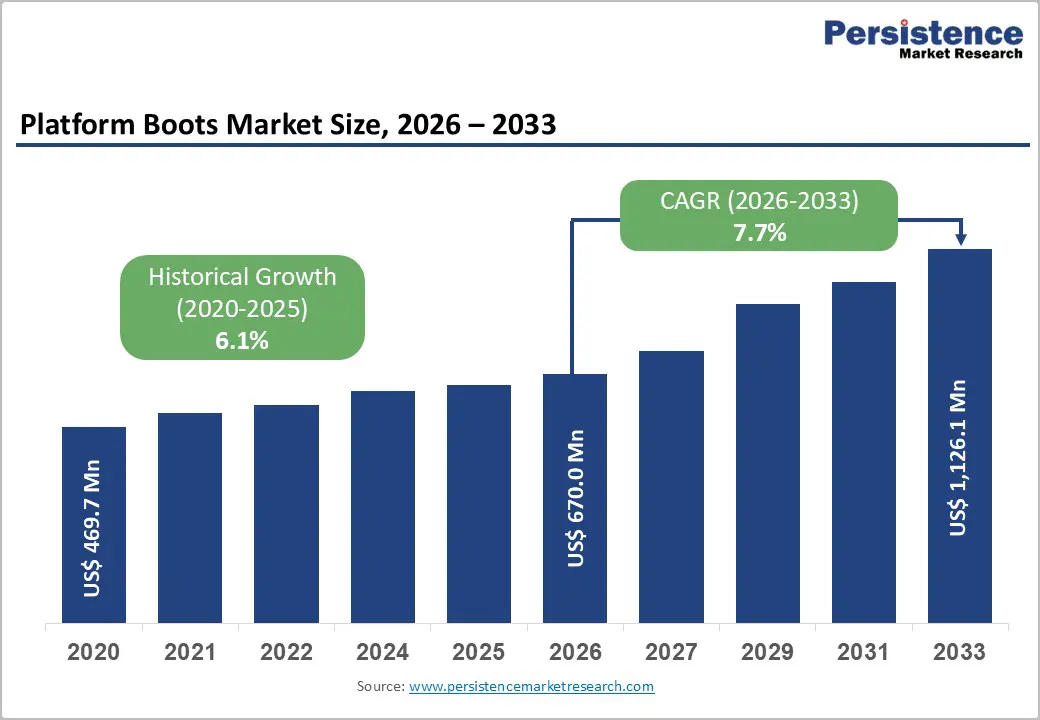
The global Platform Boots Market size is expected to be valued at US$ 670.0 million in 2026 and projected to reach US$ 1,126.1 million by 2033, growing at a CAGR of 7.7% between 2026 and 2033.

Platform boots, with their thick soles and bold designs, are increasingly embraced as a fashion statement, blending height, comfort, and style. Growth is driven by social media trends, with chunky platforms gaining popularity among Gen Z and millennials who favor striking, statement footwear. Online retail channels have expanded accessibility, making platform boots more widely available across demographics. Influencers, fashion blogs, and visual platforms like Pinterest amplify awareness, while evolving streetwear and retro fashion trends continue to fuel demand for versatile and eye-catching designs.

Key Industry Highlights:

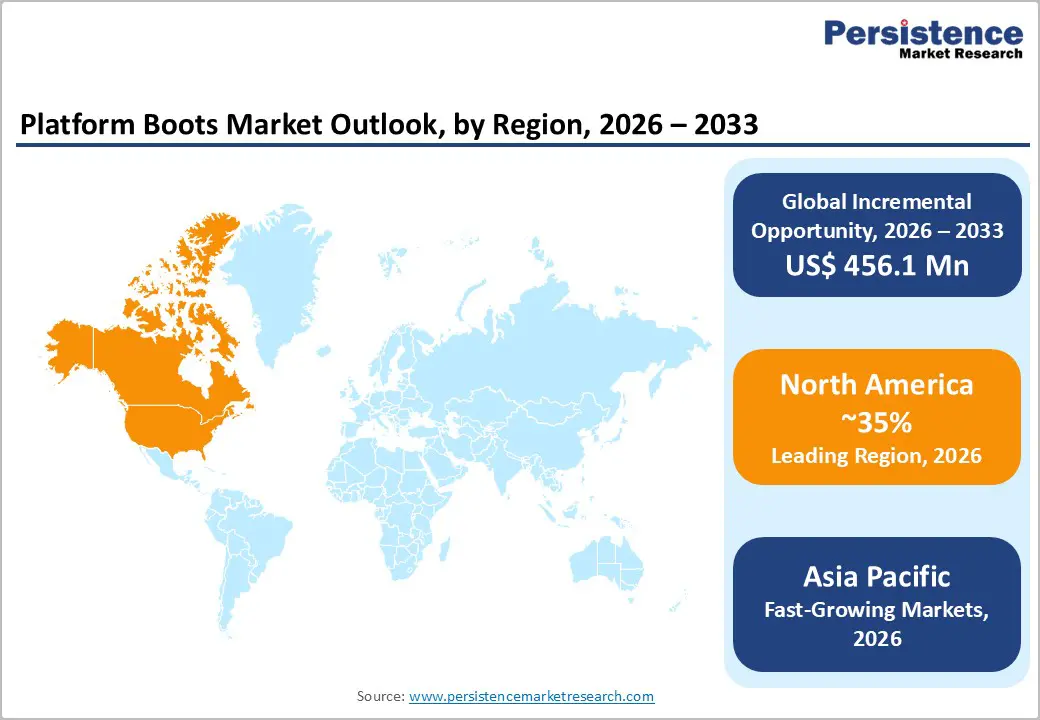
  • Leading Region: North America leads the market with 35% share, driven by U.S. fashion trends, high disposable incomes, and e-commerce dominance.
  • Fastest-Growing Region: Asia Pacific is the fastest-growing region with 10% CAGR, fueled by urbanization, rising disposable incomes, and China’s manufacturing surge.
  • Leading End-User Category: Women dominate the market with 72% share, supported by versatile styling options and strong fashion appeal.
  • Fastest-Growing Sales Channel: Online is the fastest-growing channel, capturing 48% of sales, boosted by digital convenience, e-commerce accessibility, and virtual shopping experiences.
  • Key Opportunity: Eco-friendly materials present a major opportunity, with polyurethane enabling up to 50% emission reductions and attracting sustainability-conscious consumers.
Key Insights Details

Platform Boots Size (2026E)

US$ 670.0 million

Market Value Forecast (2033F)

US$ 1,126.1 million

Projected Growth CAGR(2026-2033)

7.7%

Historical Market Growth (2020-2025)

6.1%

platform-boots-market-size-2026-2033

Market Dynamics

Drivers - Fashion Trends, Retro Revival, and Social Media Influence Driving Platform Boots Adoption

Platform boots are riding a wave of retro revival and streetwear appeal, becoming a key fashion statement that elevates outfits with boldness and attitude. Iconic brands continue to inspire both runway trends and everyday styling, blending nostalgia with modern aesthetics. Their chunky silhouettes make them versatile for casual, edgy, or statement looks that resonate across youth culture.

Social media platforms like TikTok and Instagram have amplified this trend, allowing influencers and fashion enthusiasts to showcase platform boots in creative, viral ways. Short-form videos, styling reels, and streetwear challenges create continuous engagement, spark impulse purchases, and accelerate fashion cycles. This visibility has cemented platform boots as a must-have accessory, especially among Gen Z and millennial consumers seeking statement footwear.

E-commerce Expansion and Enhanced Consumer Accessibility Fueling Demand for Platform Boots

The growing prominence of online retail has made platform boots widely accessible, allowing consumers to explore diverse styles and trends from anywhere. Digital platforms provide detailed visuals, product reviews, and styling guides, helping shoppers make informed choices and experiment with bold footwear. This accessibility has expanded the consumer base beyond traditional store locations, reaching niche and emerging markets.

Innovations like virtual try-ons, personalized recommendations, and interactive campaigns enhance the shopping experience, boosting engagement and purchase confidence. Online channels also empower smaller brands to compete globally, offering unique designs and limited editions that attract fashion-conscious consumers. The combination of convenience, personalization, and trend exposure continues to drive sustained adoption of platform boots across multiple demographics.

Restraints - Supply Chain Volatility and Its Impact on Platform Boots Production

Fluctuations in raw material availability, such as rubber and synthetic components, disrupt platform boot manufacturing and increase costs. Production delays caused by extreme weather events in key sourcing regions further strain supply chains. These interruptions make it difficult for brands to respond quickly to emerging fashion trends, slowing product launches and limiting inventory availability, which can affect consumer satisfaction and market momentum.

Rise in input costs from supply chain volatility also pressure profit margins, particularly for smaller or niche brands. Manufacturers face challenges balancing material procurement, production timelines, and competitive pricing, while maintaining quality standards. This unpredictability hinders scalability, constrains the ability to capitalize on sudden fashion trends, and can limit the adoption of innovative designs in platform boots.

Sustainability Regulations and Compliance Challenges Limiting Market Flexibility

Increasing regulations on chemicals, materials, and environmental standards add complexity for platform boot manufacturers. Compliance requirements restrict the use of certain compounds, necessitating process changes and safer material alternatives. These measures, while improving sustainability, increase operational costs and require technical adjustments that may challenge smaller brands or emerging designers.

Consumer demand for eco-friendly products adds additional pressure, as shoppers increasingly prefer brands with sustainable practices. Meeting these expectations while adhering to stringent regulations requires investments in research, certification, and supply chain audits. For some brands, the cost and complexity of compliance can limit product variety, slow innovation, and restrict responsiveness to fashion trends in the platform boots market.

Opportunity - Vegan and Eco-Material Advancements Creating Growth Potential for Platform Boots

Innovations in vegan and eco-friendly materials are driving new opportunities in the platform boots market. Alternatives such as recycled faux leather and low-emission polyurethane appeal to environmentally conscious consumers, allowing brands to align with sustainability values. These materials reduce carbon footprint, enhance brand reputation, and attract a growing segment of buyers who prioritize ethical and eco-friendly fashion choices.

Government incentives and policy support further boost adoption of sustainable materials, encouraging brands to innovate while meeting consumer expectations. With the popularity of vegan and recycled products rising steadily, manufacturers can differentiate their offerings, expand product lines, and capitalize on the demand for fashionable yet responsible footwear. This trend positions platform boots as both stylish and socially conscious.

Men’s Segment Diversification Expanding Market Reach

Gender-fluid fashion trends and increasing interest in men’s footwear present significant opportunities for platform boots. Styles traditionally associated with women are now being embraced by men, with search interest and social media engagement rising sharply. Collaborations between athletic and fashion brands create hybrid designs that appeal to men seeking bold, statement footwear.

The expanding men’s e-fashion market allows brands to explore innovative styling, marketing campaigns, and targeted online channels. By addressing the growing male consumer base with versatile, high-quality platform boots, companies can diversify their offerings, capture new demographics, and strengthen market share while tapping into evolving fashion trends.

Category-wise Analysis

Material Type Insights

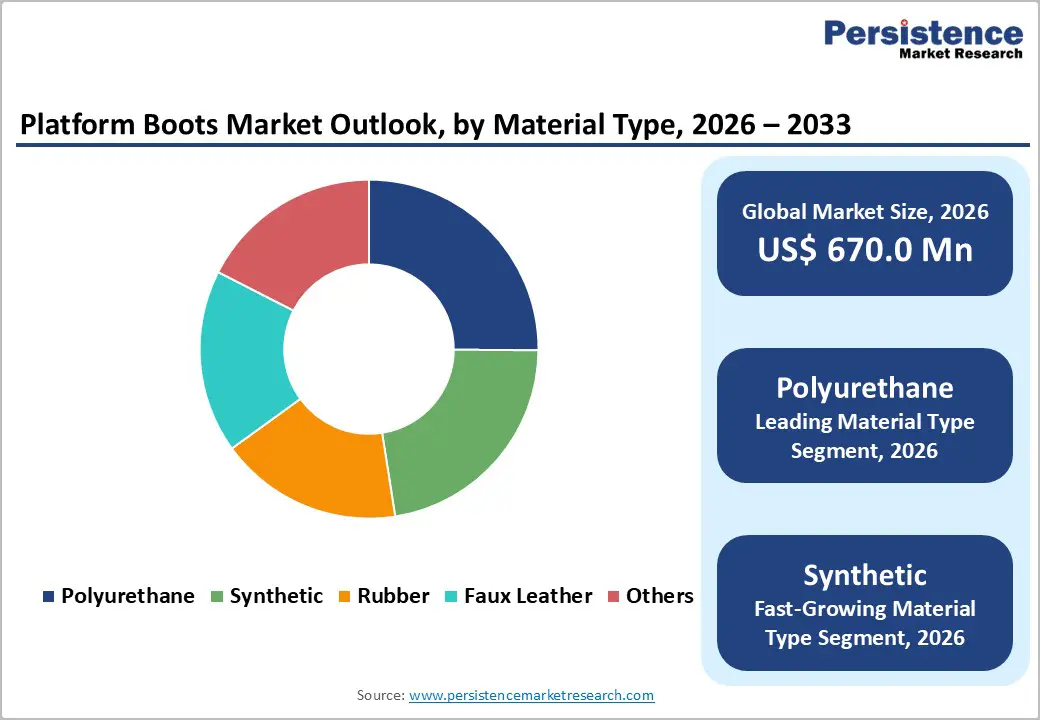
Polyurethane dominates the platform boots market, accounting for 44% share in 2025, thanks to its excellent abrasion resistance, mold compatibility, and lightweight characteristics. BASF highlights that polyurethane’s properties make it preferable over alternatives like EVA, which is widely used in about 60% of exports. Its durability and flexibility make it ideal for urban and fashion-forward platform boots, contributing to its widespread adoption by leading brands globally.

While polyurethane leads in share, synthetic and eco-friendly materials are emerging as the fastest-growing categories. These alternatives attract environmentally conscious consumers seeking vegan or sustainable options, allowing brands to experiment with innovative textures, recycled composites, and performance-enhancing features. Growing awareness of sustainability and ethical fashion is encouraging adoption of these materials across diverse demographics.

End-user Insights

Women dominate the platform boots market, capturing 72% share in 2025. This is driven by versatile styling options, fashion trends, and marketing campaigns specifically targeting female consumers. Studies from fashion institutes indicate that women’s sales outperform men’s by roughly a 2:1 ratio, as women increasingly embrace bold, statement footwear for casual, professional, and social settings.

The men’s segment is the fastest-growing category, fueled by evolving gender-fluid fashion trends and rising interest in statement footwear among younger male consumers. Collaborations with sportswear and streetwear brands are making men’s platform boots more mainstream, expanding the market reach and opening new opportunities for design experimentation and online engagement.

Sales Channel Insights

Online channels lead platform boots distribution, capturing 48% of global sales in 2025. E-commerce platforms provide extensive product variety, detailed reviews, and interactive features that enhance consumer decision-making. Growth in online sales is supported by convenience, home delivery, and increasing comfort with digital shopping, enabling both large brands and niche players to reach global audiences effectively.

Physical retail remains significant, but online stores are the fastest-growing channel. Features such as virtual try-ons, influencer-driven campaigns, and personalized recommendations enhance engagement and conversions. The digital ecosystem allows brands to quickly respond to fashion trends, promote limited-edition releases, and offer curated selections that appeal to trend-conscious and tech-savvy consumers.
platform-boots-market-outlook-by-material-type-2026-2033

Regional Insights

North America Platform Boots Market Trends and Insights

North America leads the platform boots market with 35% share in 2025, driven by strong fashion culture, high disposable incomes, and trend adoption. The U.S. dominates the region, with consumers embracing bold and statement footwear, while e-commerce channels provide convenience and wide product variety. Safety regulations and standards, particularly in California, have also encouraged innovation in vegan and sustainable materials, further boosting consumer confidence.

E-commerce continues to thrive as a distribution channel, enabling brands to target urban and suburban consumers effectively. Online promotions, influencer campaigns, and social media visibility amplify demand across demographics. The combination of fashion-forward trends, digital accessibility, and regulatory support has solidified North America as a primary market for platform boots, while niche and emerging brands continue to expand their footprint in the region.

Europe Platform Boots Market Trends and Insights

Europe accounts for a significant portion of the global platform boots market, with major contributors including Germany, the UK, and France. Fashion-conscious consumers embrace platform boots as part of streetwear, casual, and runway styles, while compliance with REACH regulations encourages the use of sustainable and safe materials. The market is projected to grow steadily, with an expected CAGR of 5.2% during 2026–2033.

Regional fashion events, such as Spain’s fashion weeks, harmonize trends and promote cross-country visibility. Urban consumers in major cities increasingly favor statement footwear, and the adoption of e-commerce platforms supports accessibility and trend responsiveness. Combined with sustainability awareness, these factors create a favorable environment for both established and emerging brands to expand their platform boots offerings across Europe.

Asia Pacific Platform Boots Market Trends and Insights

Asia Pacific is the fastest-growing region for platform boots, with an expected 10% CAGR between 2025 and 2032, fueled by rising disposable incomes, urbanization, and social media influence. China and India lead manufacturing and export growth, while Japan contributes through technologically advanced and design-focused footwear. ASEAN countries are witnessing urban lifestyle adoption, increasing demand for fashionable, bold, and functional platform boots.

Emerging middle-class consumers are embracing global fashion trends, with e-commerce and online marketplaces enabling rapid access to diverse styles. Influencer culture, streetwear trends, and collaborations between fashion and athletic brands further boost adoption. This combination of manufacturing strength, digital accessibility, and trend-driven consumer behavior positions Asia Pacific as a high-growth market for platform boots.
platform-boots-market-outlook-by-region-2026-2033

Competitive Landscape

The platform boots market is highly fragmented, comprising numerous independent brands alongside larger, established players. Companies compete by emphasizing product innovation, unique designs, and differentiation in style, material, and functionality. Sustainability initiatives and ethical manufacturing practices have become key strategies, helping brands appeal to environmentally conscious consumers and stand out in a crowded marketplace.

Direct-to-consumer channels and digital engagement are increasingly leveraged to strengthen brand presence and customer loyalty. Collaborations, limited-edition releases, and R&D in advanced materials like vegan or recycled soles allow companies to enhance their offerings, create trend-driven appeal, and capture attention across diverse consumer segments.

Key Developments:

  • In February 2026, Dr. Martens celebrated the Buzz platform anniversary by launching limited Wyoming leather editions, reinforcing the popularity of chunky platform boots and highlighting continued innovation in materials, design, and brand engagement with fashion-forward consumers.
  • In February 2025, Dr. Martens expanded its Buzz line with sneaker-platform hybrid designs for the brand’s 65th anniversary, blending casual athletic styling with elevated soles, appealing to younger consumers and reinforcing the ongoing trend for versatile, statement footwear in streetwear and fashion markets.
  • In June 2024, Boots joined the Manufacture 2030 initiative to decarbonize its supply chain, adopting sustainable production practices, improving material sourcing, and aligning with environmental standards, enhancing brand credibility and responding to growing consumer demand for eco-conscious footwear.

Companies Covered in Platform Boots Market

  • Dr. Martens
  • Steve Madden
  • Timberland
  • ASOS
  • GUCCI
  • Demonia
  • Jeffrey Campbell
  • Aldo
  • Stuart Weitzman
  • Palladium
  • Vagabond Shoemakers
  • Buffalo Boots
  • Bottega Veneta
  • H&M
  • Zara
Frequently Asked Questions

The global Platform Boots Market size in 2026 is expected to be valued at US$ 670.0 million.

Demand is driven by fashion trends, social media influence, and e-commerce accessibility that expands reach and convenience.

North America leads with 35% share, supported by U.S. fashion leadership, high disposable incomes, and strong e-commerce adoption.

Sustainable materials like polyurethane present an opportunity, enabling up to 50% lower emissions and appealing to eco-conscious consumers.

Key players include Dr. Martens, Steve Madden, Timberland, ASOS, and GUCCI.

Global Platform Boots Market Report Scope
Report Attribute Details

Historical Data/Actuals

2020 - 2025

Forecast Period

2026 - 2033

Market Analysis Units

Value: US$ Mn/Bn, Volume: As Applicable

Geographical Coverage

  • North America
  • Europe
  • Asia Pacific
  • Latin America
  • Middle East & Africa

Segmental Coverage

  • Material Type
  • End-user
  • Sales Channel
  • Region

Competitive Analysis

  • Dr. Martens
  • Steve Madden
  • Timberland
  • ASOS
  • GUCCI
  • Demonia
  • Jeffrey Campbell
  • Aldo
  • Stuart Weitzman
  • Palladium
  • Vagabond Shoemakers
  • Buffalo Boots
  • Bottega Veneta
  • H&M
  • Zara

Report Highlights

  • Market Forecast and Trends
  • Competitive Intelligence and Share Analysis
  • Growth Factors and Challenges
  • Strategic Growth Initiatives
  • Pricing Analysis
  • Future Opportunities and Revenue Pockets
  • Market Analysis Tools
Market Segmentation

By Material Type

  • Polyurethane
  • Synthetic
  • Rubber
  • Faux Leather
  • Others

By End-user

  • Men
  • Women

By Sales Channel

  • Online
  • Hypermarkets/Supermarkets
  • Footwear Stores
  • Convenience Stores
  • Others

By Region

  • North America
  • Europe
  • East Asia
  • South Asia & Oceania
  • Latin America
  • Middle East & Africa

Related Reports

  1. Executive Summary
    1. Global Platform Boots Market Snapshot 2026 and 2033
    2. Market Opportunity Assessment, 2026-2033, US$ Mn
    3. Key Market Trends
    4. Industry Developments and Key Market Events
    5. Demand Side and Supply Side Analysis
    6. PMR Analysis and Recommendations
  2. Market Overview
    1. Market Scope and Definitions
    2. Market Dynamics
      1. Driver
      2. Restraint
      3. Opportunities
      4. Trends
    3. Macro-Economic Factors
      1. Global GDP Outlook
      2. Global Prison Growth Outlook
      3. Global Crime Rates by Country
      4. Global Prison Population by Country
      5. Global Private Prison Market Growth Outlook
      6. Other Macro-economic Factors
    4. Forecast Factors – Relevance and Impact
    5. COVID-19 Impact Assessment
  3. Value Added Insights
    1. Value Chain analysis
    2. Key Market Players
    3. Product Adoption Analysis
    4. Key Promotional Strategies by key players
    5. PESTLE Analysis
    6. Porter's Five Forces Analysis
    7. Regulatory and Technology Landscape
  4. Price Trend Analysis, 2025
    1. Region-wise Price Analysis
    2. Price by Segments
    3. Price Impact Factors
  5. Global Platform Boots Market Outlook: Historical (2020 – 2025) and Forecast (2026 – 2033)
    1. Key Highlights
    2. Global Platform Boots Market Outlook: Material Type
      1. Introduction/Key Findings
      2. Historical Market Size (US$ Mn) and Volume (Units) Analysis by Material Type, 2020-2025
      3. Current Market Size (US$ Mn) and Volume (Units) Forecast, by Material Type, 2026-2033
        1. Polyurethane
        2. Synthetic
        3. Rubber
        4. Faux Leather
        5. Others
      4. Market Attractiveness Analysis: Material Type
    3. Global Platform Boots Market Outlook: End User
      1. Introduction/Key Findings
      2. Historical Market Size (US$ Mn) and Volume (Units) Analysis by End User, 2020-2025
      3. Current Market Size (US$ Mn) and Volume (Units) Forecast, by End User, 2026-2033
        1. Men
        2. Women
      4. Market Attractiveness Analysis: End User
    4. Global Platform Boots Market Outlook: Sales Channel
      1. Introduction/Key Findings
      2. Historical Market Size (US$ Mn) and Volume (Units) Analysis by Sales Channel, 2020-2025
      3. Current Market Size (US$ Mn) and Volume (Units) Forecast, by Sales Channel, 2026-2033
        1. Online
        2. Hypermarkets/Supermarkets
        3. Footwear Stores
        4. Convenience Stores
        5. Others
      4. Market Attractiveness Analysis: Sales Channel
  6. Global Platform Boots Market Outlook: Region
    1. Key Highlights
    2. Historical Market Size (US$ Mn) and Volume (Units) Analysis by Region, 2020-2025
    3. Current Market Size (US$ Mn) and Volume (Units) Forecast, by Region, 2026-2033
      1. North America
      2. Europe
      3. East Asia
      4. South Asia & Oceania
      5. Latin America
      6. Middle East & Africa
    4. Market Attractiveness Analysis: Region
  7. North America Platform Boots Market Outlook: Historical (2020 – 2025) and Forecast (2026 – 2033)
    1. Key Highlights
    2. Pricing Analysis
    3. North America Market Size (US$ Mn) and Volume (Units) Forecast, by Country, 2026-2033
      1. U.S.
      2. Canada
    4. North America Market Size (US$ Mn) and Volume (Units) Forecast, by Material Type, 2026-2033
      1. Polyurethane
      2. Synthetic
      3. Rubber
      4. Faux Leather
      5. Others
    5. North America Market Size (US$ Mn) and Volume (Units) Forecast, by End User, 2026-2033
      1. Men
      2. Women
    6. North America Market Size (US$ Mn) and Volume (Units) Forecast, by Sales Channel, 2026-2033
      1. Online
      2. Hypermarkets/Supermarkets
      3. Footwear Stores
      4. Convenience Stores
      5. Others
  8. Europe Platform Boots Market Outlook: Historical (2020 – 2025) and Forecast (2026 – 2033)
    1. Key Highlights
    2. Pricing Analysis
    3. Europe Market Size (US$ Mn) and Volume (Units) Forecast, by Country, 2026-2033
      1. Germany
      2. Italy
      3. France
      4. U.K.
      5. Spain
      6. Russia
      7. Rest of Europe
    4. Europe Market Size (US$ Mn) and Volume (Units) Forecast, by Material Type, 2026-2033
      1. Polyurethane
      2. Synthetic
      3. Rubber
      4. Faux Leather
      5. Others
    5. Europe Market Size (US$ Mn) and Volume (Units) Forecast, by End User, 2026-2033
      1. Men
      2. Women
    6. Europe Market Size (US$ Mn) and Volume (Units) Forecast, by Sales Channel, 2026-2033
      1. Online
      2. Hypermarkets/Supermarkets
      3. Footwear Stores
      4. Convenience Stores
      5. Others
  9. East Asia Platform Boots Market Outlook: Historical (2020 – 2025) and Forecast (2026 – 2033)
    1. Key Highlights
    2. Pricing Analysis
    3. East Asia Market Size (US$ Mn) and Volume (Units) Forecast, by Country, 2026-2033
      1. China
      2. Japan
      3. South Korea
    4. East Asia Market Size (US$ Mn) and Volume (Units) Forecast, by Material Type, 2026-2033
      1. Polyurethane
      2. Synthetic
      3. Rubber
      4. Faux Leather
      5. Others
    5. East Asia Market Size (US$ Mn) and Volume (Units) Forecast, by End User, 2026-2033
      1. Men
      2. Women
    6. East Asia Market Size (US$ Mn) and Volume (Units) Forecast, by Sales Channel, 2026-2033
      1. Online
      2. Hypermarkets/Supermarkets
      3. Footwear Stores
      4. Convenience Stores
      5. Others
  10. South Asia & Oceania Platform Boots Market Outlook: Historical (2020 – 2025) and Forecast (2026 – 2033)
    1. Key Highlights
    2. Pricing Analysis
    3. South Asia & Oceania Market Size (US$ Mn) and Volume (Units) Forecast, by Country, 2026-2033
      1. India
      2. Southeast Asia
      3. ANZ
      4. Rest of SAO
    4. South Asia & Oceania Market Size (US$ Mn) and Volume (Units) Forecast, by Material Type, 2026-2033
      1. Polyurethane
      2. Synthetic
      3. Rubber
      4. Faux Leather
      5. Others
    5. South Asia & Oceania Market Size (US$ Mn) and Volume (Units) Forecast, by End User, 2026-2033
      1. Men
      2. Women
    6. South Asia & Oceania Market Size (US$ Mn) and Volume (Units) Forecast, by Sales Channel, 2026-2033
      1. Online
      2. Hypermarkets/Supermarkets
      3. Footwear Stores
      4. Convenience Stores
      5. Others
  11. Latin America Platform Boots Market Outlook: Historical (2020 – 2025) and Forecast (2026 – 2033)
    1. Key Highlights
    2. Pricing Analysis
    3. Latin America Market Size (US$ Mn) and Volume (Units) Forecast, by Country, 2026-2033
      1. Brazil
      2. Mexico
      3. Rest of LATAM
    4. Latin America Market Size (US$ Mn) and Volume (Units) Forecast, by Material Type, 2026-2033
      1. Polyurethane
      2. Synthetic
      3. Rubber
      4. Faux Leather
      5. Others
    5. Latin America Market Size (US$ Mn) and Volume (Units) Forecast, by End User, 2026-2033
      1. Men
      2. Women
    6. Latin America Market Size (US$ Mn) and Volume (Units) Forecast, by Sales Channel, 2026-2033
      1. Online
      2. Hypermarkets/Supermarkets
      3. Footwear Stores
      4. Convenience Stores
      5. Others
  12. Middle East & Africa Platform Boots Market Outlook: Historical (2020 – 2025) and Forecast (2026 – 2033)
    1. Key Highlights
    2. Pricing Analysis
    3. Middle East & Africa Market Size (US$ Mn) and Volume (Units) Forecast, by Country, 2026-2033
      1. GCC Countries
      2. South Africa
      3. Northern Africa
      4. Rest of MEA
    4. Middle East & Africa Market Size (US$ Mn) and Volume (Units) Forecast, by Material Type, 2026-2033
      1. Polyurethane
      2. Synthetic
      3. Rubber
      4. Faux Leather
      5. Others
    5. Middle East & Africa Market Size (US$ Mn) and Volume (Units) Forecast, by End User, 2026-2033
      1. Men
      2. Women
    6. Middle East & Africa Market Size (US$ Mn) and Volume (Units) Forecast, by Sales Channel, 2026-2033
      1. Online
      2. Hypermarkets/Supermarkets
      3. Footwear Stores
      4. Convenience Stores
      5. Others
  13. Competition Landscape
    1. Market Share Analysis, 2025
    2. Market Structure
      1. Competition Intensity Mapping
      2. Competition Dashboard
    3. Company Profiles
      1. Dr. Martens
        1. Company Overview
        2. Product Portfolio/Offerings
        3. Key Financials
        4. SWOT Analysis
        5. Company Strategy and Key Developments
      2. Steve Madden
      3. Timberland
      4. ASOS
      5. GUCCI
      6. Demonia
      7. Jeffrey Campbell
      8. Aldo
      9. Stuart Weitzman
      10. Palladium
      11. Vagabond Shoemakers
      12. Buffalo Boots
      13. Bottega Veneta
      14. H&M
      15. Zara
  14. Appendix
    1. Research Methodology
    2. Research Assumptions
    3. Acronyms and Abbreviations

Research Methodology Framework for Market Research Excellence

At Persistence Market Research, we implement a comprehensive, validated, and multi-dimensional approachto market analysis that delivers actionable insights across complex market landscapes. Our methodology combines the analytical rigor of leading consulting firms with innovative research techniques, ensuring robust market assessments that guide strategic decision-making with confidence.

Core Research Philosophy

Our methodology is built on four foundational pillars:

Research Philosophy Image

At Persistence Market Research, our methodology is designed to transcend conventional market studies by combining analytical rigor, multi-source validation, and future-focused insights.

We integrate advanced research frameworks, robust data collection strategies, cutting-edge analytics, and innovative technologies to deliver a 360-degree view of complex markets.

We integrate advanced research frameworks, robust data collection strategies, cutting-edge analytics, and innovative technologies to deliver a 360-degree view of complex markets.

Each stage spanning from strategic scoping and hypothesis-building to competitive intelligence, quality validation, and actionable recommendations is engineered to provide clients with unmatched clarity, precision, and confidence in decision-making.

By embedding innovation and technology at the core, our approach ensures that insights are not only comprehensive but also predictive, empowering businesses to seize opportunities, mitigate risks, and achieve sustainable growth

Research Philosophy Image

Capturing Key Information and Events

During this phase, key research objectives focus on essential information and data points for assessing the market, including:

Research Philosophy Image

TAM-SAM-SOM Framework Implementation

We employ both top-down and bottom-up approaches to ensure accurate market sizing.

Top-Down Market SizingBottom-Up Market Sizing
Universe Definition: Total global/regional market identificationUnit Economics: Average transaction values, purchase frequencies, customer lifecycle
Segmentation Filters: Geographic, demographic, and behavioral constraintsCustomer Segmentation: Detailed buyer persona development and sizing
Market Share Analysis: Competitive landscape assessment and share allocationPenetration Analysis: Market penetration rates by segment and geography
Growth Rate Application: Historical trends and forward-looking growth assumptionsScaling Methodology: Extrapolation techniques with confidence intervals

Validation & Cross-Verification

  • Triangulation: Comparing top-down and bottom-up results for consistency
  • Sensitivity Analysis: Testing key assumptions and parameter variations
  • Peer Benchmarking: Comparison with analogous markets and industry benchmarks
  • Expert Review: External validation through industry specialist consultation

Research Philosophy Image

Forecasting & Projection Modeling

Our proprietary forecasting models incorporate multiple variables and scenarios.

Forecasting Components

  • Historical Trend Analysis: 10-year historical growth patterns and cyclical variations
  • Driver-Based Modeling: Economic indicators, demographic shifts, technology adoption
  • Scenario Planning: Base case, optimistic, and conservative projections
  • Monte Carlo Simulations: Probability-weighted outcomes and risk assessments

Model Validation

  • Back-Testing: Historical accuracy assessment over 3–5-year periods
  • Cross-Validation: Multiple modeling approaches for result comparison
  • External Benchmarking: Comparison with established market forecasts
  • Continuous Calibration: Quarterly model updates based on new data

Comprehensive Data Collection Strategy

Our secondary research phase establishes a robust knowledge base utilizing diverse, credible sources.

Secondary Data Sourcess

  • Industry Publications & Reports
  • Government & Regulatory Data
  • Financial Intelligence (filings & reports)
  • Academic Research & Digital Intelligence

Quality Assurance Protocol

  • Source credibility assessment and publication date validation
  • Data consistency checks across multiple sources
  • Bias identification and neutralization techniques
  • Information gap tracking for primary research prioritization

Research Philosophy Image

Primary Research Excellence

Our primary research methodology employs best-in-class techniques to capture unique market insights.

Quantitative Research Methods

  • Large-Scale Surveys: Statistically representative samples with 95% confidence intervals
  • Survey Methodology: Multi-channel deployment (online, telephone, in-person)
  • Question Architecture and Response Optimization

Qualitative Research Methods

  • Executive Interviews
  • Focus Groups
  • Expert Consultations

Quality Assurance & Validation Framework

Multi-Stage Validation Process

  • Source Verification and Consistency Testing
  • Outlier Detection and Bias Assessment
  • Peer Review Process and External Validation
  • Sensitivity Analysis and Confidence Intervals

Research Philosophy Image

Methodology Validation & Credibility

Our research methodology has been extensively validated through:

  • Academic Partnerships: Collaborations with top-tier business schools and research institutions
  • Client Success Stories: Documented case studies demonstrating research impact and ROI
  • Continuous Benchmarking: Performance comparison with leading global research firms

This comprehensive methodology framework positions Persistence Market Research at the forefront of market intelligence, combining the analytical sophistication of top-tier consulting firms with innovative research techniques. Our approach ensures that every market assessment delivers precise, actionable, and strategically valuable insights that drive business success in competitive market environments.

Ready to unlock your market potential? Contact our research experts to discuss how our validated methodology can transform your strategic decision-making with data-driven market intelligence.

Copyright © 2026 Persistence Market Research. All Rights Reserved

Connect With Us -