OTC Pet Medication Market Size, Share, Trends, Growth, and Regional Forecasts 2025 - 2032

OTC Pet Medication Market Segment Forecasted by Product Type (Fleas & Ticks, Pain Relief & Arthritis, Dewormers), by Pet Type (Dogs, Cats, Birds, Fish & Reptiles, Small Pets), by Medicine Form (Chewable & Tablets, Capsules & Ointment, Sprays), by Sales Channel and Regional Analysis

ID: PMRREP31512
Calendar

May 2025

300 Pages

Author : Likhit Meshram

OTC Pet Medication Market Size and Share Analysis

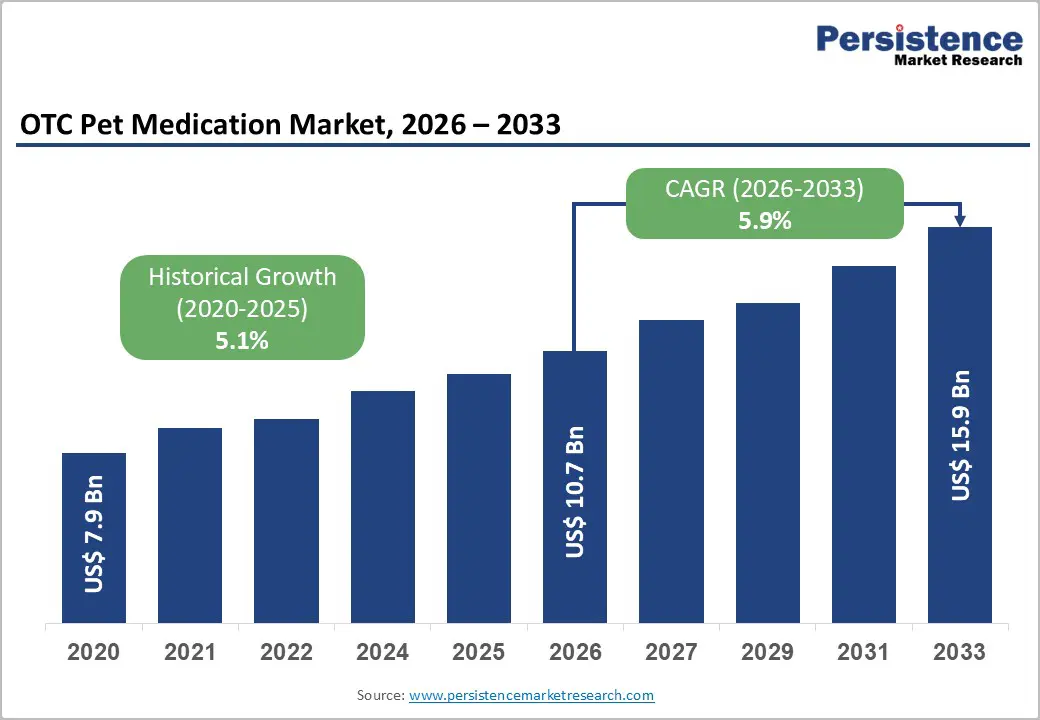
The global OTC pet medication market is projected to expand at 4.5% CAGR and reach US$ 13.6 Bn by the end of 2032, up from its current market size of US$ 10 Bn in 2025.

Global OTC Pet Medication Market Size (2024A)

US$ 9.7 Bn

Global Market Size (2025E)

US$ 10 Bn

Projected Sales of Market (2032F)

US$ 13.6 Bn

Value CAGR (2025 to 2032)

4.5%

Collective Value Share: Top 3 Countries (2024)

56%

The desire for companion animals among people and changes in lifestyle are the main drivers of the rise in pet ownership around the world. These factors, in turn, contribute to the growth of related or following sectors, such as OTC pet medications. The demand for over-the-counter pet medications has increased along with the number of pets owned and knowledge of pet health issues.

Companies are selling OTC pet medications at competitive costs through a variety of sales channels, including drug and pharmacy stores, pet specialty shops, etc. Additionally, OTC pet medications can be purchased online, which has grown to be a successful sales channel for the OTC pet medication market.

OTC Pet Medication Market Analysis from 2019 to 2024 Vs Market Outlook for 2025 to 2032

The introduction of multiple cutting-edge pet medication over the past few years has provided customers and doctors a variety of options to select the finest prescription for their pets. Another element driving demand in the market is the accessibility of customizable drugs from compounding pharmacies.

Both pet owners and farmers who own cattle are becoming more interested in medications designed specifically for treating various animal illnesses. As a result, the development of flavoured soft chews as a dose form for several over-the-counter medicines has rapidly grown. The sales of OTC pet medications are expected to increase internationally as a result.

Additionally, because the pet medication sector is growing, governments all over the world are stepping up their support for pet care. For instance, the Animal Welfare Board of India has put in place a number of programmes to help the nation's pet owners. Some of their programmes include funding for birth control, vaccination of stray dogs, and grant-in-aid for the upkeep of sheltered animals. Therefore, increasing government funding and support for pets and farm animals is driving up market demand. The market for OTC pet medications increased at a CAGR of 3.6% between 2019 and 2024.

How is Increasing Pet Adoption Boosting the OTC Pet Medication Market?

Having a pet as a friend offers a great deal of love and affection in addition to having positive health effects. An individual's loneliness is frequently reduced by pets. Having a pet encourages one to go outside and interact with others. Walking a dog together can assist with health problems like high blood pressure and cholesterol. A companion animal is viewed as a person's best friend. The close bond that develops between a human and a pet frequently aids in the treatment of conditions like depression and other forms of mental stress. It also talks about how lonely a person can be. The adoption of pets has become more popular all around the world as a result of these advantages.

The number of pet owners has risen by 11% since 1988, according to National Pet Owners figures from 2019. In 2019, almost 67% of American households had a pet, with the majority of those families having dogs. In addition, the UK's Pet Food Manufacturers Association reports that in 2019, 40% of homes (about 12 million) had a pet, with 25% of those households having dogs. It is anticipated that rising pet adoption would help the industry develop.

How is Pet Humanization driving the Sales of OTC Pet Medication?

The concept of treating pets as part of the family is known as pet humanization. The market's rising demand for pet medications is mostly due to the humanization of pets. Pet medications and other medicated goods and services are in high demand due to a number of additional causes, including the rising rate of pet adoption and rising per-person pet spending. People who own dogs care for them in a similar way to parents caring for their children in a family, since pets are treated as essential members of the family.

Many people even view raising pets as a form of child upbringing approach. Pet owners take their commitments to their animals extremely seriously. Owners of pets desire the same things for themselves as they do for their own comfort. This is a key factor in why they don't think twice about spending money on their pets' welfare. Spending by pet owners goes into essentials like veterinary care, pet grooming, and other veterinary services. The majority of pet owners today, the millennial generation, agree that animals should be treated just like children. This is a motivating factor that is anticipated to increase pet medicine sales.

Country-wise Analysis

Why the U.S. is considered the largest market for global OTC veterinary drugs?

In 2024, the U.S. accounted for 88.8% of the market share for OTC pet medication in North America. Over the projection period, the U.S. market is expected to grow at a CAGR of 2.6%.

The demand for over-the-counter (OTC) pet medications in the United States is being fuelled by the growth of the pet care business and a rise in online pharmacies. More than 3.5 million pets were covered under insurance in the United States in 2021, as reported by the North American Pet Health Insurance Association (NAPHIA).

Pet adoption is increasing in the United States as a result of the rising number of pet insurance companies and their active marketing campaigns to promote product understanding among pet owners.

How is the OTC Pet Medication Market Striving in Germany?

Germany contributed a share of 22.4% of the total European OTC pet medication market in 2024 and is anticipated to grow at a CAGR of 5.1% during the projected period.

Furthermore, a significant element driving the market for OTC pet medications in Germany is the rising prevalence of pet adoption in the country. For instance, the German dog association Deutsche Hundewesen (VDH) reported a 20% increase in pet dog sales in Germany for the entire year 2020.

Due to the presence of several major producers in Europe, including Boehringer Ingelheim, Merck Animal Health, and Virbac S.A., the availablity of pet medication in Germany is comparatively high, which illustrates why Germany has such a significant portion of the European market.

What is the Scope of OTC Pet Medication Market in China?

The primary drivers of the market expansion in the nation are the rising number of companion animals, pet humanization, prevalence of animal ailments, and initiatives by important companies. For instance, the Chinese Ministry of Agriculture and Rural Affairs granted licence to Boehringer Ingelheim in 2021 for the GastroGard medication formulated for horses. Boehringer Ingelheim established itself as the first multinational animal health company to conduct horse business in China.

The market was affected in many ways by the COVID-19 pandemic. For certain market players, the negative consequences of movement limitations and logistical challenges led to poor demand and sales. However, pet ownership increased across the nation which helped the market to get back on track. In the upcoming years, it is predicted that this would increase demand for OTC pet medications and diagnostic tools. This element, together with the expanding initiatives by industry participants, is anticipated to fuel market expansion. The Chinese OTC medication market is estimated to rise at a CAGR of 10.1% during the forecast period.

Category-wise Insights

Which Product Type has the Highest Demand in the OTC Pet Medication Market?

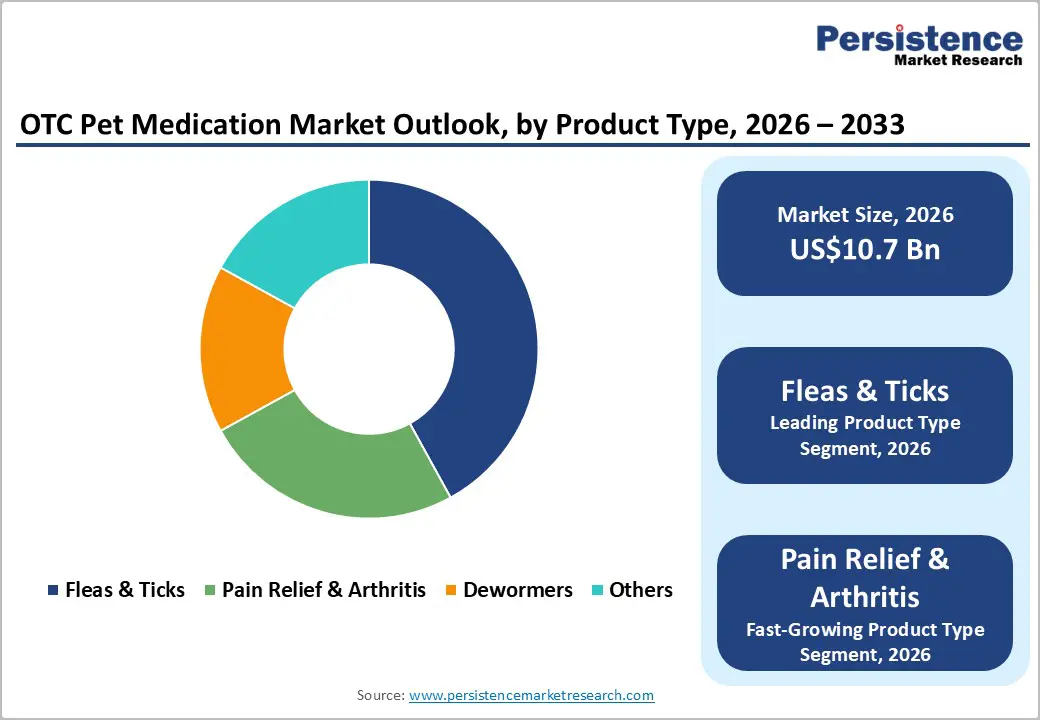
Common illnesses carried and spread by fleas and ticks include flea allergy dermatitis and Lyme disease. Arthritis is the second most frequent medical condition seen in pets. Flea & tick, pain treatment, and arthritis drugs account for the majority of sales of OTC pet medications.

Together, these items account for 70% of all OTC pet drug sales. The possible risk of transmission to people is a major factor driving the rising use of painkillers and arthritis medications as well as flea and tick repellents. However, the flea & tick segment is anticipated to rise at the highest CAGR of nearly 5.5%.

Which Type of OTC Pet Medication is Majorly Used?

Dogs held the largest percentage of all pet types in 2024, with a share of ~35%. The indications for non-infectious disorders among dogs accounted for almost 25% of the market. According to predictions, the dog segment will continue to hold its dominant position in the market as dogs are adopted as pets on a larger scale than other animal species. While dogs are also considered as man’s best friend which works in the segments favour.

Which Sales Channel is estimated to Gain Traction during the Forecast Period?

By the end of 2024, it is anticipated that drug and pharmacy stores would hold a ~62.2% market share of the global market for sales channels. However, online pharmacies have emerged on the global market as a result of increasing demand from pet owners for home delivery of all OTC pet medications.

To boost the scalability of these products, numerous market players are concentrating on promoting them via e-commerce platforms. According to Persistence Market Research, the segment is anticipated to increase at a CAGR of ~4% during the course of the projection years. A sizeable portion of the OTC pet medicine industry is also controlled by retail pharmacies.

Competition Landscape

The global OTC pet medication market is fairly consolidated in nature, where, a majority of players focus on product formulation & development, regular product launches, and mergers & acquisitions. Collaborations and acquisition of niche players is a key strategy being followed by leading OTC pet medication manufacturers.

  • Dechra Pharmaceuticals signed an agreement with Akston Biosciences for the launch of new product, AKS-425c, which is an insulin therapy for cats.
  • In 2018, Zoetis Inc. expanded its animal vaccines research and manufacturing in Suzhou, China. The company is focusing on the development and manufacturing of vaccines and supplements for companion animals, fish, cattle, and pigs. It is also planning to expand its physical presence by establishing new manufacturing and distribution centres in east China.

Companies Covered in OTC Pet Medication Market

  • Bayer Companion Animal
  • oehringer Ingelheim
  • Animal Health
  • Ceva Sante Animate
  • Merck Inc.
  • Zoetis Inc.
  • Elanco
  • Virbac SA
  • Vetoquinol SA
  • Frontline
  • Zymox
  • ChloraSeb
  • Sulfox
  • Adequan
  • Dechra Pharmaceuticals PLC
  • Nutramax Laboratories, Inc.
  • Other Players (As Requested)
Frequently Asked Questions

The global OTC pet medication market reached a valuation of US$ 9.7 Bn at the end of 2024.

Between 2019 and 2024, global sales of OTC pet medication increased at 3.6% CAGR.

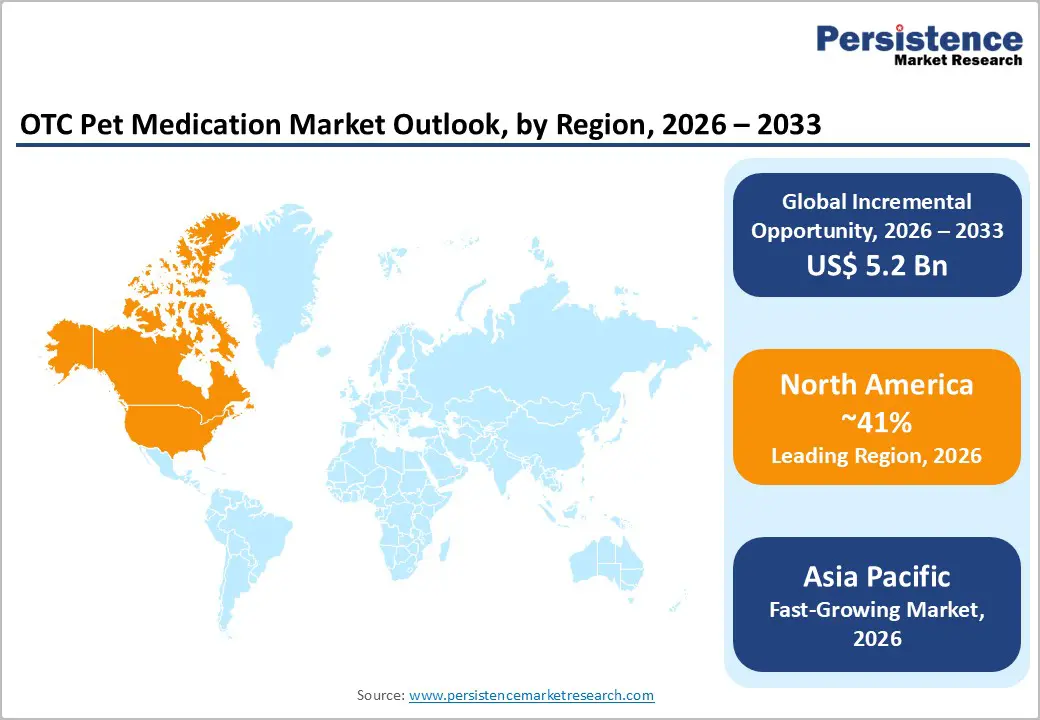
North America leads the global market and accounted for highest share in 2024.

Some of the leading manufacturers of OTC pet medication are Bayer Companion Animal, Boehringer Ingelheim Animal Health, Ceva Sante Animate, Merck Inc., Zoetis Inc., Elanco, Virbac SA, Vetoquinol SA, Frontline, Zymox, ChloraSeb, Su!fox, Adequan, Dechra Pharmaceuticals PLC, and Nutramax Laboratories, Inc. among others.

The global market for OTC pet medication is expected to expand at 4.5% CAGR through 2032.

OTC Pet Medication Industry Report Scope

Attribute

Details

Forecast Period

2025-2032

Historical Data Available for

2019-2024

Market Analysis Units Value: US$ Bn/Mn, Volume: As applicable

Key Regions Covered

  • North America
  • Latin America
  • Europe
  • East Asia
  • South Asia
  • Oceania
  • MEA

Key Countries Covered

  • United States
  • Canada
  • Brazil
  • Mexico
  • Germany
  • U.K.
  • France
  • Spain
  • Italy
  • Russia
  • South Africa
  • Northern Africa
  • GCC Countries
  • China
  • Japan
  • South Korea
  • India
  • Thailand
  • Malaysia
  • Indonesia
  • Australia
  • New Zealand

Key Market Segments Covered

  • Product Type
  • Pet Type
  • Medicine Form
  • Sales Channel
  • Region

Key Companies Profiled

  • Bayer Companion Animal
  • Boehringer Ingelheim
  • Animal Health
  • Ceva Sante Animate
  • Merck Inc.
  • Zoetis Inc.
  • Elanco
  • Virbac SA
  • Vetoquinol SA
  • Frontline
  • Zymox
  • ChloraSeb
  • Sulfox
  • Adequan
  • Dechra Pharmaceuticals PLC
  • Nutramax Laboratories, Inc.
  • Others (As per Request)
Report Highlights
  • Market Forecast and Trends
  • Competitive Intelligence & Share Analysis
  • Growth Factors and Challenges
  • Strategic Growth Initiatives
  • Pricing Analysis & Technology Roadmap
  • Future Opportunities and Revenue Pockets
  • Industry Market Analysis Tools

Customization & Pricing

Available upon Request

Key Segments Covered in OTC Pet Medication Industry Research

By Product Type:

  • Fleas & Ticks
  • Pain Relief & Arthritis
  • Dewormers
  • Others

By Pet Type:

  • Dogs
  • Cats
  • Birds
  • Fish & Reptiles
  • Small Pets
  • Others

By Medicine Form:

  • Chewable & Tablets
  • Capsules & Ointment
  • Sprays
  • Others

By Sales Channel:

  • Pet Specialty Stores
  • Veterinary Clinics
  • Drug & Pharmacy Stores
  • Online Retail
  • Others

By Region:

  • North America
  • Latin America
  • Europe
  • East Asia
  • South Asia
  • Oceania
  • Middle East Africa

Related Reports

1. Executive Summary

    1.1. Global Market Overview

    1.2. Summary of Key Statistics

    1.3. Summary of Key Findings

    1.4. Product Evolution Analysis

    1.5. PMR Analysis and Recommendations

2. Market Overview

    2.1. Market Coverage/Taxonomy

    2.2. Market Definition/Scope/Limitations

3. Key Market Trends

    3.1. Key Trends Impacting the Market

        3.1.1. World Class R&D driving Unrelenting Innovation

        3.1.2. Consumer Trends Shaping the Future

        3.1.3. Rising Number of Obese Pets Boosts the Demand for Therapeutic Offerings

        3.1.4. Pet Humanization driving Sales of Medicinal Products

    3.2. Product Innovation Trends

    3.3. Future Prospects of the OTC Pet Medication Industry

        3.3.1. Factors Fuelling the Growth

        3.3.2. Influx of Brands

        3.3.3. Innovative Distribution and Marketing Strategies

4. Global OTC Pet Medication Market Demand Analysis 2019-2024 and Forecast, 2025-2032

    4.1. Historical Market Volume (Units) Analysis, 2019-2024

    4.2. Current and Future Market Volume (Units) Projections, 2025-2032

    4.3. Y-o-Y Growth Trend Analysis

5. Global OTC Pet Medication Market - Pricing Analysis

    5.1. Pricing Analysis By Product Type

    5.2. Global Average Pricing Analysis Benchmark

6. Global OTC Pet Medication Market Demand (in Value or Medicine Form in US$ Bn) Analysis 2019-2024 and Forecast, 2025-2032

    6.1. Historical Market Value (US$ Bn) Analysis, 2019-2024

    6.2. Current and Future Market Value (US$ Bn) Projections, 2025-2032

        6.2.1. Y-o-Y Growth Trend Analysis

        6.2.2. Absolute $ Opportunity Analysis

7. Market Background

    7.1. Macro-Economic Factors

        7.1.1. GDP Growth Outlook

        7.1.2. Consumer Spending Outlook

        7.1.3. GDP Growth Rate Analysis

        7.1.4. Internet Penetration Rate Outlook

        7.1.5. Income Group Population Overview

        7.1.6. Per Capita Disposable Income

    7.2. Forecast Factors - Relevance & Impact

        7.2.1. Top Companies Historical Growth

        7.2.2. Urbanization Growth Outlook

        7.2.3. Others

    7.3. PESTLE Analysis of Global OTC Pet Medication Market

    7.4. Investment Feasibility Matrix of OTC Pet Medication Market

    7.5. Porter’s Five Forces Analysis of Global OTC Pet Medication Market

    7.6. Market Dynamics

        7.6.1. Drivers

        7.6.2. Restraints

        7.6.3. Opportunity Analysis

8. Global OTC Pet Medication Market Analysis 2019-2024 and Forecast 2025-2032, By Product Type

    8.1. Introduction / Key Findings

    8.2. Historical Market Size (US$ Bn) Analysis By Product Type, 2019-2024

    8.3. Current and Future Market Size (US$ Bn) Analysis and Forecast By Product Type, 2025-2032

        8.3.1. Fleas & Ticks

        8.3.2. Pain Relief & Arthritis

        8.3.3. Dewormers

        8.3.4. Others

    8.4. Market Attractiveness Analysis By Product Type

9. Global OTC Pet Medication Market Analysis 2019-2024 and Forecast 2025-2032, by Pet Type

    9.1. Introduction / Key Findings

    9.2. Historical Market Size (US$ Bn) and Volume Analysis By Pet Type, 2019-2024

    9.3. Current and Future Market Size (US$ Bn) and Volume Analysis and Forecast By Pet Type, 2025-2032

        9.3.1. Dogs

        9.3.2. Cats

        9.3.3. Birds

        9.3.4. Fish & Reptiles

        9.3.5. Small Pets

        9.3.6. Others

    9.4. Market Attractiveness Analysis By Pet Type

10. Global OTC Pet Medication Market Analysis 2019-2024 and Forecast 2025-2032, by Medicine Form

    10.1. Introduction / Key Findings

    10.2. Historical Market Size (US$ Bn) and Volume Analysis By Medicine Form, 2019-2024

    10.3. Current and Future Market Size (US$ Bn) and Volume Analysis and Forecast By Medicine Form, 2025-2032

        10.3.1. Chewable & Tablets

        10.3.2. Capsules & Ointment

        10.3.3. Sprays

        10.3.4. Others

    10.4. Market Attractiveness Analysis By Medicine Form

11. Global OTC Pet Medication Market Analysis 2019-2024 and Forecast 2025-2032, by Sales Channel

    11.1. Introduction / Key Findings

    11.2. Historical Market Size (US$ Bn) and Volume Analysis By Sales Channel, 2019-2024

    11.3. Current and Future Market Size (US$ Bn) and Volume Analysis and Forecast By Sales Channel, 2025-2032

        11.3.1. Pet Specialty Stores

        11.3.2. Veterinary Clinics

        11.3.3. Drug & Pharmacy Stores

        11.3.4. Online Retail

        11.3.5. Others

    11.4. Market Attractiveness Analysis By Sales Channel

12. Global OTC Pet Medication Market Analysis 2019-2024 and Forecast 2025-2032, by Region

    12.1. Introduction

    12.2. Historical Market Size (US$ Bn) and Volume (Units) Analysis by Region, 2019-2024

    12.3. Current Market Size (US$ Bn) and Volume (Units) Analysis and Forecast by Region, 2025-2032

        12.3.1. North America

        12.3.2. Latin America

        12.3.3. Europe

        12.3.4. East Asia

        12.3.5. South Asia

        12.3.6. Oceania

        12.3.7. Middle East and Africa (MEA)

    12.4. Market Attractiveness Analysis by Region

13. North America OTC Pet Medication Market Analysis 2019-2024 and Forecast 2025-2032

    13.1. Introduction

    13.2. Pricing Analysis

    13.3. Historical Market Size (US$ Bn) and Volume Trend Analysis By Market Taxonomy, 2019-2024

    13.4. Market Size (US$ Bn) and Volume Forecast By Market Taxonomy, 2025-2032

        13.4.1. By Country

            13.4.1.1. U.S.

            13.4.1.2. Canada

        13.4.2. By Product Type

        13.4.3. By Pet Type

        13.4.4. By Medicine Form

        13.4.5. Sales Channel

    13.5. Market Attractiveness Analysis

        13.5.1. By Country

        13.5.2. By Product Type

        13.5.3. By Pet Type

        13.5.4. By Medicine Form

        13.5.5. Sales Channel

14. Latin America OTC Pet Medication Market Analysis 2019-2024 and Forecast 2025-2032

    14.1. Introduction

    14.2. Pricing Analysis

    14.3. Historical Market Size (US$ Bn) and Volume Trend Analysis By Market Taxonomy, 2019-2024

    14.4. Market Size (US$ Bn) and Volume Forecast By Market Taxonomy, 2025-2032

        14.4.1. By Country

            14.4.1.1. Brazil

            14.4.1.2. Mexico

            14.4.1.3. Rest of Latin America

        14.4.2. By Product Type

        14.4.3. By Pet Type

        14.4.4. By Medicine Form

        14.4.5. Sales Channel

    14.5. Market Attractiveness Analysis

        14.5.1. By Country

        14.5.2. By Product Type

        14.5.3. By Pet Type

        14.5.4. By Medicine Form

        14.5.5. Sales Channel

15. Europe OTC Pet Medication Market Analysis 2019-2024 and Forecast 2025-2032

    15.1. Introduction

    15.2. Pricing Analysis

    15.3. Historical Market Size (US$ Bn) and Volume Trend Analysis By Market Taxonomy, 2019-2024

    15.4. Market Size (US$ Bn) and Volume Forecast By Market Taxonomy, 2025-2032

        15.4.1. By Country

            15.4.1.1. Germany

            15.4.1.2. Italy

            15.4.1.3. France

            15.4.1.4. U.K.

            15.4.1.5. Spain

            15.4.1.6. Rest of Europe

        15.4.2. By Product Type

        15.4.3. By Pet Type

        15.4.4. By Medicine Form

        15.4.5. Sales Channel

    15.5. Market Attractiveness Analysis

        15.5.1. By Country

        15.5.2. By Product Type

        15.5.3. By Pet Type

        15.5.4. By Medicine Form

        15.5.5. Sales Channel

16. South Asia OTC Pet Medication Market Analysis 2019-2024 and Forecast 2025-2032

    16.1. Introduction

    16.2. Pricing Analysis

    16.3. Historical Market Size (US$ Bn) and Volume Trend Analysis By Market Taxonomy, 2019-2024

    16.4. Market Size (US$ Bn) and Volume Forecast By Market Taxonomy, 2025-2032

        16.4.1. By Country

            16.4.1.1. India

            16.4.1.2. Thailand

            16.4.1.3. Indonesia

            16.4.1.4. Malaysia

            16.4.1.5. Rest of South Asia

        16.4.2. By Product Type

        16.4.3. By Pet Type

        16.4.4. By Medicine Form

        16.4.5. Sales Channel

    16.5. Market Attractiveness Analysis

        16.5.1. By Country

        16.5.2. By Product Type

        16.5.3. By Pet Type

        16.5.4. By Medicine Form

        16.5.5. Sales Channel

17. East Asia OTC Pet Medication Market Analysis 2019-2024 and Forecast 2025-2032

    17.1. Introduction

    17.2. Pricing Analysis

    17.3. Historical Market Size (US$ Bn) and Volume Trend Analysis By Market Taxonomy, 2019-2024

    17.4. Market Size (US$ Bn) and Volume Forecast By Market Taxonomy, 2025-2032

        17.4.1. By Country

            17.4.1.1. China

            17.4.1.2. Japan

            17.4.1.3. South Korea

        17.4.2. By Product Type

        17.4.3. By Pet Type

        17.4.4. By Medicine Form

        17.4.5. Sales Channel

    17.5. Market Attractiveness Analysis

        17.5.1. By Country

        17.5.2. By Product Type

        17.5.3. By Pet Type

        17.5.4. By Medicine Form

        17.5.5. Sales Channel

18. Oceania OTC Pet Medication Market Analysis 2019-2024 and Forecast 2025-2032

    18.1. Introduction

    18.2. Pricing Analysis

    18.3. Historical Market Size (US$ Bn) and Volume Trend Analysis By Market Taxonomy, 2019-2024

    18.4. Market Size (US$ Bn) and Volume Forecast By Market Taxonomy, 2025-2032

        18.4.1. By Country

            18.4.1.1. Australia

            18.4.1.2. New Zealand

        18.4.2. By Product Type

        18.4.3. By Pet Type

        18.4.4. By Medicine Form

        18.4.5. Sales Channel

    18.5. Market Attractiveness Analysis

        18.5.1. By Country

        18.5.2. By Product Type

        18.5.3. By Pet Type

        18.5.4. By Medicine Form

        18.5.5. Sales Channel

19. Middle East and Africa OTC Pet Medication Market Analysis 2019-2024 and Forecast 2025-2032

    19.1. Introduction

    19.2. Pricing Analysis

    19.3. Historical Market Size (US$ Bn) and Volume Trend Analysis By Market Taxonomy, 2019-2024

    19.4. Market Size (US$ Bn) and Volume Forecast By Market Taxonomy, 2025-2032

        19.4.1. By Country

            19.4.1.1. GCC Countries

            19.4.1.2. Northern Africa

            19.4.1.3. South Africa

            19.4.1.4. Rest of Middle East and Africa

        19.4.2. By Product Type

        19.4.3. By Pet Type

        19.4.4. By Medicine Form

        19.4.5. Sales Channel

    19.5. Market Attractiveness Analysis

        19.5.1. By Country

        19.5.2. By Product Type

        19.5.3. By Pet Type

        19.5.4. By Medicine Form

        19.5.5. Sales Channel

20. Key Countries’ OTC Pet Medication Market Analysis 2024

    20.1. Introduction

        20.1.1. Market Value Proportion Analysis, By Key Countries

        20.1.2. Global Vs. Country Growth Comparison

    20.2. U.S. OTC Pet Medication Market Analysis

        20.2.1. By Product Type

        20.2.2. By Pet Type

        20.2.3. By Medicine Form

        20.2.4. Sales Channel

    20.3. Canada OTC Pet Medication Market Analysis

        20.3.1. By Product Type

        20.3.2. By Pet Type

        20.3.3. By Medicine Form

        20.3.4. Sales Channel

    20.4. Mexico OTC Pet Medication Market Analysis

        20.4.1. By Product Type

        20.4.2. By Pet Type

        20.4.3. By Medicine Form

        20.4.4. Sales Channel

    20.5. Brazil OTC Pet Medication Market Analysis

        20.5.1. By Product Type

        20.5.2. By Pet Type

        20.5.3. By Medicine Form

        20.5.4. Sales Channel

    20.6. Germany OTC Pet Medication Market Analysis

        20.6.1. By Product Type

        20.6.2. By Pet Type

        20.6.3. By Medicine Form

        20.6.4. Sales Channel

    20.7. Italy OTC Pet Medication Market Analysis

        20.7.1. By Product Type

        20.7.2. By Pet Type

        20.7.3. By Medicine Form

        20.7.4. Sales Channel

    20.8. U.K. OTC Pet Medication Market Analysis

        20.8.1. By Product Type

        20.8.2. By Pet Type

        20.8.3. By Medicine Form

        20.8.4. Sales Channel

    20.9. China OTC Pet Medication Market Analysis

        20.9.1. By Product Type

        20.9.2. By Pet Type

        20.9.3. By Medicine Form

        20.9.4. Sales Channel

    20.10. Japan OTC Pet Medication Market Analysis

        20.10.1. By Product Type

        20.10.2. By Pet Type

        20.10.3. By Medicine Form

        20.10.4. Sales Channel

    20.11. S. Korea OTC Pet Medication Market Analysis

        20.11.1. By Product Type

        20.11.2. By Pet Type

        20.11.3. By Medicine Form

        20.11.4. Sales Channel

    20.12. India OTC Pet Medication Market Analysis

        20.12.1. By Product Type

        20.12.2. By Pet Type

        20.12.3. By Medicine Form

        20.12.4. Sales Channel

    20.13. Australia and New Zealand OTC Pet Medication Market Analysis

        20.13.1. By Product Type

        20.13.2. By Pet Type

        20.13.3. By Medicine Form

        20.13.4. Sales Channel

    20.14. South Africa OTC Pet Medication Market Analysis

        20.14.1. By Product Type

        20.14.2. By Pet Type

        20.14.3. By Medicine Form

        20.14.4. Sales Channel

21. Market Structure Analysis

    21.1. Market Analysis by Tier of Companies (OTC Pet Medication)

    21.2. Market Concentration

    21.3. Market Share Analysis of Top Players

    21.4. Market Presence Analysis

        21.4.1. By Regional Footprint of Players

        21.4.2. Product Footprint by Players

        21.4.3. Channel Footprint by Players

22. Competition Analysis

    22.1. Competition Dashboard

    22.2. Pricing Analysis by Competition

    22.3. Competition Benchmarking

    22.4. Competition Deep Dive

        22.4.1. Bayer Companion Animal

            22.4.1.1. Overview

            22.4.1.2. Product Portfolio

            22.4.1.3. Profitability by Market Segments (Product/Channel/Region)

            22.4.1.4. Sales Footprint

            22.4.1.5. Strategy Overview

                22.4.1.5.1. Marketing Strategy

                22.4.1.5.2. Product Strategy

                22.4.1.5.3. Channel Strategy

        22.4.2. Boehringer Ingelheim

            22.4.2.1. Overview

            22.4.2.2. Product Portfolio

            22.4.2.3. Profitability by Market Segments (Product/Channel/Region)

            22.4.2.4. Sales Footprint

            22.4.2.5. Strategy Overview

                22.4.2.5.1. Marketing Strategy

                22.4.2.5.2. Product Strategy

                22.4.2.5.3. Channel Strategy

        22.4.3. Animal Health

            22.4.3.1. Overview

            22.4.3.2. Product Portfolio

            22.4.3.3. Profitability by Market Segments (Product/Channel/Region)

            22.4.3.4. Sales Footprint

            22.4.3.5. Strategy Overview

                22.4.3.5.1. Marketing Strategy

                22.4.3.5.2. Product Strategy

                22.4.3.5.3. Channel Strategy

        22.4.4. Ceva Sante Animate

            22.4.4.1. Overview

            22.4.4.2. Product Portfolio

            22.4.4.3. Profitability by Market Segments (Product/Channel/Region)

            22.4.4.4. Sales Footprint

            22.4.4.5. Strategy Overview

                22.4.4.5.1. Marketing Strategy

                22.4.4.5.2. Product Strategy

                22.4.4.5.3. Channel Strategy

        22.4.5. Merck Inc.

            22.4.5.1. Overview

            22.4.5.2. Product Portfolio

            22.4.5.3. Profitability by Market Segments (Product/Channel/Region)

            22.4.5.4. Sales Footprint

            22.4.5.5. Strategy Overview

                22.4.5.5.1. Marketing Strategy

                22.4.5.5.2. Product Strategy

                22.4.5.5.3. Channel Strategy

        22.4.6. Zoetis Inc.

            22.4.6.1. Overview

            22.4.6.2. Product Portfolio

            22.4.6.3. Profitability by Market Segments (Product/Channel/Region)

            22.4.6.4. Sales Footprint

            22.4.6.5. Strategy Overview

                22.4.6.5.1. Marketing Strategy

                22.4.6.5.2. Product Strategy

                22.4.6.5.3. Channel Strategy

        22.4.7. Elanco

            22.4.7.1. Overview

            22.4.7.2. Product Portfolio

            22.4.7.3. Profitability by Market Segments (Product/Channel/Region)

            22.4.7.4. Sales Footprint

            22.4.7.5. Strategy Overview

                22.4.7.5.1. Marketing Strategy

                22.4.7.5.2. Product Strategy

                22.4.7.5.3. Channel Strategy

        22.4.8. Virbac SA

            22.4.8.1. Overview

            22.4.8.2. Product Portfolio

            22.4.8.3. Profitability by Market Segments (Product/Channel/Region)

            22.4.8.4. Sales Footprint

            22.4.8.5. Strategy Overview

                22.4.8.5.1. Marketing Strategy

                22.4.8.5.2. Product Strategy

                22.4.8.5.3. Channel Strategy

        22.4.9. Vetoquinol SA

            22.4.9.1. Overview

            22.4.9.2. Product Portfolio

            22.4.9.3. Profitability by Market Segments (Product/Channel/Region)

            22.4.9.4. Sales Footprint

            22.4.9.5. Strategy Overview

                22.4.9.5.1. Marketing Strategy

                22.4.9.5.2. Product Strategy

                22.4.9.5.3. Channel Strategy

        22.4.10. Frontline

            22.4.10.1. Overview

            22.4.10.2. Product Portfolio

            22.4.10.3. Profitability by Market Segments (Product/Channel/Region)

            22.4.10.4. Sales Footprint

            22.4.10.5. Strategy Overview

                22.4.10.5.1. Marketing Strategy

                22.4.10.5.2. Product Strategy

                22.4.10.5.3. Channel Strategy

        22.4.11. Zymox

            22.4.11.1. Overview

            22.4.11.2. Product Portfolio

            22.4.11.3. Profitability by Market Segments (Product/Channel/Region)

            22.4.11.4. Sales Footprint

            22.4.11.5. Strategy Overview

                22.4.11.5.1. Marketing Strategy

                22.4.11.5.2. Product Strategy

                22.4.11.5.3. Channel Strategy

        22.4.12. ChloraSeb

            22.4.12.1. Overview

            22.4.12.2. Product Portfolio

            22.4.12.3. Profitability by Market Segments (Product/Channel/Region)

            22.4.12.4. Sales Footprint

            22.4.12.5. Strategy Overview

                22.4.12.5.1. Marketing Strategy

                22.4.12.5.2. Product Strategy

                22.4.12.5.3. Channel Strategy

        22.4.13. Sulfox

            22.4.13.1. Overview

            22.4.13.2. Product Portfolio

            22.4.13.3. Profitability by Market Segments (Product/Channel/Region)

            22.4.13.4. Sales Footprint

            22.4.13.5. Strategy Overview

                22.4.13.5.1. Marketing Strategy

                22.4.13.5.2. Product Strategy

                22.4.13.5.3. Channel Strategy

        22.4.14. Adequan

            22.4.14.1. Overview

            22.4.14.2. Product Portfolio

            22.4.14.3. Profitability by Market Segments (Product/Channel/Region)

            22.4.14.4. Sales Footprint

            22.4.14.5. Strategy Overview

                22.4.14.5.1. Marketing Strategy

                22.4.14.5.2. Product Strategy

                22.4.14.5.3. Channel Strategy

        22.4.15. Dechra Pharmaceuticals PLC

            22.4.15.1. Overview

            22.4.15.2. Product Portfolio

            22.4.15.3. Profitability by Market Segments (Product/Channel/Region)

            22.4.15.4. Sales Footprint

            22.4.15.5. Strategy Overview

                22.4.15.5.1. Marketing Strategy

                22.4.15.5.2. Product Strategy

                22.4.15.5.3. Channel Strategy

        22.4.16. Nutramax Laboratories, Inc.

            22.4.16.1. Overview

            22.4.16.2. Product Portfolio

            22.4.16.3. Profitability by Market Segments (Product/Channel/Region)

            22.4.16.4. Sales Footprint

            22.4.16.5. Strategy Overview

                22.4.16.5.1. Marketing Strategy

                22.4.16.5.2. Product Strategy

                22.4.16.5.3. Channel Strategy

        22.4.17. Other Players (As Requested)

            22.4.17.1. Overview

            22.4.17.2. Product Portfolio

            22.4.17.3. Profitability by Market Segments (Product/Channel/Region)

            22.4.17.4. Sales Footprint

            22.4.17.5. Strategy Overview

                22.4.17.5.1. Marketing Strategy

                22.4.17.5.2. Product Strategy

                22.4.17.5.3. Channel Strategy

23. Assumptions and Acronyms Used

24. Research Methodology

Research Methodology Framework for Market Research Excellence

At Persistence Market Research, we implement a comprehensive, validated, and multi-dimensional approachto market analysis that delivers actionable insights across complex market landscapes. Our methodology combines the analytical rigor of leading consulting firms with innovative research techniques, ensuring robust market assessments that guide strategic decision-making with confidence.

Core Research Philosophy

Our methodology is built on four foundational pillars:

Research Philosophy Image

At Persistence Market Research, our methodology is designed to transcend conventional market studies by combining analytical rigor, multi-source validation, and future-focused insights.

We integrate advanced research frameworks, robust data collection strategies, cutting-edge analytics, and innovative technologies to deliver a 360-degree view of complex markets.

We integrate advanced research frameworks, robust data collection strategies, cutting-edge analytics, and innovative technologies to deliver a 360-degree view of complex markets.

Each stage spanning from strategic scoping and hypothesis-building to competitive intelligence, quality validation, and actionable recommendations is engineered to provide clients with unmatched clarity, precision, and confidence in decision-making.

By embedding innovation and technology at the core, our approach ensures that insights are not only comprehensive but also predictive, empowering businesses to seize opportunities, mitigate risks, and achieve sustainable growth

Research Philosophy Image

Capturing Key Information and Events

During this phase, key research objectives focus on essential information and data points for assessing the market, including:

Research Philosophy Image

TAM-SAM-SOM Framework Implementation

We employ both top-down and bottom-up approaches to ensure accurate market sizing.

Top-Down Market SizingBottom-Up Market Sizing
Universe Definition: Total global/regional market identificationUnit Economics: Average transaction values, purchase frequencies, customer lifecycle
Segmentation Filters: Geographic, demographic, and behavioral constraintsCustomer Segmentation: Detailed buyer persona development and sizing
Market Share Analysis: Competitive landscape assessment and share allocationPenetration Analysis: Market penetration rates by segment and geography
Growth Rate Application: Historical trends and forward-looking growth assumptionsScaling Methodology: Extrapolation techniques with confidence intervals

Validation & Cross-Verification

  • Triangulation: Comparing top-down and bottom-up results for consistency
  • Sensitivity Analysis: Testing key assumptions and parameter variations
  • Peer Benchmarking: Comparison with analogous markets and industry benchmarks
  • Expert Review: External validation through industry specialist consultation

Research Philosophy Image

Forecasting & Projection Modeling

Our proprietary forecasting models incorporate multiple variables and scenarios.

Forecasting Components

  • Historical Trend Analysis: 10-year historical growth patterns and cyclical variations
  • Driver-Based Modeling: Economic indicators, demographic shifts, technology adoption
  • Scenario Planning: Base case, optimistic, and conservative projections
  • Monte Carlo Simulations: Probability-weighted outcomes and risk assessments

Model Validation

  • Back-Testing: Historical accuracy assessment over 3–5-year periods
  • Cross-Validation: Multiple modeling approaches for result comparison
  • External Benchmarking: Comparison with established market forecasts
  • Continuous Calibration: Quarterly model updates based on new data

Comprehensive Data Collection Strategy

Our secondary research phase establishes a robust knowledge base utilizing diverse, credible sources.

Secondary Data Sourcess

  • Industry Publications & Reports
  • Government & Regulatory Data
  • Financial Intelligence (filings & reports)
  • Academic Research & Digital Intelligence

Quality Assurance Protocol

  • Source credibility assessment and publication date validation
  • Data consistency checks across multiple sources
  • Bias identification and neutralization techniques
  • Information gap tracking for primary research prioritization

Research Philosophy Image

Primary Research Excellence

Our primary research methodology employs best-in-class techniques to capture unique market insights.

Quantitative Research Methods

  • Large-Scale Surveys: Statistically representative samples with 95% confidence intervals
  • Survey Methodology: Multi-channel deployment (online, telephone, in-person)
  • Question Architecture and Response Optimization

Qualitative Research Methods

  • Executive Interviews
  • Focus Groups
  • Expert Consultations

Quality Assurance & Validation Framework

Multi-Stage Validation Process

  • Source Verification and Consistency Testing
  • Outlier Detection and Bias Assessment
  • Peer Review Process and External Validation
  • Sensitivity Analysis and Confidence Intervals

Research Philosophy Image

Methodology Validation & Credibility

Our research methodology has been extensively validated through:

  • Academic Partnerships: Collaborations with top-tier business schools and research institutions
  • Client Success Stories: Documented case studies demonstrating research impact and ROI
  • Continuous Benchmarking: Performance comparison with leading global research firms

This comprehensive methodology framework positions Persistence Market Research at the forefront of market intelligence, combining the analytical sophistication of top-tier consulting firms with innovative research techniques. Our approach ensures that every market assessment delivers precise, actionable, and strategically valuable insights that drive business success in competitive market environments.

Ready to unlock your market potential? Contact our research experts to discuss how our validated methodology can transform your strategic decision-making with data-driven market intelligence.

Copyright © 2026 Persistence Market Research. All Rights Reserved

Connect With Us -