




- Baby Care & Accessories
- Pet Hotel Market
Pet Hotel Market Size, Share, and Growth Forecast, 2026 - 2033
Pet Hotel Market by Pet Type (Dogs, Cats, Birds, Small Mammals, Exotics), Service (Overnight Boarding, Daycare, Grooming, Training & Behavior, Ancillary), Hotel Category (Luxury, Standard, Boutique, Economic, Mid-range), and Regional Analysis for 2026 - 2033

Pet Hotel Market Size and Trends Analysis
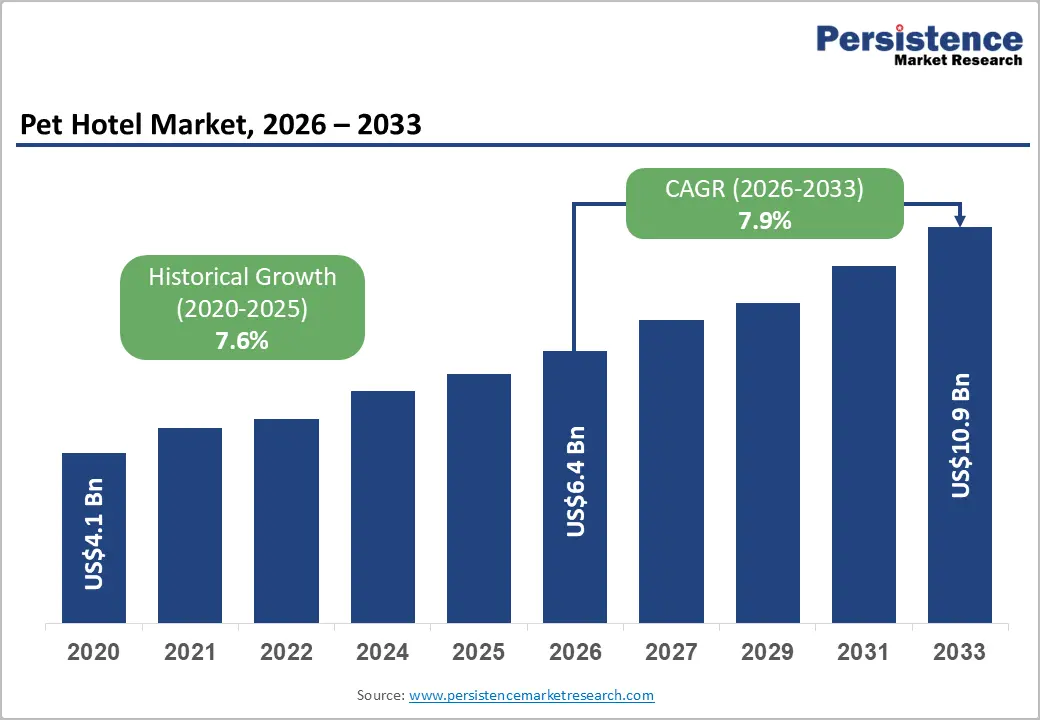
The global pet hotel market size is likely to be valued at US$6.4 billion in 2026 and is expected to reach US$10.9 billion by 2033, growing at a CAGR of 7.9% during the forecast period from 2026 to 2033, driven by a combination of evolving household lifestyles, urbanization, and the increasing humanization of pets, where companion animals are treated as integral members of the family. Busy work schedules, frequent travel, and dual-income households have heightened the need for reliable boarding, daycare, grooming, and enrichment services, prompting pet owners to seek facilities that offer safety, comfort, and personalized care.
Across regions, both mature markets and emerging economies are witnessing rising adoption of premium and boutique pet accommodations, supported by enhanced service offerings such as luxury suites, technology-enabled monitoring, wellness programs, and training. Operators are also investing in digital platforms to facilitate bookings, provide real-time updates, and enhance customer engagement, thereby reinforcing market growth. This combination of lifestyle-driven demand and willingness to pay for high-quality services is driving market growth.
Key Industry Highlights:
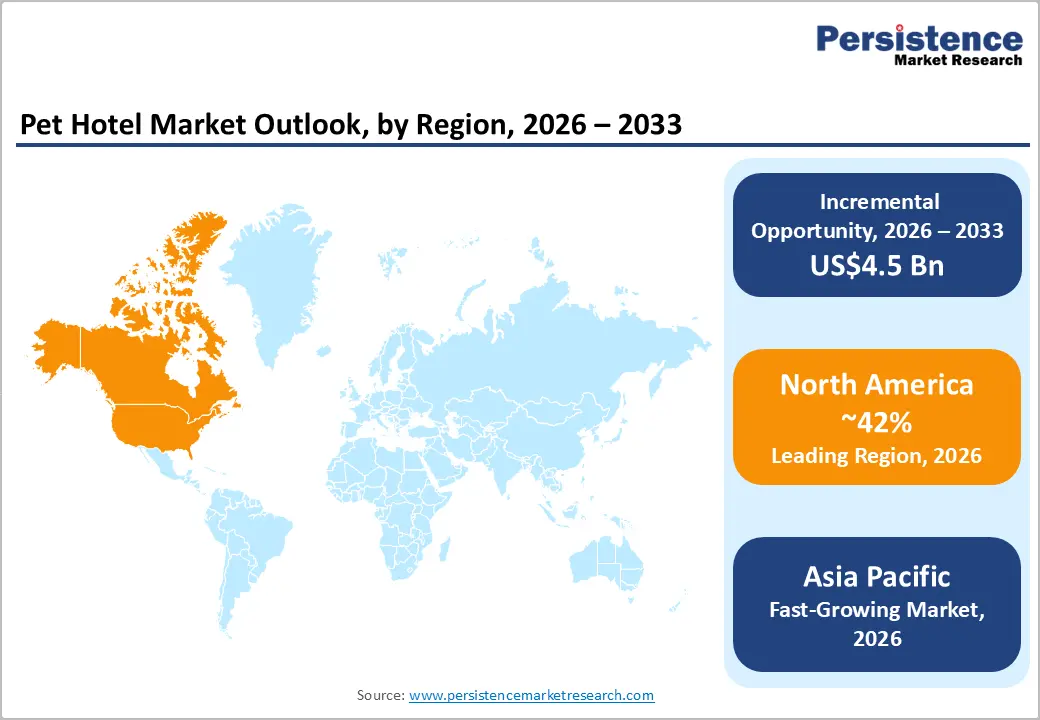
- Leading Region: North America is anticipated to be the leading region, accounting for 42% market share in 2026, driven by strong infrastructure, growing premium services, and expanding franchise and digital adoption.
- Fastest-growing Region: Asia Pacific is likely to be the fastest-growing region, supported by rapid urban affluence, rising pet adoption, and expanding premium pet hotel services.
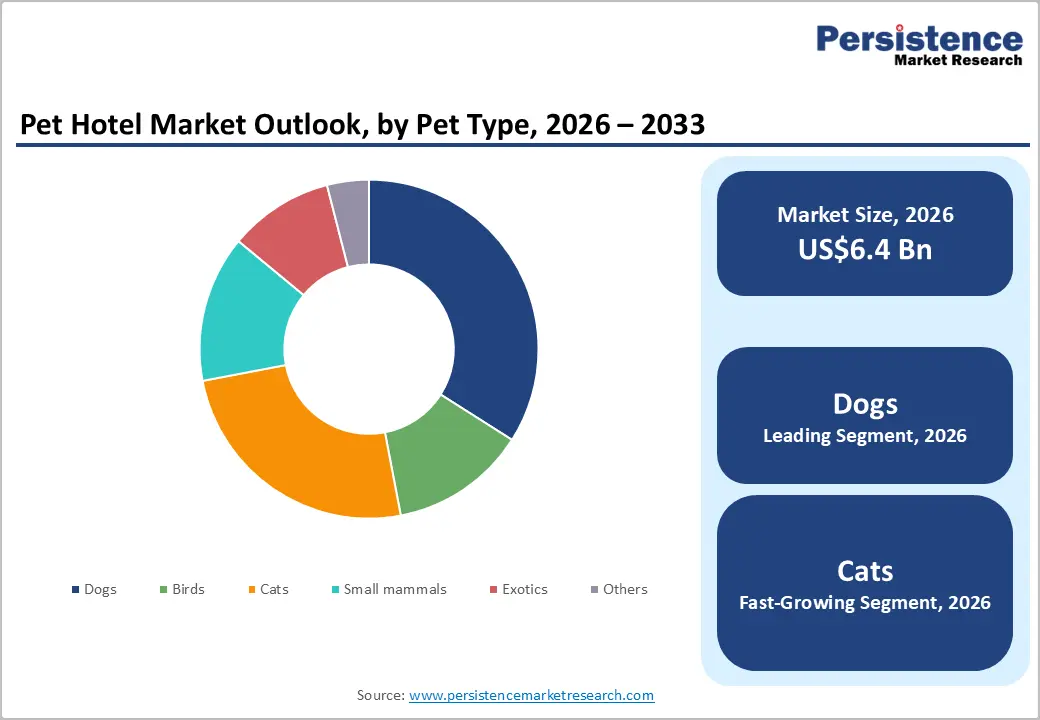
- Leading Pet Type: Dogs are projected to represent the leading pet type in 2026, accounting for 62% of the revenue share, driven by high ownership, frequent exercise needs, and established overnight and daycare infrastructure.
- Leading Service Type: Overnight boarding is anticipated to be the leading service type, accounting for over 53% of revenue share in 2026, supported by travel-related demand, extended owner absences, and the advantages of airport-adjacent facilities.
| Key Insights | Details |
|---|---|
|
Pet Hotel Market Size (2026E) |
US$6.4 Bn |
|
Market Value Forecast (2033F) |
US$10.9 Bn |
|
Projected Growth (CAGR 2026 to 2033) |
7.9% |
|
Historical Market Growth (CAGR 2020 to 2025) |
7.6% |
Market Factors - Growth, Barriers, and Opportunity Analysis
Growth Analysis- Rising Pet Humanization and Premium Care Expectations
Pet owners increasingly consider their animals family members, which significantly influences spending on professional care services. Demand for facilities that provide comfortable, secure, and personalized environments for pets continues to expand. Pet hotels now offer services such as luxury suites, climate-controlled rooms, play zones, and personalized feeding programs. These premium offerings help reassure owners that their pets receive high-quality care during travel or long work hours. The emotional attachment between owners and pets encourages them to invest in accommodation options that prioritize safety, enrichment, and overall well-being.
This shift in consumer perception has encouraged operators to continuously upgrade service standards and amenities. Many facilities are introducing spa treatments, behavioral enrichment activities, and live monitoring systems that allow owners to observe their pets remotely. Such innovations enhance transparency and build trust between service providers and customers. In addition, pet hotels increasingly focus on customized experiences tailored to different breeds and behavioral needs. The willingness of owners to pay for these premium services strengthens revenue opportunities and encourages investment in infrastructure.
Aggressive Franchise Expansion and Standardized Operations
Many companies are adopting franchise-based models to rapidly scale their operations across multiple regions while maintaining consistent service standards. Standardized operational procedures, training programs, and facility designs enable franchises to efficiently replicate successful business models. This approach allows brands to expand into new urban markets where demand for professional pet care services is increasing. Franchise networks also help maintain quality control through established protocols for hygiene, animal welfare, and customer service. Large operators can quickly build brand recognition and attract customers seeking reliable and trusted pet accommodation providers.
Standardization also improves operational efficiency and strengthens customer confidence in franchise-based pet hotel chains. Unified booking platforms, staff training guidelines, and service packages ensure a consistent experience for pet owners across different locations. Franchise operators benefit from shared marketing strategies, centralized procurement, and operational support from parent organizations. This structure reduces business risks for new investors while enabling rapid geographic expansion. Standardized operations make it easier to introduce new services such as daycare programs, grooming, and training within existing facilities. As franchise networks expand, they contribute significantly to market growth by increasing accessibility to professional pet boarding services in more cities and regions.
Barrier Analysis - Regulatory Patchwork and Welfare Compliance
Animal welfare regulations vary widely across countries, states, and municipalities, creating compliance difficulties for operators planning multi-location expansion. Facilities must adhere to numerous requirements related to hygiene standards, enclosure sizes, safety measures, and staff training. Inconsistent rules often require operators to adapt their infrastructure and operational procedures to meet local regulatory expectations. This increases administrative workloads and operational costs. Smaller businesses in particular may struggle to maintain compliance with evolving regulations. The absence of uniform standards across regions can also create uncertainty for investors evaluating opportunities in the professional pet accommodation industry.
Strict compliance requirements also require continuous monitoring, documentation, and facility upgrades to meet regulatory expectations. Inspections by local authorities ensure that animal welfare standards are maintained, but they can also create operational disruptions if facilities must make sudden adjustments. Companies operating in multiple regions must allocate resources to legal guidance and regulatory management to ensure full compliance. These requirements may slow down expansion plans or discourage new entrants from entering the market. While regulations ultimately protect animal welfare and consumer trust, the fragmented nature of regulatory frameworks remains a barrier that operators must carefully navigate when scaling pet hotel operations.
Zoning and Land-Use Constraints in Urban Areas
Many municipal planning frameworks restrict the establishment of animal boarding facilities in residential or mixed-use areas due to concerns about noise, sanitation, and neighborhood impact. Operators often struggle to secure suitable locations that comply with zoning requirements while remaining convenient for customers. Limited availability of approved sites may delay new facility development or increase property acquisition costs. In high-density urban markets where pet ownership is rising rapidly, zoning constraints can therefore limit operators' ability to meet growing demand for professional boarding services.
Land-use challenges also influence facility design and operational capacity. Developers may need to invest in soundproofing, waste management systems, and specialized infrastructure to comply with local regulations. These additional requirements increase construction costs and extend project approval timelines. In some cities, complex permit processes slow development, making it difficult for businesses to establish new locations quickly. Such constraints may push operators to build facilities in suburban areas rather than in central urban zones, potentially reducing customer accessibility. Zoning and land-use restrictions remain a significant barrier for companies seeking to expand pet hotel networks in major metropolitan regions.
Opportunity Analysis - Technological Convergence and Subscription Wellness Bundles
Facilities increasingly integrate digital tools such as online booking systems, mobile applications, and automated customer management platforms to enhance convenience for pet owners. Video monitoring systems allow customers to observe their pets remotely, improving transparency and trust in service providers. Data-driven platforms also enable operators to track pet behavior, feeding schedules, and health conditions more effectively. These technologies help improve operational efficiency while delivering a more personalized customer experience. As digital adoption increases, technology is becoming an important differentiator for modern pet hotel businesses seeking a competitive advantage.
Subscription-based wellness packages represent another promising opportunity for operators. Many pet hotels now offer membership programs that combine daycare access, grooming services, training sessions, and wellness monitoring under a recurring subscription model. This approach creates stable revenue streams while encouraging long-term customer relationships. Pet owners benefit from bundled services that simplify scheduling and provide consistent care for their animals. Technology platforms support these programs by enabling automated billing, service tracking, and customer engagement. As consumer demand for convenience and comprehensive pet care grows, the integration of technology and subscription-based wellness services is becoming an increasingly important strategy for pet hotel providers.
Specialized Services for Exotic and Small Mammals
The growing diversity of household pets is creating new opportunities for specialized accommodation services. In addition to dogs and cats, many owners now keep birds, rabbits, reptiles, and other small mammals that require unique care environments. Pet hotels that develop facilities tailored to these animals can attract a niche but valuable customer base. Specialized enclosures, temperature-controlled habitats, and trained staff capable of handling different species are important factors in delivering safe and reliable services. Since fewer operators invest in such specialized infrastructure, businesses that offer these capabilities can differentiate themselves and build strong reputations among owners seeking expert care for exotic pets.
Demand for specialized services is particularly evident in urban areas where pet ownership patterns are evolving. Owners of exotic pets often struggle to find suitable boarding facilities that understand their animals' specific dietary, environmental, and behavioral needs. Pet hotels that address these requirements can charge premium prices while facing limited competition. Partnerships with veterinarians and animal specialists help ensure appropriate care standards and strengthen customer trust. As the variety of companion animals continues to expand, investing in services tailored to exotic and small mammals presents a valuable opportunity for operators looking to diversify their offerings and capture underserved segments.
Category-wise Analysis
Pet Type Insights
Dogs are expected to lead the pet hotel market, accounting for approximately 62% of revenue in 2026, driven by a strong presence in pet ownership and the high level of care they require when owners travel or work long hours. Dogs typically need regular exercise, social interaction, and supervised playtime, which makes professional boarding and daycare facilities particularly suitable for them. Pet hotels often offer dedicated play areas, structured activity schedules, and breed-specific care programs to meet dogs' behavioral and physical needs. For example, K9 Resorts Luxury Pet Hotel operates premium boarding facilities designed specifically for dogs, offering spacious suites, climate-controlled rooms, and supervised play areas.
Cats are likely to represent the fastest-growing segment, supported by rising urban pet adoption, increasing apartment living, and growing demand for specialized feline boarding environments designed to reduce stress and ensure comfort. Unlike dogs, cats require quieter environments and carefully designed spaces that minimize stress and provide privacy. Modern pet hotels have responded by developing specialized feline accommodations that include vertical climbing structures, individual suites, and calm, low-noise environments tailored to cats' natural behavior. Rising cat adoption rates in densely populated cities are encouraging operators to expand dedicated cat boarding services. For example, The Ings Luxury Cat Hotel offers premium cat-exclusive accommodation with spacious suites, climbing structures, and enrichment features specifically designed for feline comfort.
Service Type Insights
Overnight boarding is projected to lead the market, capturing around 53% of the revenue share in 2026, as it directly addresses the needs of pet owners who travel for business, leisure, or family commitments. Professional boarding facilities provide secure accommodation, regular feeding schedules, supervised activity sessions, and health monitoring during extended stays. Many pet hotels also include amenities such as climate-controlled rooms, private suites, and trained staff who ensure pets receive consistent care while their owners are away. For example, Wag Hotels provides full-service overnight boarding with private suites, continuous staff supervision, and integrated grooming and daycare services.
Daycare is likely to be the fastest-growing service type, driven by busy urban lifestyles, increasing returns to office work, and rising demand for supervised daytime care and socialization for pets. Many pet owners now require safe environments where pets can stay during working hours, particularly as employees return to offices or maintain hybrid work schedules. Operators increasingly integrate real-time monitoring, playtime programs, and enrichment activities to enhance the daycare experience and build customer trust. For example, Camp Bow Wow operates facilities that offer supervised group play, scheduled rest periods, and live webcams that let owners monitor their pets remotely.
Regional Insights
North America Pet Hotel Market Trends
North America is anticipated to be the leading region, accounting for a market share of 42% in 2026, driven by rising pet ownership, busy lifestyles, and the increasing humanization of pets. Many pet owners now treat pets as family members and prefer professional boarding facilities that provide comfort, safety, and enrichment activities. Modern pet hotels are evolving from basic kennels to premium facilities offering cage-free stays, daycare, grooming, and wellness services. Facilities are also integrating technology such as online booking, digital monitoring, and personalized care plans to improve convenience and transparency for pet owners.
Companies are investing in upscale facilities with climate-controlled suites, play areas, and behavioral training programs to attract premium customers. For example, K9 Resorts Luxury Pet Hotel expanded its presence through a multi-unit franchise agreement to open several new locations in Illinois, strengthening its luxury boarding footprint in North America. This reflects a broader industry shift toward branded, standardized pet hospitality services that combine professional care with high-end amenities.
Europe Pet Hotel Market Trends
Europe is likely to be a significant market for pet hotels in 2026, due to rising disposable income and growing demand for professional pet care services when owners travel or work long hours. Countries such as the U.K., Germany, and France are among the largest adopters of pet boarding and hotel services because of high pet ownership and strong spending on pet welfare. Facilities in the region are moving beyond traditional kennels toward premium services, including exercise programs, daycare, grooming, and personalized care packages.
Another notable trend is the emergence of luxury and travel-integrated pet hotels that cater to pet owners seeking convenience and high-quality care. Premium pet hospitality services now include climate-controlled rooms, play areas, grooming, and technology-enabled monitoring to improve customer trust and pet comfort. For example, in 2025, a luxury pet hotel called “Dog Relais” was launched at Rome’s Fiumicino Airport, offering services such as private gardens, temperature-controlled floors, grooming, and even video-call facilities for pet owners while they travel. This development highlights how European pet hotel providers are integrating travel services with boarding facilities to meet growing demand from frequent travelers.
Asia Pacific Pet Hotel Market Trends
The Asia Pacific region is likely to be the fastest-growing region, driven by increasing pet ownership, urbanization, and rising disposable incomes in countries such as China, India, Japan, and Australia. Urban households with smaller living spaces and busy lifestyles are increasingly relying on professional boarding facilities that provide daycare, grooming, and supervised play areas. The region is considered one of the fastest-growing markets for pet hospitality services, supported by growing middle-class spending and the trend of treating pets as family members. Digital booking platforms, mobile apps, and social media marketing are helping pet hotels reach younger consumers and improve service transparency.
Another key trend in the Asia Pacific pet hotel market is the emergence of technology-enabled and platform-based pet care services that connect owners with professional boarding providers. For example, PetCloud in Australia offers a digital platform that connects pet owners with verified pet sitters and boarding services, enabling safe and convenient booking of pet accommodation. The company allows pet owners to book services, communicate with caregivers, and receive updates during the pet’s stay, improving transparency and convenience. Such platforms also support small pet hotels and independent boarding facilities by providing broader market access and standardized service frameworks.
Competitive Landscape
The global pet hotel market exhibits a moderately fragmented structure, driven by the presence of numerous regional boarding facilities, franchise chains, and digital pet care platforms offering temporary accommodation and related services for pets. The market is expanding as pet ownership rises and owners increasingly seek professional boarding facilities with safety, hygiene, and personalized care. While many small local operators serve neighborhood demand, larger branded chains and organized pet care companies are gradually expanding through franchising and facility development.
With key leaders including PetSmart, Camp Bow Wow, Dogtopia, Rover Group, and Wag Hotels, the industry demonstrates a mix of traditional boarding providers and technology-driven service platforms. Even the top players account for a relatively small share of total market revenue, highlighting the fragmented and competitive nature of the sector. These players compete through service differentiation, premium facility offerings, geographic expansion, and technology-enabled customer engagement.
Key Industry Developments:
- In February 2026, Deb’s Pet Salon announced plans to expand into the pet boarding sector by launching a new facility called Big Rapids Boarding Company in Michigan. The project is being developed through a collaboration between salon owner Deb Lipnicki and property owner Jordan White, aiming to provide overnight boarding services for dogs and occasionally cats.
- In September 2025, Camp Bow Wow announced the launch of its “Pawsitive Start Jr.” program, a structured puppy development initiative designed for dogs aged four months to one year. The program focuses on early socialization, learning, and enrichment activities that help puppies grow into confident and well-adjusted adult dogs. It includes daily group play sessions, skill-building exercises, enrichment activities, and scheduled rest periods to support balanced physical and behavioral development.
- In December 2025, CheckIn introduced a free pet-friendly stay program across all SUNDAY Hotels properties worldwide, allowing guests to stay with their pets at no additional cost. The initiative reflects the growing trend of pet-inclusive travel and aims to improve hospitality experiences for travelers who consider pets a part of their families.
Companies Covered in Pet Hotel Market
- D Pet Hotels
- Critterati
- Camp Bow Wow
- Posh Pet Hotel
- The Barkley
- Best Friend Pet Care
- Old Towne Pet Resort
- The Ings Luxury Cat Hotels
- Wag Hotels
- Pacific Pet Resort
- Pet Paradise
- K9 Resorts
- BJ's Pet Resort & Spa
Frequently Asked Questions
The global pet hotel market is projected to reach US$6.4 billion in 2026.
Rising pet ownership, increasing pet humanization, and growing demand for professional boarding and daycare services during travel or busy work schedules drive the pet hotel market.
The pet hotel market is expected to grow at a CAGR of 7.9% from 2026 to 2033.
Expansion of luxury pet hotels, integration of technology-enabled booking platforms, and growing demand for premium pet care services such as grooming, training, and wellness programs create key opportunities in the pet hotel market.
D Pet Hotels, Critterati, Camp Bow Wow, Posh Pet Hotel, and The Barkley are the leading players.


