




- Automotive Components & Materials
- Off-Highway Radiators Market
Off-Highway Radiators Market Size, Share, and Growth Forecast, 2026 - 2033
Off-Highway Radiators Market by Material Type (Aluminum, Copper, Plastic), Application (Construction, Agriculture, Mining, All-Terrain Vehicle), Sales Channel (OEM, Aftermarket), and Regional Analysis for 2026 - 2033

Off-Highway Radiators Market Size and Trends Analysis
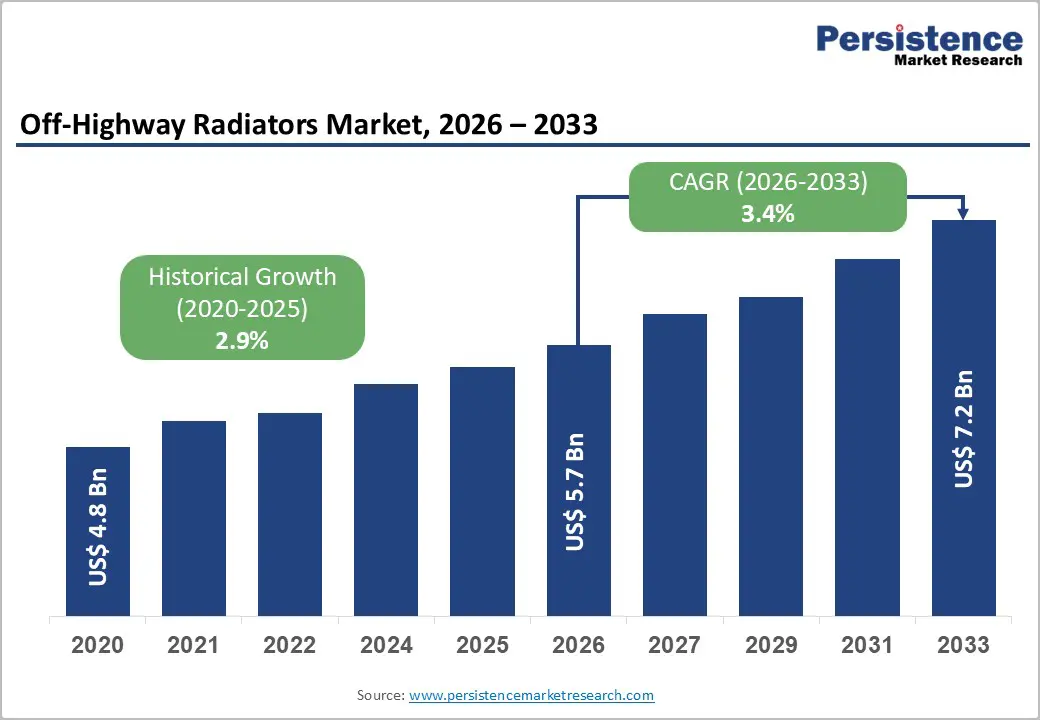
The global off-highway radiators market size is likely to be valued at US$5.7 billion in 2026, and is expected to reach US$7.2 billion by 2033, growing at a CAGR of 3.4% during the forecast period from 2026 to 2033, driven by the increasing prevalence of heavy-duty equipment in construction and agriculture, rising demand for durable cooling solutions in mining operations, and advancements in lightweight aluminum radiators.
Growing demand for efficient, corrosion-resistant off-highway radiators, especially aluminum-based in construction applications, is accelerating adoption across sectors. Advances in aftermarket replacement and hybrid materials are further boosting uptake by offering better heat dissipation and longevity. Increasing recognition of off-highway radiators as critical for equipment uptime and thermal management in emerging infrastructure markets remains a major driver of market growth.
Key Industry Highlights:
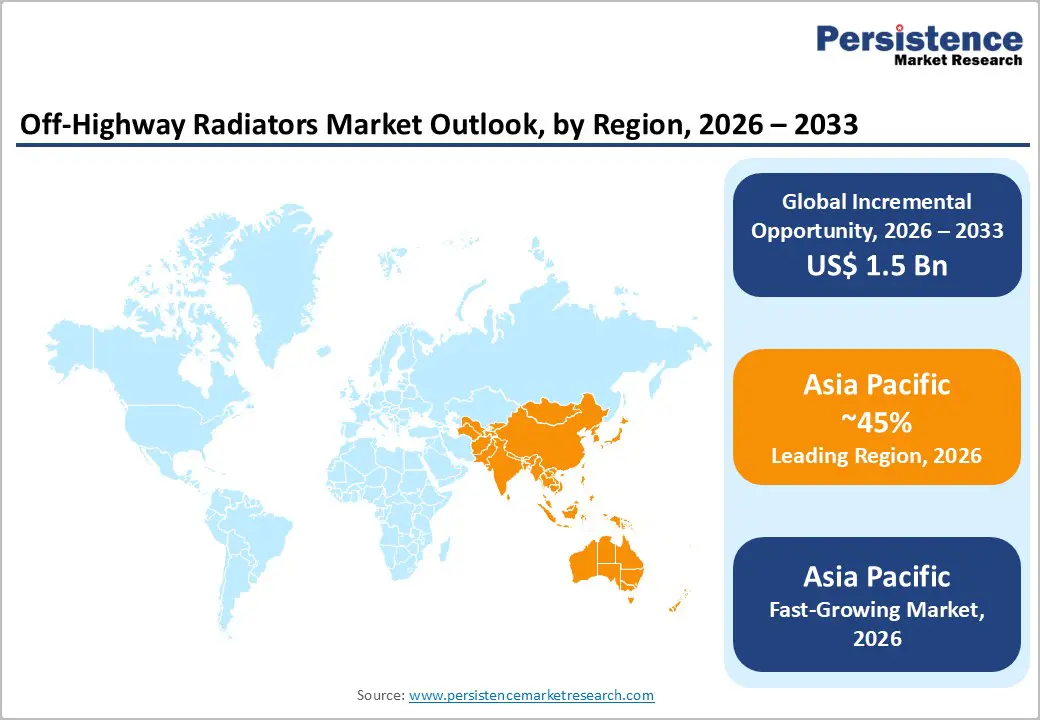
- Leading Region: Asia Pacific is anticipated to account for a 45% market share in 2026, driven by massive infrastructure projects, high agricultural mechanization, and strong demand in China and India.
- Fastest-growing Region: Asia Pacific, fueled by rapid urbanization, expanding mining activities, and growing investments in heavy machinery.
- Dominant Material Type: Aluminum, to hold approximately 65% of the market share, as it offers superior heat transfer and weight reduction.
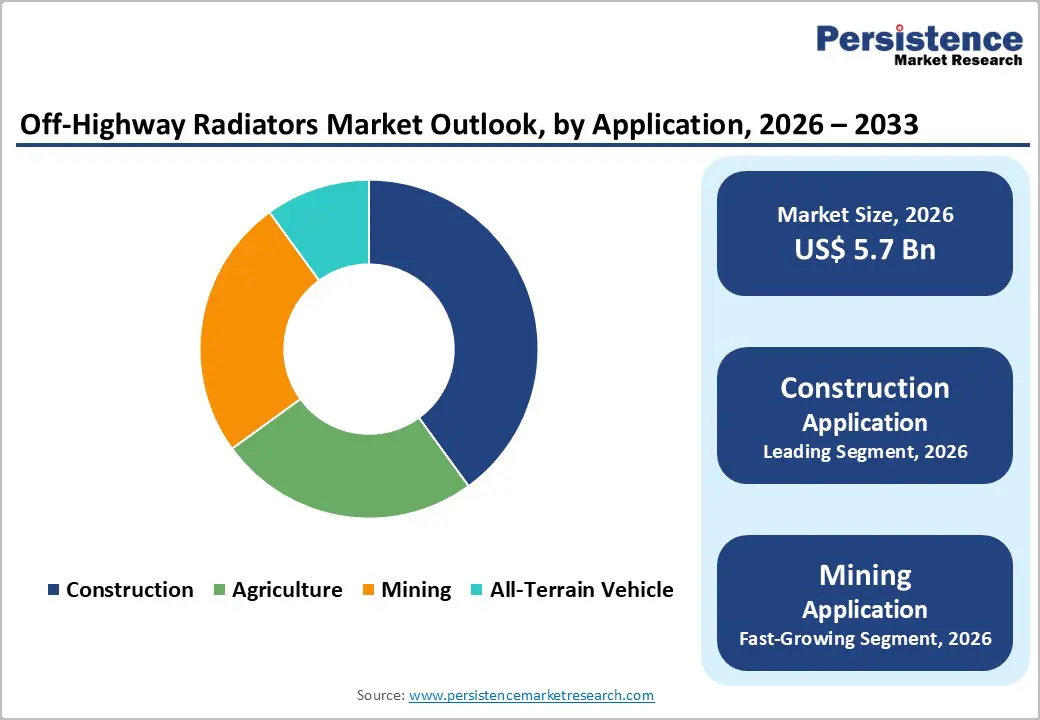
- Leading Application: The construction segment is expected to account for over 40% of the market revenue, due to high equipment utilization in road and building projects.
- Leading Sales Channel: OEM, to contribute nearly 60% of the market revenue, due to original equipment integration in new machinery.
| Key Insights | Details |
|---|---|
| Off-Highway Radiators Market Size (2026E) | US$5.7 Bn |
| Market Value Forecast (2033F) | US$7.2 Bn |
| Projected Growth (CAGR 2026 to 2033) | 3.4% |
| Historical Market Growth (CAGR 2020 to 2025) | 2.9% |
Market Factors - Growth, Barriers, and Opportunity Analysis
Rising Demand for Heavy-Duty Equipment and Efficient Cooling Solutions
The rising demand for heavy-duty equipment and efficient cooling solutions is being driven by rapid expansion across construction, mining, agriculture, logistics, and industrial manufacturing sectors. As machines operate for longer hours under high load conditions, they generate greater heat, making advanced cooling systems essential to maintain performance, durability, and operational safety. Modern heavy-duty equipment, such as excavators, loaders, trucks, and industrial generators, increasingly relies on robust cooling solutions to prevent overheating, reduce component wear, and avoid unplanned downtime.
Stricter emission regulations and higher engine efficiency requirements are also pushing manufacturers to adopt more effective thermal management systems. Engines designed for higher power output and fuel efficiency tend to operate at elevated temperatures, increasing the need for optimized radiators, heat exchangers, and cooling modules. Efficient cooling solutions help stabilize engine temperatures, improve fuel economy, and extend the service life of critical components, lowering total ownership costs for operators.
Intense Competition and OEM Pricing Pressure
Intense competition and OEM pricing pressure represent a significant restraint in the off-highway radiators market. The industry is characterized by the presence of numerous global suppliers alongside strong regional and local manufacturers, all competing for long-term contracts with original equipment manufacturers (OEMs). This crowded supplier landscape increases price competition, as OEMs often leverage multiple vendors to negotiate lower costs. As a result, radiator manufacturers are frequently required to offer aggressive pricing while still meeting strict performance, durability, and compliance standards.
OEMs prioritize cost-efficiency to remain competitive in end-equipment pricing, particularly in sectors such as construction, agriculture, and mining, where capital expenditure decisions are highly price sensitive. This focus places sustained pressure on radiator suppliers to reduce margins, optimize production costs, and limit price increases even when raw material costs fluctuate. For suppliers, maintaining profitability under these conditions becomes challenging, especially when dealing with customized designs and low-volume production runs.
Developments in Lightweight Aluminum and Hybrid Cooling Platforms
Developments in lightweight aluminum and hybrid off-highway radiator delivery platforms are transforming the global heavy equipment landscape by addressing two major challenges, weight barriers and thermal efficiency. Lightweight platforms are engineered to achieve reduced mass, reducing reliance on heavy copper and enabling better vehicle balance. Innovations, such as multi-louvered fins, fluxless brazing, integrated tanks, and high-strength alloys, significantly improve heat dissipation and reduce fuel consumption, lowering operational costs for OEMs and fleet campaigns.
Progress in hybrid platforms, including aluminum-plastic composites, copper-brass-aluminum hybrids, charge air cooler integration, and modular designs, supports more efficient cooling by minimizing weight, the radiator’s first line of defense against payload limits. These formats eliminate heavy cores, enhance corrosion resistance, and allow versatile use without oversized systems, making them highly suitable for mass construction programs. New technologies such as bio-adhesive brazing, VLP-based monitoring, and AI-optimized fin geometry further enhance durability and response.
Category-wise Analysis
Material Type Insights
The aluminum is anticipated to dominate the market, accounting for approximately 65% of the market share in 2026. Its dominance is driven by excellent heat transfer, weight savings, and corrosion resistance, making it preferred for modern equipment. Aluminum provides superior cooling, ensures longevity, and contributes to fuel efficiency, making it suitable for large-scale OEM campaigns. Modine Manufacturing Company, a global provider of thermal management and cooling solutions used in agriculture, construction, and mining equipment. Modine’s thermal systems often incorporate aluminum radiators as the material’s excellent heat transfer characteristics, lightweight nature, and corrosion resistance help maintain optimal engine temperatures under heavy loads while reducing overall equipment weight and fuel consumption key advantages for off-highway OEMs designing modern machinery.
Copper is the fastest-growing in the off-highway radiator market due to its superior thermal conductivity and high durability under extreme operating conditions. Heavy construction, mining, and agricultural equipment increasingly require efficient heat dissipation to manage higher engine loads and emissions compliance. Copper radiators offer improved cooling performance, longer service life, and resistance to mechanical stress, making them suitable for demanding environments and driving faster adoption compared to alternative materials. Weifang Sinrui Radiator Co., Ltd. manufactures copper fin-tube radiators used in Komatsu 930E mining trucks that operate in extreme heat, vibration and dust—maintaining high cooling efficiency over many years because of copper’s excellent thermal conductivity and corrosion resistance.
Application Insights
The construction segment is expected to lead the market, holding approximately 40% of the share in 2026, driven by high equipment utilization, large infrastructure programs, and strong global demand for thermal management in excavators and loaders. Their dominance continues as projects expand. Rising adoption of agricultural cooling and expanded mining campaigns highlight the growing focus on multi-sector benefits. Caterpillar Inc. and Komatsu Ltd. are two of the world’s largest construction equipment manufacturers whose machines illustrate this trend. Radiators for Caterpillar 323 series excavators, engineered to maintain optimal engine temperatures during continuous, heavy-duty operation, are critical cooling components that support prolonged use in construction projects such as infrastructure builds, road work, and urban development.
The mining segment is likely to be the fastest-growing segment, due to the strong momentum in heavy-duty operations and expanding inclusion in haul trucks. The growing shift toward rugged platforms, along with better heat rejection, accelerates the adoption. Advancements in dust-resistant designs and continued progress of high-flow entering production trials drive market growth. L&M Radiator, a Wabtec company, has been developing and deploying advanced cooling systems specifically for the mining industry, including haul trucks and heavy equipment operated in extreme environments. Their MESABI® Thermal Management System adapts rugged radiator designs to manage heat in electrified and hybrid mining equipment, addressing both traditional diesel haul trucks and the next generation of battery-powered vehicles.
End-use Insights
The industrial machinery segment is projected to lead the market, accounting for nearly 45% of total revenue in 2026, driven by its continued role as the primary end-use sector for heavy-duty cooling applications, large-scale equipment operations, and the thermal management needs of diverse, high-performance machinery requiring robust radiator systems. Their strong integration, trained operators, and ability to handle high-volume or demanding blends drive higher consumption. Industrial machinery sectors are leading aluminum rollouts as well as administering emerging copper trials. Modine Manufacturing Company, a long-established thermal management and radiator supplier, produces heavy-duty industrial radiators and cooling systems for a wide range of applications, including diesel generator sets, compressors, earthmoving equipment, locomotives, and stationary industrial machinery. Their products are engineered for high-performance heat dissipation and durability, supporting continuous operation in demanding industrial environments, a key reason the industrial machinery segment leads the radiator market.
The automotive segment is the fastest-growing, driven by its strong off-road vehicle presence and expanding role in ATVs and UTVs. It offers convenient, quick, and accessible cooling, attracting manufacturers who prefer reliable and low-maintenance settings. Increased outreach programs, electrification focus, and wider availability of routine and premium radiators further accelerate uptake, boosting rapid adoption across both urban and semi-urban areas. Polaris is a leading manufacturer of ATVs, UTVs, and side-by-side vehicles, whose products, such as the Polaris Ranger and Polaris Sportsman families, have seen sustained global demand for both recreational and utility use across urban and semi-urban areas. This rising popularity drives the demand for high-performance cooling solutions (radiators) that can handle rigorous off-road conditions without overheating.
Regional Insights
North America Off-Highway Radiators Market Trends
Growth in North America is supported by the region’s advanced equipment base, strong research and development capabilities, and high awareness of efficiency and performance benefits. Manufacturing ecosystems in the U.S. and Canada provide robust support for radiator programs, enabling the broad availability of off-highway radiators across construction, agriculture, and mining applications. Rising demand for aluminum-based, easy-to-service designs is further accelerating adoption, as these solutions enhance equipment uptime and reduce operational challenges associated with heavy-duty use.
Innovation in off-highway radiators technology, including stable lightweight cores, improved hybrid delivery, and targeted thermal enhancement, is attracting significant investment from both public and private sectors. Government initiatives and emissions campaigns continue to promote use against overheating risks, fuel costs, and emerging equipment threats, creating sustained market demand. The growing focus on mining grades and specialty uses, particularly for ATVs and others, is expanding the target applications for off-highway radiators.
Europe Off-Highway Radiators Market Trends
Growth in Europe is supported by rising awareness of efficiency gains, well-developed machinery ecosystems, and government-led sustainability initiatives. Countries such as Germany, France, and the U.K. benefit from established equipment frameworks that facilitate reliable cooling performance and promote the adoption of advanced radiator solutions, including off-highway radiators. These durable and compliant designs are especially attractive to construction operators, regulation-focused fleets, and agricultural users, enhancing equipment longevity and operational coverage.
Technological advancements in off-highway radiator development, such as enhanced aluminum, application-targeted delivery, and improved low-weight grades, are further boosting market potential. European authorities are increasingly supporting research and trials for radiators against both routine and specialized needs, strengthening market confidence. The growing emphasis on convenient, eco-friendly options is aligned with the region’s focus on preventive maintenance and reducing emissions. Public awareness campaigns and promotion drives are expanding reach in both urban and rural areas, while suppliers are investing in brazing and novel variants to increase efficacy.
Asia Pacific Off-Highway Radiators Market Trends
Asia Pacific is projected to lead the market and emerge as the fastest-growing region, capturing an estimated 45% share of the off-highway radiator market in 2026. This growth is fueled by increasing infrastructure development, supportive government initiatives, and expanding application programs across the region. Countries such as India, China, Japan, and Southeast Asian nations are actively promoting radiator adoption to meet rising equipment demands and emerging mining requirements. Off-highway radiators are particularly valued in these markets for their cost-effectiveness, scalability, and suitability for large-scale machinery operations in both urban and rural areas.
Advancements in technology are enabling the development of durable, efficient, and easy-to-maintain off-highway radiators capable of withstanding harsh operating conditions while minimizing downtime. These innovations are essential for servicing remote facilities and enhancing overall thermal management coverage. Growing demand from the construction, agriculture, and mining sectors is further driving market expansion. Additionally, public-private partnerships, rising machinery investments, and increased spending on radiator research and manufacturing capacity are accelerating growth. The combination of convenient deployment, improved cooling efficiency, and reduced failure risk reinforces the position of off-highway radiators as a preferred choice in the region.
Competitive Landscape
The global off-highway radiators market features competition between established thermal management leaders and emerging regional suppliers. In North America and Europe, Denso Corporation and Mahle Group lead through strong R&D, distribution networks, and OEM ties, bolstered by innovative aluminum and hybrid programs. In Asia Pacific region, Hanon Systems advances with localized solutions, enhancing accessibility. Lightweight delivery boosts efficiency, cuts weight risks, and enables mass integrations across regions. Strategic partnerships, collaborations, and acquisitions merge expertise, expand portfolios, and speed commercialization. Aluminum formulations solve weight issues, aiding penetration in fuel-focused areas.
Key Industry Developments
- In November 2025, Aqara unveiled its new Radiator Thermostat W600 alongside the launch of the Hub M200, following its initial showcase at IFA 2025. The W600 provides precise temperature control, automated climate management, and seamless interoperability within Matter ecosystems through Thread and Zigbee. Designed to modernize traditional radiators, the W600 delivers intelligent heating control to enhance comfort while reducing energy consumption.
- In July 2025, LDR Partners LP announced the acquisition of Active Radiator (Active), a leading U.S.-based manufacturer, service provider, and distributor of heavy-duty cooling equipment. The deal, financed by LDR Growth Partners Fund I LP and affiliated entities, was finalized on July 3, 2025. Following the acquisition, Active will operate alongside Cincinnati Radiator and Ohio Heat Transfer under a consolidated platform named Active Thermal Solutions (Active Thermal).
Companies Covered in Off-Highway Radiators Market
- Denso Corporation
- Mahle Group
- Dana Limited
- Hanon Systems
- Hangzhou Dongfeng Radiator Co., Ltd.
- BorgWarner Inc.
- Faret International Holdings Limited
- Jiangxi Xintian Auto Industry Co., Ltd.
- Nanning Baling Technology Co., Ltd.
Frequently Asked Questions
The global off-highway radiators market is projected to reach US$5.7 billion in 2026.
The rising prevalence of heavy-duty equipment in construction and agriculture, and demand for efficient cooling solutions, are key drivers.
The off-highway radiators market is poised to witness a CAGR of 3.4% from 2026 to 2033.
Advancements in lightweight aluminum and hybrid cooling platforms are the key opportunities.
Denso Corporation, Mahle Group, Dana Limited, Hanon Systems, and BorgWarner Inc. are the key players.


