




- Food Ingredients & Additives
- Natural Butter Flavor Market
Natural Butter Flavor Market Size, Share, and Growth Forecast, 2026 - 2033
Natural Butter Flavor Market by Product Type (Liquid, Powder, Paste), Application (Bakery, Confectionery, Dairy, Snacks, Beverages), and Regional Analysis for 2026 - 2033

Natural Butter Flavor Market Size and Trends Analysis
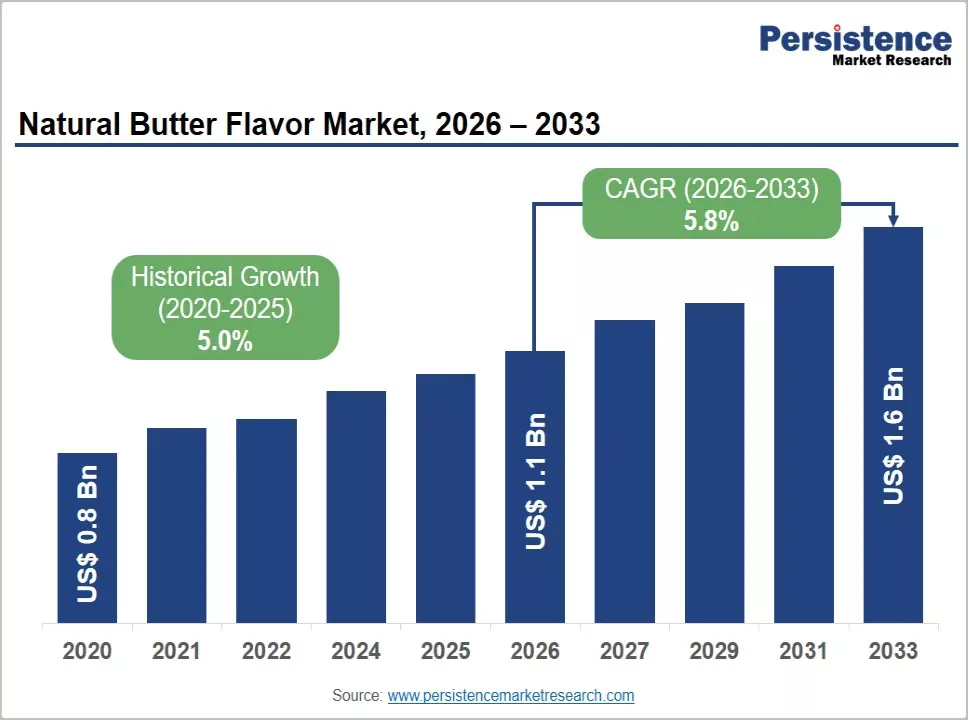
The global natural butter flavor market size is likely to be valued at US$1.1 billion in 2026 and is expected to reach US$1.6 billion by 2033, growing at a CAGR of 5.8% during the forecast period from 2026 to 2033, driven by growing demand for authentic taste profiles, clean-label formulations, and naturally positioned ingredients across bakery, confectionery, dairy, snacks, and beverages.
In the 2025 IFIC Food & Health Survey, 41% of U.S. consumers reported looking for “natural” food-production claims when shopping for foods and beverages, highlighting continued consumer interest in naturally positioned products. The U.S. FDA recognizes natural flavors as an established category of food ingredients and permits their declaration as “natural flavor” on labels.
Key Industry Highlights:
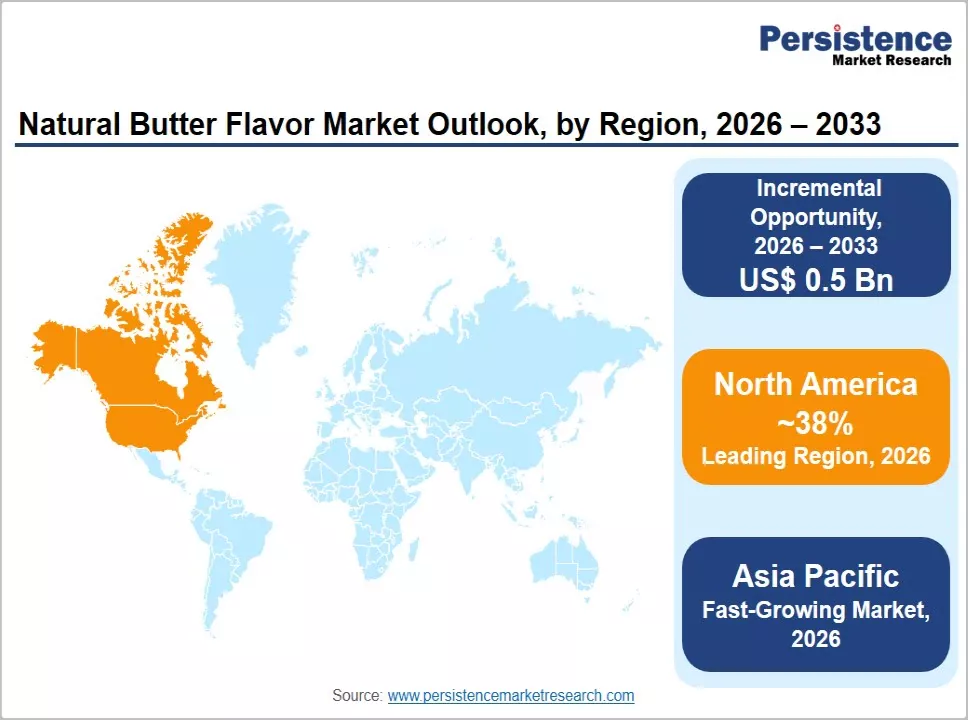
- Leading Region: North America is anticipated to be the leading region, accounting for a market share of 38% in 2026, driven by strong bakery demand, clean-label reformulation, and established flavor manufacturing capabilities.
- Fastest-growing Region: Asia Pacific is likely to be the fastest-growing region, supported by expanding packaged bakery consumption, urbanization, rising middle-class demand, and growing adoption of naturally positioned flavors.
- Leading Product Type: The liquid segment is projected to represent the leading product type in 2026, accounting for 55% of the revenue share, driven by easy incorporation and strong dispersion across food formulations.
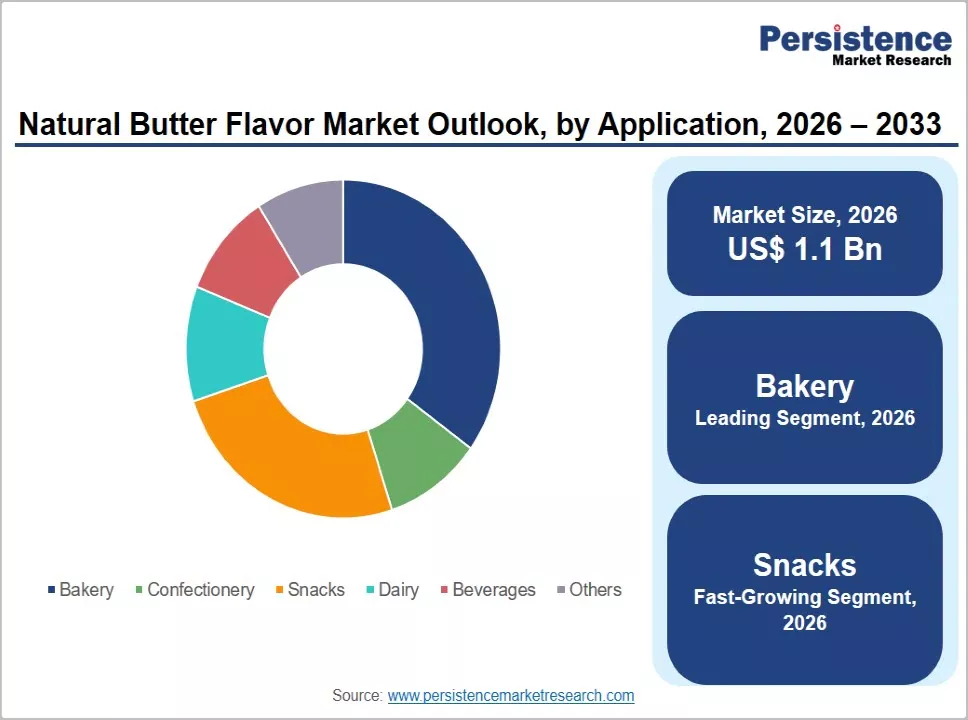
- Leading Application: The bakery segment is anticipated to be the leading application, accounting for over 46% of the revenue share in 2026, supported by extensive use across breads, cakes, cookies, and pastries.
- Key Opportunity: Expansion of natural butter flavor into clean-label, premium, bakery, snack, dairy, and plant-based food formulations, supported by growing consumer demand for recognizable ingredients and authentic taste profiles.
DRO Analysis
Driver - Expansion of Processed Food and Bakery Sectors
Growing production of breads, cookies, cakes, pastries, confectionery, snacks, and ready-to-eat foods expands the addressable application base. Natural butter flavors can provide recognizable dairy character while supporting formulation flexibility and helping manufacturers manage ingredient consistency.
Demand is supported by product premiumization, convenience-oriented eating habits, and wider availability of packaged bakery products. Flavor suppliers are responding with liquid, powder, and paste formats designed for different processing conditions and requirements. The expansion of bakery manufacturing in emerging economies is strengthening demand for natural butter flavor ingredients, particularly as organized retail and packaged food distribution become established.
Manufacturers seek dependable flavor performance for production volumes while adapting recipes to consumer preferences for richer, authentic taste profiles. Natural butter flavors are increasingly incorporated into biscuits, cakes, pastries, snacks, and other processed foods where sensory differentiation can support product innovation. Improvements in flavor delivery, encapsulation, and formulation technology also enable suppliers to serve diverse processing environments.
Restraint - Technical Challenges in Flavor Intensity and Stability
Heat exposure, oxidation, interactions with fats, moisture, acidity, and other ingredients can influence aroma retention and perceived buttery character. Manufacturers must balance flavor strength with formulation compatibility while avoiding undesirable sensory changes. These requirements can increase development complexity, especially for products exposed to baking temperatures or extended shelf life. Consistent performance across liquid, powder, and paste formats may also require specialized carriers, encapsulation approaches, or processing controls, limiting adoption.
Natural butter flavors can face additional technical limitations when manufacturers seek strong flavor impact at low usage levels while maintaining an authentic sensory profile. Volatility and processing conditions may affect top notes, while storage can influence stability and product quality. Powder formats may require encapsulation to protect volatile compounds, whereas liquid systems must maintain uniform dispersion and compatibility with formulations.
Opportunity - Plant-Based and Dairy-Alternative Formulations
Butter-like flavor profiles can help improve sensory appeal in plant-based bakery products, dairy alternatives, snacks, and desserts where formulation developers aim to reproduce familiar richness and aroma. Natural flavor systems can support clean-label positioning when they align with applicable ingredient and labeling requirements.
Flavor companies can develop customized solutions for oat, soy, almond, coconut, and other plant-based matrices, creating opportunities for differentiated products and broader application penetration as alternative food categories evolve. Innovation in plant-based foods is creating opportunities for natural butter flavor suppliers to address sensory gaps associated with dairy-free formulations.
Developers increasingly require flavors that withstand baking, mixing, pasteurization, and storage while delivering balanced buttery notes without overpowering other ingredients. Encapsulated powders, concentrated liquids, and application-specific blends can provide flexibility across different product formats. Collaboration between flavor houses, ingredient companies, and food manufacturers can accelerate development of formulations tailored to bakery, confectionery, snacks, and dairy alternatives.
Category-wise Analysis
Product Type Insights
The liquid segment is expected to lead, accounting for 55% of revenue in 2026, due to easy incorporation, rapid dispersion, and suitability across food formulations. Liquid flavors are widely used where manufacturers require uniform distribution and controlled sensory intensity, particularly in bakery, dairy, confectionery, and beverage products. Their flexibility supports customized flavor profiles and efficient integration into production processes. For example, Kerry offers butter flavor solutions in multiple formats and intensities for food manufacturers.
The powder segment is likely to represent the fastest-growing segment, supported by demand for convenient dry mixes, seasonings, powdered beverages, and bakery premixes. Powdered formats offer handling, dosing, storage, and transportation advantages, while encapsulation technologies can protect volatile flavor compounds and improve stability during processing. A notable example is that PureDelivery systems use spray drying and granulation for powdered food and flavor applications.
Application Insights
The bakery segment is projected to lead the market, capturing around 46% of the revenue share in 2026, supported by extensive use across bread, cakes, cookies, pastries, fillings, and other baked products. Natural butter flavors help manufacturers deliver recognizable dairy notes, enhance sensory appeal, and maintain consistent taste across formulations. They are valuable where producers seek buttery character while managing recipe flexibility and processing requirements. IFF provides butter flavor solutions for bakery products, including bread, cakes, pastries, biscuits, and crackers.
Snacks are likely to be the fastest-growing application due to expanding demand for differentiated savory and sweet snack profiles. Butter flavors add richness and indulgent sensory characteristics to extruded snacks, coated products, crackers, popcorn, and other convenient formats. Snack manufacturers increasingly experiment with familiar flavor cues to create distinctive products while responding to consumer interest in premium and natural ingredients. Natural butter flavor systems support formulation flexibility across seasoning blends and processed snack bases.
Regional Insights
North America Natural Butter Flavor Market Trends
North America is anticipated to be the leading region, accounting for a market share of 38% in 2026, as food manufacturers focus on clean-label formulations, familiar taste profiles, and indulgent bakery and snack products. IFF highlights butter as an important bakery flavor and identifies brown-butter profiles as a notable 2025 flavor trend, supporting opportunities for natural butter flavor across cookies, pastries, sauces, and snacks.
U.S. Natural Butter Flavor Market Trends
The U.S. is expected to dominate the regional market, accounting for approximately 80% of the market share in 2026. The U.S. market is moving toward cleaner ingredient positioning and naturally derived food formulations. The FDA initiatives announced in 2025 and 2026 are supporting the transition toward natural alternatives in food formulations. Bakery, confectionery, dairy, and snack manufacturers are exploring natural flavor systems to maintain familiar taste while improving label positioning. Butter and brown-butter profiles also benefit from renewed interest in nostalgic and comforting flavors.
Canada Natural Butter Flavor Market Trends
Canada is likely to be a significant market for natural butter flavor, holding approximately 20% of the market share in 2026. Canada maintains specific requirements around the use and labeling of natural flavor claims. CFIA guidance recognizes flavoring substances derived from plant or animal sources as potentially eligible for natural claims when requirements are met. Canadian regulations also distinguish natural-derived flavoring ingredients from imitation or artificial ingredients in certain labeling situations. These requirements encourage manufacturers to carefully select and document natural flavor ingredients.
Europe Natural Butter Flavor Market Trends
Europe is likely to be a significant market for natural butter flavor in 2026, due to demand for authentic taste, clean-label products, and premium bakery and confectionery formulations. Germany's natural flavors segment is benefiting from consumer interest in transparency, authenticity, and sustainability. Heinrich Karow Nachf. KG offers a natural butter aroma designed for bakery, confectionery, ice cream, sauces, and other food applications, demonstrating regional product availability.
U.K. Natural Butter Flavor Market Trends
The U.K. is likely to be a significant market for natural butter flavor, accounting for 15% of the Europe market in 2026, influenced by clean-label preferences and established demand for bakery, desserts, snacks, and dairy products. The Food Standards Agency maintains an official register of authorized flavorings permitted for food use in Great Britain. Since April 2025, changes have applied to how flavoring authorizations are brought into effect and published. U.K. labeling guidance also specifies how flavorings and natural flavor claims should be presented.
Germany Natural Butter Flavor Market Trends
Germany is anticipated to dominate the regional market, accounting for around 37% of the Europe market in 2026, due to strong demand for natural and recognizable flavoring ingredients. Manufacturers are increasingly developing formulations that respond to consumer interest in transparency and minimally processed ingredients. Bakery and confectionery remain important applications for butter-type flavors. Germany's flavor industry is also emphasizing product stability and consistent sensory performance.
Asia Pacific Natural Butter Flavor Market Trends
The Asia Pacific region is likely to be the fastest-growing region, driven by demand for natural food flavors as processed foods, bakery products, snacks, dairy, and convenience foods develop across major economies. China recorded steady growth in natural food flavor imports through 2024, while India is seeing increasing demand for clean-label and naturally derived flavor ingredients.
China Natural Butter Flavor Market Trends
China is projected to dominate the regional market, holding around a 30% share of the market in 2026, due to increasing consumer preference for clean-label and healthier food products. Demand is expanding across processed foods, beverages, snacks, dairy, and bakery applications. Natural ingredients sourced from fruits, vegetables, herbs, and spices are receiving greater attention. China's natural food flavor imports grew steadily between 2020 and 2024. The market also recorded stronger import growth during 2024.
India Natural Butter Flavor Market Trends
India is expected to emerge as a significant market, accounting for approximately 22% market share in 2026. India's natural flavor market is expanding alongside growth in processed food, beverages, bakery, snacks, dairy, and confectionery. Clean-label demand is becoming increasingly important as consumers seek recognizable and naturally derived ingredients. Natural flavors are gaining attention as manufacturers reformulate products for changing consumer expectations. Keva offers customized natural flavor solutions across bakery, dairy, ice cream, and confectionery applications. Its portfolio includes liquid, emulsion, granule, and encapsulated formats.
Competitive Landscape
The global natural butter flavor market exhibits a moderately fragmented structure, driven by the presence of multinational flavor houses, specialized natural-flavor suppliers, and regional manufacturers serving bakery, confectionery, dairy, snacks, and savory applications. Competition is increasingly shaped by demand for clean-label ingredients, authentic buttery profiles, formulation flexibility, and regulatory compliance.
With key leaders, including Givaudan, International Flavors & Fragrances (IFF), Symrise, Kerry Group, Sensient Technologies, and dsm-firmenich, the market combines global-scale suppliers with regional specialists. These players compete through customized flavor development, natural ingredient sourcing, application expertise, innovation, and expanded technical support.
Key Industry Developments:
- In June 2026, Organic Valley introduced Butter with Olive Oil, an organic butter product combining organic butter with organic olive oil, water, and salt to provide a smooth, spreadable texture while retaining a rich buttery taste.
- In August 2025, Kerrygold, the Ornua brand, launched Cinnamon & Sugar Butter Sticks in the U.S., combining all-natural Irish butter with cinnamon, brown sugar, and nutmeg. The launch highlights growing demand for natural, indulgent, and differentiated butter flavors across dairy, bakery, desserts, and snacks.
Companies Covered in Natural Butter Flavor Market
- Kerry Group
- Givaudan
- IFF
- Symrise AG
- Firmenich SA
- Takasago International
- Sensient Technologies
- Mane SA
- Robertet Group
- T. Hasegawa
- Frutarom Industries Limited
- McCormick
Frequently Asked Questions
The global natural butter flavor market is projected to reach US$1.1 billion in 2026.
Growing demand for clean-label, naturally derived ingredients and authentic buttery taste across bakery, confectionery, dairy, and snack products.
The natural butter flavor market is expected to grow at a CAGR of 5.8% from 2026 to 2033.
Expansion of natural butter flavor in premium bakery, plant-based foods, snacks, desserts, and clean-label processed food formulations.
Kerry Group, Givaudan, IFF, Symrise AG, and Firmenich SA are the leading players.


