




- Industrial Machinery
- Open Top Meat Membrane Skinning Machine Market
Open Top Meat Membrane Skinning Machine Market Size, Share, and Growth Forecast 2026 - 2033
Open Top Meat Membrane Skinning Machine Market by Cutting Width (Below 500 mm, 500 mm and above), Cutting Speed (Below 30 m/min, 30 m/min and above), Industry (Food Processing Industry, Restaurants, Other), and Regional Analysis for 2026 - 2033

Open Top Meat Membrane Skinning Machine Market Share Analysis
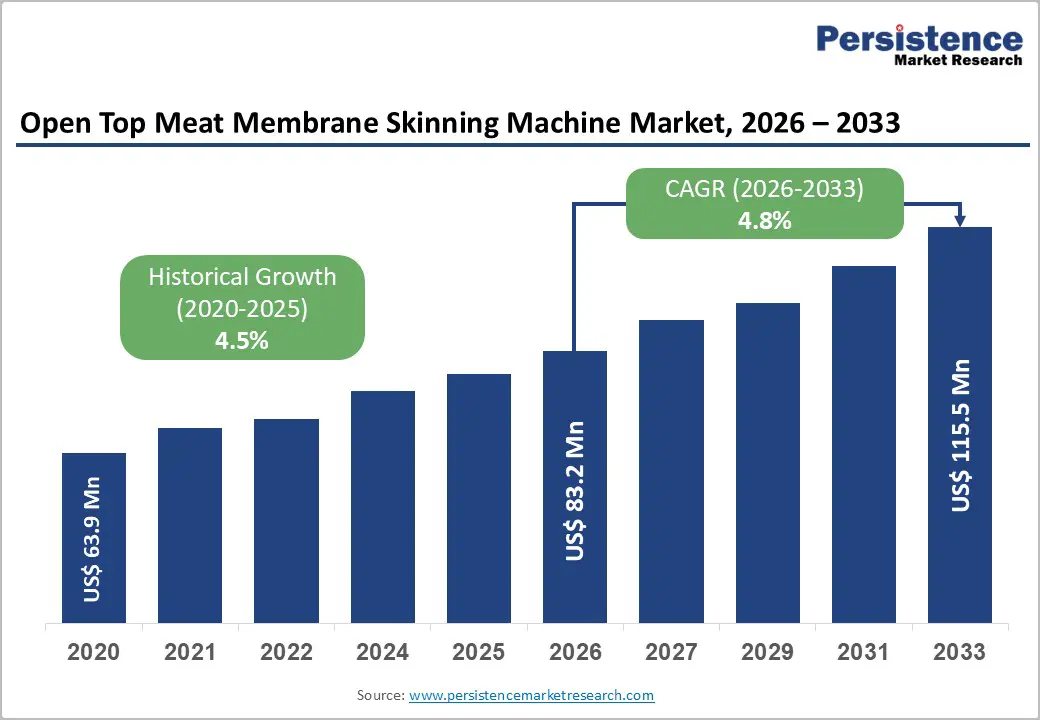
The global open top meat membrane skinning machine market is valued at US$ 83.2 million in 2026 and is projected to reach US$ 115.5 million by 2033, growing at a CAGR of 4.8% between 2026 and 2033. This sustained growth is driven by the rapid expansion of industrial meat processing facilities worldwide, increasing automation investments by abattoirs and food processors, and tightening food safety regulations mandating precision skinning to minimize contamination.
Rising global meat consumption, particularly pork and beef, coupled with a structural shift from manual to mechanized processing lines, continues to push demand for open top skinning machines that deliver high throughput, consistent yield, and operator safety across diverse protein segments.
Key Industry Highlights:
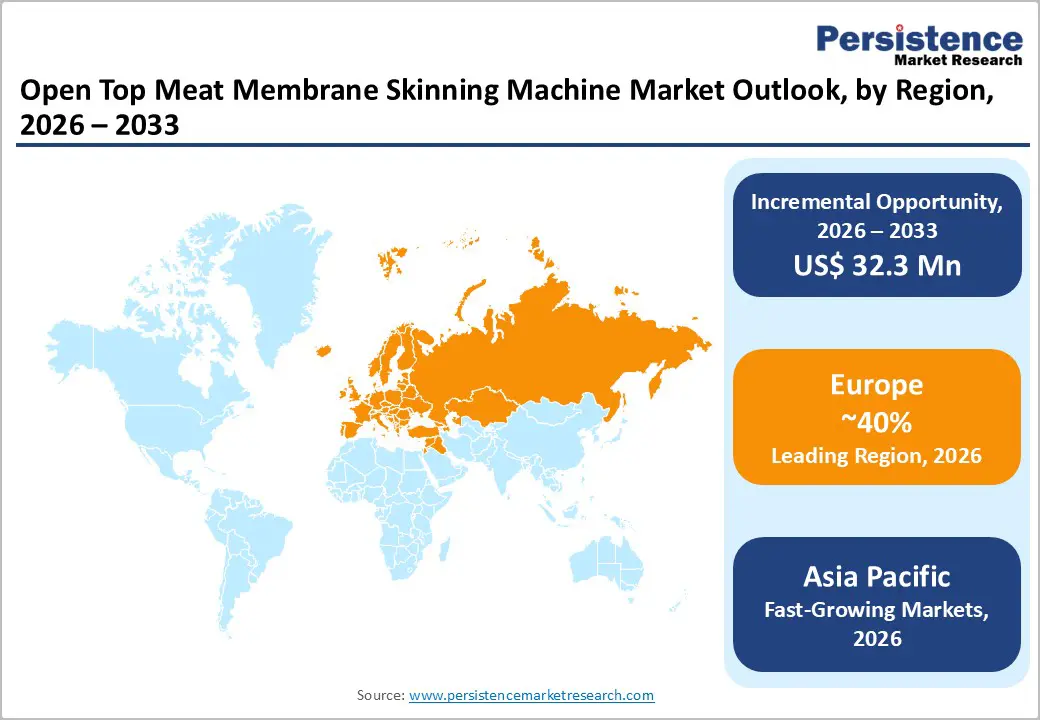
- Leading Region: Europe accounts for a dominant position in the open top meat membrane skinning machine market, with 40% of the global market in 2026, backed by stringent EU food hygiene regulations, a high density of industrial pork processors, and a strong base of leading machine manufacturers in Germany, Belgium, and France.
- Fast-Growing Market: Asia Pacific is the fastest-growing regional market, led by China's post-ASF processing modernization investments, India's expanding buffalo meat export sector, and Vietnam's rapidly scaling pork processing industry attracting foreign direct investment.
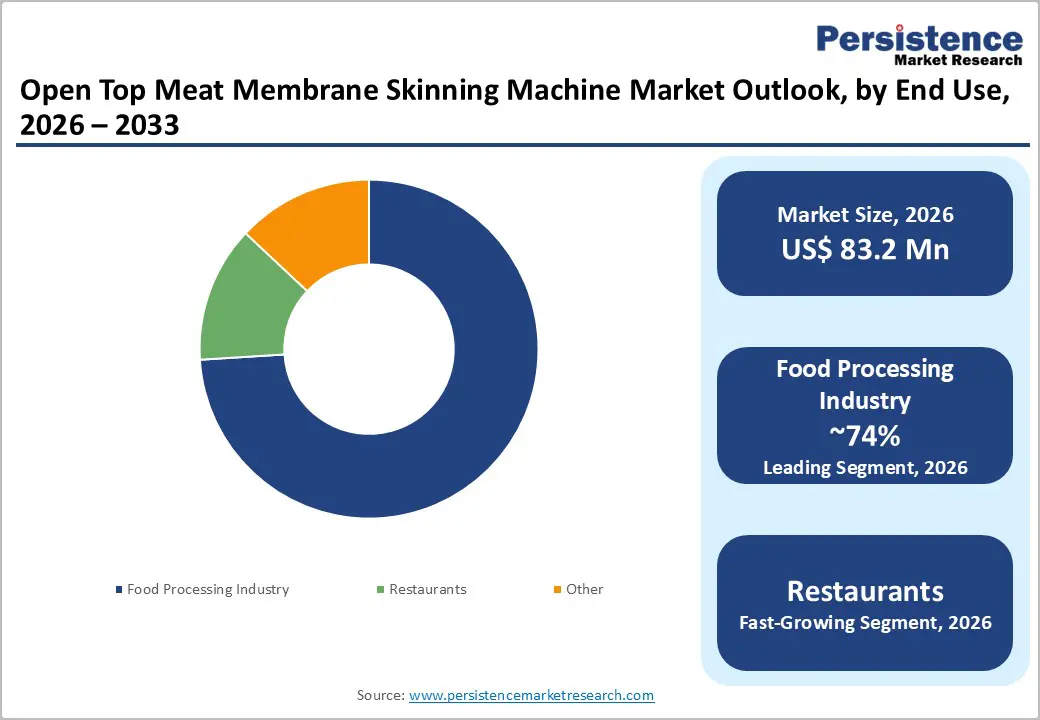
- Dominant Industry: Food processing industry is likely to command approximately 74% of the industry segment driven by regulatory compliance mandates, continuous high-volume throughput requirements, and industrial processors' strong return on investment from automated skinning lines.
- Fast-Growing Cutting Width Segment: 500 mm and above cutting width segment is the fastest growing, as large-scale processors globally standardize wide-format machines for compatibility with integrated, high-speed processing lines handling bulk meat cuts.
- Key Opportunity: Integration of IoT-enabled predictive maintenance and real-time yield monitoring into open top skinning machines offers manufacturers a differentiated value proposition, with processors reporting 2-4% yield improvements and significant reductions in unplanned downtime, a compelling commercial and compliance case.
DRO Analysis
Drivers - Rising Automation in Meat Processing Plants Globally
The global meat processing industry is undergoing a profound mechanization shift as labor costs escalate and worker safety concerns mount. According to the Food and Agriculture Organization (FAO), global meat production surpassed 340 million metric tons in 2022 and continues to grow, intensifying the need for automated processing lines. Open top meat membrane skinning machines are central to this transformation, enabling processors to achieve precise membrane removal at speeds that manual operators cannot replicate.
In the European Union, the European Commission's Farm to Fork Strategy under the Green Deal mandates efficiency improvements across food production chains, indirectly accelerating capital investment in automated skinning equipment. Countries like Germany, Denmark, and the Netherlands, home to major pork processing clusters, are actively replacing legacy manual skinning stations with CNC-controlled open top skinners to meet throughput and hygiene targets.
Strengthening Food Safety Regulations Across Major Meat-Producing Regions
Regulatory frameworks governing meat hygiene are becoming increasingly stringent, particularly in the United States, the European Union, and Australia. The U.S. Department of Agriculture's Food Safety and Inspection Service (USDA-FSIS) enforces Hazard Analysis and Critical Control Points (HACCP) protocols that require processors to minimize microbial contamination at each stage of processing, including during membrane removal.
Open top skinning machines with stainless steel construction, enclosed blade systems, and automated wash-down cycles are specifically designed to comply with these standards. Similarly, Regulation (EC) No 853/2004 of the European Parliament sets hygiene requirements for animal-origin foods, prompting abattoirs across EU member states to invest in certified skinning equipment. These regulatory mandates are translating directly into procurement cycles for new-generation skinning machines.
Restraints - High Capital Expenditure and Total Cost of Ownership
Open top meat membrane skinning machines represent a significant capital outlay, particularly for small and medium-sized meat processors. Premium machines from established manufacturers can cost between US$ 40,000 and US$ 200,000 per unit, depending on cutting width, automation level, and compliance certifications. Beyond acquisition costs, ongoing expenses, including blade replacement, preventive maintenance, and operator training, add to the total cost of ownership.
According to a 2023 study published in the Journal of Food Engineering, the payback period for automated skinning equipment in mid-scale plants typically ranges from four to six years, which can deter capital-constrained processors, especially in developing markets across Southeast Asia and Sub-Saharan Africa, where profit margins in meat processing remain thin.
Skilled Labor Shortage for Machine Operation and Maintenance
Despite the machines' automation benefits, their effective operation requires trained technicians who understand blade calibration, membrane tension settings, and hygiene protocols. The global meat processing sector faces a well-documented skilled labor shortage. The U.S. Bureau of Labor Statistics reported that slaughterer and meat packer occupations face high turnover rates, exceeding 30% annually in some regions, making consistent operator training a persistent challenge.
In markets such as Brazil and China, rapid industrial scale-up has outpaced vocational training infrastructure, meaning new equipment is frequently underutilized or improperly maintained. This technical gap limits the effective adoption rate of advanced skinning machines and increases the risk of machine downtime, ultimately constraining market expansion in price-sensitive regions.
Opportunities - Accelerating Adoption in Asia Pacific's Expanding Pork and Poultry Processing Sector
Asia Pacific, led by China, Vietnam, and India, represents the fastest-growing opportunity horizon for open top skinning machine manufacturers. China alone accounts for approximately 50% of global pork consumption, and the Chinese Ministry of Agriculture and Rural Affairs has been channeling significant subsidies toward industrial-scale meat processing modernization since 2021, following the recovery of pig herds post-African Swine Fever (ASF).
Vietnam's pork production has grown by over 8% annually since 2022, attracting investments from domestic and multinational processors who are equipping greenfield facilities with automated skinning lines. The region's accelerating shift from wet markets to packaged protein retail, catalyzed by heightened food safety awareness post-COVID-19, is creating durable demand for precision skinning solutions that can deliver retail-grade membrane-free cuts at scale.
Integration of IoT in Next-Generation Skinning Machines
The convergence of Industry 4.0 technologies with food processing equipment is creating significant differentiation opportunities for manufacturers of open top meat membrane skinning machines. Leading equipment makers are integrating Internet of Things (IoT) sensors, real-time blade wear monitoring, and predictive maintenance algorithms into their machines, allowing plant managers to pre-empt downtime and optimize blade change intervals. Marel, for instance, has outlined its Innova Food Processing Software platform as a means of connecting skinning line data to broader plant management systems.
The European Commission's Horizon Europe program has allocated funding to digital food processing projects through 2027, supporting R&D in this space. Processors that adopt IoT-enabled skinning machines report yield improvements of 2-4% through optimized membrane removal depth, a meaningful gain at industrial throughput volumes.
Category-wise Analysis
Cutting Width Insights
The 500 mm and above segment dominate the cutting width category, accounting for approximately 62% of the global open top meat membrane skinning machine market in 2026. Large-format machines with wider cutting widths are preferred by industrial-scale processors handling high-volume throughput of pork bellies, beef flanks, and large-format cuts that cannot be efficiently processed on narrower equipment.
Major slaughterhouses in Germany, the United States, and Brazil, which rank among the world's top pork and beef exporters per FAO 2023 data, standardize on wide-format skinning machines to maintain per-shift yield targets. These machines also offer greater compatibility with downstream portioning and packaging equipment, reinforcing their dominance in large integrated processing facilities investing in end-to-end automation.
Cutting Speed Analysis
The 30 m/min and above cutting speed segment holds the leading market share, estimated at approximately 58% in 2026, driven by industrial processors' relentless focus on throughput optimization. High-speed skinning machines reduce cycle times per unit weight of meat processed, directly lowering per-kilogram processing costs, a critical differentiator in a commodity-driven industry where margins are typically below 5% according to USDA Economic Research Service data.
Continuous-flow processing lines in large abattoirs require skinning equipment capable of keeping pace with upstream kill-floor and downstream portioning speeds. Machines operating above 30 m/min satisfy this requirement without creating bottlenecks. Advances in blade metallurgy and motor control systems have enabled manufacturers to achieve these speeds while maintaining cutting precision, making high-speed machines the preferred specification across major processing markets.
Industry Insights
The food processing industry is the dominant end-use category, commanding approximately 74% of total market share in 2026. Industrial meat processors, including large-scale abattoirs, further processing facilities, and export-oriented packing plants, are the primary demand generators because skinning machines deliver the highest economic returns when deployed at continuous, high-volume throughput.
Data from the American Meat Institute (AMI) indicates that the U.S. alone processes over 100 billion pounds of meat and poultry annually, with the majority passing through mechanized processing lines. Regulatory compliance requirements, particularly USDA-FSIS HACCP mandates and EU hygiene regulations, further concentrate demand in large, certified food processing operations that have both the capital and the compliance incentive to invest in certified skinning equipment.
Regional Insights
North America Open Top Meat Membrane Skinning Machine Market Trends & Analysis
North America remains one of the most mature and high-value markets for open top meat membrane skinning machines, driven by the region's large-scale integrated protein processing sector. The USDA's ongoing modernization of inspection protocols under the New Swine Slaughter Inspection System (NSIS) is prompting facilities to adopt precision skinning equipment to meet updated line speed and hygiene benchmarks.
U.S. Open Top Meat Membrane Skinning Machine Market Size:
The U.S. market is estimated at US$ 22.1 million in 2026, accounting for approximately 27% of the global market, supported by continuous reinvestment by major meat processors and compliance-driven equipment refresh cycles. The United States is home to the world's largest beef and pork processing companies, including Tyson Foods, JBS USA, and Smithfield Foods, all of which maintain extensive capital expenditure programs for processing line upgrades. The imposition of U.S. tariffs on imported steel and aluminum under Section 232 has increased machine procurement costs for North American buyers who source European-manufactured equipment.
Europe Open Top Meat Membrane Skinning Machine Market Trends, Drivers, & Insights
Europe is the global leader in open top meat membrane skinning machine adoption, accounting for around 40% market share, underpinned by a dense concentration of advanced meat processing clusters, particularly in Germany, Denmark, the Netherlands, and Spain. The EU's stringent food hygiene framework, anchored by Regulation (EC) No 178/2002 and 853/2004, mandates processing standards that are most efficiently met through certified automated skinning equipment.
Germany Open Top Meat Membrane Skinning Machine Market Size
Germany open top meat membrane skinning machine market is projected to reach approximately US$ 10.8 million in 2026. The country’s strong market position is driven by its dual role as a leading manufacturer of meat processing equipment and one of Europe’s largest pork processing hubs. Germany is home to prominent skinning machine producers, such as NOCK Maschinenbau GmbH and Weber Maschinenbau GmbH, which strengthens the domestic supply ecosystem while supporting technological innovation.
Additionally, the presence of a large and highly automated meat processing industry continues to drive demand for advanced skinning equipment, creating a well-balanced market supported by both robust production capabilities and strong end-user adoption.
U.K. Open Top Meat Membrane Skinning Machine Market Size:
The U.K. open top meat membrane skinning machine market is projected to reach US$ 4.9 million in 2026, supported by continued investment in domestic red meat processing infrastructure and adjustments in supply chains following Brexit. The growth is influenced by efforts to strengthen local processing capacity and improve operational efficiency. Although post-Brexit trade changes have introduced certain procurement challenges for processors relying on EU-based equipment suppliers, the UK-EU Trade and Cooperation Agreement has helped reduce the extent of broader trade disruption.
France Open Top Meat Membrane Skinning Machine Market Size:
France is estimated at US$ 4.2 million in 2026, driven by its established pork and veal processing industry centered in Brittany and the Pays de la Loire regions. The European Green Deal and associated Farm to Fork Strategy continue to encourage resource-efficient processing, further stimulating investment in precision equipment. Additionally, the industry growth is supported by its well-established pork and veal processing industry, particularly in Brittany and the Pays de la Loire regions.
Market expansion is reinforced by ongoing efforts to improve processing efficiency and adopt advanced precision equipment. In addition, policy initiatives under the European Green Deal and the Farm to Fork Strategy continue to promote resource-efficient processing practices, thereby encouraging further capital investment in modern skinning and meat processing technologies.
Asia Pacific Open Top Meat Membrane Skinning Machine Market Drivers & Analysis
Asia Pacific is the fastest-growing regional market, propelled by China's massive pork processing industry, India's expanding buffalo and goat meat processing sector, and Japan's high-specification processed meat segment. Geopolitical tensions, including ongoing U.S.-China trade friction and U.S. tariffs on Chinese-manufactured goods, have prompted some Chinese equipment manufacturers to compete aggressively on price in Southeast Asian markets, creating a bifurcated competitive landscape between premium European machines and cost-effective Chinese alternatives.
China Open Top Meat Membrane Skinning Machine Market Size:
China is the largest Asia Pacific market, estimated at US$ 9.7 million in 2026, driven by post-ASF herd recovery investments and the government-led modernization of pork processing infrastructure. The Chinese government's 14th Five-Year Plan (2021-2025) explicitly targets modernization of the agricultural and food processing value chain, with dedicated subsidies for automated slaughterhouse equipment.
India Open Top Meat Membrane Skinning Machine Market Size:
India is estimated at US$ 3.1 Mn in 2026, with growth anchored by the expansion of buffalo meat export processing facilities catering to markets in the Middle East and Southeast Asia. Increasing demand from key international markets, particularly in the Middle East and Southeast Asia, is encouraging processors to enhance operational efficiency and product quality through advanced skinning equipment. Furthermore, rising investments in modern meat processing infrastructure and export-oriented production capabilities are expected to support the adoption of open top meat membrane skinning machines, contributing to sustained market development during the forecast period.
Japan Open Top Meat Membrane Skinning Machine Market Size
Japan is estimated at US$ 2.8 million in 2026, supported by the country's premium processed pork segment and stringent domestic food safety standards that mandate high-specification skinning equipment. The country’s well-established premium processed pork industry emphasizes product consistency, quality, and operational efficiency. Additionally, Japan’s rigorous food safety and hygiene regulations encourage meat processors to adopt advanced, high-performance skinning equipment that meets strict industry standards.
The increasing focus on automation, precision processing, and compliance with domestic quality requirements is anticipated to drive the demand for open top meat membrane skinning machines across the Japanese meat processing sector.
Competitive Landscape
The global open top meat membrane skinning machine market exhibits a moderately consolidated structure, with a handful of European manufacturers, particularly from Germany, Belgium, and France, commanding significant market share through technological leadership and long-standing OEM relationships with major meat processors. NOCK Maschinenbau GmbH, Grasselli S.p.A., Marel, and Weber Maschinenbau GmbH collectively account for a substantial portion of premium segment revenues.
Emerging competitive trends include strategic acquisitions to consolidate product portfolios, partnerships with IoT platform providers for smart machine capabilities, and expansion into high-growth Asia Pacific markets through regional distributors and localized service networks.
Key Developments
- February 2026: Bettcher Industries announced an expanded collaboration with Italy-based Grasselli to introduce integrated high-yield skinning, derinding, and defatting technologies for North American beef and pork processors, strengthening innovation in the open top meat membrane skinning machine market. The partnership combines Grasselli’s advanced skinning systems with Bettcher’s domestic service infrastructure to improve processing yields, operator safety, and automation efficiency.
- November 2025: Bettcher Industries, along with other companies under the Fortifi Food Processing Solutions platform, announced plans to showcase advanced meat processing and automation technologies at the International Production & Processing Expo (IPPE) 2026 in Atlanta.
- February 2025: NOCK Maschinenbau GmbH announced the launch of its new MBC 660 SLICER automatic multi-blade cutting machine at IFFA 2025 in Frankfurt, expanding its advanced meat processing equipment portfolio for high-capacity industrial applications.
Top Companies in Open Top Meat Membrane Skinning Machine Market
- Marel (Reykjavik, Iceland) is a global leader in advanced food processing solutions, offering a comprehensive portfolio of skinning, portioning, and inspection equipment for red meat, poultry, and fish. Its broad installed base across Europe, North America, and the Asia Pacific, combined with its Innova software ecosystem, positions it as the most influential full-line provider in the market.
- NOCK Maschinenbau GmbH (Pleinfeld, Germany) is a specialist manufacturer of skinning and membrane removal machines for the meat processing industry, with a strong reputation for precision engineering and EHEDG-certified hygienic design. The company's open top skinners are widely adopted in German and broader European pork processing operations, where blade quality and sanitary design are paramount. Its focused product specialization gives it deep application expertise.
- Grasselli S.p.A. (Crevalcore, Italy) is a leading Italian manufacturer of industrial cutting and skinning machinery, with a well-established global distribution network spanning over 60 countries. Its open top skinning machines are recognized for robust construction and versatility across pork, beef, and lamb processing applications. The company's consistent R&D investment in blade technology and food-grade material compliance has sustained its competitive position in Europe, the Americas, and Asia Pacific.
Companies Covered in Open Top Meat Membrane Skinning Machine Market
- NOCK Maschinenbau GmbH
- Hong Teng Food Machinery Co., Ltd.
- Marel
- Grasselli S.p.A.
- Varlet Machines
- Cretel N.V.
- Weber Maschinenbau GmbH
- IRE Korea Industry Co., Ltd.
- Amisy Food Machine
- Dadaux SAS
- Provisur Technologies
- MAJA Maschinenfabrik
- JBT Corporation
- Bettcher Industries
- Treif Maschinenbau GmbH
- Castellvall SL
- Torras Elias SL
Frequently Asked Questions
The global Open Top Meat Membrane Skinning Machine market is valued at US$ 83.2 Mn in 2026 and is projected to reach US$ 115.5 Mn by 2033, growing at a CAGR of 4.8% over the forecast period from 2026 to 2033.
The key demand drivers include rapid automation of industrial meat processing lines globally, stringent food safety and hygiene regulations such as USDA-FSIS HACCP standards and EU Regulation (EC) No 853/2004 and rising global meat consumption, particularly pork and beef, that necessitates high-throughput precision skinning solutions.
The Food Processing Industry is the leading end-use segment, accounting for approximately 74% of the total market in 2026. Industrial-scale abattoirs and further processing facilities dominate demand due to continuous high-volume throughput requirements and regulatory compliance obligations that make automated skinning economically and operationally essential.
Europe is the leading regional market, with 40% market share, driven by a high concentration of advanced industrial pork and beef processors, rigorous EU food hygiene regulatory standards, and the presence of major global machine manufacturers, including NOCK Maschinenbau GmbH and Weber Maschinenbau GmbH, headquartered in Germany.
The integration of IoT-enabled predictive maintenance and real-time yield monitoring represents the most significant near-term opportunity, enabling processors to achieve 2-4% yield improvements and reduce unplanned downtime. Simultaneously, Asia Pacific's rapidly modernizing meat processing sector, particularly in China, Vietnam, and India, offers substantial volume growth potential for machine manufacturers.
Leading companies operating in the market include NOCK Maschinenbau GmbH, Marel, Grasselli S.p.A., Weber Maschinenbau GmbH, Provisur Technologies, MAJA Maschinenfabrik, JBT Corporation, Bettcher Industries, Dadaux SAS, Cretel N.V., Varlet Machines, IRE Korea Industry Co., Ltd., Hong Teng Food Machinery Co., Ltd., and Amisy Food Machine, among others.


