




- Hardware & Software IT Services
- Intelligent Automation Market
Intelligent Automation Market Size, Share, and Growth Forecast, 2026 - 2033
Intelligent Automation Market by Deployment Type (On-Premises, Cloud), Organization Size (Large Enterprises, Small & Medium-Sized Enterprises (SMEs)), Industry Vertical (BFSI, Retail, Manufacturing, Healthcare, IT & Telecom, Others), and Regional Analysis for 2026 - 2033

Intelligent Automation Market Share and Trends Analysis
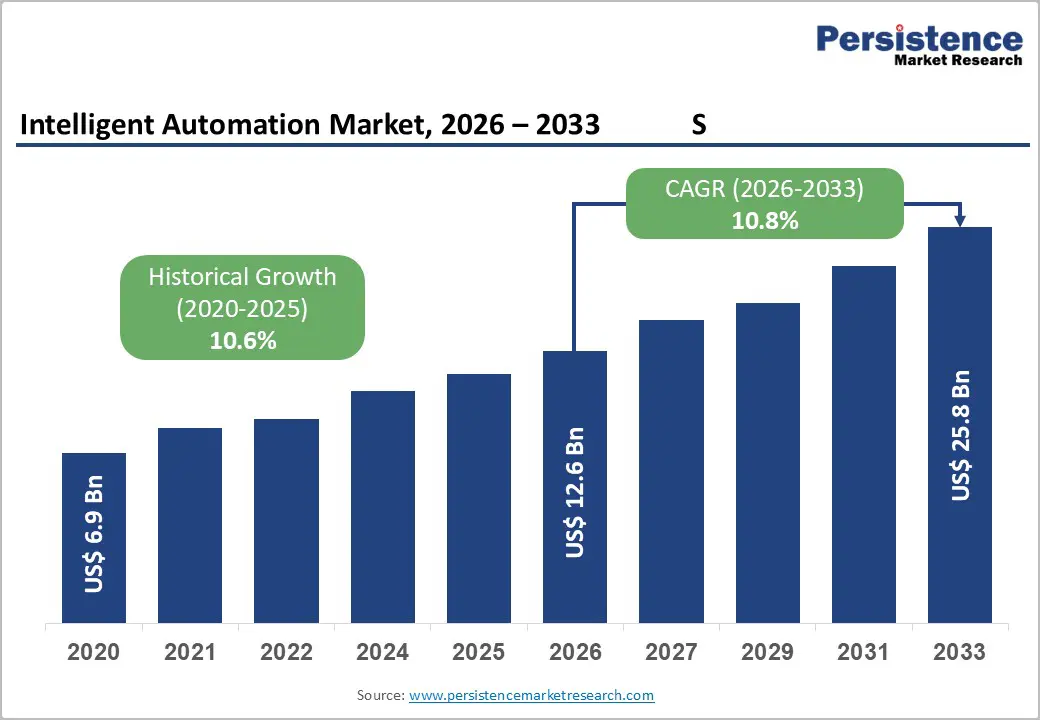
The global intelligent automation market size is likely to be valued at US$ 12.6 billion in 2026, and is projected to reach US$ 25.8 billion by 2033, growing at a CAGR of 10.8% during the forecast period 2026−2033. Market growth is driven by rapid advancements in artificial intelligence (AI) and machine learning (ML), as well as rising demand for business automation to enhance efficiency and reduce costs.
Technological progress in automation tools and the increasing availability of cloud infrastructure have fueled market expansion. The COVID-19 pandemic further emphasized the need for digital transformation, accelerating the adoption of intelligent automation solutions across industries. As businesses strive for greater operational efficiency, the integration of AI and automation technologies continues to shape the future of numerous sectors.
Key Industry Highlights
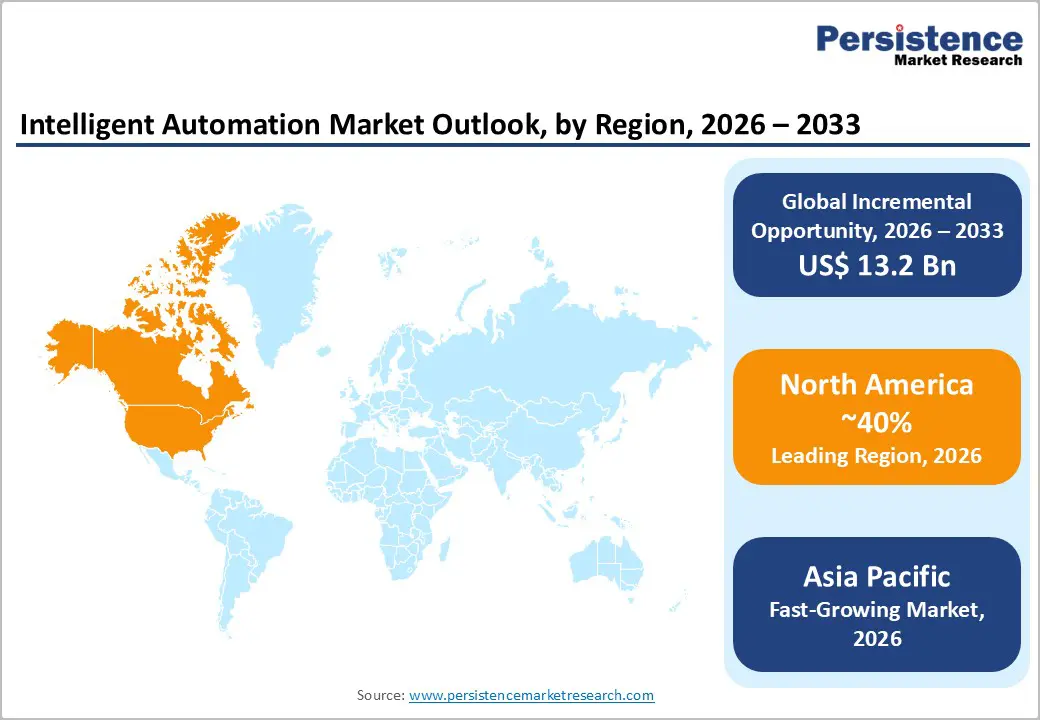
- Dominant Region: North America is predicted to hold a 40% market share in 2026, driven by a strong regulatory environment and advanced technological infrastructure.
- Fastest-growing Regional Market: Asia Pacific is forecast to be the fastest-growing market from 2026 to 2033, driven by rapid industrialization and digital transformation in businesses.
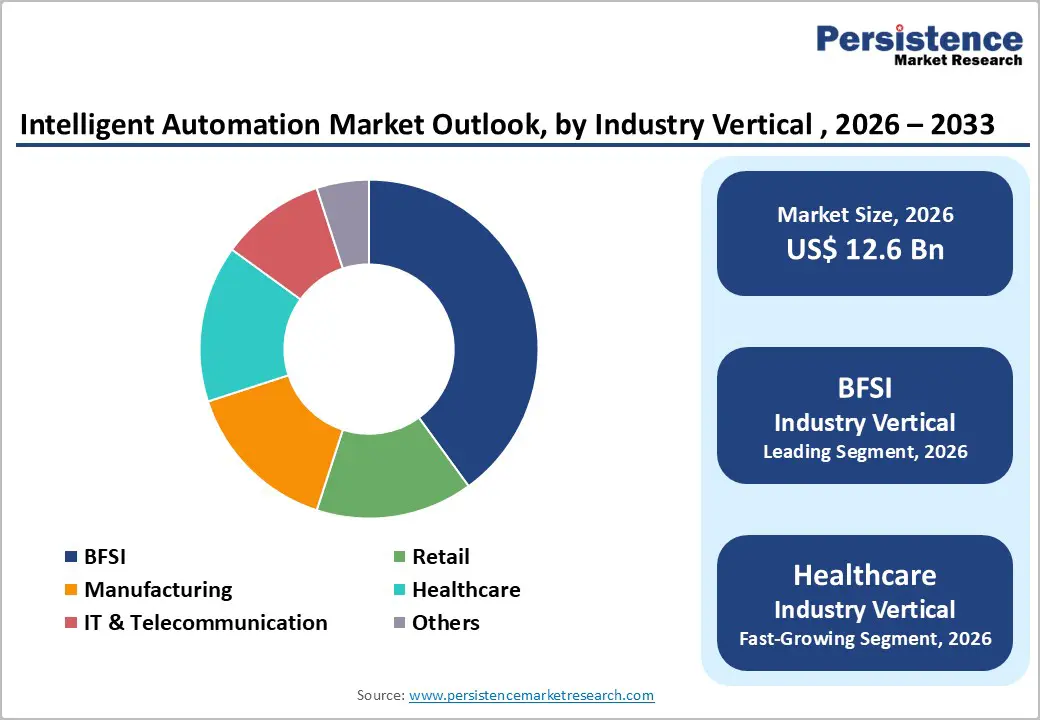
- Leading Industry Vertical: The BFSI sector is likely to lead with about 35% market share in 2026, fueled by significant investments in automation for fraud detection, compliance, and enhanced customer experience.
- Fastest-growing Industry Vertical: The healthcare sector is projected to grow the fastest through 2033, driven by the adoption of automation technologies in patient monitoring and diagnostics.
- November 2025: Wind River partnered with ServiceNow to launch an AI-ready private cloud solution via its Cloud Platform, enabling on-premises hosting of ServiceNow AI applications with automated lifecycle management, real-time edge performance, and compliance for regulated industries.
| Key Insights | Details |
|---|---|
|
Intelligent Automation Market Size (2026E) |
US$ 12.6 Bn |
|
Market Value Forecast (2033F) |
US$ 25.8 Bn |
|
Projected Growth (CAGR 2026 to 2033) |
10.8% |
|
Historical Market Growth (CAGR 2020 to 2025) |
10.6% |
Market Factors - Growth, Barriers, and Opportunity Analysis
Technological Advancements in AI and Machine Learning
The widespread integration of AI and machine learning technologies drives the expansion of intelligent automation solutions across various industries. AI systems process and analyze vast amounts of data in real time, enabling automation to carry out tasks with greater precision and less human involvement. Machine learning algorithms improve continuously as they learn from new data, allowing automation systems to adapt and enhance performance. This results in faster decision-making, improved productivity, and cost reduction, positioning AI and ML as essential for businesses aiming to optimize operations and provide high-quality services.
The evolution of AI and machine learning further strengthens their role in intelligent automation. Their application across sectors such as manufacturing, healthcare, and finance enables businesses to automate complex processes such as predictive maintenance, fraud detection, and customer service. For instance, in June 2023, in collaboration with the Standards and Industrial Research Institute of Malaysia (SIRIM), Hitachi launched the Smart Manufacturing Experience Centre to promote Industry 4.0 in Malaysia and support SMEs. With advanced AI models, increased processing power, and greater data storage, automation capabilities are expanding, enabling businesses to push the limits of efficiency. The widespread use of AI and ML in automation is reshaping industries and fostering innovation across various sectors.
Data Security and Privacy Concerns
Data security and privacy concerns act as a major restraint on the growth of intelligent automation, as businesses face increasing pressure to protect sensitive information. Automation systems process large amounts of personal and confidential data, making them vulnerable to cyberattacks. Without strong security measures in place, these systems risk exposing valuable data, which can lead to financial losses, reputational damage, and legal repercussions. Ensuring secure data storage and transmission becomes essential in maintaining the reliability of automation processes while protecting user privacy.
As organizations adopt intelligent automation more broadly, they must navigate compliance with stringent data protection regulations, including the General Data Protection Regulation (GDPR) and the California Consumer Privacy Act (CCPA). These regulations require businesses to maintain tight control over user data, making it difficult to implement automated systems that rely on real-time data processing. Managing consent, ensuring transparency, and securing personal information complicate automation efforts. Concerns over data breaches, unauthorized access, and the misuse of personal data further hinder the widespread adoption of automation, particularly in industries that handle highly sensitive information.
Convergence with Generative AI Technologies
The convergence of intelligent automation and generative AI technologies presents a significant opportunity to enhance business operations. Generative AI, with its ability to create new content, solutions, and insights, can complement automation systems by adding a layer of creativity and innovation. This fusion enables businesses to automate routine tasks while generating personalized outputs, such as customized reports, dynamic marketing materials, or customer service interactions. The integration of these technologies enables organizations to streamline operations and deliver more tailored services, driving greater customer engagement.
The potential of combining generative AI with intelligent automation extends across multiple industries, from content creation to healthcare and finance. For example, AI models can generate real-time data insights to support decision-making or assist in creating personalized customer experiences. This synergy not only improves operational efficiency but also enhances the ability to deliver innovative solutions that were previously time-consuming or labor-intensive. As AI continues to advance, integrating generative capabilities into automation systems offers businesses a powerful tool to optimize their processes and unlock new opportunities for growth and market differentiation.
Category-wise Analysis
Deployment Type Insights
Cloud-based deployments are anticipated to capture approximately 60% of the intelligent automation market revenue share by 2026, driven by its ability to scale seamlessly, offering businesses the flexibility and cost-efficiency they need to rapidly expand operations. With minimal upfront investment, cloud solutions enable companies to grow without requiring substantial infrastructure and without the complexity of traditional implementation processes. As such, cloud models are becoming the preferred choice for modern, agile enterprises. For instance, in July 2025, SS&C Blue Prism enhanced its Next Gen cloud-native platform with the Blue Prism Assistant, an agentic AI tool for instant enterprise guidance, and Automation Orchestrator for hybrid cloud/on-premises orchestration. These updates will accelerate scalability, security, and deployment while enabling dynamic allocation of digital workers across fintech ecosystems.
The on-premises segment is expected to be the fastest-growing between 2026 and 2033, driven by industries with stringent data security and compliance requirements. These sectors value the control over sensitive data that on-premises solutions provide, ensuring that they can meet regulatory requirements and maintain data sovereignty. While cloud adoption remains widespread, many organizations in highly regulated industries prefer to keep critical operations on-site to mitigate potential risks associated with third-party environments.
Organization Size Insights
Large enterprises are poised to lead the intelligent automation market, expected to hold a dominant 70% share by 2026. Their significant financial resources enable them to invest heavily in advanced automation technologies, streamlining operations and enhancing efficiency across departments. These organizations typically face complex, multi-faceted operational structures that require robust, scalable automation solutions to drive productivity gains. Large enterprises are increasingly adopting automation to stay competitive in a fast-evolving digital landscape.
SMEs are anticipated to experience the fastest growth in the intelligent automation market from 2026 to 2033. SMEs are increasingly leveraging cost-effective automation solutions, particularly through cloud-based platforms, which offer flexibility without requiring large upfront investments. This adoption allows SMEs to enhance operational efficiency, reduce overhead costs, and remain competitive in a rapidly digitalizing environment. For example, in November 2025, Huawei unveiled integrated intelligent tech packages at its 2025 eKit European Autumn Launch, combining routing, Wi-Fi, VPNs, and AI-assisted IdeaHub systems into single devices to simplify IT deployment and reduce support complexity for SMEs. A growing number of SMEs are recognizing the need to modernize their business processes to meet customer demands and improve service delivery.
Industry Vertical Insights
The BFSI sector is slated to hold a dominant position, with an anticipated 35% revenue share in 2026, driven by significant investments in automation technologies. These advancements focus on enhancing fraud detection, ensuring compliance, and improving customer experience. As the financial industry faces increasing pressure to transform digitally, automation provides the tools to stay ahead of competitors, reduce operational risks, and meet growing customer demands for seamless, digital-first services, further cementing the BFSI sector's dominant position in the market. For example, agentic AI, which represents autonomous systems for reasoning and executing complex banking tasks such as credit underwriting, fraud detection, and anti-money laundering, is being swiftly deployed by banks for smart overlays, design applications, and process redesigns to leverage multi-agent networks.
The healthcare sector is forecasted to be the fastest-growing segment between 2026 and 2033, boosted by the growing adoption of automation technologies across patient monitoring, diagnostic support, and administrative functions. The COVID-19 pandemic underscored the critical need for scalable and efficient healthcare solutions, driving rapid digitization. Hospitals have been adopting robotic process automation (RPA) to alleviate administrative burdens, workforce shortages, and compliance pressures by automating repetitive tasks such as claims processing and scheduling. RPA has evolved from basic rule-based bots to AI-enhanced intelligent systems that incorporate machine learning (ML) and natural language processing (NLP). As healthcare providers increasingly prioritize patient care, operational efficiency, and cost reductions, automation is expected to play a pivotal role in advancing healthcare outcomes and accelerating sector growth.
Regional Insights
North America Intelligent Automation Market Trends
North America is expected to dominate with an estimated 40% of the intelligent automation market share in 2026, reflecting advanced technological infrastructure, substantial investments in automation, and a business environment highly conducive to innovation. The region leads due to early adoption of automation technologies across industries such as finance, healthcare, and manufacturing. The presence of major tech companies, combined with supportive government initiatives, ensures North America maintains a strategic advantage in the development and implementation of intelligent automation solutions.
The focus on operational efficiency and the drive to meet evolving consumer expectations are the other key factors aiding regional market growth. Companies in the region leverage automation to address labor shortages, enhance productivity, and streamline complex processes. In December 2025, for instance, Asamaka Industries showcased its pioneering automation solutions at the 2025 Emerging Technologies in Automation Conference, highlighting innovations in RPA, AI-driven workflows, and intelligent manufacturing systems. The presentation emphasized scalable integration for SMEs, addressing labor shortages and operational efficiency through next-generation agentic technologies. The increasing demand for AI-powered solutions in customer service, compliance management, and marketing is pushing industries to accelerate digital transformation. The highly skilled workforce and strong venture capital support provide a solid foundation for scaling intelligent automation.
Europe Intelligent Automation Market Trends
Europe is expected to hold a significant share of the intelligent automation market by 2033, driven by a strong focus on digital transformation across key industries such as automotive, manufacturing, healthcare, and finance. European countries are increasingly adopting intelligent automation to enhance productivity, optimize supply chains, and improve customer experiences. The regional market emphasizes innovation and government support for digitalization initiatives, positioning Europe as a critical player in the intelligent automation space. The ongoing push toward sustainability and energy efficiency is accelerating the adoption of automation technologies, particularly in industries such as manufacturing and logistics.
Growth in intelligent automation across Europe is also fueled by highly developed infrastructure and a skilled workforce. Countries such as Germany, the U.K., and France lead the way in automating industrial processes, with an emphasis on Industry 4.0 and smart factories. The rise of AI-driven automation solutions in financial services and healthcare, coupled with regulatory frameworks that support innovation, boosts the overall market. For example, in December 2025, Belgian rail automation startup OTIV raised € 9 million to scale its AI-driven train inspection and predictive maintenance platform, enabling autonomous monitoring of track conditions, signaling systems, and rolling stock across European networks. The funding supports expansion from pilot deployments with Belgian Rail to commercial operations targeting labor shortages and infrastructure reliability amid growing high-speed rail demands.
Asia Pacific Intelligent Automation Market Trends
Asia Pacific is forecasted to be the fastest-growing regional market for intelligent automation between 2026 and 2033, stimulated by rapid industrialization, digital transformation, and government-backed innovation. Countries such as China and India are aggressively integrating automation into manufacturing, retail, and logistics. The region features a large labor force and increasing demand for cost-effective solutions that accelerate the shift toward automation, as businesses aim to optimize operations, enhance productivity, and reduce costs. Government initiatives, such as national programs promoting technological advancements, provide substantial support for automation, AI, and robotics, fostering rapid adoption of IA solutions across diverse industries.
Growth in Asia Pacific is also fueled by a growing emphasis on smart manufacturing and Industry 4.0 technologies. Automation plays a crucial role in enhancing operational efficiency, minimizing errors, and improving quality control. The rising number of tech startups and increased investment in AI-driven automation further contribute to market expansion. In December 2025, for example, Singapore-based Galatek secured US$ 30 million in Series A funding to expand its AI automation platform Abio for smart laboratories in life sciences and precision semiconductor manufacturing, leveraging a global supply chain with localized service centers. As businesses across Asia Pacific prioritize scalability, improved customer experiences, and faster delivery, the adoption of intelligent automation solutions is expected to continue accelerating in the coming years.
Competitive Landscape
The global intelligent automation market structure continues to display moderate fragmentation, with dominant players such as UiPath, Automation Anywhere, IBM Corporation, and Microsoft Corporation holding substantial market shares. Larger, well-established companies benefit from brand recognition, extensive product portfolios, and strong distribution networks that enable them to capture a significant portion of the market. These players often focus on offering comprehensive automation solutions that serve a wide array of industries, including finance, healthcare, manufacturing, and retail. This allows them to maintain a competitive edge and secure long-term partnerships with large enterprises.
Smaller vendors and specialized innovators such as WorkFusion, Blue Prism, and Pegasystems are leveraging their agility to cater to niche market segments. These companies focus on unique, highly customizable automation solutions that address specific business needs or industries, such as regulated sectors, AI-driven document processing, and low-code automation platforms. Strategic positioning among these players emphasizes innovation, with a strong focus on emerging technologies such as AI, cloud automation, and machine learning.
Key Industry Developments
- In October 2025, SAP unveiled new intelligent applications designed to empower organizations with advanced data-driven decision-making capabilities, enhancing business agility and operational efficiency.
- In June 2025, Cognizant is recognized as a leader in the Everest Group's Intelligent Process Automation Solutions PEAK Matrix® Assessment, showcasing its strength in delivering cutting-edge automation solutions to global enterprises.
- In April 2025, BuildTrack launched its Smart Automation Experience Centre in Mohali, providing businesses with a hands-on platform to explore advanced automation solutions and IoT technologies.
Companies Covered in Intelligent Automation Market
- UiPath,
- IBM Corporation
- Microsoft Corporation
- Blue Prism (SS&C)
- Pegasystems
- SAP SE
- Oracle Corporation
- WorkFusion
- NICE
- Cognizant
- Genpact
- HCL Technologies
- Accenture
- Infosys
Frequently Asked Questions
The global intelligent automation market is projected to reach US$ 12.6 billion in 2026.
The market is driven by the heightened need for enhanced operational efficiency, cost reduction, and improved decision-making through AI and machine learning technologies.
The market is poised to witness a CAGR of 10.8% from 2026 to 2033.
The growing demand for AI-driven automation, cloud-based solutions, and digital transformation across industries is the key opportunities in the market.
Some of the key market players include UiPath, IBM Corporation, Microsoft Corporation, Blue Prism (SS&C), Pegasystems, and SAP SE.


