




- Hardware & Software IT Services
- Intelligent Document Processing Solution Market
Intelligent Document Processing Solution Market Size, Share, and Growth Forecast 2026 – 2033
Intelligent Document Processing Solution by Technology (OCR, Machine Learning, NLP), Deployment (Cloud, On-Premises), Component (Solutions, Services), Industry Vertical (BFSI, Healthcare, Manufacturing, Others), and Regional Analysis 2026 – 2033

Intelligent Document Processing Solution Market Size and Trends Analysis
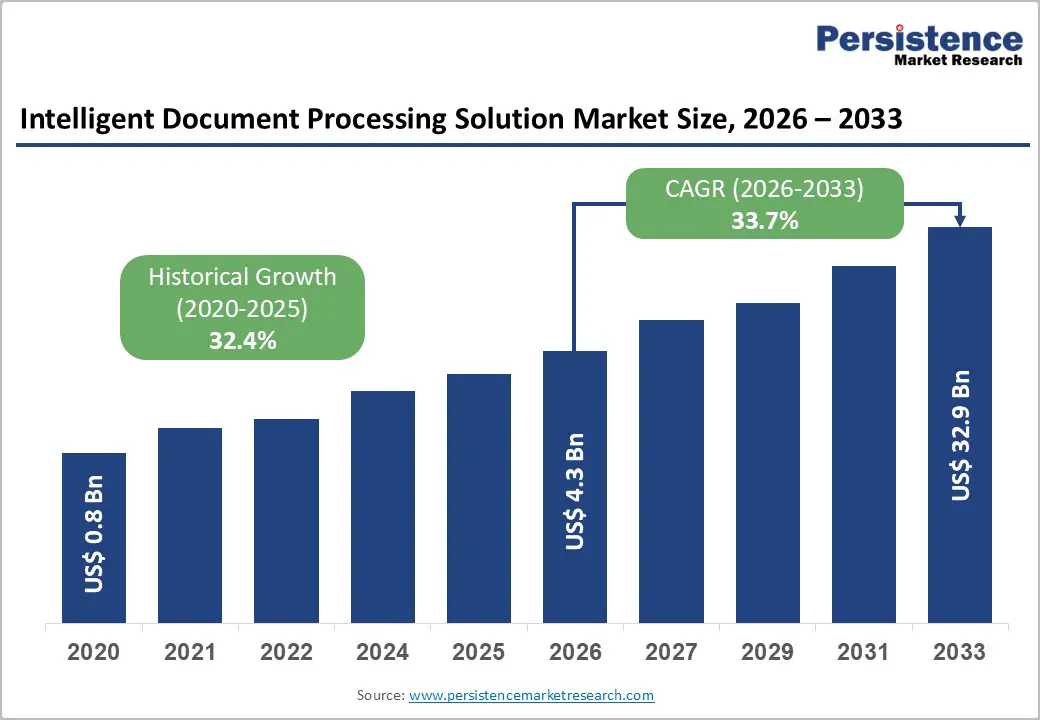
The global intelligent document processing solution market size is likely to be valued at US$ 4.3 billion in 2026 and is expected to reach US$ 32.9 billion by 2033, growing at a CAGR of 33.7% during the forecast period from 2026 to 2033, driven by the increasing adoption of advanced technologies such as machine learning (ML), natural language processing (NLP), optical character recognition (OCR), computer vision, and robotic process automation (RPA).
The BFSI sector is the largest end-user, while the Asia Pacific region is anticipated to experience the fastest growth. Cloud-based deployment models are currently the dominant choice. As of 2026, unstructured data accounts for 80-90% of enterprise information, underscoring the need for IDP solutions to efficiently handle and process such data. Organizations are increasingly shifting from rule-based automation to advanced cognitive and semantic-based processing to cope with the growing volume of digital documents in sectors, including BFSI, healthcare, and government.
Key Industry Highlights:
- Leading Region: North America, anticipated to account for a 42% market share in 2026, driven by high adoption of innovative therapies, including biologics, regenerative treatments, and advanced surgical interventions.
- Fastest-growing Region: Asia Pacific, fueled by rising musculoskeletal disease burden, expanding specialty orthopedic infrastructure, and growing investments in biologics in China and India.
- Dominant Treatment Type: Non-steroidal anti-inflammatory drugs, to hold approximately 38% of the market share, as they remain first-line therapy for acute and chronic pain control.
- Leading Disease Indication: Plantar fasciitis, contributing nearly 28% of the market revenue, due to highest community prevalence.
| Key Insights | Details |
|---|---|
| Intelligent Document Processing Solution Market Size (2026E) | US$4.3 Bn |
| Market Value Forecast (2033F) | US$32.9 Bn |
| Projected Growth (CAGR 2026 to 2033) | 33.7% |
| Historical Market Growth (CAGR 2020 to 2025) | 32.4% |
Market Factors – Growth, Barriers, and Opportunity Analysis
Integration of Generative AI and Large Language Models (LLMs) into Intelligent Document Processing
The integration of Generative AI and LLMs is structurally reshaping the intelligent document processing market by enabling a transition from rigid, rule-based extraction toward context-aware document understanding. Traditional IDP (Intelligent Document Processing) systems were constrained by templates and predefined fields, limiting scalability across document formats and languages. Generative AI overcomes these limitations by interpreting unstructured and multimodal content, including narrative text, tables, and embedded visuals, with greater semantic awareness. This capability materially improves extraction accuracy while reducing dependence on manual configuration and exception handling. As enterprises face rising document volumes across finance, healthcare, legal, and public administration, AI-driven contextual understanding is emerging as a core enabler of operational efficiency and compliance consistency.
Beyond extraction, Generative AI expands the functional scope of IDP into higher-value workflow automation and decision support. LLMs support document summarization, classification, response generation, and drafting, allowing IDP platforms to participate directly in downstream business processes rather than acting as isolated preprocessing tools. This evolution shortens deployment cycles through pre-trained models and accelerates time-to-value, particularly in cloud-based and low-code environments. Concurrently, vendors are embedding human-in-the-loop governance and domain-specific model tuning to balance automation with regulatory assurance. The growing use of retrieval-augmented generation further strengthens enterprise adoption by aligning AI outputs with proprietary data, positioning Generative AI as a foundational driver of IDP market expansion rather than a peripheral enhancement. In September 2025, Infosource published its 2025 Global IDP Market report, highlighting the impact of GenAI and agentic automation. The report underscores GenAI's contribution to template-free extraction and multimodal processing, indicating significant growth potential and performance improvements across various industries.
Data Privacy, Security, and Governance Risks
Data security concerns represent a severe structural restraint on the adoption of intelligent document processing platforms, particularly as deployments shift toward cloud-based architectures. IDP systems routinely process highly sensitive information, including personally identifiable and protected health data, making them high-value targets for cyberattacks. The digitization, ingestion, and transmission stages introduce multiple exposure points where breaches can occur, elevating operational and regulatory risk. For regulated sectors such as banking, healthcare, insurance, and government, the potential consequences of data leakage extend beyond financial penalties to reputational damage and long-term trust erosion. As a result, many enterprises continue to favor on-premises or hybrid deployments to retain tighter control over data flows, even when this constrains scalability and integration efficiency.
These risks are further intensified by governance and explainability challenges associated with AI-driven IDP systems. Compliance teams often view advanced models as opaque, particularly when extraction logic and confidence scoring cannot be easily audited or traced. This lack of transparency complicates regulatory reporting, internal validation, and dispute resolution, especially under stringent data protection frameworks. The growing enforcement intensity around data privacy amplifies caution, slowing full-scale cloud migration and lengthening procurement cycles. Until vendors can demonstrably address end-to-end security, model transparency, and auditability at an enterprise level, data privacy concerns will continue to cap adoption in high-compliance industries and act as a meaningful drag on market expansion.
Transition from Passive IDP to Agentic Automation
The evolution from passive intelligent document processing to agentic automation represents a structural inflection point for enterprise automation. This shift moves IDP beyond assistive intelligence toward autonomous goal execution, where systems are designed to achieve outcomes rather than simply extract or classify data. By this stage of market maturity, agentic architectures are increasingly embedded at the core of enterprise workflows, enabling AI to interpret intent, evaluate constraints, and execute multi-step actions across interconnected systems. The commercial significance lies in redefining IDP from a productivity tool into an operational control layer that directly influences financial, operational, and customer-facing outcomes. Agentic IDP platforms enable fully autonomous, end-to-end workflows that extend across enterprise software stacks. Instead of flagging documents for downstream action, agents can validate transactions, reconcile records, trigger approvals, and execute actions within ERP, CRM, and procurement environments.
The emergence of federated multi-agent orchestration strengthens this capability, allowing specialized agents to collaborate across data extraction, contextual reasoning, and execution layers, thereby supporting complex cross-functional processes at scale.A critical enabler of this opportunity is the parallel rise of real-time adaptive governance. As autonomy increases, enterprises are prioritizing governance-as-code frameworks that embed compliance, security, and ethical constraints directly into agent logic. This approach supports continuous operation while aligning with tightening regulatory expectations for trustworthy automation. Collectively, these dynamics position agentic automation as a foundational layer for knowledge work automation, delivering measurable efficiency gains and reshaping how enterprises allocate human judgment across high-value decision domains.
Category–wise Analysis
Technology Insights
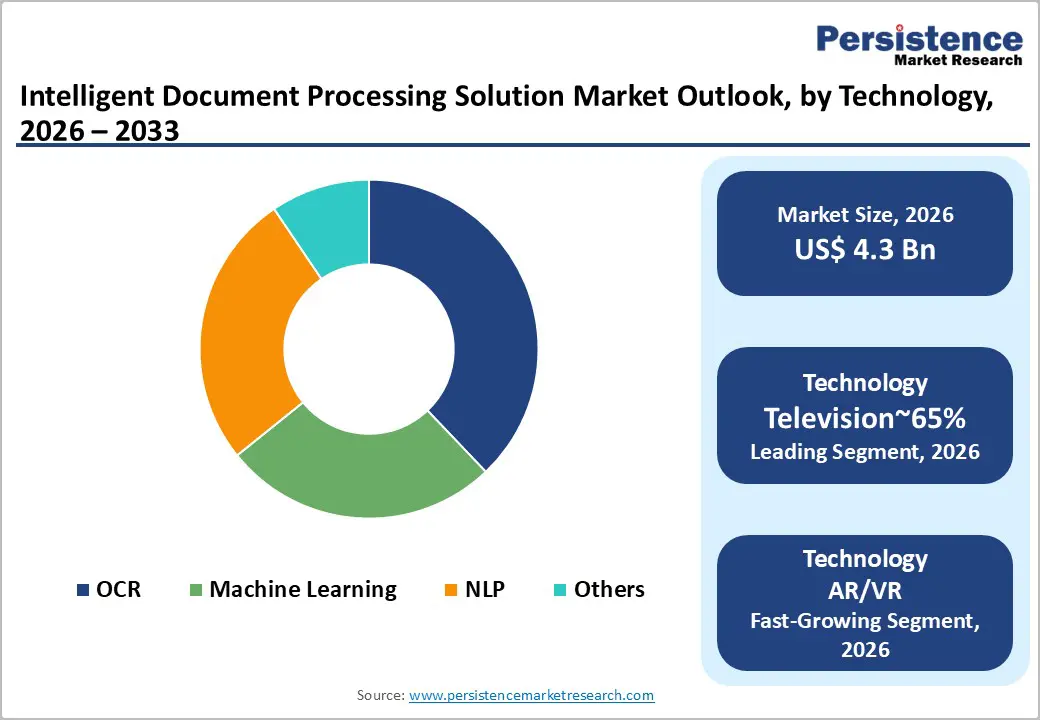
OCR (Optical Character Recognition) is expected to remain the leading technology segment, accounting for approximately 36% of the market share, anchored in its role as the mandatory entry layer for digitizing paper-based and scanned documents that still dominate enterprise records. Organizations are expected to prioritize OCR to convert PDFs, faxes, and image-based files into machine-readable text before applying higher-order intelligence. A key trend is the shift toward AI-powered OCR, which improves accuracy for handwriting, skewed scans, and low-resolution inputs. In mortgage and banking workflows, OCR is widely used to digitize large loan application packets with mixed document quality. In logistics, it enables automated reading of shipping labels and bills of lading under variable conditions, reinforcing its structural necessity across industries.
Machine Learning (ML) is rapidly outpacing traditional OCR in the Intelligent Document Processing (IDP) market. Its ability to handle unstructured, complex documents without templates drives this shift. ML powers autonomous document reasoning, context understanding, and self-improvement via human feedback. Key players, including Hyperscience, UiPath, and Microsoft, have integrated ML features such as Retrieval-Augmented Generation (RAG), multimodal learning, and low-code/no-code training for non-technical users. Industry trends include agentic IDP platforms, M&A for ML talent, and synthetic data for privacy. Growth is fueled by increasing unstructured data, labor shortages, and cloud-native ML adoption, with regulations such as the EU AI Act shaping compliant ML use.
Component Insights
Solution and software components are expected to remain the leading segment, accounting for approximately 62% of total market demand in 2026, driven by enterprise preference to allocate budgets toward core IDP platforms that function as foundational decision infrastructure rather than standalone tools. Software solutions such as document ingestion, classification, and data extraction engines are increasingly embedded directly into enterprise workflows, enabling large-scale processing of unstructured data that represents the majority of organizational information. Verticalized software offerings for BFSI and healthcare are expected to reinforce adoption, as pre-trained models for invoices, KYC documents, insurance claims, and medical records reduce deployment friction. Real-world use cases include banks automating loan document verification and hospitals digitizing patient intake forms, both of which prioritize robust, scalable software platforms. As enterprises standardize IDP across departments, solution-centric spending is expected to remain structurally dominant.
Services are expected to be the fastest-growing component, representing approximately 38% of overall demand. Growth is anticipated to be driven by increasing implementation complexity as organizations move from pilot projects to enterprise-wide automation. Integration with ERP and CRM systems, AI readiness assessments, and data governance consulting are expected to elevate service requirements. In regulated industries, services supporting auditability and explainability of AI-driven decisions are becoming essential. Real-world examples include insurers engaging third-party partners to redesign claims workflows and global enterprises relying on managed services for continuous model tuning and workforce training. This expanding scope positions services as the primary acceleration engine supporting long-term IDP deployment maturity.
Regional Insights
North America Intelligent Document Processing Solution Market Trends
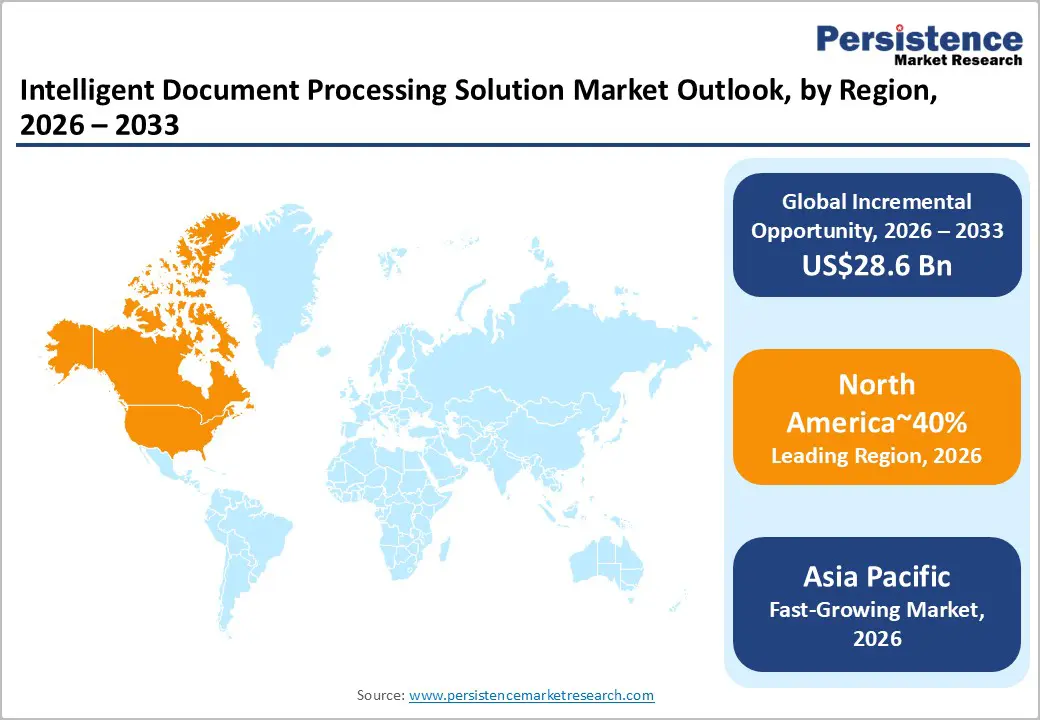
North America is expected to lead the global intelligent document processing market, accounting for approximately 40% of total revenue in 2026. This dominance will be reinforced by early and sustained adoption of AI, machine learning, and NLP across U.S. enterprises, supported by a mature regulatory environment that includes SOX, Dodd-Frank, HIPAA, and CCPA. Organizations in BFSI and healthcare will increasingly deploy IDP to enable touchless processing, audit readiness, and regulatory compliance at scale. The region will also benefit from the strong presence of core vendors such as Microsoft, UiPath, IBM, Automation Anywhere, and Hyperscience, which will anchor continuous platform innovation and enterprise-grade deployments.
Market momentum will be shaped by a clear shift toward GenAI-first IDP platforms, as U.S. enterprises pilot and scale LLM-based extraction for complex legal, financial, and clinical documents. Hyper-scaler investments by AWS, Google, and Microsoft will expand cloud-native infrastructure required for large-scale document intelligence. Banks will further automate KYC, AML, and mortgage underwriting workflows, while healthcare providers will accelerate digitization to replace paper- and fax-based processes. Venture capital activity in Silicon Valley will remain focused on vertical-specific IDP solutions, strengthening North America’s position as the leading and most technologically mature regional market.
Europe Intelligent Document Processing Solution Market Trends
Europe is expected to hold approximately 20% of the global market in 2026, maintaining a mature and stable regional position. The market will be shaped by stringent regulatory frameworks, particularly GDPR, which will continue to drive demand for secure, audit-compliant IDP solutions capable of anonymizing sensitive data. Enterprises across BFSI, government, and manufacturing will increasingly integrate IDP to optimize workflows, automate KYC and AML processes, and enhance administrative efficiency. Adoption will also be influenced by multilingual document processing requirements and the growing preference for hybrid or sovereign cloud deployments that ensure data remains within EU borders.
The U.K. is projected to remain the leading country within Europe, driven by expansive digitalization initiatives in financial services and government sectors. Germany will maintain strong uptake due to Industry 4.0 integration in manufacturing, automating supply chain documentation and logistics workflows. France will continue expanding through enterprise-level AI adoption, particularly in insurance and public sector processes. Overall, Europe will exhibit steady, regulated growth, emphasizing compliance, operational efficiency, and controlled digital transformation rather than rapid market expansion.
Asia Pacific Intelligent Document Processing Solution Market Trends
Asia Pacific is expected to hold approximately 25% of the global market in 2026, positioning it as the fastest-growing regional segment. The growth will be fueled by rapid digital transformation initiatives across India, China, and Japan, coupled with expansive government-led Digital Public Infrastructure programs. Enterprises will increasingly adopt AI-powered IDP solutions to automate paper-intensive processes, streamline administrative workflows, and ensure compliance with emerging regulatory frameworks. Mobile-first adoption in Southeast Asia will further accelerate growth, with IDP platforms capable of processing camera-captured documents becoming standard across e-commerce, fintech, and public service sectors. The aging workforce in Japan and South Korea will continue to drive automation adoption, creating high demand for solutions that can offset labor shortages while maintaining operational efficiency.
China will play a pivotal role in shaping global IDP trends through platforms such as DeepSeek, which standardizes cross-border document verification and has influenced AI-driven workflow optimization internationally. India is emerging as a regional hub for AI-enabled IDP development, supported by government programs such as DigiLocker and ABDM, which provide interoperable document ecosystems for education, health, and finance. These structural, demographic, and regulatory dynamics are expected to sustain APAC’s accelerated expansion and global influence in IDP adoption.
Competitive Landscape
The global intelligent document processing solution market is moderately consolidated at the top, with ABBYY, UiPath, and Tungsten Automation (Kofax) collectively controlling approximately 40–45% of the market. The top 10 players capture roughly 40–50%, while the remainder consists of a long tail of specialized startups and regional vendors. Market concentration is highest among firms offering integrated AI+RPA solutions, where platform capabilities, scalability, and enterprise-grade security create structural advantages. Leaders differentiate through end-to-end platforms that combine IDP, RPA, and BPM, enabling clients to automate complex workflows at scale.
Fragmentation persists in niche and emerging segments, with smaller players targeting specific verticals such as mortgage processing, insurance claims, or multilingual document understanding. Startups and challengers leverage AI-native architectures, generative AI, and large language models to bypass legacy template reliance and deliver autonomous, agentic workflows. Traditional software giants such as IBM and Microsoft maintain influence through IDP integration within cloud ecosystems, while RPA vendors such as Automation Anywhere use existing client bases to expand IDP adoption. Competitive positioning hinges on domain specialization, AI sophistication, and workflow integration capabilities.
Key Industry Highlights:
- In October 2025, AWS launched the open-source GenAI IDP Accelerator. This provided deployment patterns with Bedrock and SageMaker integration for agentic extraction, lowering barriers to advanced IDP adoption and fostering innovation in cloud-based processing.
- In August 2025, KnowledgeLake secured a US$65 million growth investment from Edison Partners. The funding accelerated AI-powered IDP expansion, enhancing customer success, partnerships, and capabilities for 70% faster processing, 98% accuracy, and significant savings in government and enterprise sectors.
- In September 2025, the AIIM Market Momentum Index Survey revealed that 65% of companies accelerated IDP projects. This confirmed IDP as a mainstream enterprise AI use case, driving the modernization of document workflows and indicating sustained high adoption rates.
- In March 2025, SER Group acquired Klippa to enhance its next-generation smart content platform. The acquisition integrated Klippa's advanced IDP into Doxis, enabling no-code workflows, custom ML models, and stronger solutions for regulated industries, including finance and healthcare.
Companies Covered in Intelligent Document Processing Solution Market
- ABBYY
- AntWorks
- Appian
- Automation Anywhere
- Google Cloud
- HCL Technologies
- Hyland Software
- Hyperscience
- IBM
- Infrrd
- Microsoft
- OpenText
- Parascript
- Rossum
- SS&C Blue Prism
- Tungsten Automation (formerly Kofax)
- UiPath
Frequently Asked Questions
The global intelligent document processing solution market is projected to be valued at US$4.3 billion in 2026 and is expected to reach US$32.9 billion by 2033, driven by the need to process vast amounts of unstructured enterprise data.
The incorporation of Generative AI and Large Language Models (LLMs) is transforming the intelligent document processing market by moving away from traditional, template-driven extraction methods to a more flexible, context-sensitive approach. This shift enhances accuracy and scalability, enabling IDP systems to automate more complex tasks such as summarization and decision-making support.
The intelligent document processing solution market is forecast to grow at a CAGR of 33.7% from 2026 to 2033, reflecting rapid enterprise adoption of AI-driven automation.
Asia Pacific is the fastest-growing regional market, fueled by rapid digital transformation, government-led digital public infrastructure initiatives, mobile-first document capture, and expansive automation across enterprises in India, China, and Japan.
The intelligent document processing solution market is moderately consolidated, with major players such as ABBYY, UiPath, Tungsten Automation (Kofax), IBM, Microsoft, and Hyperscience standing out through their AI+RPA-integrated platforms and enterprise-grade capabilities.


