




- Automation & Robotics
- Infrastructure Inspection Robots Market
Infrastructure Inspection Robots Market Size, Share, and Growth Forecast, 2026 - 2033
Infrastructure Inspection Robots Market by Product Type (Non-autonomous, Semi-autonomous, fully autonomous), Application (Visual inspection, Ultrasonic inspection, Laser scanning inspection, Others), and Regional Analysis for 2026 - 2033

Infrastructure Inspection Robots Market Size and Trends Analysis
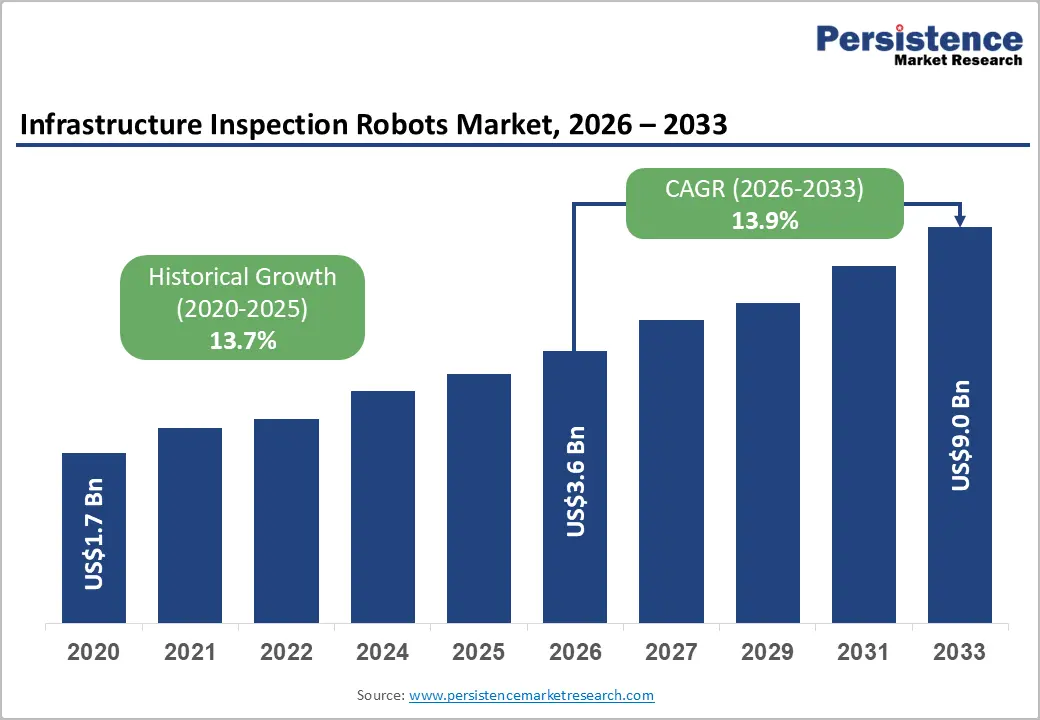
The global infrastructure inspection robots market size is likely to be valued at US$3.6 billion in 2026 and is expected to reach US$9.0 billion by 2033, growing at a CAGR of 13.9% during the forecast period from 2026 to 2033, driven by rising investments in the inspection and maintenance of aging infrastructure such as bridges, tunnels, pipelines, rail networks, dams, and power transmission systems.
Governments and asset owners are increasingly adopting robotic inspection solutions to enhance worker safety, minimize service disruptions, and reduce long-term maintenance costs compared to traditional manual inspections. Technological advancements play a crucial role in market expansion, with innovations in AI-driven analytics, high-resolution imaging, LiDAR, ultrasonic testing, and thermal sensors enabling precise defect detection and real-time structural health monitoring.
Key Industry Highlights:
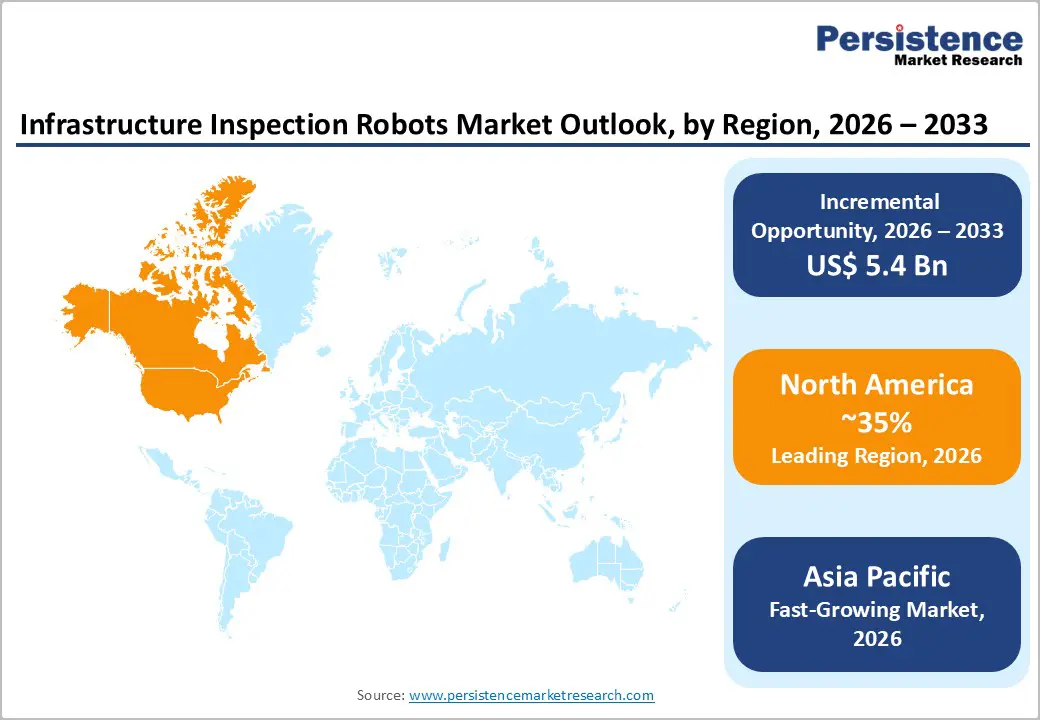
- Leading Region: North America is anticipated to be the leading region, accounting for 35% market share in 2026, driven by U.S.-led aging infrastructure renewal, strict PHMSA and OSHA regulations, strong utility investments, and growing adoption of AI-enabled predictive maintenance solutions.
- Fastest-growing Region: Asia Pacific is likely to be the fastest-growing region in the infrastructure inspection robots, supported by rapid urbanization, large-scale infrastructure projects in China, Japan, India, and ASEAN, evolving safety regulations, and strong local–global partnerships focused on scalable robotic inspection solutions.
- Leading Product Type: Semi-autonomous robots are projected to represent the leading product type in 2026, accounting for 50% of the revenue share, driven by their optimal balance of automation and human control in complex inspection environments.
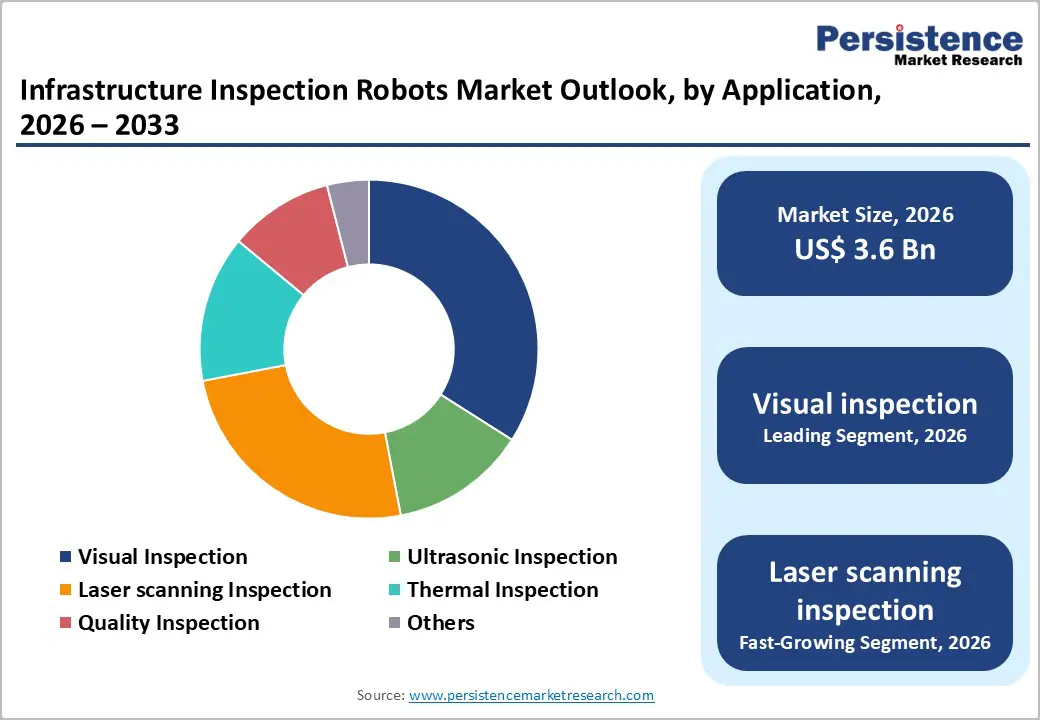
- Leading Application: The visual inspection segment is anticipated to be the leading application, accounting for over 40% of revenue in 2026, driven by the widespread use of high-resolution imaging to detect surface defects in infrastructure assets.
| Key Insights | Details |
|---|---|
|
Infrastructure Inspection Robots Market Size (2026E) |
US$3.6 Bn |
|
Market Value Forecast (2033F) |
US$9.0 Bn |
|
Projected Growth (CAGR 2026 to 2033) |
13.9% |
|
Historical Market Growth (CAGR 2020 to 2025) |
13.7% |
Market Factors - Growth, Barriers, and Opportunity Analysis
Aging Infrastructure and Safety Requirements
In many developed regions, bridges, tunnels, pipelines, rail networks, and power grids are several decades old and require frequent inspection to prevent structural failures. Traditional manual inspection methods are often labor-intensive, time-consuming, and limited in scope, making them insufficient to address the complexity of modern infrastructure systems. Infrastructure inspection robots, equipped with advanced sensors, high-resolution cameras, ultrasonic probes, and laser scanning technologies, provide a reliable alternative by offering rapid and precise assessments of structural health. These robotic systems can access hard-to-reach or hazardous areas, such as deep pipelines, high-rise bridges, or underwater tunnels, reducing human risk while ensuring comprehensive inspections.
Safety regulations and stringent compliance standards drive the integration of inspection robots in infrastructure maintenance. Regulatory bodies such as the U.S. Department of Transportation (USDOT), Occupational Safety and Health Administration (OSHA), and international standards organizations mandate periodic structural inspections to ensure public safety and prevent accidents. Non-compliance or delayed inspections can result in heavy penalties, operational shutdowns, or even catastrophic failures. Robots mitigate these risks by performing inspections in hazardous environments where human presence is unsafe, including confined pipelines, chemical plants, or unstable bridge structures.
Integration Challenges and Skilled Labor Shortage
The widespread adoption of infrastructure inspection robots is constrained by the complexity of integrating these advanced technologies into the existing infrastructure management frameworks. Many assets, especially in older facilities, depend on legacy monitoring systems that are incompatible with modern robotic platforms. Integration challenges span software interoperability, data standardization, and communication protocols linking robotic sensors, AI-driven analytics, and enterprise asset management systems. As a result, operators often struggle to consolidate inspection data into actionable insights, slowing decision-making and diminishing the effectiveness of predictive maintenance strategies. The high initial costs of system customization, integration, and workflow redesign pose significant financial barriers, particularly for smaller operators and municipalities.
Another major constraint is the shortage of skilled personnel needed to operate, maintain, and interpret data from sophisticated robotic inspection systems. While robots reduce the need for human involvement in hazardous environments, they still require trained operators, AI specialists, and maintenance technicians to function effectively. Limited access to skilled labor can lead to underutilization of robotic systems, errors in data interpretation, and delays in identifying critical infrastructure issues. This challenge is especially acute in emerging markets, where technical expertise and training programs are less developed. Although companies and governments are investing in workforce development, closing the skills gap is a gradual process. Until adequate talent is available, adoption is likely to progress slowly despite technological advances and supportive regulations, making labor shortages a persistent barrier to market growth.
Emerging Applications in Renewable Energy Infrastructure
Wind turbines, often located in remote or offshore locations, require frequent and detailed inspections of blades, towers, and nacelles to maintain operational efficiency and prevent costly failures. Large-scale solar farms demand regular monitoring of photovoltaic panels for cracks, shading, soiling, and electrical faults. Traditional manual inspections in these environments are time-consuming, labor-intensive, and can pose safety risks due to height, accessibility, or harsh conditions. Robotic solutions, including drones and ground-based inspection systems equipped with high-resolution cameras, thermal imaging, LiDAR, and AI-based analytics, enable rapid, precise, and cost-effective monitoring.
Emerging renewable energy assets, such as offshore wind farms, tidal energy installations, and concentrated solar power plants, expand the potential applications of infrastructure inspection robots. These environments often involve harsh weather, submerged components, or complex structural configurations, making manual inspection extremely challenging. Inspection robots, particularly autonomous aerial and underwater systems, can navigate these conditions to conduct high-precision assessments, detect defects, and monitor structural integrity over time. The integration of robotics with digital twins and cloud-based asset management platforms enhances predictive maintenance and operational planning for renewable infrastructure. Governments worldwide are investing heavily in decarbonization and renewable energy expansion, and demand for reliable, efficient, and scalable inspection solutions is rising.
Category-wise Analysis
Product Type Insights
Semi-autonomous robots are expected to lead the infrastructure inspection robots market, accounting for approximately 50% of revenue in 2026, driven by their optimal balance of human oversight and automation. These systems are widely adopted in complex environments such as pipelines, tunnels, and bridges, where human decision-making is critical, but automation enhances efficiency and safety. For example, Eddyfi Technologies’ magnetic crawler robots combine semi-autonomous navigation with high-resolution ultrasonic sensors, allowing inspectors to monitor pipeline integrity while maintaining control in challenging environments. Semi-autonomous platforms reduce human exposure to hazardous conditions, streamline inspection workflows, and generate actionable data for preventive maintenance. Their adaptability across diverse infrastructure applications makes them the preferred choice for operators seeking reliability, cost-effectiveness, and flexibility.
Fully autonomous robots are likely to represent the fastest-growing segment in 2026, supported by advancements in AI, machine learning, and sensor fusion that enable independent navigation and decision-making in hazardous inspections. For example, Boston Dynamics' Spot robot, equipped with LiDAR, thermal, and visual sensors, can autonomously navigate complex industrial facilities and bridges, collecting inspection data with minimal human intervention. These systems significantly reduce operational costs by eliminating the need for constant human supervision, while enabling round-the-clock monitoring and predictive maintenance. Fully autonomous platforms are increasingly adopted in energy infrastructure, oil and gas pipelines, and large-scale urban assets, where continuous and precise monitoring is critical.
Application Insights
Visual inspection is projected to lead the market, capturing around 40% of the revenue share in 2026, supported by its versatility and widespread use across infrastructure assets such as bridges, buildings, and pipelines. High-resolution cameras and imaging systems enable inspectors to efficiently detect surface defects, corrosion, cracks, and structural deformations. For example, Cognex vision-based inspection systems are employed for monitoring bridge surfaces and industrial facilities, providing detailed imagery and automated defect detection. Visual inspection remains dominant as it delivers reliable, real-time data with relatively lower investment compared to advanced non-destructive testing technologies. Its ease of integration with semi-autonomous robots enhances operational efficiency and reduces human exposure to risky environments.
Laser scanning is likely to be the fastest-growing application, driven by increasing demand for precision and condition monitoring in critical infrastructure, particularly pipelines and energy facilities. For example, Eddyfi Technologies’ laser-scanning platforms are deployed on oil and gas pipelines to capture detailed 3D models. These advanced inspection techniques provide quantitative data that supports predictive maintenance, structural analysis, and energy efficiency improvements. The adoption of these technologies is expanding rapidly due to the integration of AI-based analytics, enabling automated defect recognition and predictive modeling. Infrastructure complexity grows, and regulatory pressure for precise monitoring intensifies; laser scanning and thermal inspection become indispensable tools for operators seeking accurate diagnostics, operational efficiency, and risk reduction.
Regional Insights
North America Infrastructure Inspection Robots Market Trends
North America is anticipated to be the leading region, accounting for a market share of 35% in 2026, driven by aging infrastructure, government investments, and safety regulations. The region’s extensive network of bridges, highways, pipelines, and power grids requires frequent inspection to prevent structural failures, making robotic solutions increasingly essential. Operators are adopting advanced robotic platforms to improve efficiency, reduce human exposure to hazardous environments, and lower operational costs. Semi-autonomous robots remain widely used due to their balance of automation and human oversight, while fully autonomous systems are gaining traction as AI-enabled navigation and predictive maintenance capabilities mature.
Technological innovation is a key trend shaping the North American market, with AI-driven analytics, high-resolution imaging, LiDAR, thermal sensors, and multi-sensor platforms enhancing inspection precision. For example, Gecko Robotics, a U.S.-based company, has developed magnetic crawler robots equipped with ultrasonic and visual sensors that inspect boilers, pipelines, and storage tanks autonomously, providing real-time data to asset managers. The company’s solutions address the dual demand for safety and efficiency while enabling predictive maintenance strategies, which reduce downtime and extend asset lifespans. There is a notable increase in service-based models such as robotics-as-a-service, allowing smaller utilities and municipalities to access advanced inspection technologies without high upfront costs.
Europe Infrastructure Inspection Robots Market Trends
Europe is likely to be a significant market for Infrastructure inspection robots in 2026, driven by the region’s aging infrastructure, stringent safety regulations, and increasing adoption of advanced automation technologies. Countries such as Germany, the U.K., France, and the Netherlands are investing heavily in bridges, rail networks, tunnels, and energy assets, where manual inspections are time-consuming, costly, and risky. Semi-autonomous robotic platforms dominate the market, offering a balance between human oversight and automation, while fully autonomous systems are emerging as utilities and industrial operators embrace AI-driven predictive maintenance. European regulatory frameworks, including the European Union Machinery Directive and national health and safety standards, emphasize preventive inspections and safety compliance, encouraging widespread robotic deployment.
Technological innovation is a key trend shaping the European market, with LiDAR, high-resolution imaging, ultrasonic sensing, and thermal inspection capabilities enabling precise condition assessments across complex structures. For example, IBAK Helmut Hunger, a Germany-based company, specializes in advanced in-pipe inspection robots for sewer and water networks, combining autonomous navigation with high-definition imaging and sonar sensors. These systems allow operators to identify structural defects, blockages, and corrosion with high accuracy, reducing maintenance costs and ensuring regulatory compliance. Europe is also witnessing the rise of service-based models and collaborative projects between robotics firms and infrastructure operators, particularly in urban smart city initiatives.
Asia Pacific Infrastructure Inspection Robots Market Trends
The Asia Pacific region is likely to be the fastest-growing region in the infrastructure inspection robots market, driven by rapid urbanization, large-scale infrastructure projects, and industrial expansion across China, India, Japan, and ASEAN countries. Aging bridges, tunnels, pipelines, and energy networks, coupled with high demand for new infrastructure, have intensified the need for automated inspection solutions. Semi-autonomous robots dominate adoption due to their balance of human oversight and automation in complex environments, while fully-autonomous platforms are emerging for predictive maintenance and high-risk inspections. Government initiatives and public-private investments in smart cities, renewable energy, and urban transportation networks propel the demand for robotic inspections.
Technological advancements are a key driver in the Asia Pacific market, with AI-enabled navigation, high-resolution imaging, LiDAR, ultrasonic, and thermal sensors enhancing inspection precision. For example, RedZone Robotics, a U.S.-origin company with significant deployments in Asia, provides robotic in-pipe inspection solutions for water and sewer networks, capable of autonomous navigation in challenging environments while delivering detailed condition data. Their platforms help utilities detect cracks, corrosion, and structural weaknesses, enabling predictive maintenance and compliance with local safety standards. The market is also seeing increasing collaborations between international robotics firms and regional infrastructure operators to scale operations and adapt robots to diverse environmental conditions.
Competitive Landscape
The global infrastructure inspection robots market exhibits a moderately fragmented structure, driven by the coexistence of large automation and robotics firms alongside specialized inspection technology companies that cater to diverse infrastructure applications across energy, transportation, utilities, and industrial sectors. Innovation, technological differentiation, and integration capabilities are central competitive factors, as companies strive to meet rising demand for automated, safe, and precise inspection solutions that can navigate complex environments such as pipelines, bridges, tunnels, and substations. Market growth is supported by increasing digitalization.
With key leaders including Boston Dynamics, DJI Technology Co., Ltd., ABB Ltd., GE Inspection Robotics, and Honeybee Robotics, the competitive landscape balances long-established automation giants with highly innovative robotics specialists that push technological boundaries. These players compete through continuous product innovation, strategic partnerships, tailored service offerings, and geographic market expansion, aiming to deepen customer penetration and enhance solution portfolios. Companies differentiate by investing in R&D to improve autonomy, sensor integration, real-time analytics, and multi-platform interoperability, as well as offering robotics-as-a-service (RaaS) models to reduce adoption barriers for smaller operators.
Key Industry Developments:
- In August 2025, Sensyn Robotics, Inc. announced the launch of a new generative AI-powered image diagnosis service aimed at improving the efficiency and accuracy of infrastructure inspections. Integrated into the company’s AI platform “SENSYN CORE”, the service automates the initial diagnosis of equipment conditions by analyzing images uploaded to the SENSYN CORE Datastore. The platform leverages generative AI alongside conventional machine learning to detect specific objects, such as cracks or structural defects, based on natural language instructions in Japanese, eliminating the need for large image datasets.
- In June 2025, Luminys Systems Corporation, part of the Foxlink Group, announced the launch of the SYNC ROBOTIC AI Security Patrol Robot Solution in Taiwan, powered by NVIDIA’s AI ecosystem, including Jetson AGX, DGX, and Omniverse platforms. The solution delivers autonomous, 24/7 inspection capabilities for commercial buildings, industrial sites, retail centers, and public infrastructure, addressing labor shortages and high-risk environments. The AI-powered system combines voice and visual recognition, visual language models (VLM), simultaneous localization and mapping (SLAM), path planning, and crowd-aware obstacle avoidance, enabling flexible deployment using quadruped robots or drones.
Companies Covered in Infrastructure Inspection Robots Market
- ABB
- Cognex
- Fanuc
- Kuka
- Universal Robots
- Gecko Robotics
- Eddyfi Technologies
- Honeybee Robotics
- Boston Dynamics
Frequently Asked Questions
The global infrastructure inspection robots market is projected to reach US$3.6 billion in 2026.
The infrastructure inspection robots market is fueled by the growing demand for safer, faster, and more precise monitoring of aging and complex infrastructure through the use of advanced automation and AI technologies.
The infrastructure inspection robots market is expected to grow at a CAGR of 13.9% from 2026 to 2033.
Emerging applications in renewable energy infrastructure, adoption of AI and predictive maintenance, integration with digital twins, expansion in fast-growing regions such as Asia Pacific, and robotics-as-a-service models for cost-effective deployment.
ABB, Cognex, Fanuc, KUKA, Universal Robots, Gecko Robotics, Eddyfi Technologies, and Honeybee Robotics are the leading players.


