




- Hardware & Software IT Services
- Grid Computing Market
Grid Computing Market Size, Share, and Growth Forecast, 2026 – 2033
Grid Computing Market by Deployment Type (Public Grid, Private Grid, Hybrid Grid), Component (Hardware, Software, Services), End-User (Information Technology (IT) & Telecommunications, BFSI, Healthcare & Life Sciences, Manufacturing & Engineering, Energy & Utilities, Government & Defense, Education & Research Institutions), and Regional Analysis for 2026-2033

Grid Computing Market Share and Trends Analysis
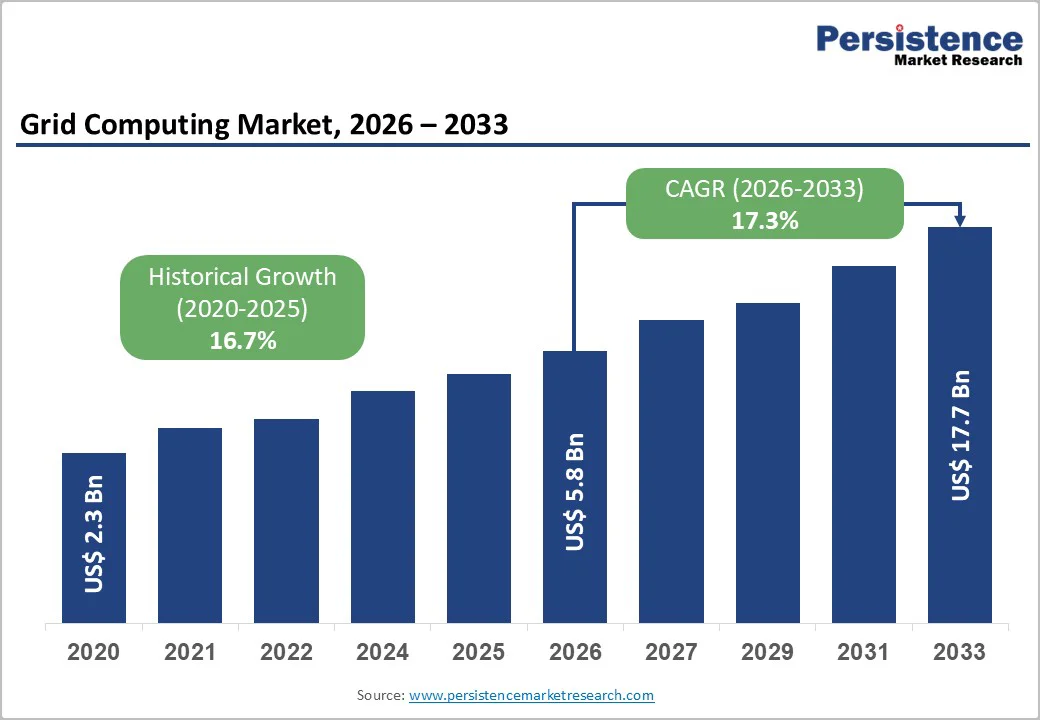
The global grid computing market size is likely to be valued at US$ 5.8 billion in 2026 and is estimated to reach US$ 17.7 billion by 2033, growing at a CAGR of 17.3% during the forecast period 2026−2033. Rising global demand for distributed computing frameworks capable of handling large-scale computational workloads efficiently primarily underpins market growth. Key drivers include the proliferation of big data analytics, increasing adoption of artificial intelligence (AI) and machine learning (ML), and the need for scalable high-performance computing (HPC) architectures across industry verticals. Advancements in networking infrastructure and uptake of hybrid cloud deployments further elevate demand. Regulatory incentives in digital infrastructure modernization, particularly in North America and Asia Pacific, are catalyzing investment flows. Strategic partnerships among technology providers and public-sector initiatives to support compute resource sharing are reinforcing long-term market expansion.
Key Industry Highlights
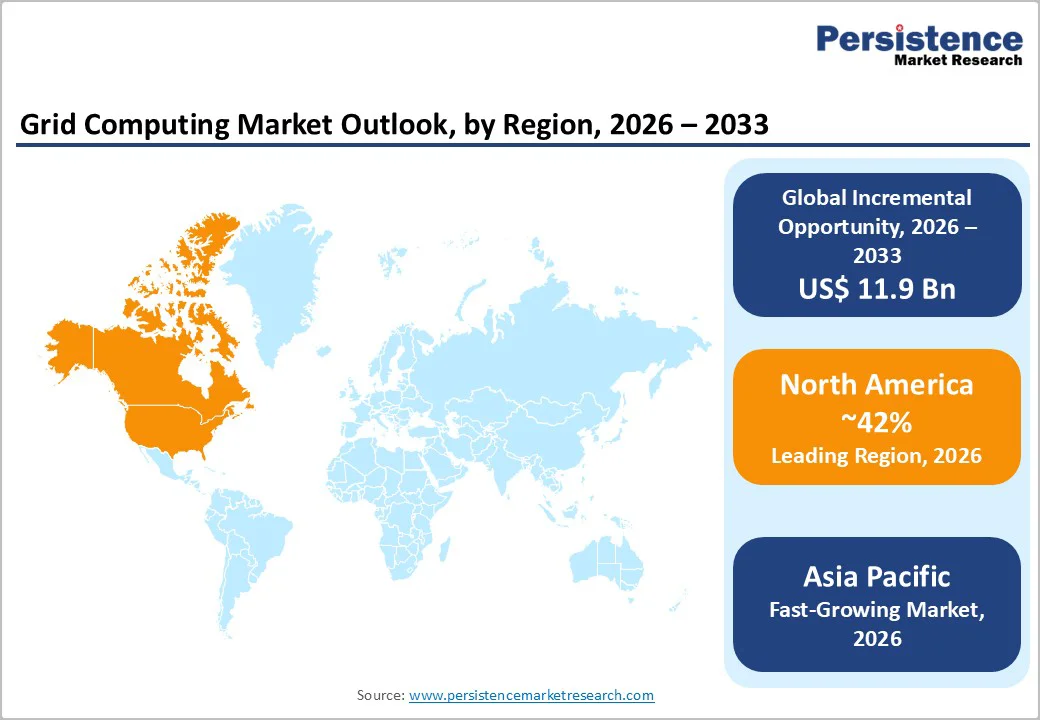
- Dominant Region: North America is set to lead in 2026 with 42% market share, driven by advanced data centers, HPC clusters, and integrated distributed computing.
- Fastest-growing Regional Market: Asia Pacific is projected as the fastest-growing market through 2033, fueled by digital infrastructure expansion and rising demand for advanced analytics across enterprises.
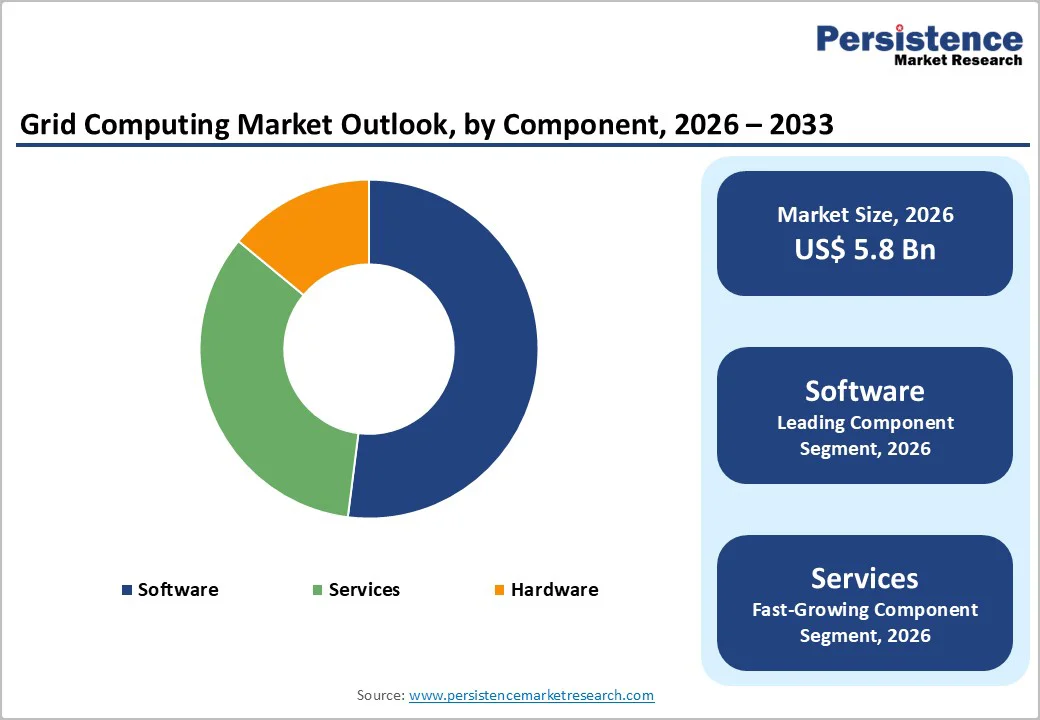
- Leading Component: In 2026, the software segment is projected to hold 52% of the revenue share, driven by middleware, orchestration platforms, and monitoring tools that streamline large-scale, high-performance distributed computing.
- Fastest-growing Component: The services segment is anticipated to grow the fastest between 2026 and 2033, supported by extensive deployment complexity and managed services.
| Key Insights | Details |
|---|---|
| Grid Computing Market Size (2026E) | US$ 5.8 Bn |
| Market Value Forecast (2033F) | US$ 17.7 Bn |
| Projected Growth (CAGR 2026 to 2033) | 17.3% |
| Historical Market Growth (CAGR 2020 to 2025) | 16.7% |
Market Factors – Growth, Barriers, and Opportunity Analysis
Rising Demand for High-Performance Computing
Rising adoption of HPC is transforming data processing and analysis at a large scale. HPC provides parallel processing power for complex simulations, large-scale modelling and compute-intensive workloads that exceed capabilities of traditional single-system setups. Sectors such as scientific research, engineering, and climate modelling rely on HPC for rapid processing and operational efficiency. Grid computing enhances this capability by linking distributed computing resources into a unified system, improving computational throughput and optimising utilisation of diverse hardware. Increasing volumes of data drive demand for scalable processing platforms, highlighting the need for advanced compute solutions.
HPC supports real-time analytics and high-speed decision-making in industries where performance directly affects outcomes. Financial modelling, genomic analysis, and engineering simulations leverage grid-based HPC to minimise processing bottlenecks and increase concurrency. Organisations implementing these infrastructures gain faster innovation cycles, higher resource efficiency, and robust computational resilience. Grid computing enables flexible scaling and reliable performance for HPC workloads, establishing computing capacity as a strategic enabler for digital initiatives and long-term operational growth.
High Implementation Complexity and Integration Challenges
High implementation complexity and integration challenges act as a key restraint on the grid computing market growth, as grids involve the coordination of diverse computing resources across distributed environments. Systems must align heterogeneous hardware, varied software platforms, and distinct communication protocols, which demands advanced middleware and technical expertise. Integration efforts require establishing interoperability standards, configuring network orchestration, and ensuring consistent workflow execution. These technical requirements escalate initial effort and can result in extended timelines as teams adjust configurations and troubleshoot interdependent components. High complexity amplifies risks related to project setbacks, rework, and resource allocation strain, which can deter organizations from committing to extensive system deployment.
Integration challenges further restrict adoption by increasing ongoing operational demands and exposing teams to potential performance inconsistencies. Ensuring stable data flow, maintaining service quality across nodes, and addressing fault tolerance require sustained coordination mechanisms that extend beyond basic setup. Technical teams can find it difficult to manage system evolution, version compatibility, and secure access controls in a distributed context.
Integration with AI and Machine Learning
Integration with AI and ML opens a transformative avenue in computing by enabling large-scale data processing and complex model training across distributed systems. AI and ML workloads demand extensive computational power and high-speed data access, which exceeds the capacity of traditional single-server setups. Grid computing delivers parallel processing capabilities and resource pooling, allowing algorithms to execute efficiently on massive datasets. This synergy accelerates model development, reduces processing times, and supports real-time analytics, creating a competitive advantage in innovation-driven sectors. For example, the Bank of England active promotes the responsible adoption of AI, distributed ledger technology (DLT), and quantum computing to drive productivity, growth, and collaborate internationally while safeguarding financial and monetary stability.
The collaboration between distributed computing frameworks and AI/ML accelerates adoption across industries reliant on predictive analytics, automation, and intelligent decision-making. High-performance data orchestration, coupled with scalable processing resources, enhances accuracy in simulations, pattern recognition, and predictive modeling. Organizations can implement advanced solutions without incurring costs associated with dedicated supercomputing infrastructure. Integration ensures agility in handling evolving data volumes and algorithmic complexity while supporting strategic initiatives in operational efficiency, research, and product development. The ability to process diverse datasets concurrently positions businesses to achieve insights faster, optimize resource utilization, and maintain technological leadership in a rapidly advancing digital environment.
Category-wise Analysis
Deployment Type Insights
The private segment is likely to lead with a projected 46% of the grid computing market revenue share in 2026. Leadership is driven by strong demand for controlled environments that support data security, regulatory compliance, and predictable performance. Regulated industries prioritize internal resource pools to manage sensitive workloads without exposure to external networks. Large enterprises adopt this model to support mission-critical applications and stable compute scheduling. A representative example includes banking institutions running fraud detection and risk modeling workloads within isolated grid environments to meet audit and governance standards.
The hybrid grid segment is expected to witness the fastest growth between 2026 and 2033, supported by a balanced approach to scalability and governance. Enterprises seek flexibility to manage fluctuating workloads while maintaining security for core operations. Integration of private infrastructure with public resources enables dynamic workload distribution and cost optimization. Cloud platform maturity and improved orchestration tools accelerate adoption across data-intensive industries. A practical example appears in retail analytics, where seasonal demand forecasting workloads shift to public resources during peak periods while customer data processing remains within controlled internal environments.
Component Insights
Software is poised to lead with a forecasted 52% share in 2026. Dominance of this segment is supported by the widespread adoption of middleware, orchestration platforms, and monitoring tools that enable efficient coordination of distributed computing resources. Enterprises prioritize standardized software layers to ensure interoperability, workload scheduling accuracy, and system reliability across heterogeneous environments. Revenue strength is reinforced through recurring licensing and subscription-based models. A valid example includes research institutions deploying grid management platforms to coordinate thousands of compute nodes for large-scale simulations and data-intensive analysis.
The services segment is anticipated to be the fastest-growing between 2026 and 2033, fueled by increasing deployment complexity and rising demand for specialized expertise. Enterprises require consulting, integration, and managed services to design architectures, integrate legacy systems, and maintain operational continuity. Expansion of hybrid environments and mission-critical workloads amplifies reliance on professional support models. Managed service offerings enable predictable performance and operational efficiency. A representative example includes healthcare networks engaging service providers to implement and manage grid environments supporting genomic analysis and advanced diagnostic workloads.
End-User Insights
The IT and telecommunications segment is slated to hold a dominant position, with an anticipated 45% of the grid computing market revenues in 2026. Leadership is powered by continuous demand for distributed computing to manage large-scale data traffic, network virtualization, and cloud-based application development. Grid frameworks enable efficient workload distribution for software testing, network optimization, and real-time analytics. Adoption remains strong among telecom operators deploying 5G network planning simulations and IT service providers managing multi-client compute environments that require scalability, uptime assurance, and performance consistency.
The healthcare and life sciences segment is predicted to be the fastest-growing from 2026 to 2033, boosted by the rising adoption of data-intensive research and precision healthcare initiatives. Grid computing supports parallel processing of genomic datasets, advanced medical imaging, and large-scale clinical trials across distributed research centers. Growth is reinforced by digital transformation in healthcare delivery and collaborative research models. Pharmaceutical research networks using distributed compute frameworks to accelerate drug discovery simulations and population-scale genomic analysis while maintaining regulatory alignment and data integrity illustrate the application of grid computing in the healthcare and life sciences domain.
Regional Insights
North America Grid Computing Market Trends
North America is positioned to dominate in 2026, capturing an estimated 42% of the grid computing market share, reflecting structural advantages across enterprise technology ecosystems. Leadership is fueled by deep integration of distributed computing within large-scale digital operations across information technology, telecommunications, financial services, and government research programs. Advanced data center density, high-bandwidth networking, and widespread deployment of high-performance computing clusters support large-volume parallel workloads. Early commercialization of cloud-native orchestration platforms accelerates grid adoption for production environments rather than limited research use. Strong alignment between academic research networks and enterprise infrastructure enables efficient transfer of innovation into commercial applications, strengthening sustained demand.
Market dominance is further reinforced by strong enterprise spending capacity and strategic emphasis on data-intensive initiatives such as artificial intelligence training, real-time analytics, and complex simulations. Large enterprises leverage grid architectures to optimize infrastructure utilization across geographically distributed facilities, improving cost efficiency and workload resiliency. Federal and regional digital infrastructure programs promote compute resource sharing across national laboratories and universities, expanding large-scale deployments. Technology vendors headquartered in the region accelerate ecosystem maturity through advanced middleware development and enterprise-grade support models. Grid frameworks increasingly support regulated workloads, including financial risk modeling and public-sector analytics, positioning the region as the primary hub for scalable, production-grade distributed computing adoption.
Europe Grid Computing Market Trends
Europe represents a strategically significant region in grid computing adoption, characterized by strong emphasis on collaborative research, data governance, and cross-border digital integration. The region benefits from advanced academic and scientific computing networks that support large-scale simulations, climate modeling, and physics research. Enterprises across manufacturing, automotive, aerospace, and energy sectors deploy distributed computing frameworks to optimize design simulations, predictive maintenance, and industrial analytics. Mature broadband infrastructure and high-performance research networks enable efficient workload distribution across multiple countries, reinforcing regional adoption.
Regional momentum is further shaped by strict data protection standards and regulatory frameworks that encourage controlled, region-based compute environments. Organizations prioritize grid architectures to support data localization requirements while enabling collaboration across institutional boundaries. Publicly funded research programs and pan-European digital initiatives promote shared compute platforms and standardized interoperability frameworks. Adoption extends into healthcare research, financial analytics, and smart infrastructure projects that require parallel processing and secure data handling. Focus on sustainability and energy-efficient computing also supports deployment of optimized grid environments across data centers and research facilities throughout Europe.
Asia Pacific Grid Computing Market Trends
Asia Pacific is projected to emerge as the fastest-growing regional market for grid computing during the 2026-2033 forecast period, powered by accelerated digital infrastructure expansion and rising enterprise demand for scalable computing platforms. Rapid growth in data generation from telecommunications, e-commerce, financial technology, and manufacturing creates strong demand for distributed computing frameworks. Large-scale investments in data centers, high-speed networks, and cloud platforms across China, India, and Southeast Asia enable wider adoption of grid architectures. Enterprises increasingly deploy grid systems to support AI workloads, real-time analytics, and large simulation tasks without reliance on centralized infrastructure.
Regional market growth momentum is further strengthened by public and private initiatives focused on research computing and digital transformation. National science programs and regional research consortia promote shared compute environments across universities, laboratories, and innovation hubs. Cost sensitivity across emerging economies encourages adoption of grid frameworks that maximize utilization of existing infrastructure. Expansion of healthcare analytics, smart manufacturing, and energy optimization platforms intensifies demand for parallel processing capabilities. Technology service providers accelerate regional adoption through localized platforms and industry-specific solutions, positioning Asia Pacific as the most dynamic region for distributed computing expansion.
Competitive Landscape
The global grid computing market exhibits a moderately consolidated structure, with leading technology firms holding significant market shares through advanced software platforms, middleware, and integrated grid solutions. IBM, Oracle, Intel, Amazon Web Services (AWS), Google, and Microsoft represent the core group of dominant players, leveraging extensive research and development capabilities, global distribution networks, and established enterprise customer bases.
The market ecosystem includes a balanced mix of software vendors, hardware manufacturers, and service providers delivering end-to-end grid computing frameworks. While these established players benefit from strong brand recognition, proprietary technologies, and long-term enterprise contracts, emerging and specialized vendors continue to introduce targeted innovations, particularly in workload orchestration, resource scheduling, and grid management software, contributing to ongoing competitive differentiation and technological evolution.
Key Industry Developments
- In December 2025, Taiwan opened its largest AI grid cloud computing center in Tainan Science Park, anchored by the Nano 4 supercomputer using Nvidia Blackwell chips, to advance its Ten New AI Infrastructure Projects and green, resilient computing goals.
- In December 2025, CERN celebrated 20 years of the Worldwide LHC Computing Grid, marking two decades of global collaboration in large-scale scientific computing.
- In September 2025, National Grid and AI specialist Emerald AI launched a live trial in the U.K. to test dynamic energy management for AI-intensive data centers, aiming to adjust power draw in real time based on workload demands.
Companies Covered in Grid Computing Market
- IBM
- Oracle
- Intel
- Amazon (AWS)
- Microsoft
- Dell Technologies
- Atos SE
- NEC Corporation
- Red Hat, Inc.
- Univa Corporation
- Rescale, Inc.
Frequently Asked Questions
The global grid computing market is projected to reach US$ 5.8 billion in 2026.
Rising demand for large-scale data processing, high-performance computing, and distributed resource optimization drives the market.
The market is poised to witness a CAGR of 17.3% from 2026 to 2033.
Integration with AI, machine learning, and hybrid cloud deployments offers key growth opportunities in the market.
Some of the key market players include IBM, Oracle, Intel, Amazon (AWS), Google, Microsoft, and Dell Technologies.


