




- Automotive Components & Materials
- Gear Linkage Rod Market
Gear Linkage Rod Market Size, Share, and Growth Forecast, 2025 - 2032
Gear Linkage Rod Market By Material (Steel, Aluminium, Others), Fitment Type (Standard Fit, Universal Fit), Rod Length, Application, and Regional Analysis for 2025 – 2032

Gear Linkage Rod Market Size and Trends Analysis
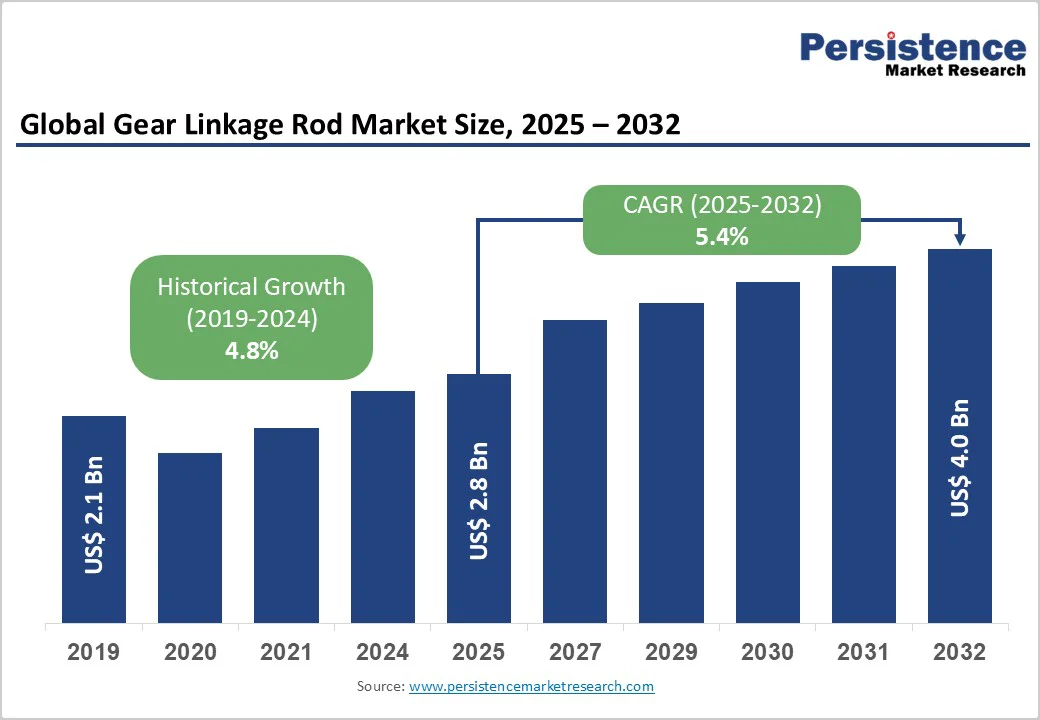
The global gear linkage rod market size is likely to be valued at US$2.8 Billion in 2025, projected to reach at US$4.0 Billion by 2032 growing at a CAGR of 5.4% during the forecast period from 2025 to 2032 driven by increasing demand for precision-engineered components in automotive and industrial applications, fueled by global vehicle production growth and advancements in lightweight materials.
The market benefits from rising electric vehicle (EV) adoption and automation in agriculture and industrial sectors, enhancing linkage rod market trends for durable, high-performance transmission components. Innovations in composite materials and automated manufacturing processes are key to meeting the demand for fuel-efficient and eco-friendly solutions, particularly in high-growth regions such as Asia Pacific.
Key Industry Highlights:
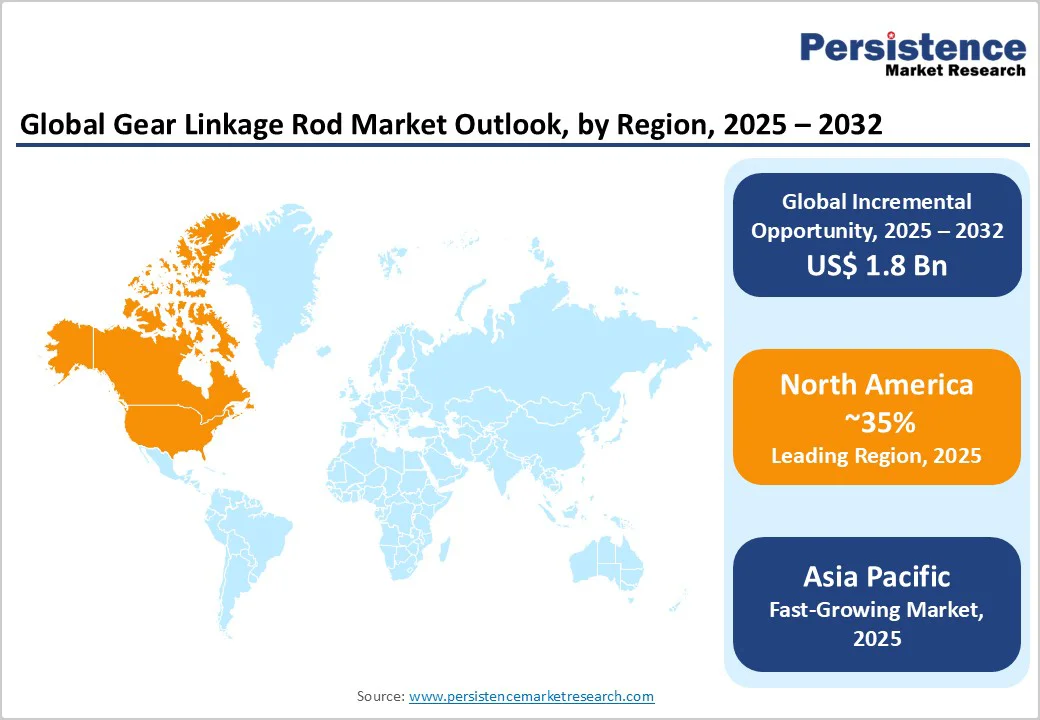
- Leading Region: North America, with a 35% market share in 2025, driven by strong automotive manufacturing in the U.S. and Canada.
- Fastest-growing Region: Asia Pacific is fastest-growing region driven by booming vehicle production in China and India.
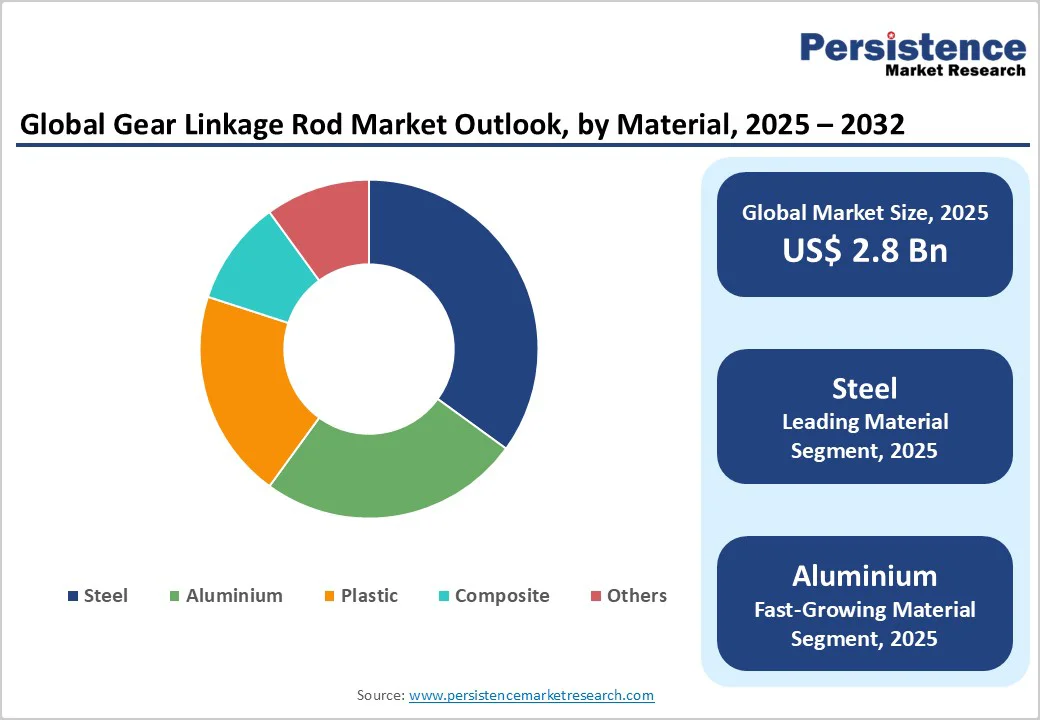
- Dominant Material: Steel, holding 50% market share, due to its strength and cost-effectiveness in gear shift rod applications.
- Leading Application: Automotive, contributing over 60% of market revenue, driven by transmission reliability needs.
- Leading Fitment Type: Standard Fit, accounting for 65% share, due to OEM compatibility.
- Growth Opportunity: Expansion in EVs and automated machinery, leveraging lightweight composites for 15-20% weight reduction.
| Global Market Attribute | Key Insights |
|---|---|
|
Gear Linkage Rod Market Size (2025E) |
US$2.8 Bn |
|
Market Value Forecast (2032F) |
US$4.0 Bn |
|
Projected Growth (CAGR 2025 to 2032) |
5.4% |
|
Historical Market Growth (CAGR 2019 to 2024) |
4.8% |
Market Factors – Growth, Barriers, and Opportunity Analysis
Rising Demand for Lightweight and Durable Gear Linkage Rods
The gear linkage rod market is witnessing significant growth driven by the rising demand for lightweight and durable components across automotive and industrial sectors. Manufacturers are increasingly focusing on the use of advanced materials such as aluminium and composites to enhance performance, reduce overall vehicle weight, and support sustainability goals. The growing shift toward electric and hybrid vehicles has intensified the need for efficient gear linkage systems that ensure smooth and precise gear shifting while improving energy efficiency. Major companies such as Bosch are developing advanced linkage technologies that enhance performance and meet stringent environmental regulations. Additionally, rapid industrial automation and agricultural mechanization are boosting demand for high-strength linkage rods in machinery and equipment. Regions such as Asia Pacific and North America are emerging as key growth hubs, supported by expanding automotive production, technological innovation, and increasing emphasis on efficient mobility solutions.
High Production Costs and Supply Chain Challenges
The industry faces several challenges that hinder its growth despite rising demand from the automotive and industrial sectors. High production costs remain a major restraint, as the manufacturing process requires specialized materials such as high-grade steel and composites, which are often subject to global supply uncertainties. Precision manufacturing techniques such as CNC machining add to operational expenses due to the need for advanced equipment, skilled labor, and stringent quality control. Moreover, compliance with international standards such as ISO and NHTSA regulations extends production timelines, affecting market responsiveness and profitability. For example, larger companies, including ZF Friedrichshafen and Magna International, have the resources to manage these complexities, but smaller manufacturers often struggle to compete, limiting their scalability and market share. The high cost of certification and technological investment also discourages new entrants. In cost-sensitive markets, alternatives such as hydraulic or electronic shift systems are gaining preference due to their lower upfront costs, further challenging the widespread adoption of traditional mechanical gear linkage rods.
Growth in Electric Vehicles and Smart Machinery
The industry presents strong growth opportunities driven by advancements in electric vehicles and smart industrial machinery. The transition toward sustainable and energy-efficient technologies is encouraging manufacturers to adopt innovative production methods such as additive forging, which significantly improves rod durability and overall performance. Companies such as JTEKT Corporation are focusing on developing universal-fit rods that cater to a wide range of vehicle models, making them highly popular in aftermarket applications. Additionally, partnerships promoting sustainable sourcing are helping manufacturers reduce material costs and improve supply stability. The expansion of e-commerce platforms has also made it easier for both OEMs and consumers to access customized linkage solutions, enhancing market reach. Increasing automation across manufacturing industries is boosting the need for reliable and high-strength linkage systems in industrial machinery. Regions such as Asia Pacific and Europe are emerging as key hubs for growth due to strong automotive production, rapid electrification, and ongoing technological innovation, positioning the gear linkage rod market for steady expansion in the coming years.
Category-wise Analysis
Material Insights
Steel dominates the gear linkage rod Market with a 50% share in 2025, due to its superior tensile strength, durability, and cost-effectiveness. It is widely used in both automotive and industrial applications where mechanical stability and load-bearing capacity are critical, ensuring reliable performance and extended component lifespan.
Aluminium is the fastest-growing segment, driven by its lightweight and corrosion-resistant properties that enhance vehicle efficiency. Its increasing use in electric vehicle transmissions supports improved energy performance and reduced overall vehicle weight, making it a preferred choice for manufacturers focusing on sustainability and advanced mobility solutions.
Fitment Type Insights
Standard Fit leads with a 65% share, due to their widespread use in original equipment manufacturing (OEM) applications. Holding the largest share, they are preferred by automotive producers for their precise compatibility, reliability, and ease of integration into vehicle assembly lines, ensuring consistent performance and meeting stringent manufacturing standards across global markets.
Universal Fit is the fastest-growing, driven by their adaptability across various vehicle models and ease of installation. Their versatility makes them highly popular in aftermarket and retrofit applications, allowing consumers and repair shops to replace or upgrade components without model-specific constraints, thereby reducing inventory costs and improving market accessibility.
Rod Length Insights
16"inch rods hold a 45% share, holding a significant share due to their suitability for mid-sized vehicles and industrial machinery. Their length provides optimal leverage and precision in gear shifting, balancing performance and compatibility, which makes them a preferred choice for manufacturers and maintenance applications across automotive and machinery sectors.
24"inch rods are the fastest-growing, fueled by increasing demand in heavy-duty industrial and agricultural equipment. Their extended length offers enhanced leverage and durability, making them ideal for machinery that requires robust performance under high loads, which drives adoption in sectors where reliability and strength are critical for operational efficiency.
Application Insights
Automotive applications dominate with over 60% share, due to the essential role of linkage rods in ensuring reliable gear shifting. Both passenger and commercial vehicles rely on durable, precise rods to maintain transmission performance, smooth driving experience, and long-term vehicle reliability, making this segment the primary driver of market growth.
Industrial machinery is the fastest-growing segment, propelled by increasing automation in manufacturing processes. High-strength and precise linkage rods are essential for reliable operation of automated equipment, enabling efficiency, durability, and consistent performance, which drives adoption in factories and industrial settings seeking advanced mechanical solutions.
Regional Insights
North America Gear Linkage Rod Market Trends
North America holds a 35% market share in 2025, due to robust automotive production and supportive government policies. The United States drives growth through high vehicle manufacturing volumes and incentives promoting electric vehicle adoption under the Inflation Reduction Act. These factors have increased demand for lightweight, durable linkage rods that enhance transmission efficiency and contribute to overall vehicle performance. Advanced manufacturing technologies and material innovations, including aluminium and composite rods, are increasingly implemented to meet both efficiency and sustainability goals in the region. Meanwhile, the United Kingdom represents a smaller but strategically important market within Europe. Growth here is fueled by luxury automotive brands such as Jaguar Land Rover, which prioritize high-performance vehicles that incorporate lightweight linkage rods to optimize shifting precision and reduce overall vehicle weight. Stringent emission and environmental regulations in the U.K. further encourage the adoption of advanced materials and high-quality manufacturing processes. Together, these factors position North America and select European markets as key hubs for gear linkage demand, emphasizing innovation, sustainability, and performance-driven solutions in the automotive sector.
Europe Gear Linkage Rod Market Trends
Europe accounts for 25% of the market, led by Germany and France. Germany’s automotive sector, with companies such as Volkswagen, drives demand for high-precision gear linkage rods, achieving 8% fuel savings via lightweight materials, supported by Euro 7 regulations. Manufacturers are increasingly adopting lightweight materials such as aluminium and composites to reduce vehicle weight, enhance fuel efficiency, and meet strict European emission standards. The growing shift toward electric and hybrid vehicles is further accelerating the use of advanced linkage systems designed for improved energy efficiency and smoother transmission performance. In addition to automotive applications, the European industrial sector is contributing to market growth through increased automation and modernization of machinery, which requires robust and precise linkage components. Aftermarket and retrofit segments are also expanding, driven by consumer preference for performance upgrades and easy-to-install universal-fit rods. Companies are leveraging sustainable sourcing practices and innovative manufacturing technologies, including CNC machining and additive forging, to improve durability, reduce costs, and comply with regulatory standards.
Asia Pacific Gear Linkage Rod Market Trends
Asia Pacific, with a 20% share, is the fastest-growing region, driven by rapid industrialization, increasing vehicle production, and a shift toward electric mobility. Countries such as China and India are at the forefront of this growth, driven by expanding automotive manufacturing, rising consumer demand for passenger and commercial vehicles, and supportive government policies promoting electric vehicles. The increasing adoption of EVs has intensified the need for lightweight, durable linkage rods that enhance transmission efficiency and energy performance, contributing to overall vehicle sustainability. In addition to automotive applications, the region’s robust agricultural sector is driving demand for reliable and high-strength linkage rods in mechanized equipment. Government-led initiatives to modernize agriculture and boost productivity are encouraging the integration of advanced machinery, further supporting the market. Cost-effectiveness is a critical factor in Asia Pacific, prompting manufacturers to adopt locally sourced materials and efficient production techniques to maintain affordability while ensuring quality.
Competitive Landscape
The global gear linkage rod market is highly competitive, featuring a mix of established global leaders and specialized suppliers that drive innovation and strategic growth. Key players include JTEKT Corporation, FAG, Schaeffler, Aisin Seiki, NTN Corporation, Bosch, ZF Friedrichshafen, Magna International, Mahindra & Mahindra, Thyssenkrupp, Trelleborg, Hutchinson, Delphi Technologies, and Timken. These companies leverage advanced manufacturing technologies, extensive R&D capabilities, and global supply chains to maintain their competitive edge. The market is witnessing a shift toward lightweight materials such as aluminium and composites, driven by growing electric vehicle adoption and the demand for improved fuel efficiency.
Manufacturing advancements such as additive forging and CNC machining are enhancing rod durability and performance. North America and Europe hold significant market shares due to mature automotive industries and stringent regulatory standards, while Asia Pacific is the fastest-growing region, fueled by increasing automotive production and EV adoption in countries such as China and India. Companies are focusing on product innovation, strategic partnerships, and expanded manufacturing capabilities to capture market share, positioning the industry for steady growth driven by technological advancement, regulatory pressures, and rising demand for efficient, durable components.
Key Developments
- In 2025, JTEKT Corporation Japan, has introduced the JTEKT Integrated Gear Bearing® (JIGB®), a groundbreaking component that merges gears and bearings into a single unit. Traditionally, these components have been assembled separately due to their distinct functional requirements in automotive and industrial machinery. Leveraging its core competencies in automotive parts, bearings, and machine tools, JTEKT developed JIGB® to address the industry's demand for more compact, efficient, and high-performance solutions
- In 2025, ZF Friedrichshafen AG, a leading global automotive supplier, has announced the expansion of its aluminium rod production capabilities to meet the growing demand for lightweight components in electric vehicles (EVs) and industrial machinery. This strategic move aligns with the company's commitment to advancing sustainable mobility solutions and enhancing manufacturing efficiency.
Companies Covered in Gear Linkage Rod Market
- Bosch
- Continental AG
- ZF Friedrichshafen
- Magna International
- Aisin Seiki
- JTEKT Corporation
- NTN Corporation
- FAG (Schaeffler)
- Others
Frequently Asked Questions
The global gear linkage rod market is projected to reach US$ 2.8 Billion in 2025, driven by demand for durable transmission components in automotive and industrial sectors.
Rising vehicle production, EV adoption, and lightweight material innovations, reducing weight by 15-20%, fuel gear linkage rod market growth across global markets.
The market is expected to grow at a CAGR of 5.4% from 2025 to 2032, supported by automation and regional manufacturing surges in Asia Pacific.
Expansion in EVs and smart machinery offers opportunities for lightweight, durable Gear Linkage Rods, with 20% improved durability via advanced composites.
Key players such as Bosch, ZF Friedrichshafen, and Magna International lead through innovative materials and strategic OEM partnerships in automotive and industrial applications.


