




- Food Ingredients & Additives
- Food Acids Market
Food Acids Market Size, Share, and Growth Forecast, 2026 - 2033
Food Acids Market by Product Type (Citric Acid, Malic Acid, Others), Application (Beverages, Plant-Based Meat & Seafood, Others), Source, and Regional Analysis for 2026 - 2033

Food Acids Market Size and Trends Analysis
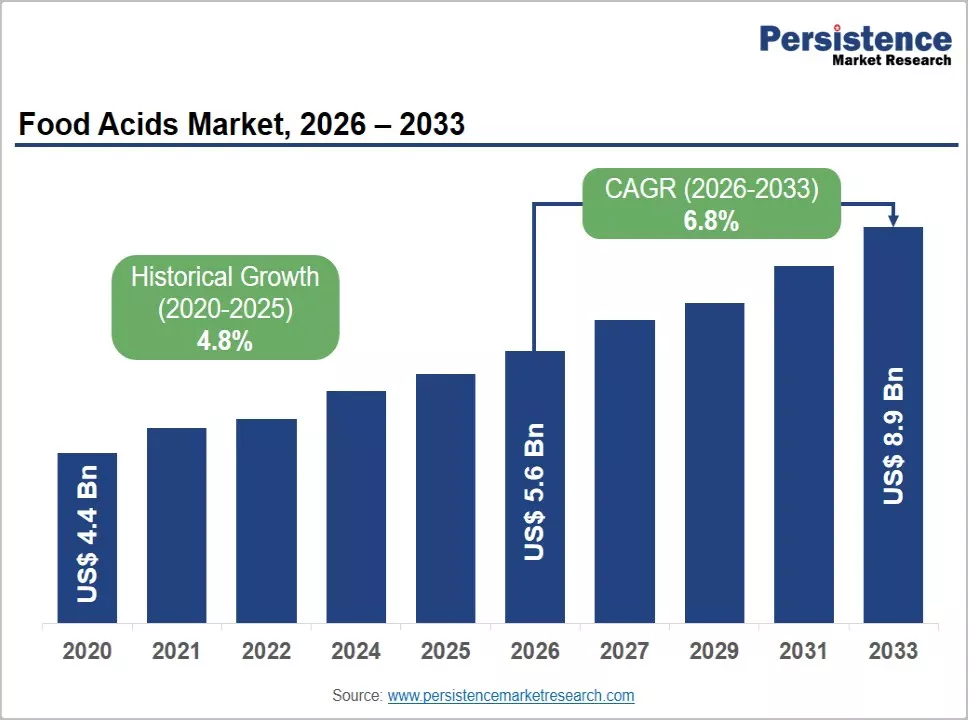
The global food acids market size is likely to be valued at US$5.6 billion in 2026 and is expected to reach US$8.9 billion by 2033, growing at a CAGR of 6.8% during the forecast period from 2026 to 2033, driven by increasing consumption of processed foods, beverages, convenience products, and plant-based formulations requiring acidity regulation, flavor enhancement, pH control, and preservation support.
Urbanization and changing dietary patterns are expanding packaged-food consumption, particularly across emerging economies. At the same time, advances in fermentation technology and growing interest in naturally derived ingredients are reshaping production and sourcing strategies.
Key Industry Highlights:
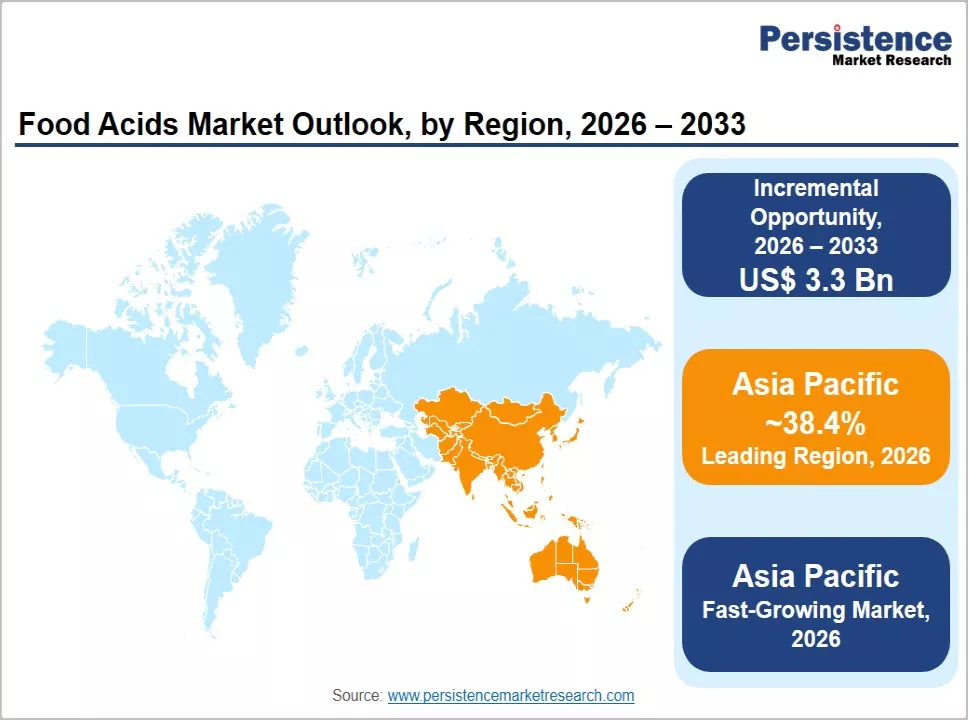
- Leading Region: Asia Pacific is projected to account for 38.4% of the market share in 2026, supported by expanding food processing, packaged-food consumption, fermentation capacity, and strong manufacturing activity in China and India.
- Fastest-growing Region: Asia Pacific, driven by rising demand for beverages, convenience foods, plant-based products, and functional foods across India, China, Southeast Asia, and other emerging markets.
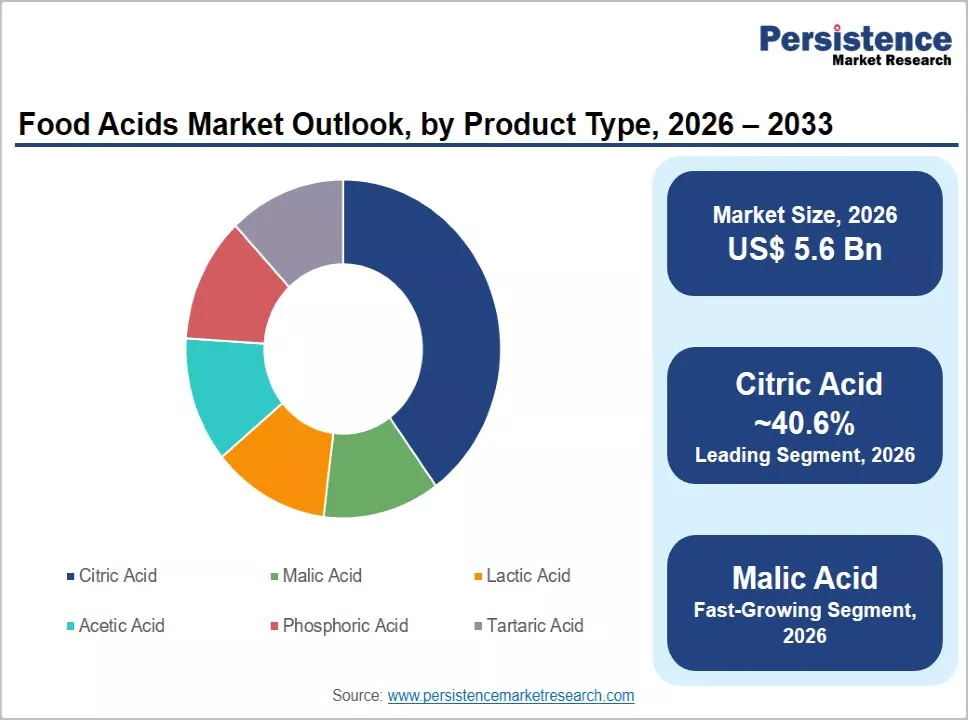
- Dominant Product Type: Citric acid, anticipated to account for 40.6% of the market share, supported by its broad use in beverages, confectionery, sauces, dairy products, processed foods, and functional beverages.
- Leading Application: Beverages, anticipated to account for 34% of the market share, supported by carbonated soft drinks, fruit beverages, sports drinks, energy drinks, functional beverages, flavored water, and ready-to-drink products.
DRO Analysis
Driver - Expansion of Processed Foods, Beverages, and Convenience-Oriented Consumption
The expansion of processed-food and beverage manufacturing is creating a broader demand base for food acids because these ingredients perform multiple technical functions, including acidity regulation, flavor enhancement, pH adjustment, buffering, preservation support, and stabilization. U.S. Department of Agriculture data indicate that food and beverage manufacturing establishments accounted for 16.8% of manufacturing sales and 15.4% of manufacturing employment in 2021. U.S. nonalcoholic beverage exports reached approximately US$2.9 billion in fiscal 2024, increasing 2% from the previous year.
The market impact is particularly significant for citric, malic, phosphoric, lactic, and acetic acids, which serve high-volume applications across beverages, confectionery, dairy, bakery, meat, sauces, dressings, and processed foods. Citric acid provides tartness, regulates pH, enhances flavor, and supports product stability, enabling manufacturers to address multiple formulation requirements with one ingredient. As food companies expand product portfolios and reformulate products for lower sugar, longer shelf life, and improved sensory performance, demand is shifting toward multifunctional acid systems. This supports recurring industrial demand and increases the importance of consistent purity, reliable supply, technical support, and regulatory documentation.
Fermentation Technology Is Strengthening Production Efficiency and Bio-Based Sourcing
Fermentation has become an important industrial production route for food acids such as citric and lactic acid. Commercial citric acid production commonly uses microbial fermentation, while lactic acid production also relies extensively on fermentation processes. Improvements in microbial strains, fermentation conditions, feedstock utilization, purification, and process control are allowing manufacturers to improve yields and consistency while exploring alternative feedstocks.
Technology development is also strengthening the connection between food-acid production and sustainability objectives. Corbion's circular lactic acid technology in Thailand, for example, is designed to reduce resource consumption and environmental impact.
The company has reported that cradle-to-gate greenhouse gas emissions associated with the process are more than 30% lower than conventional lactic acid production in Thailand. The process also recycles processing chemicals and eliminates lime use. Such developments are increasing the strategic value of fermentation platforms because suppliers can compete through production efficiency, carbon performance, feedstock flexibility, and traceability in addition to conventional price and manufacturing scale.
Restraint - Raw-Material, Energy, and Regulatory Volatility Can Constrain Margins
Food-acid manufacturing remains exposed to fluctuations in feedstock, energy, transportation, and processing costs. Corn, glucose, sugar, cassava, and other carbohydrate sources influence the economics of fermentation-based production, while energy costs affect fermentation, concentration, drying, and purification. International freight costs can further influence delivered prices in import-dependent markets. Feedstock diversification toward cassava, sugarcane, and agricultural byproducts can reduce exposure to individual raw materials, but these alternatives also introduce differences in availability, quality, and processing requirements.
Regulatory compliance represents another structural challenge. In Europe, food additives must satisfy safety, technological-need, and authorization requirements before being included on the approved list. In the United States, food ingredients must comply with applicable Food and Drug Administration requirements governing their permitted uses and conditions of use. Differences in labeling, specifications, permitted applications, and maximum-use levels across jurisdictions can increase compliance costs. These requirements create particular pressure for smaller suppliers while favoring companies with established quality-control, traceability, regulatory, and technical-support systems.
Opportunities - Expansion of Food-Processing Infrastructure in Emerging Economies
Emerging economies offer substantial opportunities as food manufacturing becomes more organized and processing capacity expands beyond major metropolitan markets. India's food-processing sector accounted for 12.41% of employment in registered or organized manufacturing in 2022-23, while processed food represented approximately 23.4% of agri-food exports in fiscal 2024. Government-supported manufacturing initiatives are also increasing investment in processing infrastructure.
Beneficiaries under India's Production Linked Incentive Scheme for Food Processing had invested approximately INR 8,910 crore by October 2024, while the food-processing sector attracted approximately US$540.76 million in foreign direct investment during fiscal 2024-25.
For food-acid suppliers, this expansion creates opportunities beyond conventional commodity sales. Local technical laboratories, application-development centers, customized acid blends, smaller packaging formats, and regional distribution networks can improve penetration among small and mid-sized processors. Increasing demand from Tier II and Tier III cities also creates opportunities for suppliers that can provide localized technical assistance and dependable delivery.
Establishing production or blending capabilities closer to customers can reduce logistics costs and improve supply continuity, particularly in markets where imported ingredients remain exposed to currency movements, freight costs, and trade restrictions.
Growth of Plant-Based and Functional Food Formulations
The expansion of plant-based and high-protein foods is creating new formulation requirements for acidulants. Alternative proteins can produce bitterness, mineral interactions, pH instability, and flavor challenges that differ from conventional animal-based formulations. Acid systems can help control pH, balance flavor, manage mineral interactions, and support formulation stability. The formulation opportunity extends beyond meat alternatives into plant-based dairy, protein beverages, functional drinks, and nutritional products.
Malic acid is suited to applications requiring persistent acidity and compatibility with fruit profiles, while lactic acid and citrate systems can support dairy alternatives and protein-based beverages. This is encouraging a shift from single-ingredient procurement toward application-specific acid systems, in which suppliers provide combinations of acids, buffers, stabilizers, and technical formulation services. Suppliers that can address sensory performance while meeting clean-label and sustainability requirements can capture additional value from product-development partnerships.
Category-wise Analysis
Product Type Insights
Citric acid is anticipated to account for 40.6% of the market share in 2026. Its position is supported by broad application coverage, high water solubility, favorable sensory characteristics, and established use across food and beverage formulations.
For example, citric acid is widely used in carbonated soft drinks, fruit beverages, jams, confectionery, processed cheese, sauces, and functional beverages. Citric acid provides tartness, controls acidity, supports flavor balance, assists pH adjustment, and can function as a sequestrant. Its multifunctionality supports demand from manufacturers seeking consistent performance across high-volume product lines. Established production capacity and distribution infrastructure further reinforce its use across global food-processing markets.
Malic acid is anticipated to be the fastest-growing product type during the forecast period, supported by its smooth, persistent sourness and compatibility with fruit flavors. It is increasingly used in fruit-flavored beverages, sour candies, sports drinks, and reduced-sugar formulations, where sustained acidity helps maintain flavor balance. Demand is also supported by the growing use of blended acid systems. Malic acid can be combined with citric or other acids to achieve specific sensory profiles and acidity levels.
Lactic acid remains important in meat, dairy, fermented foods, and beverages, while acetic acid is used in pickles, sauces, dressings, and condiments. Phosphoric acid is widely used in cola beverages, and tartaric acid has specialized applications in bakery, confectionery, and beverages.
Application Insights
Beverages are anticipated to account for 34% of the market share in 2026. Acidulants are widely used in carbonated soft drinks, fruit beverages, sports drinks, energy drinks, functional beverages, ready-to-drink products, and flavored water for acidity adjustment, flavor balancing, buffering, and product stability. Citric acid is particularly suited to fruit-based beverages, while phosphoric acid is commonly used in cola-type drinks and malic acid supports fruit-forward and reduced-sugar formulations. The continued introduction of functional beverages, low-sugar drinks, and new flavor profiles is increasing demand for application-specific acid systems and technical formulation support.
Plant-based meat and seafood are anticipated to be the fastest-growing application segment. These products require careful control of flavor, pH, texture, and mineral interactions, creating additional opportunities for acidulants. For example, acidulants can support flavor modulation and pH control in products formulated with pea, soy, wheat, and blended plant proteins. Dairy and frozen products, bakery and confectionery, meat and poultry, and sauces, dressings, and condiments also generate steady demand, with requirements varying according to acidity, flavor, preservation, and stability needs.
Regional Insights
North America Food Acids Market Trends
North America is a mature food acids market supported by a large food-processing industry, sophisticated beverage manufacturing, established ingredient distribution, and advanced food-science capabilities. The U.S. is expected to account for the largest share of regional demand, with food and beverage manufacturing establishments representing 16.8% of manufacturing sales and 15.4% of manufacturing employment in 2021.
U.S. Food Acids Market Trends
Beverages remain a major demand center, particularly as manufacturers expand ready-to-drink, functional, sports, energy, and reduced-sugar products. Citric, malic, phosphoric, and lactic acids support acidity adjustment, flavor balance, sweetness perception, and stability. In November 2025, Jungbunzlauer completed its acquisition of an Illinois production facility from IFF, establishing its first U.S. manufacturing site. The investment strengthens domestic ingredient supply and supports shorter supply chains for North American food manufacturers.
Canada Food Acids Market Trends
Canada represents a smaller but established market supported by processed foods, beverages, dairy, bakery, and prepared-food production. Growing interest in plant-based foods and reformulated products is increasing demand for acidulants that provide pH control and flavor consistency. North American suppliers are consequently expanding application support and customized acid systems rather than relying only on commodity volumes.
Europe Food Acids Market Trends
Europe is a mature market characterized by advanced food manufacturing, harmonized food-additive regulation, and growing demand for specialty, clean-label, and reformulated products. EU manufactured food-product production increased approximately 3.8% in 2025 from 2024 and remained 11.2% above 2015 levels. Citric, malic, lactic, acetic, and tartaric acids are widely used across beverages, dairy, bakery, confectionery, sauces, and alternative proteins. In April 2025, Tate & Lyle completed the first phase of an energy-efficiency and decarbonization program at its Lille Skensved facility in Denmark, illustrating how European ingredient producers are incorporating energy efficiency and lower-carbon manufacturing into production strategies.
Germany Food Acids Market Trends
Germany has a large industrial food-processing base and strong ingredient-manufacturing capabilities. Demand is supported by beverages, bakery, dairy, processed foods, and plant-based alternatives. Increasing emphasis on lower-carbon production is also influencing ingredient procurement. Investments in energy-efficient manufacturing and traceable supply chains are encouraging acid producers to improve production efficiency while maintaining consistent food-grade specifications.
U.K. Food Acids Market Trends
The U.K. remains an important market for convenience foods, beverages, and plant-based products. Plant-based product development is creating additional applications for acidulants in dairy alternatives and meat substitutes, where pH, flavor, and formulation stability are important.
Asia Pacific Food Acids Market Trends
Asia Pacific accounted for approximately 38.4% of the market share in 2026 and is also the fastest-growing region. Expanding food processing, urbanization, packaged-food consumption, agricultural feedstock availability, and competitive manufacturing support regional demand. China and India are particularly important, while Japan and Southeast Asia contribute substantial consumption growth.
China Food Acids Market Trends
China is a major production and export hub for food acids. Large fermentation capacity and agricultural feedstock availability support China's competitive position. Producers such as Weifang Ensign Industry contribute to the region's extensive citric acid supply base, while export-oriented production connects Chinese manufacturers with food and beverage processors across Asia and international markets.
India Food Acids Market Trends
India is emerging as a major demand center as food processing and packaged-food manufacturing expand. The food-processing sector generated approximately INR 1.92 lakh crore in GVA in 2022-23, while processed food represented around 23.4% of agri-food exports in fiscal 2024. Companies such as Parry Enterprises India participate in domestic and international citric acid supply, while government-supported food-processing investment is strengthening manufacturing infrastructure. This expansion is increasing requirements for acidulants in beverages, confectionery, sauces, dairy products, and processed foods.
Competitive Landscape
The global food acids market includes large-scale acid producers, integrated food-ingredient manufacturers, specialty chemical companies, fermentation specialists, and global ingredient distributors. Citric acid has a relatively concentrated production structure because of the scale required for efficient fermentation and purification, while malic, tartaric, lactic, and specialty acids have a broader supplier base. Competitive positioning depends on manufacturing scale, production cost, feedstock flexibility, product purity, geographical proximity, technical support, regulatory capabilities, and sustainability performance.
Leading suppliers are emphasizing production efficiency, portfolio expansion, regional manufacturing, application development, regulatory expertise, and sustainability. Companies are increasingly offering customized acid blends, liquid delivery systems, technical formulation support, and long-term supply arrangements. This is shifting competition from basic acid supply toward integrated ingredient partnerships and application-specific solutions.
Key Industry Developments
- In November 2025, Jungbunzlauer completed the acquisition of IFF’s production site in Thomson, Illinois, establishing its first U.S. manufacturing facility.
Companies Covered in Food Acids Market
- Archer Daniels Midland Company (ADM)
- Cargill, Incorporated
- Corbion N.V.
- Jungbunzlauer Suisse AG
- Tate & Lyle PLC
- Bartek Ingredients Inc.
- Weifang Ensign Industry Co., Ltd.
- FBC Industries, Inc.
- Parry Enterprises India Limited
- Galactic S.A.
- Aditya Birla Chemicals
- Henan Jindan Lactic Acid Technology Co., Ltd.
- RZBC Group Co., Ltd.
- COFCO Biochemical (Anhui) Co., Ltd.
- Gadot Biochemical Industries Ltd.
- Musashino Chemical Laboratory, Ltd.
Frequently Asked Questions
The global food acids market is expected to be valued at US$5.6 billion in 2026.
The food acids market is expected to reach US$8.9 billion by 2033.
Key trends include increasing demand for clean-label and bio-fermented acidulants, functional and reduced-sugar beverages, plant-based foods, customized acid systems, and lower-carbon fermentation technologies.
Citric acid is the leading product type, anticipated to account for 40.6% of the market in 2026. Its broad use in beverages, dairy, confectionery, sauces, processed foods, and other applications supports its leading position.
The food acids market is projected to grow at a 6.8% CAGR from 2026 to 2033.
Major companies include Cargill, Incorporated, Archer Daniels Midland Company (ADM), Jungbunzlauer Suisse AG, and Corbion N.V.


