




- Automotive
- Europe Compact Wheel loader Market
Europe Compact Wheel loader Market Size, Share, and Growth Forecast for 2025 – 2032
Europe Compact Wheel loader Market by Powertrain Type (Electric Wheel loader and ICE Wheel loader), Application Type (Construction, Agriculture, Industrial Waste Handling, Landscaping and Scraping, Forestry and Others), and Regional Analysis 2025 - 2032

Europe Compact Wheel loader Market Size and Trends
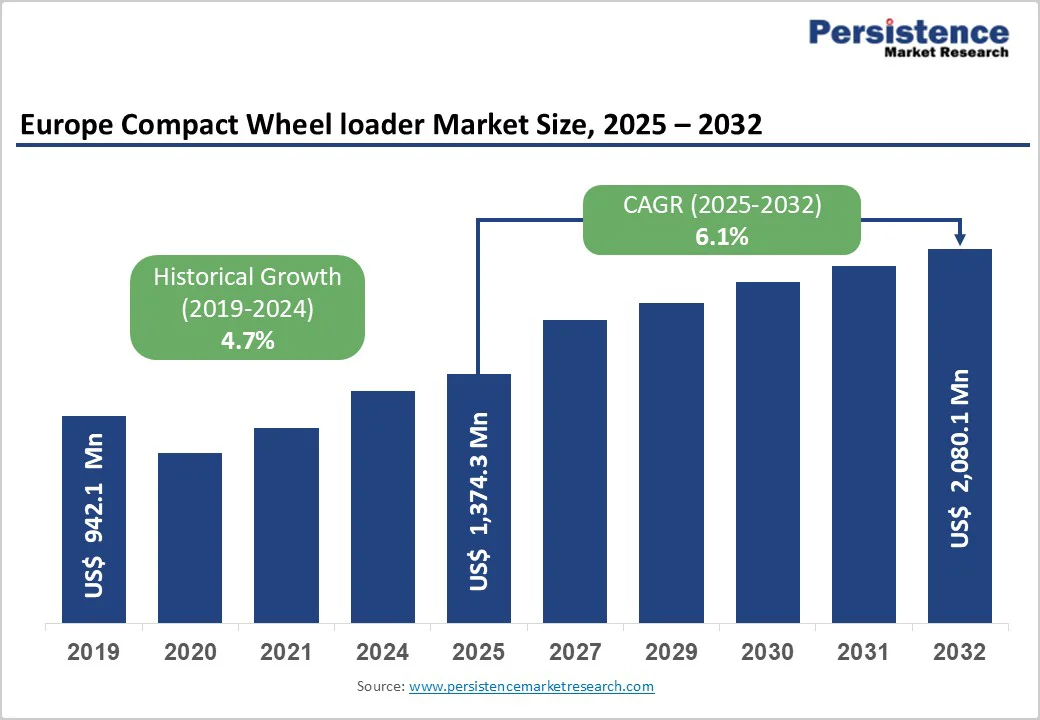
Europe Compact Wheel Loader market size is valued at US$ 1,374.3 million in 2025 and projected to reach US$ 2,080.1 million growing at a CAGR of 6.5% from 2025 to 2032.
The demand for automated and energy-efficient powered advanced wheel loaders is increasing with big infrastructural projects, particularly in developed countries. Germany alone is expecting an investment for the development of construction infrastructure to the tune of USD 147.6 billion by 2030 as stated in the Federal Transport Infrastructure Plan (FTIP) 2030, which in turn increases the demand for construction machinery including wheel loaders.
Key Industry Highlights
- The compact wheel loader favored for their high load capacity, stability, and ability to operate continuously under tough working conditions. Their articulated steering and wide field of vision enhance operator control and safety. Wheel Loaders are indispensable for operations that require efficient, repeated loading and movement of loose or bulk materials.
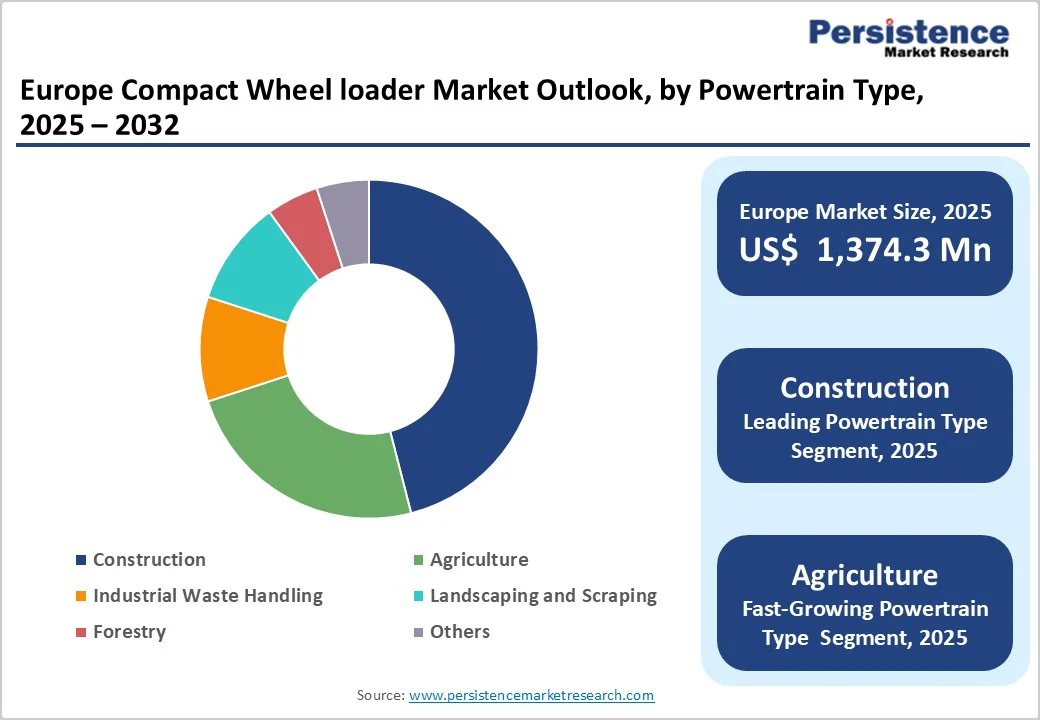
- In 2025, the 60HP to 80HP segment dominated the Compact Wheel loaders market with a 55% share. This segment’s popularity is driven by its optimal balance of power and efficiency, making these loaders highly versatile for a wide range of applications, including construction, landscaping, and agriculture.
- The construction segment is poised for significant growth in the compact wheel loaders market due to increasing urbanization, infrastructure development, and rising construction activities worldwide. These loaders are favored for their compact size, maneuverability, and fuel efficiency, making them ideal for confined construction sites and urban projects.
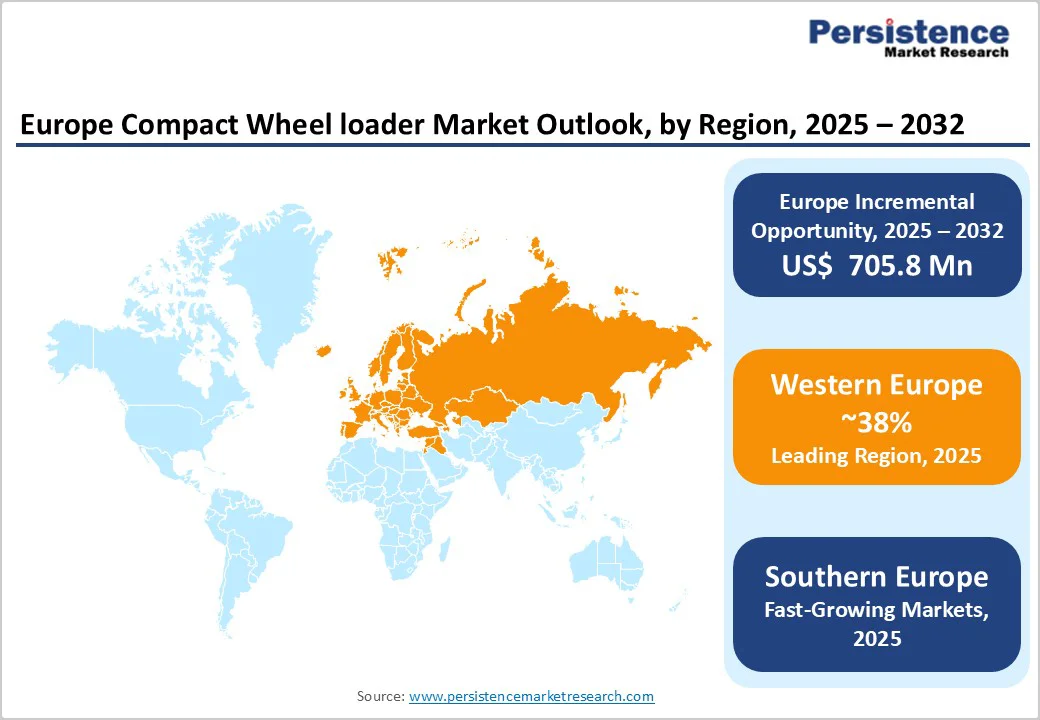
- Western Europe dominated the Europe wheel loader market with over 38% share due to its strong construction, infrastructure, and industrial activity, particularly in Germany. The region benefits from continuous investments in transportation networks, urban redevelopment, and smart city projects, driving steady demand for advanced wheel loaders.
| Key Insights | Details |
|---|---|
| Europe Compact Wheel loader Market Size (2025E) | US$ 1,374.3 Mn |
| Market Value Forecast (2032F) | US$ 2,080.1 Mn |
| Projected Growth (CAGR 2025 to 2032) | 6.1% |
| Historical Market Growth (CAGR 2019 to 2024) | 4.7% |
Market Dynamics
Driver - Focus on the Adoption of Technologically Advanced Products Items
Manufacturers of loaders are adopting new technology to develop new products and compete in the market. Launching new and innovative products in the market has become a key strategy for manufacturers to gain competitive advantage.
- In 2023, Deere & Company introduced significant advancements to its compact wheel loader lineup by transitioning the 244L, 324L, and 344L models to the new P-Tier series. These P-Tier compact wheel loaders retain the industry-exclusive Articulation Plus™ technology, enhancing maneuverability and stability.
- In Jan 2022, Liebherr launched a new compact loader series with the new L 504 compact model. The most important innovations in this series include the redesigned operator's cab, which provides the operator with excellent visibility thanks to its generous use of glass.
Several market players in the construction vehicle industry are coming up with new compact and sustainable designs. Such new innovative and unique machines are boosting the revenue of these companies. Wheel Loaders have seen a significant change in the use of technology in machines over the past few years.
Market Restraining Factor
Competition from Skid Steer and Backhoe Loaders
In Europe, the adoption of compact wheel loaders faces restraint due to the strong presence of skid steer loaders and backhoe loaders, which remain widely preferred by contractors and fleet operators. Skid steer loaders, valued for their exceptional maneuverability and extensive attachment compatibility, continue to dominate small equipment fleets, particularly in dense urban construction zones common across Western and Southern Europe. This reduces the relative appeal of compact wheel loaders for light-duty tasks.
Backhoe loaders also maintain a solid foothold in several European markets, especially in Southern and Eastern Europe, where their dual functionality—excavation and material handling provides greater operational efficiency for infrastructure and municipal projects. Their ability to replace multiple machines on-site makes them an attractive, cost-effective option, limiting demand and investment in compact wheel loaders across the region.
Key Market Opportunity
Urban Infrastructure Growth & Infill Development
The rapid expansion of urban infrastructure and growing emphasis on urban infill development across Europe create a significant opportunity for compact wheel loaders. European cities characterized by dense layouts, narrow streets, and strict zoning constraints require construction equipment that can operate efficiently in confined spaces. As redevelopment projects increase in major metropolitan areas such as Paris, Berlin, Milan, and Amsterdam, demand is rising for maneuverable, low-emission machinery suited for tight urban job sites.
Compact wheel loaders are well aligned with these needs, offering small turning radii, reduced noise levels, and versatile attachment compatibility. They are increasingly preferred for municipal tasks such as road maintenance, utility upgrades, landscaping, and winter snow removal. Moreover, Europe’s strong push toward low-carbon construction enhances adoption, as compact loaders deliver high productivity while complying with stringent urban emission and noise regulations.
- Volvo CE, Caterpillar, and Bobcat are expanding their compact ranges for urban suitability. Volvo L20 Electric and L25 Electric are targeted at emission-sensitive zones, offering zero-emission operation with full performance capabilities.
Category wise Analysis
Powertrain Type Insights
60HP to 80 HP is expected to Drive High Demand for Compact Wheel loaders
The 60HP to 80HP segment is expected to drive high demand for compact wheel loaders due to its ideal balance of power, productivity, and efficiency for diverse applications such as construction, landscaping, and agriculture. Leading manufacturers are focusing on this segment with innovative models to meet growing market needs.
- Bobcat’s L95, launched in 2023, features a 74HP engine, a spacious cab, self-leveling bucket, and quick-attach system, enhancing operator comfort and versatility.
This power range offers sufficient Powertrain Type for demanding tasks while maintaining fuel efficiency and maneuverability, making it popular among small and medium enterprises. Additionally, the integration of telematics, smart hydraulics, and electric powertrains is boosting adoption by reducing operational costs and emissions.
Market forecasts project steady growth driven by urban infrastructure expansion, precision agriculture, and environmental regulations, positioning the 60HP to 80HP segment as a key growth driver in the compact wheel loader market.
Application Insights
Construction segment to Hold Prominent Market Share
The construction segment holds a prominent share in the global wheel loader market, driven primarily by ongoing infrastructure development and urbanization worldwide. Wheel loaders are indispensable in construction for tasks such as excavation, material handling, site preparation, and loading, making them critical to project efficiency and timelines.
The surge in government and private investments in roads, bridges, commercial buildings, and residential projects fuels demand for these machines. Medium-sized wheel loaders, offering a balance of power and maneuverability, are particularly favored in construction applications.
Several industries including landscaping, forestry, industrial material handling, and mining are contributing to market expansion. For example, in July 2024, the Canadian Ministry of Energy and Natural Resources, together with the Ministry of Energy, Mines and Low Carbon Innovation and the Ministry of Transportation and Infrastructure, announced an investment of approximately USD 195 million to support infrastructure and highway development projects.
Regional Insights
Western Europe dominated the Europe wheel loader market with a major share of over 38% in 2024 and Germany leads the market in Western division
Germany’s rising infrastructure investments continue to drive strong demand for construction equipment, particularly wheel loaders. In March 2025, the Bundestag and the upper parliamentary house approved a special infrastructure fund worth USD 540 billion, enabled through constitutional amendments. This fund will support large-scale infrastructure, climate action, and defense projects over the next 12 years, boosting construction activity nationwide.
In line with EU Stage V emission norms, manufacturers are increasingly introducing advanced electric and hybrid zoom boom cranes equipped with high-performance hydraulic pumps and energy-efficient drive motors to meet strict environmental requirements.
Additionally, the government’s USD 90 billion railway modernization program for 2020 - 2030, along with major urban redevelopment initiatives, is expected to further elevate the need for modern wheel loaders across Germany.
The UK wheel loader market in Northern Europe is expected to experience significant and promising growth
The UK construction sector is expanding due to major road development programs and smart city initiatives, resulting in rising demand for wheel loaders across public and private municipal projects. According to the 2023 National Infrastructure and Construction Pipeline, the UK is projected to invest over USD 700 billion in infrastructure through 2035, supporting sustained equipment needs.
The country’s shift toward low-carbon construction is also accelerating the adoption of eco-friendly machinery, with electric and hybrid wheel loaders expected to account for 35% of total sales by 2027 as urban regions enforce carbon-neutral policies.
Growth in the equipment leasing and rental market is further enabling SMEs to use high-capacity loaders without high upfront costs. Additionally, AI- and GPS-enabled wheel loaders introduced by major OEMs like JCB and Caterpillar are transforming productivity and automation on UK job sites.
Italy wheel loader market in Southern Europe is anticipated to witness lucrative growth
Construction activity in Italy’s metropolitan areas is increasing demand for compact and mid-sized wheel loaders, which are essential for navigating tight urban job sites and supporting vertical metro construction.
To promote low-carbon operations, Italy launched a 2023 incentive program offering tax reimbursements of up to 40% for hybrid and electric equipment, accelerating the shift toward sustainable wheel loaders. The aftermarket sector is also expanding, driven by rising demand for customized attachments tailored to urban and industrial applications.
Additionally, Italy’s USD 40 billion investment in transportation and metro projects through 2030 is creating consistent requirements for high-performance loaders for excavation and bulk material handling. In response to the broader USD 80 billion EU-funded infrastructure pipeline, local manufacturers are scaling production of advanced wheel loaders, further boosting equipment procurement across the country.
Competitive Landscape
The compact Wheel Loader (<100Hp) Market is highly consolidated, with organized players holding maximum market share, while regional and unorganized manufacturers hold the remaining. Leading OEMs dominate through technology, service, and global presence.
Smaller players compete on price and local manufacturing. As demand grows, market expansion is expected through partnerships, new entrants, and increased production capacity, especially in emerging markets. Innovation and electrification remain key growth drivers.
Presence of Established OEMs like Wacker Neuson, Hitachi, Caterpillar, Volvo, maintain solid market positions. Their continued emphasis on technology innovation, durability, and global support networks ensures steady demand across developed regions.
Key Industry Developments
- In January 2025, Next Generation Cat Telehandlers (TH0642, TH0842, TH1055, TH1255), launched to replace previous models, featuring customer-inspired designs, extended service intervals, and enhanced safety features like standard rear-view
- In October 2024, Komatsu presented the WA475-11 and WA485-11 models, equipped with state-of-the-art technology to deliver superior performance, fuel efficiency, and operator comfort. These loaders feature newly developed high-torque engines combined with hydro-mechanical transmissions, resulting in significant improvements in fuel efficiency compared to their predecessors.
- In March 2024, Kramer launched the premium 8-series wheel loaders and telescopic wheel loaders, including models such as KL36.8, KL38.8, KL41.8, KL43.8, KL33.8T, and KL37.8T. These machines are characterized by enhanced efficiency, fuel savings, and modern features, with tipping loads ranging from 3,650 to 4,250 kilograms.
Companies Covered in Europe Compact Wheel loader Market
- Caterpillar
- CNH Industrial (CASE Construction Equipment)
- Doosan Infracore (Develon)
- Hitachi Construction Machinery
- Hyundai Construction Equipment
- JCB
- Komatsu
- Kubota Corporation
- Liebherr
- Volvo Construction Equipment
- Other Key Players
Frequently Asked Questions
Europe compact wheel loader market is set to reach US$ 1,374.3 Mn in 2025.
Growing demand for compact and agile loaders in Urban Infrastructure and Municipal Projects are the major growth drivers.
Europe compact wheel loader industry is estimated to rise at a CAGR of 6.5% through 2032.
Development of Emission-Free Compact Machinery, and Urban Infrastructure Growth & Infill Development are the key market opportunities.
Caterpillar, CNH Industrial (CASE Construction Equipment), Doosan Infracore (Develon), Hitachi Construction Machinery and Hyundai Construction Equipment are a few leading players.


