




- Technology
- Digital Holography Market
Digital Holography Market Size, Share, and Growth Forecast, 2025 - 2032
Digital Holography Market By Offering Type (Hardware, Software), Dimensions (Two Dimensional (2D), Three Dimensional (3D)), Application (Holographic Microscopy, Others), End-user (Healthcare, Automotive, Others), and Regional Analysis for 2025 - 2032

Digital Holography Market Size and Trends Analysis
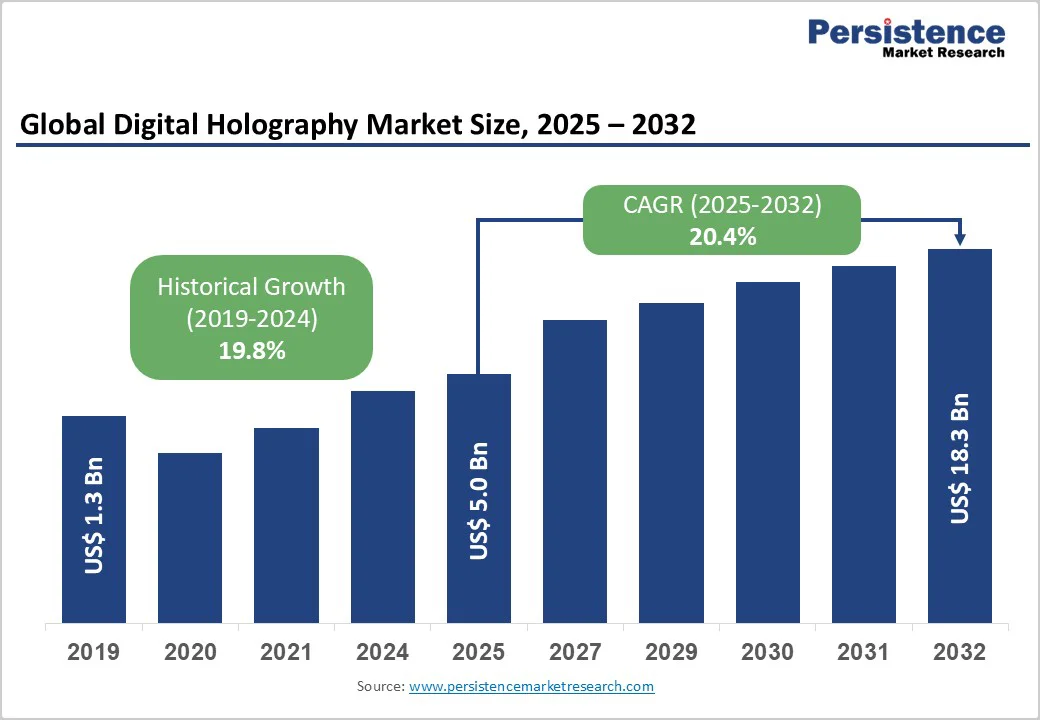
The global digital holography market is expected to reach US$5.0 billion in 2025. It is expected to reach US$18.3 billion by 2032, growing at a CAGR of 20.4% during the forecast period from 2025 to 2032, driven by the increasing prevalence of 3D imaging technologies, rising demand for non-invasive diagnostics, and advancements in holographic displays.
The need for high-resolution visualization, especially in healthcare, is accelerating the adoption of digital holography. Innovations in hardware and 3D imaging, along with rising demand for immersive AR/VR experiences in entertainment, are driving strong market growth across sectors.
Key Industry Highlights:
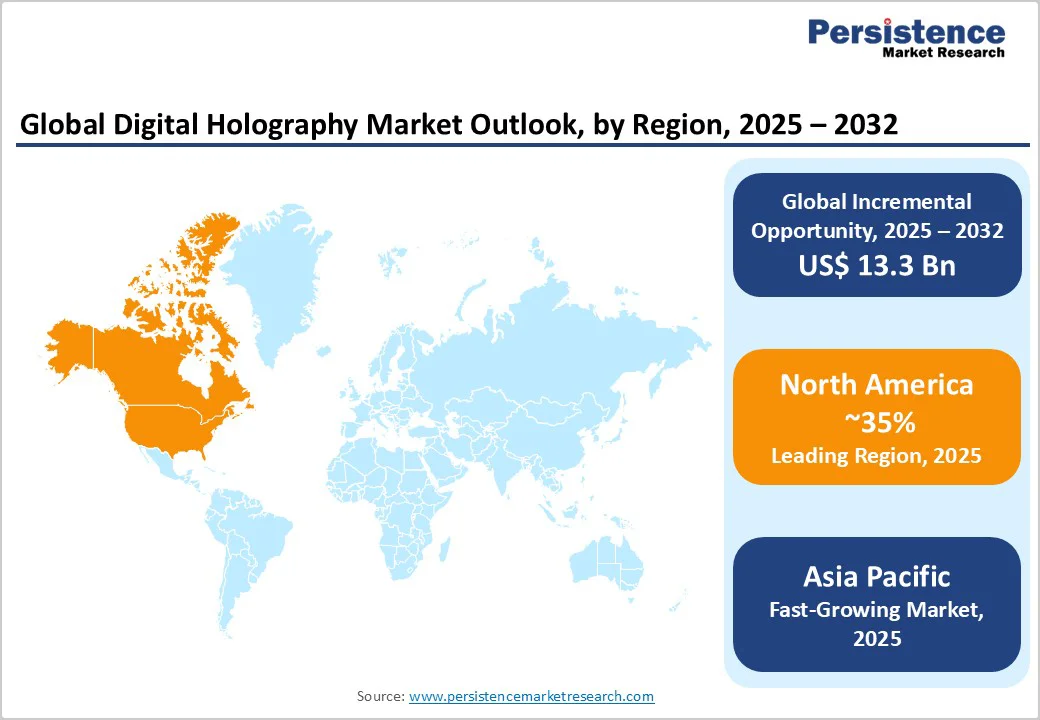
- Leading Region: North America, commanding a 35% market share in 2025, driven by advanced R&D infrastructure, high prevalence of holographic startups, and strong investments in AR/VR in the U.S.
- Fastest-growing Region: Asia Pacific, fueled by rapid adoption of consumer holography, rising awareness of medical imaging, and growing investments in automotive HUDs in countries, including China and India.
- Dominant Offering Type: Hardware, holding approximately 60% of the market share, due to core components such as SLMs.
- Leading Dimensions: Three Dimensional (3D), accounting for over 70% of market revenue, driven by immersive applications.
- Leading Application: Holographic Microscopy, contributing nearly 40% of market revenue, due to biomedical needs.
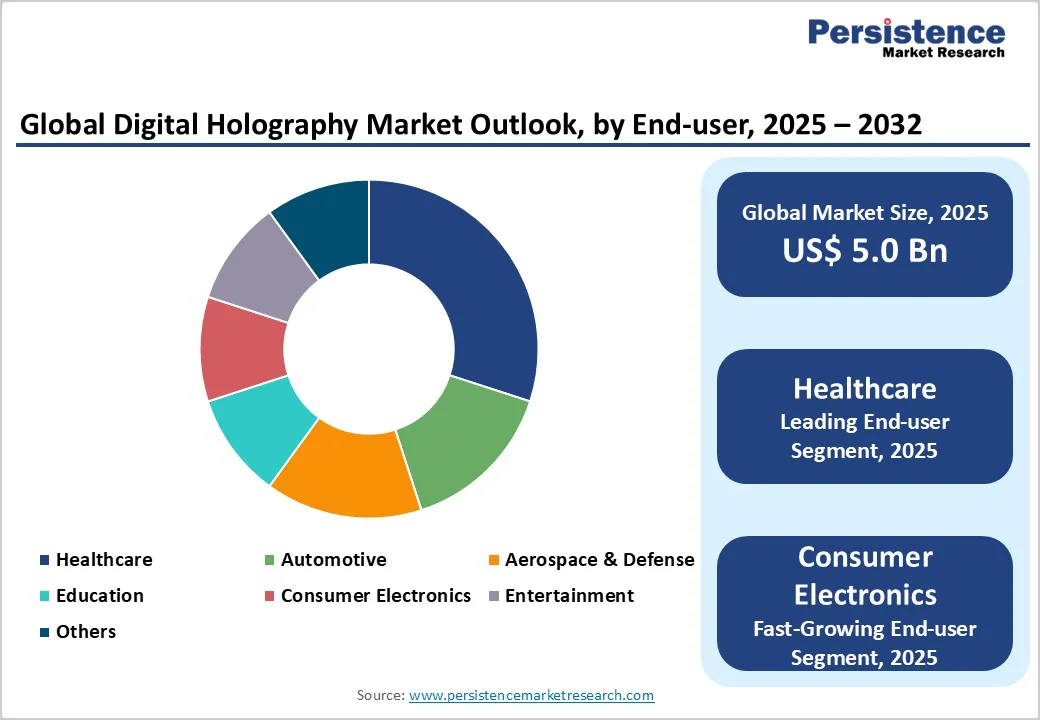
- Leading End-user: Healthcare, with approximately 30% share, driven by diagnostic precision.
- Key Market Driver: Growing adoption in metrology, surface inspection, and quality control under Industry 4.0 initiatives drives market growth.
- Market Opportunity: Rising demand for non-invasive, label-free imaging in diagnostics, pathology, and life sciences boosts opportunities in holographic microscopy and quantitative phase imaging.
| Key Insights | Details |
|---|---|
|
Digital Holography Market Size (2025E) |
US$5.0 Bn |
|
Market Value Forecast (2032F) |
US$18.3 Bn |
|
Projected Growth (CAGR 2025 to 2032) |
20.4% |
|
Historical Market Growth (CAGR 2019 to 2024) |
19.8% |
Market Factors - Growth, Barriers, and Opportunity Analysis
Rising Prevalence of 3D Imaging and Demand for Non-Invasive Diagnostics
The increasing prevalence of 3D imaging technologies globally is a primary driver of the Digital Holography Market. As healthcare and life sciences increasingly prioritize accuracy, safety, and efficiency, digital holography’s ability to capture three-dimensional, high-resolution images without physical contact has become invaluable. Unlike conventional microscopy or imaging techniques, it allows real-time, quantitative phase imaging of cells, tissues, and biological processes without staining or damaging samples, making it ideal for biomedical diagnostics, pathology, and live-cell monitoring.
The surge in 3D imaging adoption across medical, industrial, and research fields is transforming how data is visualized and analyzed. The technology offers depth perception and volumetric measurement, improving precision in surgery planning, material inspection, and product design. With increasing cases of chronic and infectious diseases, the healthcare sector is shifting toward non-invasive diagnostic tools that provide faster, safer, and more detailed results.
High Development and Computational Costs
The high costs associated with development and computational requirements of digital holography pose a significant restraint on market growth. The process of generating, recording, and reconstructing holographic images requires sophisticated optical components, such as high-resolution sensors, lasers, and precision lenses, all of which contribute to high equipment costs. Digital holography involves complex algorithms and intensive computational processing to reconstruct three-dimensional images from interference patterns accurately. This demands powerful graphics processing units (GPUs) and advanced computing infrastructure, increasing both capital and operational expenditures.
Developing AI-enhanced and real-time holographic systems further escalates costs due to the need for machine learning integration, large data handling, and high-speed rendering capabilities. Smaller companies and research institutions often face budget constraints, limiting large-scale adoption and commercialization. Maintenance and calibration of holographic setups also add to overall expenses, especially in precision-driven applications such as medical imaging and metrology.
Advancements in AI-Enhanced Holography and Metaverse Integrations
Advancements in AI-enhanced holography and metaverse integrations present significant growth opportunities for the digital holography market. Artificial intelligence (AI) is increasingly being applied to holographic systems to improve image reconstruction, noise reduction, and real-time rendering, enabling more precise and efficient 3D imaging. AI algorithms analyze large volumes of holographic data to generate sharper, high-resolution visualizations, enhancing performance in fields such as biomedical imaging, industrial inspection, and AR/VR applications. These innovations allow holographic systems to operate faster and adaptively, reducing computational load while improving image accuracy.
The integration of holography with the metaverse is transforming digital communication and immersive experiences. Holographic avatars and 3D environments powered by AI bring lifelike interactions to virtual meetings, gaming, retail, and education, bridging the gap between physical and digital worlds. Companies are investing heavily in developing AI-driven holographic telepresence and display technologies that support interactive, real-time collaboration in virtual spaces.
Category-wise Analysis
Offering Type Insights
By offering, hardware leads, accounting for approximately 60% share in 2025. Its dominance comes from essential components, cameras, lasers, sensors, SLMs, and holographic displays, which enable accurate image capture and reconstruction, making it critical for high-precision industrial, medical, and research applications.
Software is the fastest-growing segment, driven by advances in computational imaging, AI-based reconstruction, and real-time processing. It enhances noise reduction, 2D/3D image reconstruction, and automation, becoming increasingly vital as holography shifts toward AI-enhanced and data-intensive imaging workflows.
Dimensions Insights
Three-dimensional (3D) leads the market in 2025 with a 70% share due to its superior depth perception, enhanced realism, and broad applicability across industries. Its dominance is reinforced by growing demand for immersive, high-accuracy visualization. Examples include 3D holographic microscopy in biomedical imaging for detailed cell and tissue analysis, industrial inspection for non-destructive testing of microelectronics, defense applications involving real-time situational imaging, AR/VR systems used in training and simulation, and emerging consumer electronics such as smartphones and smart glasses integrating 3D holographic interfaces.
Two-dimensional (2D) is the fastest-growing segment, propelled by cost-effective display technologies and increasing adoption in education and training. Its simplicity, portability, and ease of use make it ideal for interactive learning and visual demonstrations. Growing demand for affordable holographic visualization tools continues to accelerate their widespread implementation across institutions.
Application Insights
Holographic microscopy dominates the market, accounting for 40% of the market share in 2025, driven by its extensive use in biotechnology, life sciences, and medical research. Its non-invasive, label-free imaging and quantitative phase measurement capabilities make it ideal for cellular analysis and live imaging. These advantages solidify its dominance in research and diagnostic applications worldwide.
Holographic telepresence is the fastest-growing segment, driven by rising demand for remote collaboration, immersive communication, and metaverse integration. Its interactive and realistic 3D visualization capabilities enable lifelike virtual meetings and training experiences. Advancements in real-time projection and AI-based imaging are further accelerating adoption across enterprise and entertainment sectors.
End-user Insights
Healthcare dominates the market, with a 30% share in 2025, driven by its extensive use in diagnostics, microscopy, and biomedical imaging. The technology enables high-precision, label-free visualization of cells and tissues, enhancing diagnostic accuracy and research efficiency. Growing demand for advanced imaging solutions continues to strengthen healthcare’s leading position.
Consumer electronics represent the fastest-growing segment, fueled by rising demand for AR glasses, holographic displays, and immersive entertainment experiences. Advancements in high-resolution visualization and compact optical components are enabling realistic 3D projections in smartphones, wearables, and smart displays, driving adoption across gaming, media, and next-generation visual communication applications.
Regional Insights
North America Digital Holography Market Trends
North America commands a 35% share in 2025, driven by advancements in imaging technologies, strong R&D investments, and rapid adoption across industrial, medical, and defense sectors. The U.S. dominates the regional market, supported by a robust ecosystem of optics companies, research institutions, and tech innovators. Key applications include biomedical imaging, security, 3D display systems, and industrial metrology, where digital holography enhances precision and visualization.
Major players in the region are leveraging AI, AR/VR, and deep learning algorithms to improve holographic image processing and real-time data analysis. The growing influence of metaverse technologies and remote visualization tools is further expanding use cases in entertainment and telepresence. Strong government support for defense and healthcare innovation encourages the integration of holographic systems in advanced imaging and simulation programs. Companies are focusing on strategic partnerships, acquisitions, and product innovation to gain a competitive edge.
Europe Digital Holography Market Trends
Europe is driven by advancements in optics, microscopy, and 3D imaging technologies across industrial and healthcare sectors. The region benefits from strong research foundations, well-established photonics industries, and government support for digital transformation and smart manufacturing. Countries such as Germany, France, the U.K., and Switzerland are leading innovation, with key players such as Lyncée Tec SA and Ovizio Imaging Systems contributing to breakthroughs in holographic microscopy and quantitative imaging. European firms are leveraging digital holography for biomedical diagnostics, quality control, automotive design, and defense imaging, enhancing real-time visualization and measurement accuracy.
The market is also gaining momentum from AI integration, AR/VR applications, and metaverse-based holographic displays, which are expanding commercial use cases beyond traditional scientific applications. Collaborative projects between universities, research institutes, and private companies are accelerating the development of advanced holographic sensors and data visualization tools.
Asia Pacific Digital Holography Market Trends
Asia Pacific is the fastest-growing market for digital holography, driven by technological advancements, expanding electronics manufacturing, and increasing adoption of holographic imaging across industries. Countries such as China, Japan, South Korea, and Taiwan are at the forefront due to their strong semiconductor and display technology ecosystems. The region’s demand is fueled by applications in medical imaging, industrial metrology, security, and consumer electronics, where digital holography enhances 3D visualization, inspection, and precision measurement.
Rising investments in augmented and virtual reality (AR/VR) technologies and the metaverse are accelerating innovation in holographic displays and imaging sensors. Local players such as Himax Technologies, Inc. and EON Reality are focusing on affordable and scalable solutions tailored for regional needs. Government initiatives promoting digitalization and advanced manufacturing further support market expansion. Increasing research collaborations between universities and tech companies are fostering breakthroughs in AI-integrated holographic systems.
Competitive Landscape
The global digital holography market is highly competitive, with North America and Europe led by Lyncée Tec SA and Ovizio Imaging Systems, supported by strong R&D, advanced microscopy platforms, and broad industrial and biomedical distribution. In Asia Pacific, rapid tech adoption and manufacturing scale position Himax Technologies, Inc. as a major contributor.
Across regions, companies increasingly integrate AI, AR, and metaverse-focused holographic systems to enhance automation and user interaction. Competition intensifies through partnerships, acquisitions, and product diversification, as firms aim to improve display performance, lower computational costs, and expand real-time 3D visualization for diverse applications.
Key Industry Developments
- In January 2025, Park Systems Corp. announced the acquisition of Lyncée Tec SA, a Swiss pioneer in Digital Holographic Microscope (DHM®) technology. This acquisition by Park Systems strengthened its optical metrology business, following its 2022 acquisition of Accurion GmbH, the world's leading manufacturer of Imaging Spectroscopic Ellipsometers (ISE).
Companies Covered in Digital Holography Market
- Lyncée Tec SA
- RealView Imaging Ltd.
- EON Reality
- Phase Holographic Imaging PHI AB
- Holotech
- Holmarc Opto-Mechatronics Ltd.
- Geola
- Leia Inc.
- Ovizio
- REALFICTION
- Himax Technologies, Inc.
- MetroLaser
- HYPERVSN
- SAMSUNG
- Meta
Frequently Asked Questions
The global digital holography market is projected to reach US$5.0 Billion in 2025.
The rising prevalence of 3D imaging and demand for non-invasive diagnostics are key drivers.
The digital holography market is poised to witness a CAGR of 20.4% from 2025 to 2032.
Advancements in AI-enhanced holography and metaverse integrations are the key opportunities.
Lyncée Tec SA, RealView Imaging Ltd., EON Reality, Phase Holographic Imaging PHI AB, and Leia Inc. are the key players.


