




- Specialty & Fine Chemicals
- Ceramic Binders Market
Ceramic Binders Market Size, Share, and Growth Forecast 2026 - 2033
Ceramic Binders Market Product Type (Cement, Alumina, Phosphate, Silica, Other), Chemistry (Organic, Inorganic, Hybrid), Application (Ceramics, Abrasives, Refractories, Protective Coating, Other), and Regional Analysis for 2026 - 2033

Ceramic Binders Market Size and Trend Analysis
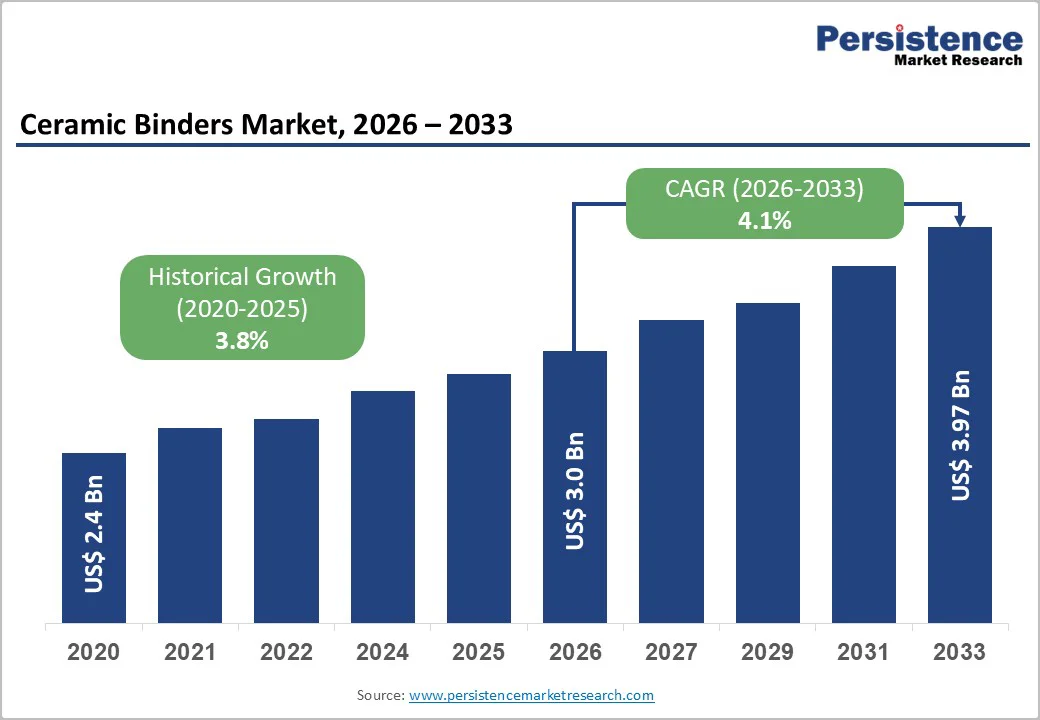
The global ceramic binders market size is supposed to be valued at US$ 3.0 Bn in 2026 and is projected to reach US$ 4.0 Bn by 2033, growing at a CAGR of 4.1% between 2026 and 2033.
The market growth is driven by escalating demand for high performance ceramics across multiple industries, with nearly 50% of applications relying on specialized binders to deliver improved mechanical strength and thermal resistance. Simultaneously, over 35% of manufacturers are shifting toward ecofriendly binder formulations, reflecting a comprehensive movement toward sustainable manufacturing practices and alignment with increasingly stringent environmental regulations worldwide. This dual momentum of performance enhancement and environmental responsibility is creating unprecedented opportunities for ceramic binder manufacturers to innovate and expand their market presence.
Key Market Highlights
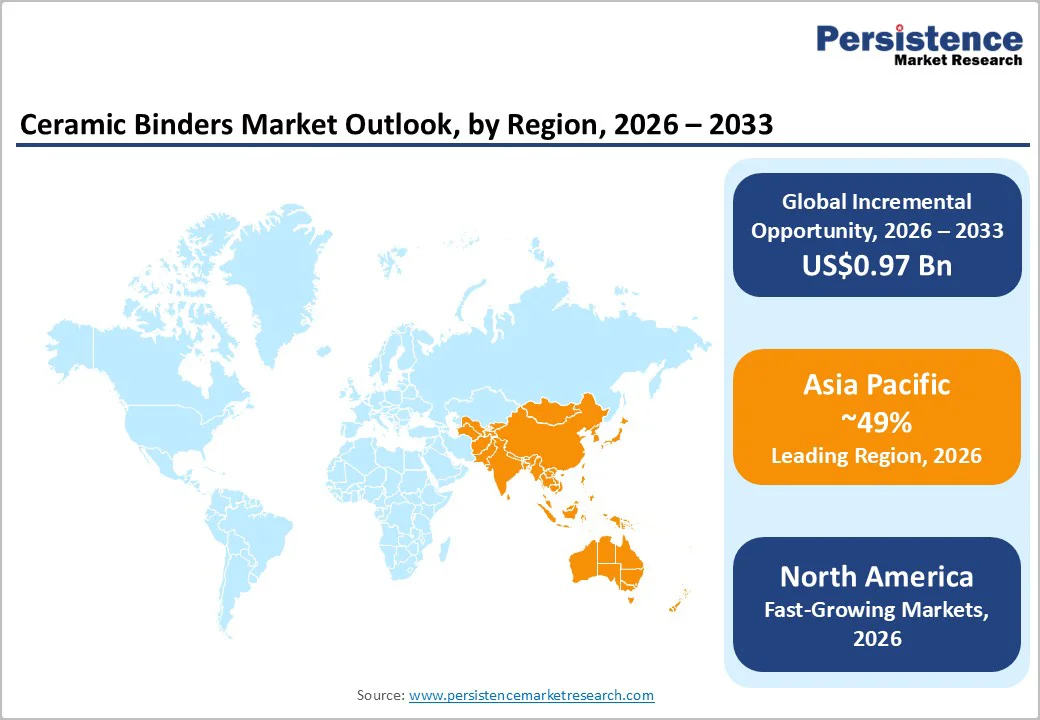
- Leading Region: AsiaPacific dominates the global ceramic binders market with approximately 49% regional demand share, driven by China's massive industrial base, India's rapid industrialization, and Japan's technological advancement, positioning the region as the critical growth nucleus through 2033.
- Fastest Growing Region: North America emerges as the fastest growing region, driven by advanced aerospace, automotive, and defense sectors requiring specialized solutions for critical applications
- Dominant Segment: Cement binders command the largest market share at approximately 38% of the ceramic binders market, driven by widespread adoption in refractories, construction materials, and established manufacturing processes supporting multiple industrial applications.
- Fastest Growing Segment: Organic binders represent the fastestgrowing chemistry category, driven by sustainability mandates, environmental regulations, and increasing adoption of ecofriendly, watersoluble formulations across decorative ceramics and technical applications.
- Key Market Opportunity: Additive manufacturing and 3D ceramic printing represent a transformative opportunity, projected to unlock hundreds of millions in market value by 2033, enabled by advanced binder jetting technologies from Desktop Metal and Lithoz, particularly for aerospace, medical device, and electronics applications.
| Key Insights | Details |
|---|---|
| Ceramic Binders Market Size (2026E) | US$ 3.0 Bn |
| Market Value Forecast (2033F) | US$ 4.0 Bn |
| Projected Growth (CAGR 2026 to 2033) | 4.1% |
| Historical Market Growth (CAGR 2020 to 2025) | 3.8% |
Market Dynamics
Market Growth Drivers
Rising Demand for Advanced Ceramics in Aerospace and Automotive Sectors
The aerospace and automotive industries are major growth catalysts for the ceramic binders market, driven by the increasing need for lightweight, high temperatu reresistant materials that improve fuel efficiency and performance. Advanced ceramics are now integral to manufacturing turbine blades, engine components, brake systems, and electronic housings in these sectors. According to recent industry data, more than 50% of industry stakeholders anticipate broader integration of advanced binders in nextgeneration ceramic applications by 2030.
The global automotive sector's shift toward electric vehicles has further accelerated demand, as EV batteries require thermally stable ceramic components and specialized binder systems. Polysilazane binders, for instance, are gaining traction for high-temperature protective coatings in aerospace applications, demonstrating excellent thermal stability up to 1000°C. This expansion is particularly pronounced in North America and Europe, where leading aerospace companies continue investing heavily in ceramic technologies.
Infrastructure Development and Industrial Expansion in AsiaPacific
AsiaPacific represents the fastest growing regional market for ceramic binders, with China and India driving unprecedented demand through massive infrastructure projects and industrial capacity additions. China commands approximately 59% of the global refractories market, supporting the region's dominance in ceramic binder consumption. India's rapid industrialization, supported by government initiatives like the "Urban Infrastructure Development Plan" with over US$ 11 billion in investment, is creating substantial demand for refractories and advanced ceramic materials.
The steel industry across AsiaPacific is experiencing significant expansion, with China commissioning 12 new blast furnaces totaling 18.97 million tons in the first half of 2024, necessitating replacement and upgrades to refractory systems and ceramic binders. Japan's investments in EAF (Electric Arc Furnace) technology, supported by JFE Holdings' capital commitments, are redirecting specifications toward premium binder formulations. This regional momentum is expected to continue through 2033, positioning AsiaPacific as the dominant market force.
Market Restraints
High Raw Material Costs and Supply Chain Vulnerabilities
Ceramic binders are dependent on critical raw materials including alumina, silica, phosphoric acid, and specialty chemicals, many of which face supply chain disruptions and volatile pricing. China's dominant position in supplying key minerals, oxides, and metals essential for binder manufacturing creates significant market vulnerabilities. Geopolitical tensions, trade disputes, and uneven resource distribution are driving up procurement costs for manufacturers outside Asia.
Companies struggle to secure stable supplies at competitive prices, particularly for specialty binders like phosphate binders and monoaluminum phosphate (MAP). The global supplydemand gap for raw materials continues to widen, forcing manufacturers to optimize supply chains and develop costefficient production processes to maintain profitability. Small and midsized enterprises face particular challenges in managing these cost pressures without alternative sourcing options.
Challenges in Performance Standardization and Regulatory Compliance
The ceramic binders market lacks comprehensive standardization across product categories, making it difficult for manufacturers to establish consistent performance benchmarks and gain customer confidence. Increasingly stringent environmental regulations, particularly EU's REACH framework and ISO 14001compliant environmental management systems, impose compliance burdens on manufacturers.
Requirements to eliminate hydrolyzed ethyl silicate (HES) and transition to watersoluble binder systems demand significant R&D investments and production modifications. These regulatory changes create barriers to entry for smaller players while increasing operational costs for established manufacturers. Meeting demanding specifications for aerospace, automotive, and biomedical applications requires continuous innovation and rigorous quality control, imposing significant financial and operational constraints.
Market Opportunities
Expansion of 3D Printing and Additive Manufacturing Technologies
Additive manufacturing presents exceptional growth opportunities for ceramic binders, as 3D printing technologies enable production of complex, highprecision ceramic components previously impossible through traditional methods. Desktop Metal and Lithoz technologies represent breakthrough developments, with binder jetting capabilities enabling production of silicon carbide optical mirrors for aerospace applications. The integration of advanced ceramic binders into additive manufacturing systems is expected to drive significant demand growth, particularly in aerospace, medical device, and electronics sectors.
Lithoz's partnership with Almatis, involving 99.8% thermally reactive alumina powder for aerospace and healthcare applications, demonstrates commercial viability of this convergence. The Ceramic 3D Factory network is expanding globally, connecting manufacturers and enabling interconnected production chains. This opportunity is projected to unlock new application areas and market segments worth hundreds of millions by 2033.
Surge in Sustainable and BioBased Binder Development
The global sustainability movement is driving explosive growth in ecofriendly ceramic binder development, with companies investing heavily in biobased, watersoluble, and lowVOC formulations. Organic ceramic binders are expected to grow at approximately 6% CAGR over the next five years, significantly outpacing conventional binder growth rates. Recent innovations include advancements in formulations enhancing thermal stability, chemical degradation resistance, and biodegradability, making production processes more efficient.
Government incentives supporting sustainable manufacturing, such as EU carbonneutral manufacturing targets and India's clean technology programs, are accelerating market adoption. Research institutions are collaborating with manufacturers to develop phosphorous slagbased binders and silicaaluminabased cementitious materials (SAC), which utilize industrial byproducts while improving mechanical properties. Companies achieving lowcarbon footprints and developing waterbased binders are gaining competitive advantages and command premium pricing in markets prioritizing sustainability.
Categorywise Insights
Product Type Analysis
Cement binders dominate the ceramic binders market, accounting for approximately 38% of the overall market share, driven by their widespread use in refractory applications and construction materials. Calcium aluminate cements and silica sol binders represent the largest segments within this category, leveraging established manufacturing processes and proven performance characteristics across multiple industries. Their prevalence stems from superior mechanical strength, thermal resistance, and costeffectiveness in traditional ceramic manufacturing.
Alumina binders represent the secondlargest segment, particularly valued for high temperature applications in aerospace, electronics, and industrial furnaces. Phosphate binders, including monoaluminum phosphate (MAP), are gaining traction in specialized applications requiring exceptional chemical inertness and thermal stability up to 1700°C. Growth is expected to accelerate in premium binder segments as industries demand higher performance standards.
Chemistry Analysis
Inorganic binders command the largest market share at approximately 62%, with dominance in industrial and refractory applications where thermal stability and mechanical strength are paramount. Phosphatebased and aluminate chemistries represent the leading segments within inorganic binders, offering superior performance in high temperature environments and corrosionresistant applications. The inorganic segment is supported by extensive research infrastructure and established supply chains across major manufacturing regions.
Organic binders are experiencing the fastest growth trajectory, driven by sustainability mandates and environmental regulations. Products such as Kuraray Poval, polyvinyl alcohol, and watersoluble polymers are gaining market penetration in decorative ceramics, tableware, and technical ceramics. Hybrid binder systems, combining organic and inorganic chemistries, are emerging as a transformative category, offering balanced performance characteristics and environmental advantages. This hybrid segment is expected to witness accelerated adoption through 2033.
Application Analysis
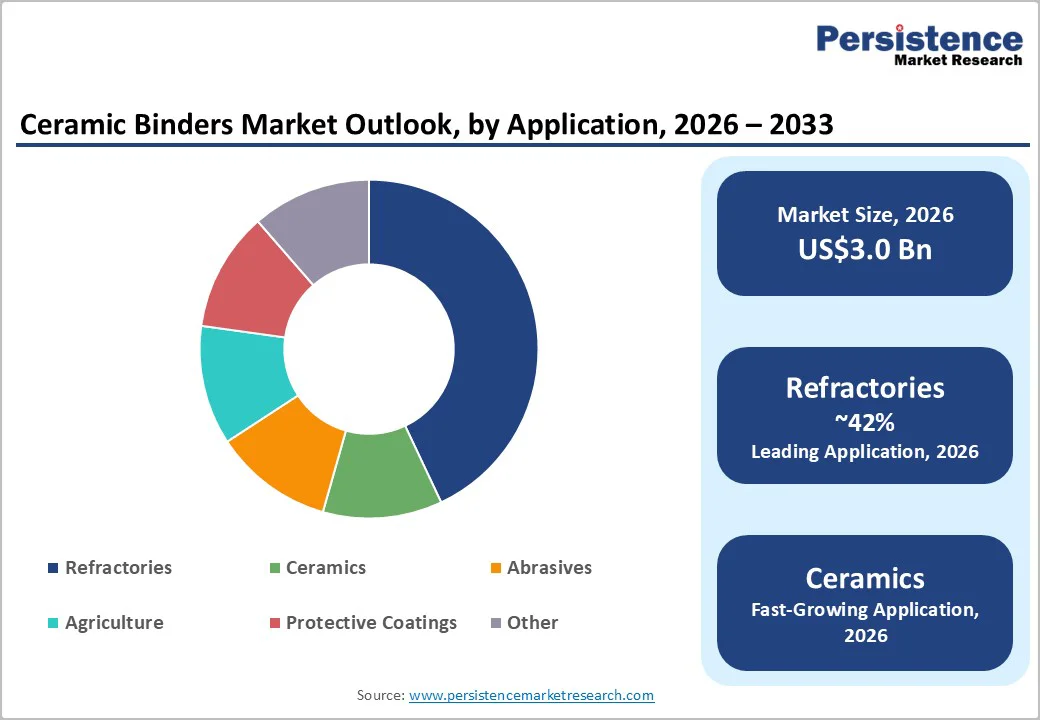
Refractories represent the dominant application segment, commanding approximately 42% of the ceramic binders market, driven by persistent demand from steel, cement, and glass manufacturing industries. Refractory materials utilizing phosphate binders, alumina binders, and silicabased systems are critical for furnace linings, kiln walls, and high temperature containment systems across industrial operations. The steel industry's continuous capacity additions, particularly in AsiaPacific with China leading production, sustain substantial demand for monolithic refractories and castable binders.
Ceramics applications encompass traditional tiles, sanitaryware, and technical ceramics. This segment benefits from urbanization and housing demand, particularly in developing economies where construction activities accelerate. Abrasives applications represent 18% of the market, with ceramic binders serving as binding agents in grinding wheels, polishing tools, and precision instruments.
Regional Insights
North America Ceramic Binders Trends
North America holds a prominent position in the ceramic binders market, driven by advanced aerospace, automotive, and defense sectors requiring specialized solutions for critical applications. The U.S. accounts for nearly 78% of regional demand, supported by major investments from leading companies such as 3M, DuPont de Nemours, and Almatis. A strong innovation ecosystem fosters the development of binders for turbine blades, electronic enclosures, and thermal management systems in electric vehicles.
Compliance with stringent environmental standards and ISO certifications is fueling demand for lowVOC, watersoluble formulations. Recent capacity expansions, including Almatis’ 15% increase in calcined alumina production at Benton, Arkansas, underscore robust growth and supply continuity. Additionally, strategic investments in additive manufacturing by Lithoz and Desktop Metal, along with partnerships for 3Dprinted ceramic components, are accelerating technological advancements across aerospace and medical applications.
Europe Ceramic Binders Trends
Europe stands out in the ceramic binders market through its strong emphasis on sustainability, regulatory compliance, and technological innovation. Germany, the United Kingdom, France, and Spain lead regional advancements in highperformance ceramic binder development. The region’s commitment to carbonneutral manufacturing and adherence to the EU’s REACH framework is driving significant demand for organic, watersoluble, and lowemission formulations. Germany’s robust industrial base, particularly in automotive and equipment manufacturing, underpins this growth, while France and Spain contribute through investments in ceramic additive manufacturing and advanced refractory applications for energy and industrial sectors.
European manufacturers prioritize ecofriendly solutions, investing in biobased binders and recycled material integration. Evonik Industries AG spearheads innovation with silanemodified polymers and sustainable binding systems. Additionally, stringent firesafety and thermal insulation standards foster adoption of ceramic fiber and zirconiabased binders, supported by Lithoz’s Vienna headquarters and its expanding Ceramic 3D Factory network.
Asia Pacific Ceramic Binders Trends
Asia-Pacific remains the dominant region in the global ceramic binders market, accounting for nearly 49% of total demand. This leadership is driven by rapid industrialization, extensive manufacturing bases, and largescale infrastructure development across China, Japan, India, and ASEAN nations. China leads production and consumption, supported by its position as the world’s largest steel and cement producer, with refractories commanding approximately 59% of the market.
Japan continues to advance high performance ceramic technologies for electronics, automotive, and aerospace sectors, while South Korea sustains demand through premium steel production. India is the fastestgrowing market, with robust growth projected at 7% annually, fueled by infrastructure initiatives and EV battery manufacturing. Emerging Southeast Asian economies, including Vietnam, Indonesia, and Malaysia, are gaining traction through supply chain diversification under China+1 strategies, supported by Kuraray’s regional production capabilities.
Competitive Landscape
Market Structure Analysis
The ceramic binders market is moderately consolidated, with global leaders and regional players shaping its competitive structure. Multinational corporations such as 3M, BASF SE, Almatis GmbH, Evonik Industries AG, and DuPont de Nemours collectively hold 45–50% of the global share, leveraging advanced technologies, extensive distribution networks, and significant R&D investments. These companies differentiate through comprehensive portfolios spanning organic, inorganic, and hybrid binder systems. Consolidation trends are reinforced by strategic acquisitions and capacity expansions in high growth regions, particularly AsiaPacific. Midtier firms, including KYOEISHA CHEMICAL, Zircar Ceramics, Kuraray, Ransom & Randolph, Sekisui Specialty Chemicals, and Ferro Corporation, focus on niche markets emphasizing innovation and customization. Emerging business models increasingly feature partnerships with technology providers such as Lithoz and collaborative R&D initiatives addressing sustainability challenges bwhile regional manufacturers gain momentum through cost advantages and strong domestic penetration.
Key Market Developments
- April 2024: Desktop Metal introduced advanced binder jet 3D printing technologies, enabling the production of high performance ceramic components, including silicon carbide optical mirrors for aerospace applications, demonstrating significant scalability and precision manufacturing capabilities in ceramic additive manufacturing.
- January 2024: Almatis launched lowcarbon tabular alumina, representing a 15% reduction in weight while maintaining performance characteristics, directly aligning with company commitments to sustainability and supporting the broader industry shift toward ecofriendly ceramic binder formulations.
- 2025 Strategic Expansion: Lithoz GmbH launched its global Ceramic 3D Factory network at ceramitec 2025, expanding interconnected production capabilities for precision ceramic manufacturing with advanced binder systems, revolutionizing commercial production of complex ceramic components.
Top Companies in the Ceramic Binders Market
3M Company (Minnesota, U.S.) maintains a commanding global position through extensive aerospace, automotive, and industrial coatings portfolios. The company's diversified binder offerings, including ceramicbased systems and high performance coatings, generate substantial revenue from multiple enduse sectors. 3M's investment in R&D and strategic positioning in advanced material markets ensures sustained market leadership.
Almatis GmbH (Germany) specializes in calcined alumina and aluminabased binders, commanding significant market share in refractories and technical ceramics. Recent capacity expansions in North America and ongoing innovation in lowcarbon products demonstrate a strategic commitment to market growth and sustainability leadership. Almatis serves over 700 customers across diverse industrial applications globally.
Evonik Industries AG (Germany) leverages comprehensive specialty chemicals expertise to deliver advanced binders and resins for diverse applications. The company's portfolio includes silanemodified polymers, reactive systems, and sustainable solutions, with an expanding presence in ecofriendly and high-performance ceramic binder markets across Europe and the AsiaPacific regions.
Companies Covered in Ceramic Binders Market
- 3M Company
- BASF SE
- Almatis GmbH
- DuPont de Nemours, Inc.
- Evonik Industries AG
- KYOEISHA CHEMICAL Co. Ltd.
- Zircar Ceramics
- Kuraray Co., Ltd.
- Ransom & Randolph
- Sekisui Specialty Chemicals
- Ferro Corporation
Frequently Asked Questions
The global ceramic binders market is projected to reach US$ 4.0 Bn by 2033, expanding from US$ 3.0 Bn in 2026, representing a 4.1% CAGR through the forecast period, driven by increasing demand for advanced ceramics across aerospace, automotive, and industrial applications.
The primary demand drivers include rising demand for advanced ceramics in aerospace and automotive sectors requiring hightemperature materials, rapid infrastructure development in AsiaPacific regions particularly China and India, and accelerating adoption of sustainable, ecofriendly binder formulations to comply with stringent environmental regulations across North America and Europe.
Cement binders command the largest market segment at approximately 38% market share, driven by widespread adoption in refractories, construction materials, and proven performance characteristics in traditional ceramic manufacturing applications across multiple industrial sectors globally.
AsiaPacific dominates the global ceramic binders market with approximately 49% regional demand share, supported by China's position as the world's largest steel producer, India's rapid industrialization with 613% annual refractory growth, and Japan's technological advancement in advanced ceramics.
Additive manufacturing and 3D ceramic printing technologies, including binder jetting capabilities from Desktop Metal and Lithoz, represent transformative opportunities projected to unlock hundreds of millions in market value through 2033, enabling production of complex aerospace, medical device, and electronics components.
Leading market participants include 3M Company, BASF SE, Almatis GmbH, DuPont de Nemours, Inc., Evonik Industries AG, KYOEISHA CHEMICAL Co. Ltd., Zircar Ceramics, Kuraray Co., Ltd., Ransom & Randolph, Sekisui Specialty Chemicals, and Ferro Corporation, collectively commanding significant global market share through technological expertise and diversified product portfolios.


