




- Biotechnology
- Bone Marker Test Market
Bone Marker Test Market Size, Share and Growth Forecast, 2026 - 2033
Bone Marker Test Market by Sample (Blood, Urine), Application (Osteoporosis, Metabolic Bone Disorders, Oncology, Others), Test Technology (Immunoassays, Automated Analyzers, Point-of-Care, Advanced Diagnostics), and Regional Analysis for 2026 - 2033

Bone Marker Test Market Share and Trends Analysis
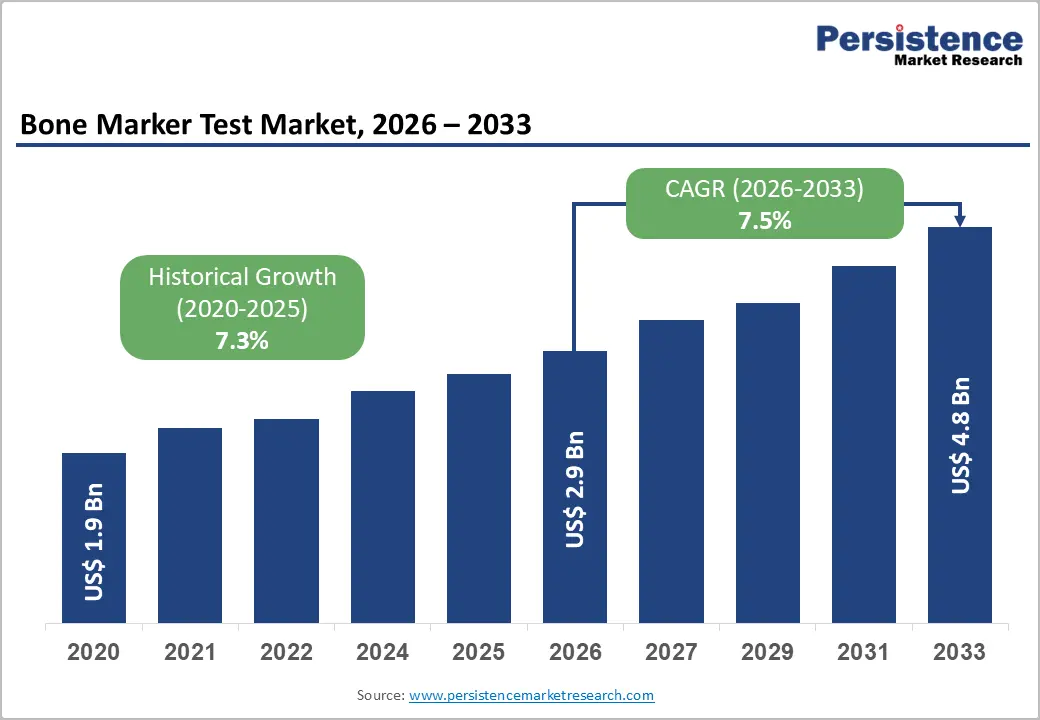
The global bone marker test market is valued at US$ 2.9 billion in 2026 and is projected to reach US$ 4.8 billion by 2033, growing at a 7.5% CAGR during 2026–2033.
The market is expanding due to rising demand for early, non-invasive, and preventive diagnostics for osteoporosis and metabolic bone disorders. Increasing adoption of automated immunoassays and digital laboratory integration is improving test accuracy, speed, and clinical decision-making. Growth in oncology and osteoporosis applications, along with aging populations, is further supporting demand. Additionally, emerging markets are benefiting from urbanization, rising incomes, and improved diagnostic infrastructure, driving wider accessibility and adoption of bone marker testing.
Key Industry Highlights:
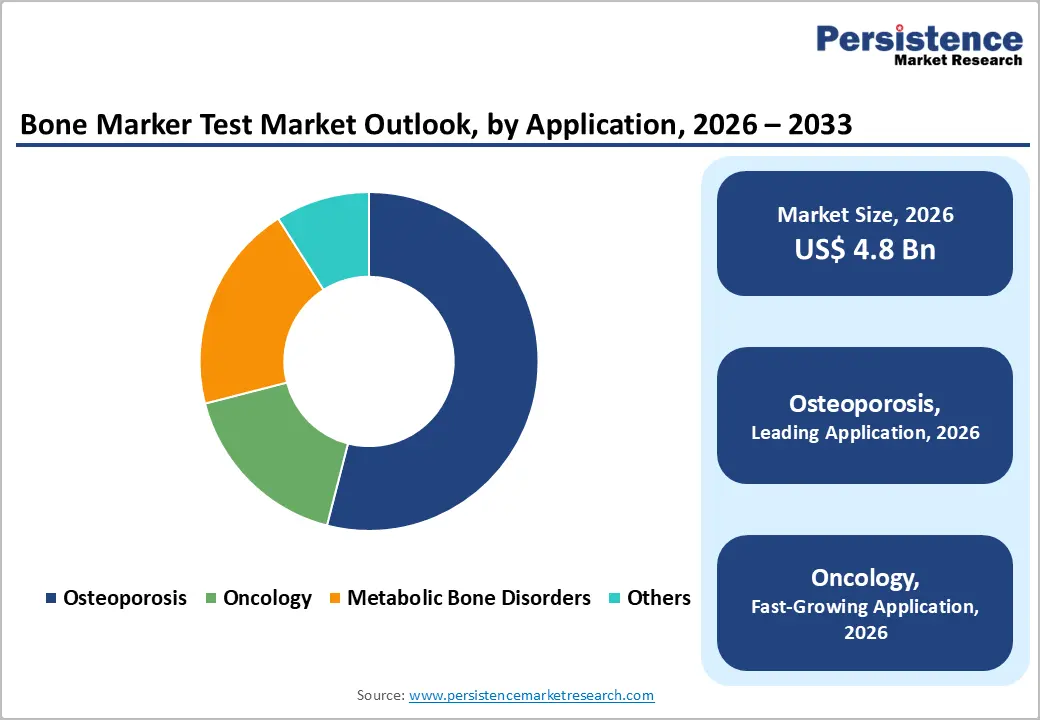
- Dominant Application Segment: Osteoporosis is expected to lead the market in 2026, commanding an estimated 54% share, while oncology is likely to be the fastest-growing segment through 2033, supported by rising cancer incidence and increasing use in bone metastasis monitoring.
- Sample Type Leadership: Blood-based testing is anticipated to dominate with an estimated 60% share in 2026, while urine-based testing is expected to grow at the fastest pace due to increasing preference for non-invasive and convenient diagnostic sampling.
- Technology Landscape: Immunoassays are projected to lead with an estimated 62% share in 2026, while point-of-care diagnostics are likely to register the fastest growth, driven by decentralized healthcare delivery and demand for rapid results.
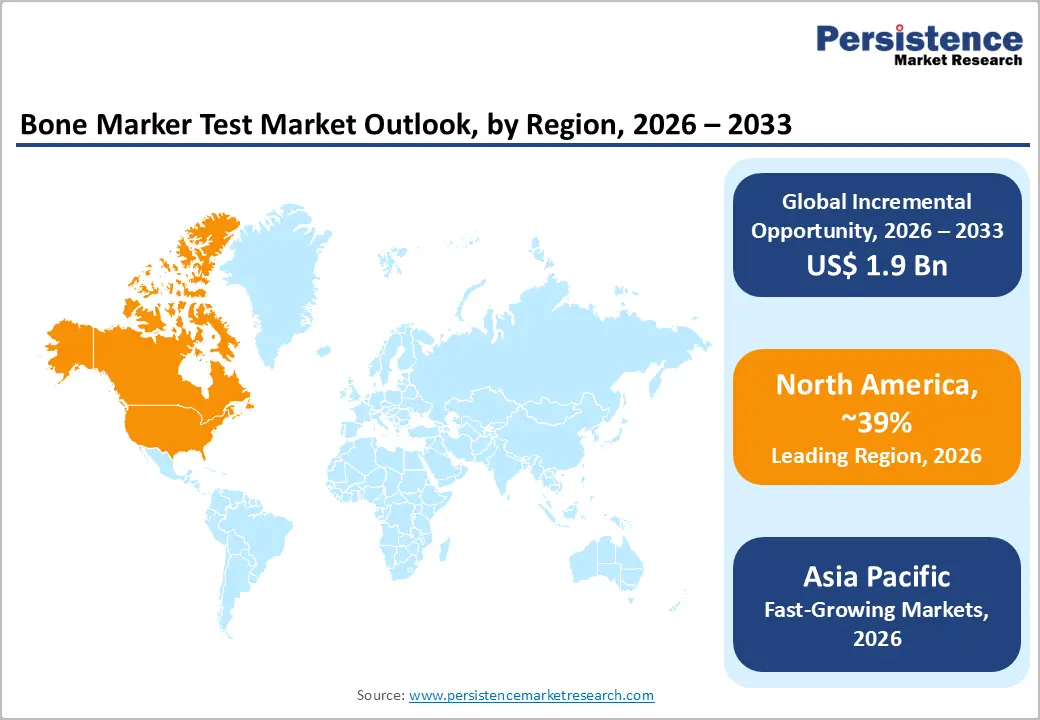
- Regional Leadership: North America is expected to hold an estimated 39% share in 2026, while Asia Pacific is projected to be the fastest-growing region owing to rising healthcare investments, urbanization, and expanding diagnostic infrastructure.
- Competitive Environment: Market dynamics are increasingly shaped by AI integration, automation in laboratory workflows, and strategic expansion into emerging markets, alongside technology partnerships and portfolio diversification among leading diagnostic companies.
DRO Analysis
Driver - Rising burden of osteoporosis and technological advancements in diagnostics
The bone marker test market is primarily driven by the rising global burden of osteoporosis and continuous advancements in diagnostic technologies. According to the International Osteoporosis Foundation (IOF), over 200 million people are affected globally, with significant fracture risk in aging populations, while the World Health Organization (WHO) identifies osteoporosis as a major public health concern. This growing disease burden is increasing reliance on early diagnosis and long-term monitoring through bone turnover marker testing, supporting stronger clinical adoption across healthcare systems.
At the same time, rapid improvements in immunoassays, automated analyzers, and point-of-care systems are enhancing test accuracy, speed, and standardization. In 2025, broader regulatory support for advanced diagnostic platforms and increased deployment of automated laboratory systems will further improve efficiency and reduce variability, strengthening the integration of bone marker testing into routine clinical workflows worldwide.
Restraint - High cost and lack of standardization in advanced diagnostic technologies
High costs associated with advanced bone marker testing systems, including automated analyzers and specialized diagnostic platforms, continue to restrain market growth. Significant capital investment and maintenance expenses limit adoption, particularly in low- and middle-income countries, restricting usage largely to tertiary hospitals and large diagnostic laboratory networks.
According to the World Bank, healthcare spending disparities and limited reimbursement policies further reduce accessibility, while recent policy focus on cost containment in laboratory diagnostics has tightened funding for specialty biomarker panels. This has slowed procurement of bone turnover testing systems across broader healthcare settings. In parallel, the lack of standardization in assay methods, reference ranges, and biomarker measurement, which is affected by biological variability such as circadian rhythm and renal function, continues to affect result consistency. In 2025, ongoing clinical discussions highlighted persistent inter-laboratory variability in CTX and P1NP testing across immunoassay platforms, limiting full clinical confidence and slowing routine adoption.
Opportunity - Expansion in emerging markets and integration with digital health and AI
Emerging economies across Asia Pacific, Latin America, and the Middle East offer strong growth opportunities for the bone marker test market, driven by rising healthcare investments, improved diagnostic infrastructure, and greater awareness of bone-related disorders. Countries such as India and China are expanding healthcare access through national programs, including India’s Ayushman Bharat Health Infrastructure Mission and China’s Healthy China 2030 initiative, improving the availability of bone turnover marker testing in secondary care settings.
In parallel, rising private diagnostic networks and insurance penetration are improving affordability and test adoption among large, underserved populations. The integration of artificial intelligence (AI) and digital health platforms is improving diagnostic accuracy, workflow efficiency, and clinical decision-making.
Regulatory support from the U.S. Food and Drug Administration (FDA) and the European Medicines Agency (EMA) for AI-enabled diagnostic systems, along with the adoption of platforms such as Roche’s Navify, has strengthened data standardization and enabled continuous monitoring of bone health across connected healthcare systems.
Category-wise Analysis
Sample Insights – Blood-based testing remains the clinical gold standard, driving market dominance
Blood-based testing dominates the bone marker test market, accounting for an estimated 60% share in 2026, driven by high analytical accuracy, strong clinical validation, and widespread use across hospitals and diagnostic laboratories. It enables precise measurement of key markers such as CTX and P1NP for reliable assessment of bone turnover, while strong compatibility with automated laboratory systems ensures workflow standardization.
In 2025, the U.S. Centers for Medicare & Medicaid Services (CMS) maintained reimbursement coverage for outpatient bone metabolism testing, while Japan’s Ministry of Health, Labor and Welfare (MHLW) expanded osteoporosis screening under national aging-care programs, reinforcing adoption of blood-based testing as the clinical backbone of the market.
Urine-based testing is the fastest-growing segment, supported by its non-invasive collection and suitability for repeated monitoring in outpatient and home-care settings. It is increasingly used in long-term osteoporosis follow-ups, though variability linked to hydration and circadian rhythm still limits its consistency compared with blood-based testing.
In 2025, the U.S. Food and Drug Administration (FDA) updated biomarker diagnostic validation frameworks, while China’s National Medical Products Administration (NMPA) tightened standards for non-invasive diagnostic assays, improving reliability and supporting broader adoption of urine-based bone marker testing in decentralized care.
Application Insights - Osteoporosis remains the backbone while oncology accelerates growth momentum
Osteoporosis leads the bone marker test market, accounting for an estimated 54% share in 2026, driven by high disease prevalence and strong dependence on early diagnosis and fracture risk assessment. Bone marker testing is widely used to monitor bone turnover and evaluate long-term treatment response, particularly in aging populations. In 2025, the European Commission’s DG SANTE expanded osteoporosis prevention initiatives across member states, while Australia’s Therapeutic Goods Administration (TGA) updated clinical guidance for bone health biomarkers, strengthening osteoporosis screening and clinical adoption.
Oncology is the fastest-growing segment, driven by rising cancer incidence and the increasing use of bone markers to detect skeletal metastases and monitor disease progression. These biomarkers are gaining importance in assessing tumor spread to bone and improving treatment planning in advanced cancer cases. The U.S. National Institutes of Health (NIH) expanded funding for metastatic biomarker research, while South Korea’s Ministry of Food and Drug Safety (MFDS) strengthened validation requirements for oncology diagnostics, accelerating integration of bone marker testing into cancer care workflows.
Regional Insights
North America Bone Marker Test Market Trends
North America is expected to be the leading region in the bone marker test market, accounting for an estimated 39% share in 2026, driven primarily by the United States. The region benefits from advanced healthcare infrastructure, strong reimbursement systems, and high awareness of bone health diagnostics, with the U.S. leading due to high osteoporosis prevalence and widespread adoption of advanced diagnostic technologies. Regulatory oversight ensures high-quality standards and continuous innovation in clinical diagnostics, while strong R&D investments and established diagnostic companies reinforce market maturity.
The rising focus on preventive healthcare, aging population trends, and the integration of AI-enabled diagnostics and automation are further strengthening demand and laboratory efficiency. In 2025, the U.S. National Institute on Aging (NIA) expanded skeletal health research programs, while Canada’s Health Canada strengthened regulatory pathways for laboratory-developed tests, improving standardization. Additionally, U.S. hospital networks increasingly adopted automated laboratory platforms for bone metabolism profiling, reinforcing regional leadership in bone marker testing through improved throughput, reduced variability, and stronger clinical research integration.
Europe Bone Marker Test Market Trends
Europe holds a significant share of the bone marker test market, supported by well-established healthcare systems across Germany, the U.K., France, and Spain. The region benefits from structured osteoporosis management programs, strong preventive screening frameworks, and consistent regulatory alignment across countries, ensuring standardized diagnostic quality. Rising geriatric population and increasing fracture incidence continue to drive demand for bone marker testing, while early adoption of advanced diagnostic technologies in countries such as Germany and the U.K. supports steady market penetration.
However, cost-containment pressures in certain national healthcare systems continue to moderate the adoption of high-end testing platforms. The UK National Institute for Health and Care Excellence (NICE) updated fracture risk assessment guidance, France’s Ministry of Health expanded osteoporosis screening in elderly care programs, and Germany’s hospital laboratory networks have increased the deployment of high-throughput analyzers.
Asia Pacific Bone Marker Test Market Trends
Asia Pacific is projected to be the fastest-growing region in the bone marker test market, expanding at an estimated 8.5% CAGR by 2033, driven by rising healthcare investments, expanding diagnostic infrastructure, and growing awareness of bone-related disorders. Key markets such as China, India, Japan, South Korea, and ASEAN countries are witnessing strong demand growth, with China and India benefiting from increased healthcare expenditure and expanding diagnostic access.
Japan’s aging population continues to drive sustained demand for bone health monitoring, while expanding private healthcare networks and insurance coverage are improving affordability and accessibility.
The rapid adoption of automated diagnostic systems and cost-effective laboratory expansion is further supporting market penetration. In 2025, South Korea’s Ministry of Health and Welfare strengthened chronic disease screening programs, Singapore’s Ministry of Health (MOH) expanded preventive health initiatives under national wellness programs, and China advanced hospital laboratory automation under provincial health reforms, collectively accelerating the adoption of bone marker testing across the region.
Competitive Landscape
The global bone marker test market is moderately consolidated, with key players such as Roche, Abbott, Siemens Healthineers, and Beckman Coulter holding a strong combined share. These companies maintain leadership through broad immunoassay portfolios, established hospital networks, and integrated laboratory platforms for bone turnover marker testing. Continuous R&D investments in assay sensitivity, automation, and workflow integration further strengthen their market position across developed healthcare systems.
Regional and specialized players such as DiaSorin and bioMérieux are expanding through focused biomarker solutions and improved assay specificity. High regulatory and clinical validation barriers limit new entrants, but digitalization and cloud-based diagnostics are enabling greater participation through software-led models. In 2025, growing partnerships between diagnostic firms and hospital networks across Europe and Asia are accelerating adoption of automated testing ecosystems, supporting a shift toward more integrated bone marker testing solutions.
Key Developments:
- In November 2025, Abbott announced a US $21–23 billion acquisition of Exact Sciences, marking its largest diagnostics expansion in years and strengthening its entry into oncology screening and molecular diagnostics. The deal expands Abbott’s diagnostics portfolio into high-growth cancer testing segments relevant to biomarker-based diagnostics.
- In July 2025, Waters Corporation announced a US$ 17.5 billion Reverse Morris Trust merger with Becton Dickinson’s Biosciences & Diagnostic Solutions division in July 2025, expected to close in early 2026. The deal significantly expands Waters’ exposure to multiplex diagnostics and bioanalytical testing, strengthening its position in high-growth laboratory diagnostics.
Companies Covered in Bone Marker Test Market
- Roche Diagnostics
- Abbott Laboratories
- Siemens Healthineers
- Thermo Fisher Scientific
- Beckman Coulter
- bioMérieux
- DiaSorin S.p.A.
- Ortho Clinical Diagnostics
- Sysmex Corporation
- Randox Laboratories
- IDS Ltd
- QuidelOrtho Corporation
- Fujirebio
- Mindray Medical International
Frequently Asked Questions
The global bone marker test market is projected to reach US$ 2.9 billion in 2026.
Rising osteoporosis prevalence, aging populations, and demand for early and non-invasive diagnostics drive market growth.
The market is expected to grow at a 7.5% CAGR from 2026 to 2033.
Expansion in emerging healthcare markets and adoption of AI-enabled and automated diagnostic platforms create key opportunities.
Roche, Abbott, Siemens Healthineers, and Beckman Coulter are among the leading players in the market.


