




- Transportation & Logistics
- Bicycle Accessories Market
Bicycle Accessories Market Size, Share, and Growth Forecast 2026 - 2033
Bicycle Accessories Market by Product Type (Saddles, Pedals, Lighting System, Mirrors, Water Bottle Cages, Lock, and Others), Bicycle Type (Mountain Bikes, Hybrid Bikes, Road Bikes, Cargo Bikes, and Others), Sales Channel (Offline and Online), and Regional Analysis, 2026 - 2033

Bicycle Accessories Market Size and Share Analysis
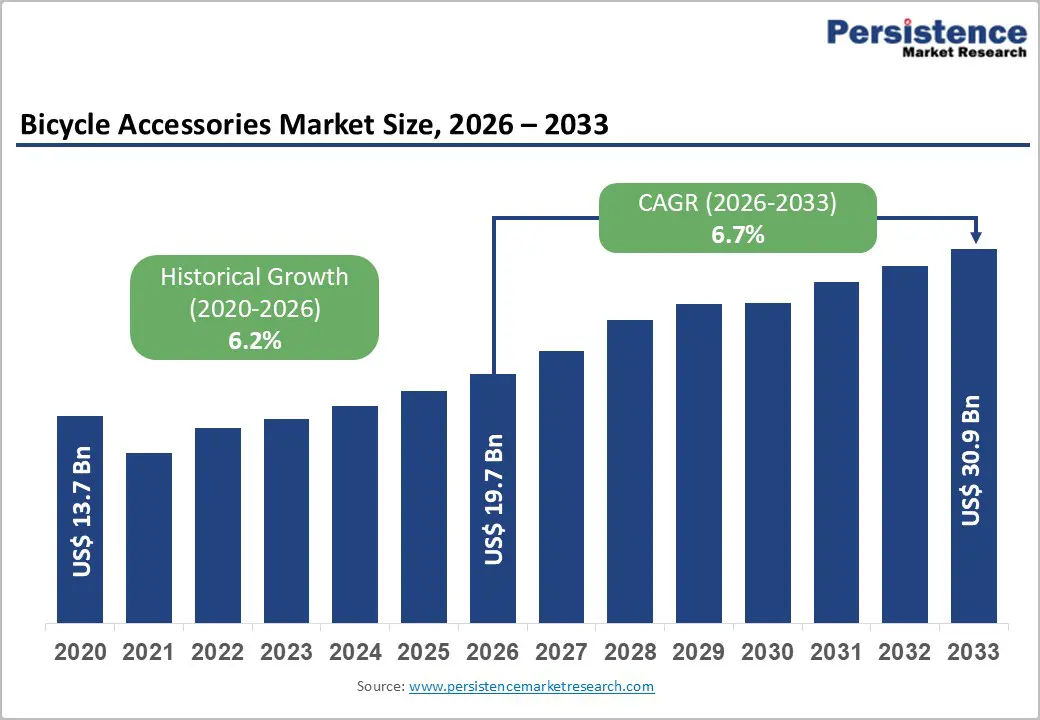
The global bicycle accessories market size is likely to be valued at US$ 19.7 billion in 2026 and is projected to reach US$ 30.9 billion by 2033, growing at a CAGR of 6.7% between 2026 and 2033.
The market expansion is primarily driven by increasing urbanization and the global shift toward sustainable transportation solutions, with bicycle adoption rising significantly across developed and emerging economies. Government initiatives promoting cycling infrastructure, coupled with growing health consciousness among consumers and the rise of cycling as both a recreational activity and commuting alternative, are fueling demand for enhanced bicycle accessories that improve safety, comfort, and performance.
Key Industry Highlights:
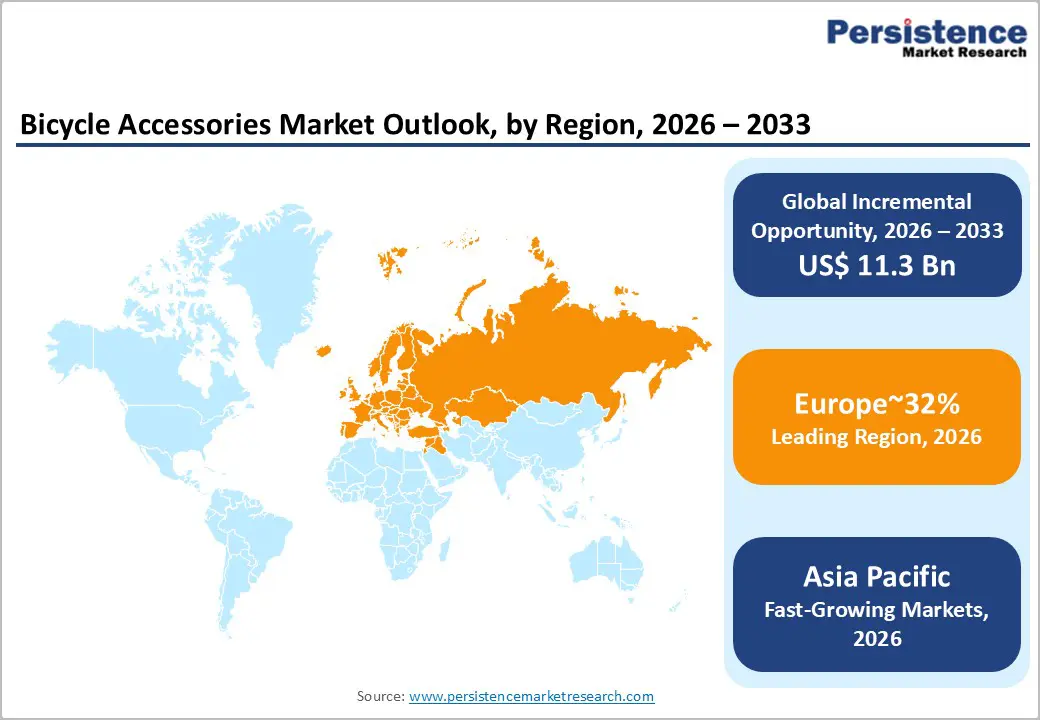
- Leading Region: Europe leads the global Bicycle Accessories Market with approximately 36% market share, supported by deeply embedded cycling culture across Netherlands, Denmark, and German, and extensive cycling infrastructure investments, and stringent safety regulations driving accessory adoption across recreational and commuting segments.
- Fastest Growing Region: Asia Pacific represents the fastest-growing regional market with projected CAGR of 7.9% during 2026-2033, fueled by massive bicycle ownership in China, rapid urbanization across India and Southeast Asia, explosive e-bike growth, and government cycling infrastructure investments.
- Dominant Product Type: Lighting systems dominate the product type category with 26% market share, driven by mandatory safety regulations including European Standard EN 1078 and German StVZO requirements.
- Fastest Growing Segment: Online sales channels emerge as the fastest-growing distribution segment with anticipated CAGR of 9.2% through 2033, driven by e-commerce convenience, broader product selection unavailable through physical retailers.
- Key Opportunity: Integration of smart technology and IoT-enabled connected accessories represents the most significant market opportunity, with 22% of regular cyclists using connected devices per Consumer Technology Association.
| Key Insights | Details |
|---|---|
|
Global Bicycle Accessories Market Size (2026E) |
US$ 19.7 Bn |
|
Market Value Forecast (2033F) |
US$ 30.9 Bn |
|
Projected Growth CAGR (2026-2033) |
6.7% |
|
Historical Market Growth (2020-2025) |
6.2% |
Market Dynamics
Drivers - Rising Adoption of Cycling for Urban Mobility and Sustainable Transportation
The global shift toward sustainable urban transportation is fundamentally driving demand for bicycle accessories across all consumer segments. According to the European Cyclists' Federation (ECF), cycling for daily commuting increased by 47% across major European cities between 2019 and 2023, with cities like Copenhagen, Amsterdam, and Berlin reporting over 35% of all trips made by bicycle. The League of American Bicyclists reports that 12 million Americans now commute regularly by bicycle, representing a 28% increase since 2020. Urban congestion and parking challenges are compelling city dwellers to adopt bicycles as practical alternatives to automobiles, directly increasing demand for essential accessories including lighting systems, locks, fenders, and cargo carriers.
The United Nations Environment Programme (UNEP) highlights cycling as a key strategy for achieving Sustainable Development Goal 11 on sustainable cities, with over 200 cities worldwide implementing bike-friendly infrastructure programs by 2024. Government incentives such as tax credits for bicycle purchases in France, cycling allowances in Belgium (up to €0.27 per kilometer), and the Cycle to Work Scheme in the United Kingdom are making cycling more economically attractive. This transportation transition creates sustained demand for safety accessories, with the World Health Organization (WHO) reporting that helmet usage can reduce head injury risk by 70%, driving regulatory mandates and consumer adoption.
Explosive Growth of Electric Bicycles Requiring Specialized Accessory Solutions
The electric bicycle revolution is creating unprecedented demand for specialized and premium-priced accessories designed to accommodate higher speeds, extended riding durations, and integrated electronic systems. The Light Electric Vehicle Association (LEVA) reports global e-bike sales reached 56 million units in 2023, with projections indicating 85 million units annually by 2030, representing a 52% increase. E-bikes require reinforced components including heavy-duty locks capable of securing higher-value assets (averaging $2,000 to $5,000 per unit), upgraded lighting systems for enhanced visibility at higher speeds, and specialized saddles designed for extended comfort during longer commutes.
According to the Bicycle Product Suppliers Association (BPSA), e-bike owners spend on average $380 annually on accessories compared to $165 for conventional bicycle owners, reflecting both the premium positioning and specialized requirements of electric cycling. The China Bicycle Association reports that China produced 41 million e-bikes in 2023, with domestic consumption and exports driving substantial accessory demand. Battery management accessories, GPS tracking systems for theft prevention, and reinforced kickstands capable of supporting heavier e-bike frames represent emerging product categories.
Restraints - Product Standardization Challenges and Bicycle Compatibility Issues
The lack of universal standardization across bicycle designs creates significant compatibility challenges for accessory manufacturers and frustrates consumers seeking reliable fit solutions. Variations in frame geometries, mounting points, axle standards (including quick-release, thru-axle 12mm, 15mm, and 20mm configurations), and seat post diameters (ranging from 27.2mm to 34.9mm) necessitate extensive product variants or adaptable designs that increase manufacturing complexity and costs. The International Organization for Standardization (ISO) maintains bicycle standards, yet proprietary designs by major manufacturers create fragmentation.
Component manufacturers must maintain extensive inventories to accommodate diverse specifications, increasing working capital requirements and risk of obsolescence, particularly as bicycle designs evolve with new material technologies and frame geometries optimized for aerodynamics and weight reduction.
Opportunity - Integration of Smart Technology and IoT-Enabled Connected Accessories
The convergence of cycling and digital technology presents substantial growth opportunities for manufacturers developing smart, connected accessories that enhance safety, performance tracking, and user experience. Companies like Garmin Ltd and Wahoo Fitness have demonstrated consumer appetite for GPS-enabled cycling computers, with the Consumer Technology Association (CTA) reporting that 22% of regular cyclists now use connected devices to track performance metrics. Smart lighting systems with automatic brightness adjustment, turn signal integration, and collision detection capabilities are gaining market traction, with Lumos Helmet raising over $2.5 million through crowdfunding for integrated lighting solutions.
The Internet of Things (IoT) revolution enables accessories including smart locks with smartphone integration and GPS tracking electronic shifting systems providing precise gear changes, and power meters measuring rider output. Shimano Inc. has invested significantly in Di2 electronic shifting technology, with adoption rates in premium bicycle segments exceeding 35% by 2024. Opportunities exist for accessory manufacturers to develop ecosystems of compatible products that integrate through mobile applications, creating recurring revenue through subscription services for advanced features, theft monitoring, and predictive maintenance alerts.
Expansion into Emerging Markets with Growing Cycling Infrastructure Investment
Emerging economies present significant untapped opportunities as governments invest in cycling infrastructure and populations adopt bicycles for affordable transportation and fitness. The Asian Development Bank (ADB) reports that India allocated $1.2 billion for cycling infrastructure development under its Smart Cities Mission through 2025, with cities including Pune, Chandigarh, and Bhubaneswar implementing dedicated cycling lanes exceeding 500 kilometers collectively. China's central government promotes cycling through its Green Transportation Development Strategy, targeting 10% modal share for cycling in urban areas by 2030. The World Bank has funded cycling infrastructure projects in Vietnam, Indonesia, and Philippines, totaling $450 million between 2021 and 2024.
These infrastructure investments create immediate demand for essential accessories including lighting systems, locks, and safety equipment. Middle-income consumers in these markets prioritize value-oriented products, creating opportunities for manufacturers to develop cost-effective product lines optimized for local market conditions and price sensitivities. Statista reports bicycle ownership in India reached 220 million units in 2023, yet accessory penetration remains below 40%, compared to 75% in mature European markets, indicating substantial growth potential. Distribution partnerships with local retailers and e-commerce platforms enable market penetration while adapting product specifications to regional preferences, climate conditions, and usage patterns.
Category-wise Analysis
Product Type Insights
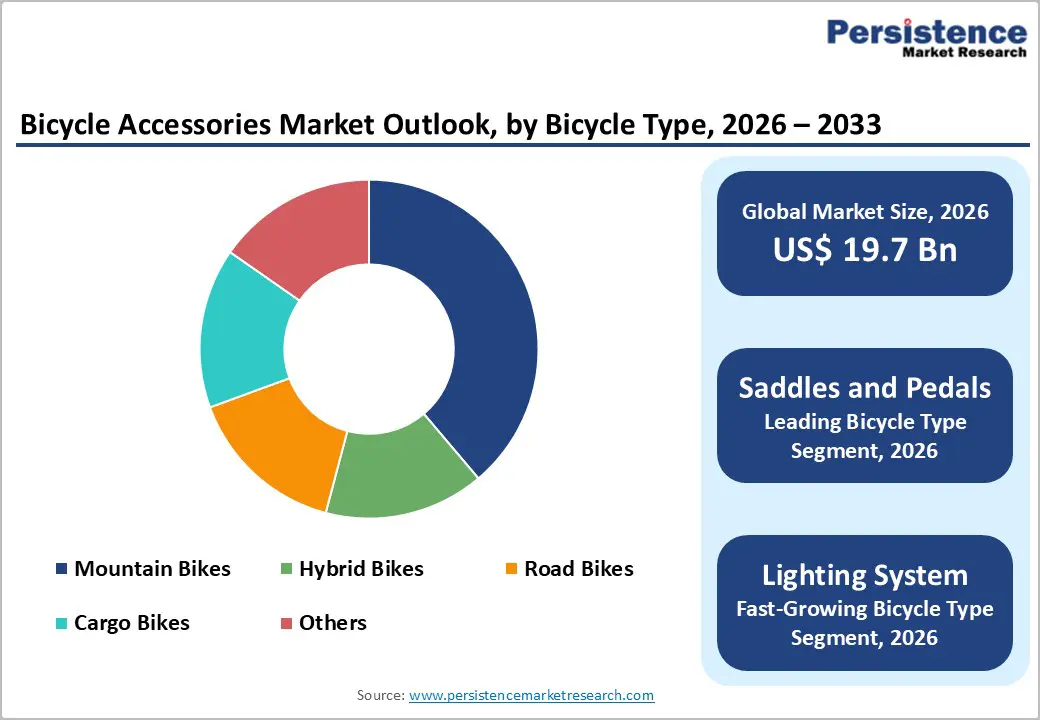
Lighting systems dominate the product type category, accounting for approximately 26% of the market share, driven by mandatory safety regulations, increasing night-time cycling, and technological advancements in LED and rechargeable battery technologies. Safety regulations across major markets mandate lighting for bicycles operated during low-visibility conditions, with the European Standard EN 1078 specifying minimum illumination requirements and the German StVZO (Road Traffic Licensing Regulations) requiring specific beam patterns and brightness levels. The National Highway Traffic Safety Administration (NHTSA) reports that 49% of fatal bicycle accidents occur during evening or night hours, compelling both regulatory bodies and safety-conscious consumers to prioritize lighting solutions.
Modern LED lighting systems offer 200 to 2,000 lumens output with rechargeable lithium-ion batteries providing 3 to 20 hours runtime, eliminating the recurring cost and environmental concerns of disposable batteries. Smart lighting systems with automatic ambient light sensors, Bluetooth connectivity, and integrated turn signals represent the fastest-growing lighting subsegment, with premium products priced between $80 and $250. Trek Bicycle Corporation reports that over 78% of new bicycle sales include lighting system purchases, reflecting both consumer safety awareness and effective point-of-sale bundling strategies. The growing e-bike segment particularly drives lighting demand, as higher speeds necessitate more powerful illumination for adequate visibility and reaction time.
Bicycle Type Insights
Mountain bikes represent the leading bicycle type segment, capturing approximately 34% of the market share, reflecting the segment's requirement for extensive accessorization to optimize performance across diverse terrain and riding conditions. Mountain bike enthusiasts typically invest heavily in specialized accessories including high-performance pedals (clipless and platform variants ranging from $50 to $400), suspension-optimized saddles, tubeless tire conversion kits, dropper seat posts, and protective equipment. The International Mountain Bicycling Association (IMBA) reports that 38 million Americans participate in mountain biking annually, with dedicated riders averaging $520 in annual accessory purchases.
Mountain biking's technical nature drives continuous component upgrades, with riders frequently replacing grips, pedals, and saddles to optimize bike setup for specific disciplines, including cross-country, trail, enduro, and downhill riding. The Professional Mountain Bike Association indicates that 67% of mountain bikers modify their bicycles within six months of purchase, creating robust aftermarket demand. Regional trail development initiatives, including the International Mountain Bicycling Association's work establishing sustainable trail networks across North America, Europe, and the Asia Pacific, expand participation and consequently drive accessory demand.
Sales Channel Insights
Offline retail channels maintain dominance with approximately 64% share as consumers prefer physical evaluation of accessory fit, quality, and compatibility before purchase, particularly for critical safety and performance components. Independent bicycle dealers, specialty cycling retailers, and sporting goods stores provide expert consultation, professional installation services, and immediate product availability that online channels struggle to replicate for complex accessories. The National Bicycle Dealers Association (NBDA) reports that 72% of consumers purchasing bicycles over $500 also buy accessories in-store during the same transaction, demonstrating the effectiveness of point-of-sale recommendations and bundling strategies.
Physical retailers enable consumers to physically test saddle comfort, assess lock security mechanisms, verify lighting brightness, and ensure proper component compatibility before purchase. Professional bike shops offer value-added services, including installation, adjustment, and warranty support that justify premium pricing over online alternatives.
Regional Insights
North America Bicycle Accessories Market Trends
The United States maintains market leadership in North America, supported by strong recreational cycling culture, extensive trail networks managed by organizations like the Rails-to-Trails Conservancy (maintaining over 24,000 miles of converted rail trails), and growing urban cycling adoption in cities implementing Vision Zero safety programs. The People for Bikes organization reports that 52 million Americans rode bicycles in 2023, with the pandemic-driven cycling surge demonstrating sustained participation despite initial predictions of decline. Federal infrastructure investments, including the $1.2 trillion Infrastructure Investment and Jobs Act, allocated $1.5 billion specifically for bicycle and pedestrian infrastructure through 2026, creating favorable conditions for continued cycling growth.
The National Sporting Goods Association (NSGA) reports average accessory spending per cyclist at $285 annually in the United States, substantially higher than global averages. E-bike adoption is accelerating, with the Electric Bike Report indicating sales reached 1.1 million units in 2023, representing 35% year-over-year growth. This creates demand for specialized accessories, including higher-capacity locks, upgraded lighting systems, and comfort-focused components for extended commutes. Canada contributes significantly through government cycling promotion initiatives, with cities like Montreal, Vancouver, and Toronto implementing expansive cycling infrastructure programs and bike-sharing systems serving 15 million trips annually, according to Statistics Canada.
Europe Bicycle Accessories Market Trends
Europe represents the most mature and sophisticated bicycle accessories market globally, with cycling deeply integrated into transportation infrastructure and cultural norms across the Netherlands, Denmark, Germany, Belgium, and France. The European Cyclists' Federation reports that 270 million Europeans cycle regularly, with the Netherlands achieving a remarkable 27% modal share for cycling in daily transportation. The European Union's Cycling Strategy, adopted in 2023, commits €2 billion for cycling infrastructure development through 2030, aiming to double cycling distances by the end of the decade. Regulatory harmonization across the European Union creates consistent safety standards while enabling efficient market access for accessory manufacturers.
France implemented mandatory helmet usage for children under 12 in 2017, significantly boosting helmet sales. The United Kingdom, despite Brexit, maintains close alignment with EU product standards through its Vehicle Certification Agency oversight. Spain's growing cycling tourism industry, generating €1.8 billion annually according to Turespaña, drives demand for touring-specific accessories, including panniers, bike-packing equipment, and navigation devices. The European Bike Sharing Association reports that 700 bike-sharing systems are operating across European cities serving 150 million trips annually, creating demand for maintenance accessories and user-focused safety equipment.
Asia Pacific Bicycle Accessories Market Trends
Asia Pacific represents the largest and fastest-growing regional market, driven by massive bicycle ownership in China, India, Japan, and Southeast Asian countries, combined with manufacturing advantages that position the region as the global production hub for bicycle accessories. China dominates with the China Bicycle Association reporting 330 million bicycles in active use and production capacity exceeding 50 million units annually, creating enormous domestic accessory demand while supplying global markets. The Ministry of Transport in China promotes cycling through the National Green Transportation Development Strategy, investing $8 billion in cycling infrastructure through 2025.
India presents exceptional growth potential, with the Ministry of Housing and Urban Affairs implementing cycling infrastructure across 100 Smart Cities, and the Confederation of Indian Industry (CII) projecting bicycle market growth at 12% CAGR through 2028. Urban air pollution concerns and government promotion of cycling as affordable transportation are driving adoption, with accessory penetration remaining substantially below developed market levels, indicating significant opportunity. ASEAN countries including Vietnam, Thailand, Indonesia, and Philippines demonstrate rapid cycling growth, supported by urban density, traffic congestion, and tropical climates favoring two-wheeled transportation.
Competitive Landscape for the Bicycle Accessories Market
The global bicycle accessories market exhibits moderate fragmentation, characterized by a mix of established bicycle component manufacturers, specialized accessory brands, and numerous regional players competing across diverse product categories and price segments. The top ten global players collectively account for approximately 45% of market share, with significant regional and category-specific variations. Companies pursue differentiated strategies including vertical integration (manufacturing complete bicycle ecosystems), specialization in premium performance segments, and mass-market value positioning targeting price-conscious consumers. Shimano Inc. and SRAM Corporation dominate drivetrain and component categories through technological leadership and extensive original equipment manufacturer partnerships.
Emerging business model trends include subscription services for accessory replacement and maintenance, integration with fitness and cycling applications creating data-driven ecosystems, sustainability-focused products utilizing recycled materials and carbon-neutral manufacturing, and customization services enabling personalized component specifications. Research and development investments focus on weight reduction through advanced materials, smart technology integration enabling connectivity and performance tracking, and safety innovations addressing regulatory requirements and consumer preferences.
Key Developments:
- In September 2025, Lezyne, a U.S.-based accessory maker, introduced a new front + rear LED light system that includes vehicle-detection radar and visual + audio alerts. This is a significant step in making radar-based safety tech more accessible, moving beyond premium brands like Garmin and Trek, and targeting commuters and safety-conscious riders.
- In 2025, Trek also announced packaging changes for its saddles and other accessories, moving away from plastic zip-ties and lamination to more recyclable materials, saving large amounts of plastic annually.
- In October 2024, Shimano Inc. expanded electronic-compatible product lines meeting rising demand in cities promoting cycling infrastructure, introducing motor-compatible gear systems and heavy-duty braking mechanisms designed for e-bike applications, reinforcing market leadership in high-performance component segments.
- In April 2024, Trek Bicycle Corporation launched CarBack Radar Tail Light featuring updated 77GHz radar technology with claimed detection range up to 240m, representing significant advancement in cycling safety accessories and smart technology integration, though competing directly with Garmin Varia radar systems in premium safety equipment segment. provide more key developments like this in the U.S.
Companies Covered in Bicycle Accessories Market
- Accell Group
- Avon Cycles Ltd
- Campagnolo S.R.L.
- Garmin Ltd.
- Shimano Inc.
- Giant Manufacturing Co., Ltd.
- Merida Industry Co Ltd
- Samchuly Bicycle Co., Ltd.
- Trek Bicycle Corporation
- DT SWISS
- Endura Ltd.
Frequently Asked Questions
The global Bicycle Accessories Market is projected to reach US$ 30.9 Bn by 2032, growing from US$ 19.7 Bn in 2025 to a CAGR of 6.7% during the forecast period, driven by increasing urbanization, rising adoption of electric bicycles, and expanding cycling infrastructure investments globally.
The market is primarily driven by the global shift toward cycling as sustainable urban transportation, mandatory safety regulations requiring lighting and protective equipment, and health consciousness.
Lighting systems lead the product type category with approximately 26% market share, attributed to mandatory safety regulations across major markets.
Europe maintains market leadership with approximately 36% global market share, driven by a deeply embedded cycling culture in the Netherlands, achieving 27% modal share, and Denmark's cycling-centric cities.
Integration of smart technology and IoT-enabled connected accessories represents the most significant opportunity, with the Consumer Technology Association reporting 22% of regular cyclists using connected devices.


