




- Electric Mobility
- Folding Bicycle Market
Folding Bicycle Market Size, Trends, Share, and Growth Forecast 2026 - 2033
Folding Bicycle Market Size, Share, Product (Conventional, Electric), Size (20”, 24”, 26”, Others), Distribution Channel (Offline, Online), Price Range (Low, Economy, Premium), and Regional Analysis, 2026 - 2033

Folding Bicycle Market Size and Trend Analysis
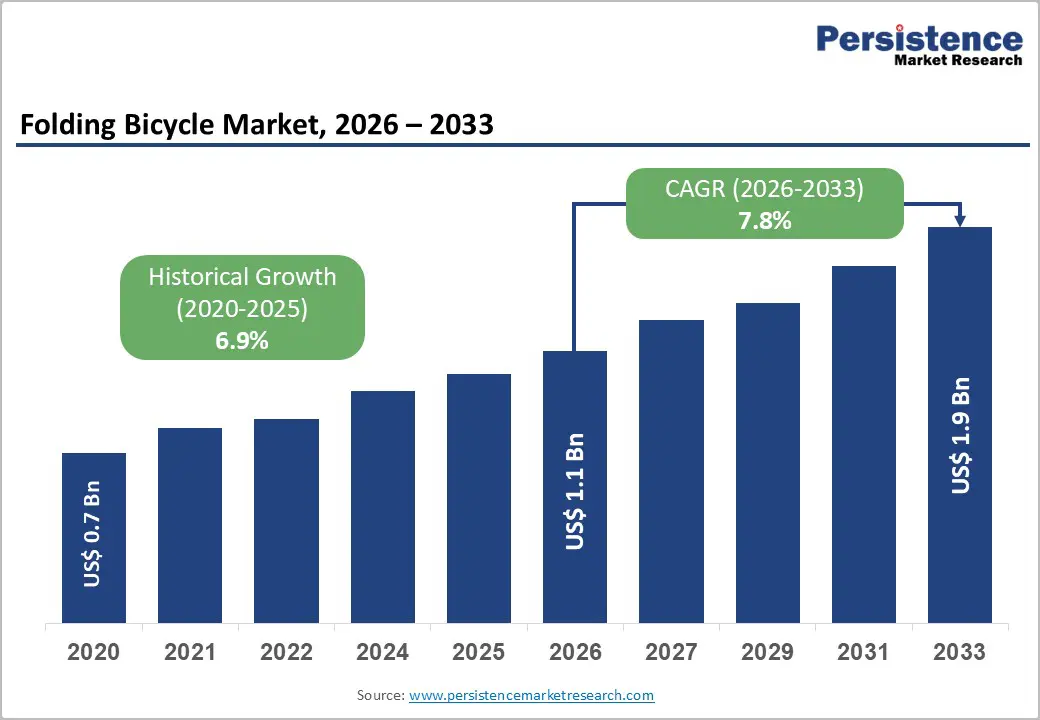
The global folding bicycle market size is likely to be valued at US$ 1.1 billion in 2026 and is expected to reach US$ 1.9 billion by 2033, growing at a CAGR of 7.8% during the forecast period from 2026 to 2033. This expansion is primarily driven by rising urbanization, increasing traffic congestion, and a growing preference for compact, multi-modal mobility solutions that integrate seamlessly with public transport and micro-mobility ecosystems.
Key Industry Highlights:
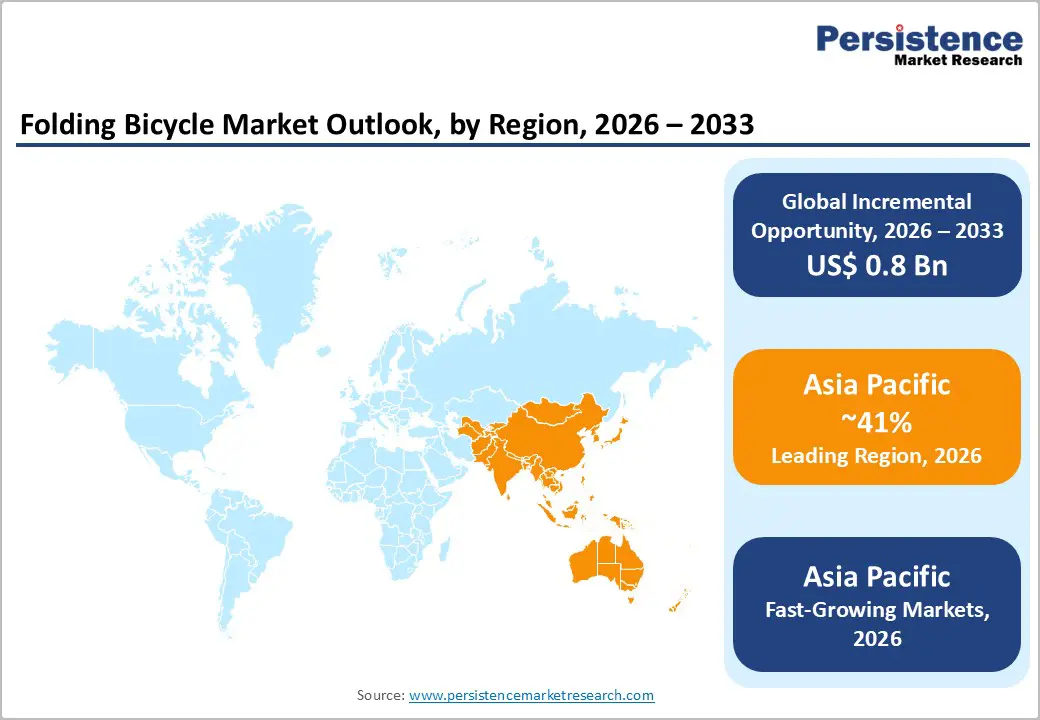
- Leading Region: Asia Pacific dominates the folding bicycle market with 41% share in the market, due to high urbanization, strong manufacturing base, and supportive government initiatives in countries such as China, Japan, and India.
- Fastest-growing Region: Asia Pacific is also the fastest-growing region with rising CAGR of 9.7%, fueled by rising middle-class incomes, traffic congestion, and expanding cycling infrastructure in India and ASEAN economies.
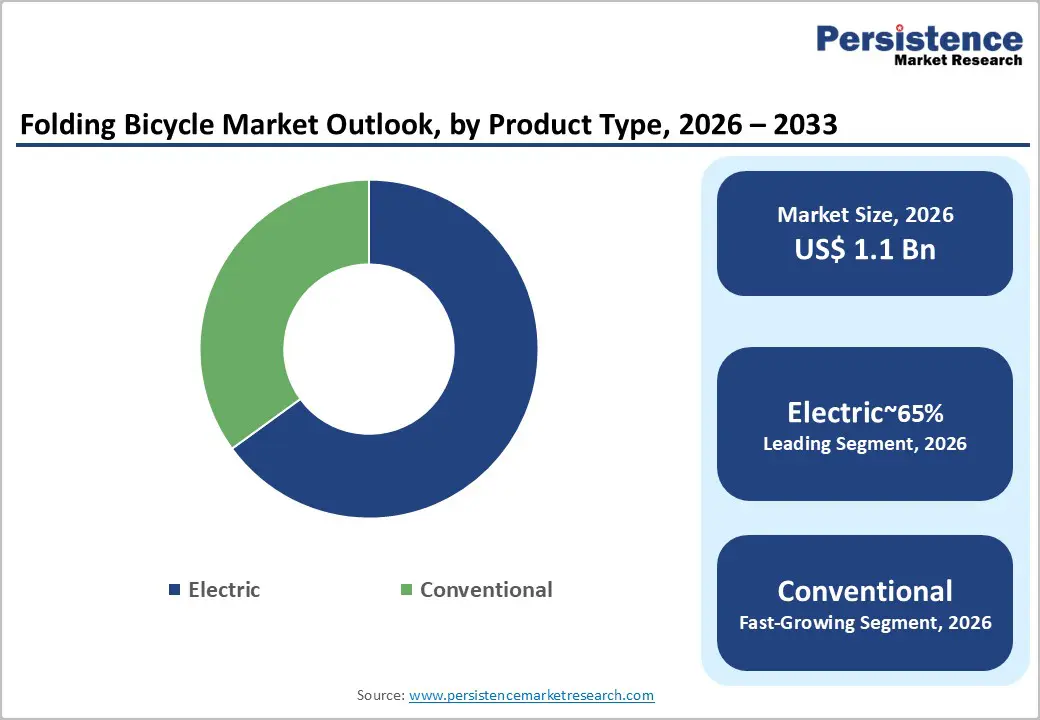
- Dominant Product Segment: The Electric product segment is the leading growth driver, capturing around 65% share by 2025, supported by government incentives and consumer demand for assisted-pedal commuting.
- Fastest-growing Size: The 20-inch size segment is the fastest-growing within the Size category, favored for its compactness and ease of storage in high-rise urban environments.
- Key Opportunity: Deeper integration of folding bicycles with public-transport networks and micromobility platforms offers a major opportunity to position folding bikes as core components of urban mobility ecosystems.
| Key Insights | Details |
|---|---|
|
Folding Bicycle Market Size (2026E) |
US$ 1.1 Billion |
|
Market Value Forecast (2033F) |
US$ 1.9 Billion |
|
Projected Growth CAGR (2026–2033) |
7.8% |
|
Historical Market Growth (2020–2025) |
6.9% |
Market Dynamics
Drivers - Growing Urban Density Is Driving Strong Demand for Compact, Space-Saving Folding Mobility Solutions Worldwide
Rapid urbanization across major metropolitan areas is steadily pushing consumers toward compact and flexible mobility solutions that fit into smaller living spaces and busy transit systems. In Asia Pacific, countries such as China, India, and Japan are experiencing strong urban population growth, with China’s urbanization rate crossing 64%, which directly supports rising demand for folding bicycles. These bikes are easy to store in apartments and convenient to carry into elevators, buses, and trains. In Europe, high housing and parking costs in cities such as Berlin, Paris, and London are encouraging consumers to shift from full-size bicycles to foldable options. This long-term transition toward space-efficient transportation is strengthening the folding bicycle market’s role within the broader micromobility ecosystem.
Electric Folding Bicycles and Lightweight Technology Innovations are Transforming Urban Commuting Preferences
The growing popularity of electric folding bicycles is one of the strongest forces driving market expansion, as riders seek comfort, efficiency, and extended commuting range. In Europe, countries such as Germany, France, and Netherlands are witnessing rapid adoption, supported by government incentives and improved cycling infrastructure. At the global level, advances in lithium-ion batteries, lightweight aluminum frames, carbon fiber materials, and smoother folding mechanisms are improving performance while reducing overall bike weight.
These improvements appeal strongly to urban professionals, students, and older riders who want assisted mobility without bulky designs. Electric folding bikes are increasingly viewed as practical daily transport alternatives to cars and scooters, particularly in congested cities. As sustainability concerns rise, these technology-driven products are reinforcing the folding bicycle market’s position within the fast-growing green mobility sector.
Restraints - High Product Costs and Import-Related Expenses Continue Limiting Market Penetration in Price-Sensitive Regions
Despite their convenience and design advantages, folding bicycles often carry higher price tags than traditional bicycles, especially electric models and premium branded products. This cost gap limits adoption in price-sensitive regions such as parts of Latin America and Africa, where many consumers continue to prefer basic bikes or used alternatives. Import duties, shipping expenses, currency fluctuations, and specialized component costs further increase retail prices in developing markets.
Premium brands such as Brompton Bicycle Ltd., Tern Bicycles, and Gocycle rely on advanced engineering and proprietary designs, which adds to production costs. While demand exists, affordability remains a key barrier for mass-market penetration. Until pricing becomes more accessible through local manufacturing and economies of scale, cost sensitivity will continue to slow adoption across emerging economies.
Consumer Concerns Over Durability, Safety, and Long-Term Reliability Are Slowing First-Time Adoption Rates
Although modern folding bicycles are engineered for strength and reliability, some consumers remain concerned about long-term durability and safety. Common worries include wear in folding hinges, frame flexibility, and alignment issues after repeated folding and unfolding. In North America and Europe, occasional negative user reviews amplify these concerns, even when actual failure rates are low. Lightweight designs also raise fears around stability in mixed traffic conditions and rough urban roads.
Theft risk and the perceived fragility of compact frames discourage risk-averse buyers from making first-time purchases. These psychological barriers can significantly influence buying behavior, particularly among commuters who depend on daily reliability. Manufacturers are responding through stronger materials, improved locking mechanisms, longer warranties, and extensive product testing. However, building long-term consumer trust remains essential for accelerating broader market acceptance.
Opportunity - Public Transport Integration Is Unlocking Multimodal Commuting Opportunities for Folding Bicycles in Urban Ecosystems
One of the strongest growth opportunities lies in integrating folding bicycles with public transportation systems and shared mobility platforms. Many urban authorities now allow folding bikes on metros, buses, and commuter trains, enabling smooth multi-modal travel. Cities across Europe and North America are increasingly adjusting transport policies to encourage compact bikes for first- and last-mile connectivity. In Asia Pacific, several metro systems are also becoming more accommodating during off-peak hours.
This flexibility makes folding bicycles practical daily commuting tools rather than occasional leisure products. Partnerships between bike manufacturers, mobility apps, and transit authorities can create subscription services, rental models, and bundled transport solutions. These approaches not only expand user access but also generate recurring revenue streams. As cities aim to reduce congestion and emissions, folding bicycles are well positioned to become a permanent component of integrated urban mobility networks.
Premium Features, Smart Technology, and Custom Designs Are Creating High-Value Growth Segments in Developed Markets
In developed economies, demand is shifting toward premium folding bicycles that combine performance with smart technology and stylish design. Consumers increasingly seek features such as GPS tracking, smart locks, digital performance monitoring, and personalized frame colors. Established brands like Brompton Bicycle Ltd., Tern Bicycles, and Gocycle are already capitalizing on this trend with high-end product lines aimed at urban professionals and tech-savvy commuters.
Buyers in North America, Western Europe, and Japan are willing to pay higher prices for comfort, aesthetics, and brand reputation. This premium segment is expanding faster than economy models, creating strong profit margins for manufacturers. Customization options further enhance brand loyalty and customer engagement. As urban cycling becomes part of lifestyle identity, premium folding bicycles are evolving from simple transport tools into aspirational mobility products.
Category-wise Analysis
Product Insights
The electric folding bicycle segment is emerging as the fastest-growing product category, projected to capture nearly 45% of market share by 2025. This growth is driven by rising urban commuting distances, traffic congestion, and demand for effortless mobility. In Europe and North America, electric folding bikes are increasingly viewed as serious daily transport solutions rather than recreational gadgets. Government incentives and workplace commuting benefits further support adoption.
Brands such as Dahon and Tern Bicycles have expanded electric model offerings to meet this rising demand. In the Asia Pacific, high fuel prices and dense city traffic are pushing commuters toward electric-assisted options that reduce fatigue while maintaining portability. The ability to cover longer distances without heavy physical effort is a major advantage. As battery technology improves and costs decline, this segment will continue to drive overall market growth.
Size Insights
The 20-inch folding bicycle category holds the largest market share, estimated at around 40%, due to its ideal balance between compactness and riding comfort. These bikes are small enough for easy storage yet large enough to offer smooth handling and better stability than ultra-compact models. Urban commuters prefer this size for carrying into offices, storing in apartments, and fitting into car trunks or public transport spaces. Manufacturers have heavily invested in this category by improving frame materials, folding speed, and accessory integration such as racks and lighting systems. Brands including Brompton Bicycle Ltd., Dahon, and Tern Bicycles continue launching refined 20-inch models tailored for daily commuting. Strong adoption across European city centers and university campuses further supports this segment’s leadership position. Its practicality makes it the preferred choice for both new and experienced folding bike users.
Distribution Channel Insights
Online sales channels are rapidly gaining traction and are expected to account for roughly 35% of global folding bicycle sales by 2025. Rising e-commerce penetration, digital payment adoption, and improved logistics networks are making it easier for consumers to purchase bicycles online. E-retailers now offer product videos, virtual fitting guides, easy returns, and installment payment options that reduce buying hesitation.
In Asia Pacific, platforms such as Alibaba, JD.com, and Flipkart have played major roles in boosting online bicycle sales through promotions and flash deals. While physical stores still dominate due to test-ride preferences, the online channel is expanding faster, particularly among young and tech-savvy buyers. This shift is reshaping brand-to-consumer engagement strategies across the market.
Price Range Analysis
The economy price segment holds the largest market share at approximately 40%, driven by affordability and broad consumer accessibility. This segment is particularly strong across the Asia Pacific, where large middle-income populations seek low-cost commuting solutions. Local manufacturers often target this tier with simpler mechanical designs, steel frames, and basic folding mechanisms that are easy to maintain.
In Latin America and Africa, economy folding bicycles serve as practical short-distance transport for work, education, and daily errands. Although feature sets are limited, price competitiveness remains the primary purchase driver. As disposable incomes gradually rise and product quality improves, many economy buyers are expected to upgrade to mid-range or premium models. This creates a natural customer progression path and long-term revenue growth opportunity for manufacturers across different price tiers.
Regional Insights
North America Folding Bicycle Market Trends
North America’s folding bicycle market is expanding steadily due to urban population growth, rising fuel costs, and increasing environmental awareness. Cities such as New York, San Francisco, Toronto, and Vancouver have invested heavily in bike lanes, shared mobility programs, and commuter-friendly transport policies. Relaxed rules for carrying folding bicycles on public transit have strengthened multi-modal commuting adoption.
The region also benefits from strong technological innovation, with smart bike features such as GPS, mobile apps, and anti-theft systems gaining popularity. Consumers are increasingly viewing folding bicycles as reliable daily transport rather than occasional leisure equipment. This combination of infrastructure support, sustainability focus, and tech integration is positioning North America as a high-value and innovation-driven market for folding bicycle manufacturers.
Europe Folding Bicycle Market Trends
Europe remains one of the most mature and policy-supported markets for folding bicycles, driven by sustainability initiatives and strong cycling culture. The European Union has introduced regulations promoting low-emission transport and active mobility infrastructure across member states. Countries such as Germany, France, and the Netherlands offer subsidies and tax benefits for electric bicycles, accelerating folding e-bike adoption.
Cities including Berlin, Paris, and Amsterdam have invested extensively in protected bike lanes and secure parking facilities. High real-estate costs and limited storage space in urban apartments further encourage compact bicycle use. Leading brands continue expanding their European presence to meet growing demand. With strong policy backing, infrastructure development, and environmental awareness, Europe continues to set the benchmark for folding bicycle adoption worldwide.
Asia Pacific Folding Bicycle Market Trends
Asia Pacific is both the largest and fastest-growing region in the folding bicycle market, driven by urban congestion, manufacturing scale, and rising middle-class incomes. China serves as the global production hub, while Japan remains a premium consumer market with strong brand loyalty. In India, government initiatives promoting non-motorized transport and smart city development are boosting demand for compact commuting solutions.
Southeast Asian countries such as Thailand, Vietnam, and Indonesia are experiencing rising urbanization and traffic congestion, making folding bicycles increasingly practical. Smaller apartments and busy road conditions favor portable, easy-to-store bikes. Combined with improving infrastructure and growing environmental awareness, these factors are transforming folding bicycles into essential urban mobility tools across the region. Asia Pacific’s diverse demand spectrum supports both the economy and premium segment expansion.
Competitive Landscape
The folding bicycle market is moderately fragmented, featuring established global brands alongside regional manufacturers and private-label players. Leading companies compete primarily on design quality, folding technology, durability, and brand reputation. Many firms invest heavily in research and development to create lighter frames, faster folding mechanisms, and integrated smart features such as tracking systems and digital performance monitoring. Direct-to-consumer online sales, subscription ownership models, and collaborations with mobility platforms are emerging as new revenue strategies.
Premium brands focus on customization and lifestyle positioning, while regional players compete aggressively on price. Competitive intensity is strongest in electric and high-end segments, where innovation and user experience drive purchasing decisions. As urban mobility continues evolving, manufacturers that combine product performance with ecosystem integration and strong customer engagement are expected to gain long-term competitive advantage in the global folding bicycle market.
Key Developments:
- In September 2024: Brompton Bicycle Ltd. introduced its latest Electric T Line folding e-bike featuring a detachable 345 Wh battery with up to ~90 km range and enhanced smart connectivity via the Brompton Electric app, offering smarter urban riding with Start and Walk Assist modes for commuters.
- In March 2025: Dahon showcased its new lightweight 20-inch folding series at the 2025 Taipei Cycle Show, emphasizing advanced frame tech, modular accessories, and improved folding mechanisms to expand presence in Asia Pacific and select Latin American markets.
- In June 2025: Tern Bicycles announced plans to launch Tern ZE, a Cologne-based European distribution and operations hub, enabling deeper integration of its folding bikes within shared micromobility platforms and dealer networks in Germany and France.
Companies Covered in Folding Bicycle Market
- Brompton Bicycle Ltd.
- Dahon
- Tern Bicycles
- Montague Corporation
- Gocycle
- Strida
- Birdy
- Bike Friday
- Citizen Bike
- Allen Sports
- Schwinn
- Retrospec
- Zizzo
- Xspec
- Columba
- Giant Bicycle
- Pacific Cycles
- Merida Industry Co., Ltd.
- KHS Bicycles
- Lynx Bicycles
Frequently Asked Questions
The global folding bicycle market is valued at US$ 1.1 Billion in 2026 and is projected to reach US$ 1.9 Billion by 2033, growing at a CAGR of 7.8% during the forecast period.
Key demand drivers include urbanization, space‑constrained living, rising traffic congestion, environmental concerns, and supportive government policies promoting cycling infrastructure, which collectively boost adoption of folding bicycles as compact, eco‑friendly mobility tools.
The Electric product segment dominates, capturing about 65% share by 2025, because electric folding bicycles offer assisted pedaling for longer commutes, hilly terrains, and last‑mile connectivity, aligning with growing demand for green mobility and urban commuting solutions.
Asia Pacific leads the folding bicycle market, supported by China’s manufacturing base, India’s urban expansion, Japan’s cycling culture, and strong government initiatives promoting non‑motorized transport and last‑mile connectivity.
A key opportunity lies in integrating folding bicycles with public‑transport networks and micromobility platforms, enabling multi‑modal commuting and positioning folding bikes as core components of urban mobility ecosystems.


