




- Food Ingredients & Additives
- Bakery Emulsions Market
Bakery Emulsions Market Size, Share, and Growth Forecast, 2026 - 2033
Bakery Emulsions Market by Flavor Type (Vanilla Emulsion, Lemon Emulsion, Almond Emulsion, Red Velvet Emulsion), Source Type (Plant, Animal), and Regional Analysis for 2026 - 2033

Bakery Emulsions Market Size and Trends Analysis
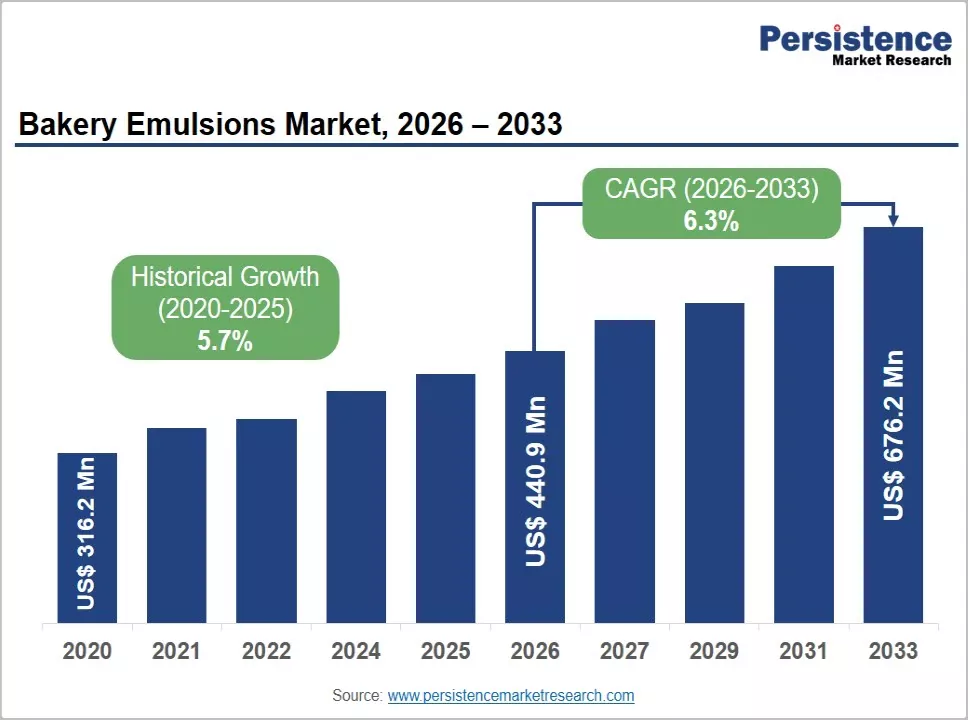
The global bakery emulsions market size is likely to be valued at US$440.9 million in 2026 and is expected to reach US$676.2 million by 2033, growing at a CAGR of 6.3% during the forecast period from 2026 to 2033, driven by increasing demand for consistent flavor delivery, improved texture, aeration, and moisture retention across cakes, cookies, pastries, breads, and fillings.
In 2025, the USDA Economic Research Service reported that U.S. foodservice sales reached US$1.41 trillion, underscoring the scale of commercial foodservice channels that support demand for bakery ingredients.
Key Industry Highlights:
- Leading Region: North America is anticipated to be the leading region, accounting for a market share of 47% in 2026, driven by established commercial bakeries, extensive foodservice networks, and strong demand for consistent flavor and texture in packaged and freshly prepared baked goods.
- Fastest-growing Region: Asia Pacific is likely to be the fastest-growing, supported by expanding bakery consumption, urbanization, organized retail, foodservice development, and increasing adoption of Western-style baked foods.
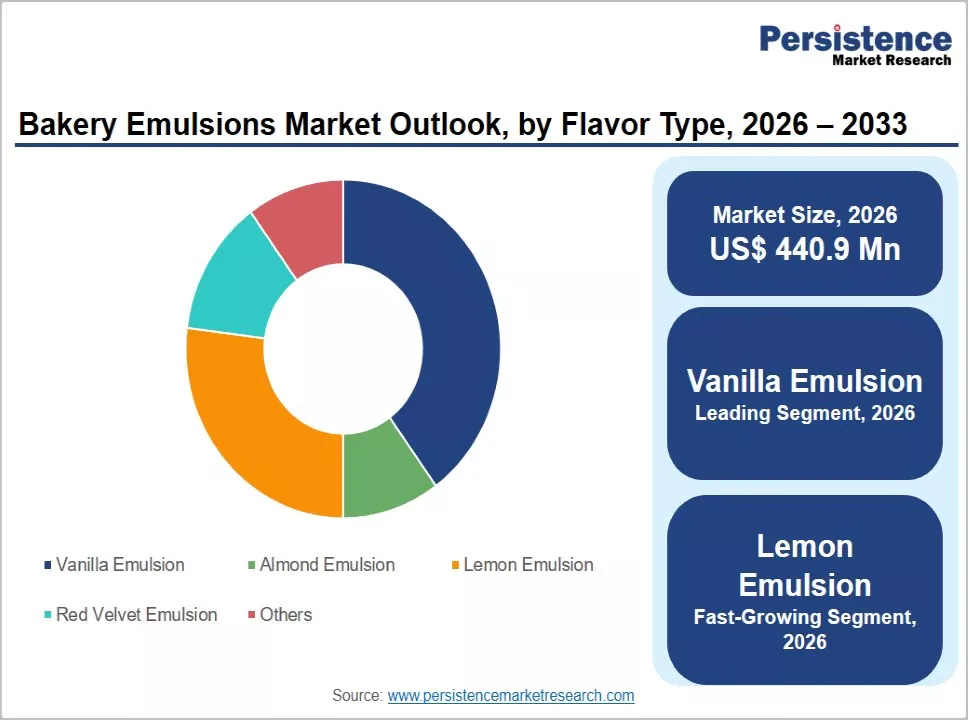
- Leading Flavor Type: Vanilla emulsion is projected to represent the leading flavor type in 2026, accounting for 45% of the revenue share, for its broad application across cakes, cookies, muffins, frostings, and pastries.
- Leading Source Type: Plant-based emulsions are anticipated to be the leading source type, accounting for over 69% of the revenue share in 2026, supported by clean-label positioning, vegan product development, and growing preference for non-animal ingredients.
- Key Opportunity: Expanding clean-label and plant-based bakery innovation creates opportunities for specialty emulsions that combine distinctive flavors with stable, consistent, and multifunctional performance.
DRO Analysis
Driver - Rising Demand for Consistent Quality and Extended Shelf Life in Industrial Baking
Rising demand for consistent quality and extended shelf life is a driver for bakery emulsions as industrial and high-volume bakeries prioritize uniform product performance across batches. Emulsions can help distribute flavors consistently and efficiently while supporting texture, moisture retention, and processing stability in cakes, pastries, breads, cookies, and fillings.
This becomes increasingly relevant as foodservice and commercial bakery channels expand. Greater production scale encourages ingredient standardization, reducing formulation variability and supporting dependable sensory performance during baking, storage, transport, and retail handling. Bakery manufacturers increasingly require ingredients that can perform reliably across automated mixing, baking, cooling, packaging, and distribution processes.
Emulsions provide concentrated flavor delivery and can support more uniform incorporation than conventional flavoring approaches, particularly in high-volume formulations. Their ability to help maintain sensory consistency can reduce batch-to-batch variation and improve finished-product quality. Demand is also supported by growing use of frozen dough, packaged bakery products, cakes, and ready-to-serve desserts that require stability throughout processing and storage.
Restraint - Technical Performance Gaps of Natural Systems
Technical performance gaps of natural systems remain a restraint because plant-derived and clean-label emulsions may not always reproduce the stability, intensity, or processing tolerance of conventional formulations. Differences in flavor release, oxidation sensitivity, heat exposure, pH tolerance, and interaction with fats or starches can complicate reformulation. Bakers may therefore require additional trials, optimization, or supporting ingredients to achieve equivalent sensory and functional results. FDA guidance notes that emulsifiers and related additives can provide texture and consistency, while manufacturers remain responsible for ingredient safety and regulatory compliance.
Natural systems can also face variability associated with raw-material composition, extraction methods, carrier selection, and storage conditions. Such variability may influence flavor strength, color, dispersion, and stability within different bakery matrices. Reformulating established recipes can therefore require adjustments to dosage, mixing conditions, fat levels, water activity, and processing temperatures.
Opportunity - Plant-Based and Clean-Label Innovation Pipelines
Plant-based and clean-label innovation represents a significant opportunity as bakery manufacturers seek ingredient systems that align with consumer expectations for recognizable, non-animal, and sustainably positioned formulations. Emulsion developers can create plant-sourced solutions tailored to cakes, cookies, pastries, frostings, and specialty bakery products while maintaining flavor consistency and processing performance.
FDA guidance confirms that emulsifiers can improve or maintain food texture and consistency, creating a functional role for these ingredients. Innovation can focus on naturally derived carriers, allergen-conscious systems, concentrated formats, and customized flavor delivery. Partnerships between ingredient suppliers and bakeries can accelerate trials, improve application performance, and expand adoption.
The opportunity extends beyond replacing animal-derived ingredients, as manufacturers increasingly seek multifunctional emulsions that combine flavor delivery with improved texture, moisture management, and processing stability. Plant-based systems can be developed for vegan cakes, dairy-free frostings, clean-label cookies, and premium pastries, allowing suppliers to address multiple formulation requirements simultaneously.
Category-wise Analysis
Flavor Type Insights
Vanilla emulsion is expected to lead. accounting for 45% of revenue in 2026, due to its broad use across cakes, cupcakes, cookies, muffins, pastries, frostings, and other sweet bakery applications. Its familiar sensory profile allows manufacturers to maintain consistent flavor across different formulations and production scales. Puratos continues developing bakery solutions aimed at helping industrial and artisanal bakers deliver consistent taste and sensory performance.
Lemon emulsion is likely to represent the fastest-growing segment, supported by increasing interest in refreshing citrus profiles, premium patisserie, seasonal products, and distinctive flavor combinations. Citrus flavors can provide contrast in cakes, fillings, cookies, glazes, and frostings, helping manufacturers differentiate products while maintaining familiar bakery formats.
Source Type Insights
Plant-based emulsions are projected to lead the market, capturing around 69% of the revenue share in 2026, supported by demand for vegan formulations, cleaner ingredient positioning, and alternatives to animal-derived systems. Plant-based formulation is increasingly relevant across cakes, pastries, fillings, frostings, and other bakery applications where manufacturers need flavor and functional performance without compromising consumer expectations.
Plant-based emulsions are also likely to be the fastest-growing source type due to clean-label development, vegan bakery launches, sustainability priorities, and reformulation toward recognizable ingredients. The trend extends beyond dietary positioning as manufacturers increasingly seek plant-derived systems that maintain softness, flavor, structure, and processing stability.
Regional Insights
North America Bakery Emulsions Market Trends
North America is anticipated to be the leading region, accounting for a market share of 47% in 2026, supported by a mature commercial bakery base, extensive foodservice channels, and demand for consistent flavor and texture. U.S. Census Bureau data classify commercial bakeries as manufacturers of fresh and frozen bread, rolls, and other fresh bakery products, while 2024 Census data recorded substantial activity across commercial bakeries, retail bakeries, frozen pastries, and cookie and cracker manufacturing.
U.S. Bakery Emulsions Market Trends
The U.S. is expected to account for approximately 80% of the North American bakery emulsions market in 2026, supported by expanding foodservice channels across restaurants, cafés, and institutional settings. Growing consumer interest in clean-label and functional bakery products is further encouraging manufacturers to adopt reliable flavor and functional ingredient systems.
Canada Bakery Emulsions Market Trends
Canada is likely to be a significant market for bakery emulsions, holding approximately 20% of the North America market in 2026, supported by its established packaged-bakery and foodservice industries. Demand is strengthened by consumer interest in premium baked goods, plant-based options, and transparent ingredient positioning. Manufacturers supplying cakes, pastries, breads, cookies, and frozen bakery products require consistent flavor performance across production and distribution. Clean-label formulation is becoming increasingly important as consumers evaluate ingredient lists more closely.
Europe Bakery Emulsions Market Trends
Europe is likely to be a significant market for bakery emulsions, due to its strong artisan and industrial bakery culture, sophisticated ingredient supply chains, and increasing focus on cleaner formulations. Regulatory attention toward food composition and labeling encourages manufacturers to carefully evaluate emulsifier systems and ingredient declarations. These trends support demand for plant-based and application-specific bakery emulsions that can maintain flavor, texture, and stability while helping manufacturers respond to evolving consumer preferences.
U.K. Bakery Emulsions Market Trends
The U.K. is likely to be a significant market for bakery emulsions, accounting for 15% of Europe market in 2026, supported by established bread, cake, pastry, and packaged bakery production. Bread prices increased 1.9% in 2025, highlighting continuing cost and pricing pressures affecting manufacturers. These conditions encourage efficient formulation and ingredient optimization.
Germany Bakery Emulsions Market Trends
Germany is anticipated to dominate, accounting for around 37% of the Europe market in 2026, due to extensive production of breads, cakes, pastries, and convenience bakery products. German manufacturers increasingly balance traditional bakery expectations with cleaner formulation requirements. Sustainability, ingredient transparency, and plant-based development are influencing new product formulation. Premium bakery formats also create demand for distinctive flavor profiles and consistent sensory performance.
Asia Pacific Bakery Emulsions Market Trends
The Asia Pacific region is likely to be the fastest-growing region, driven by its urbanization, expanding organized retail, café culture, foodservice development, and increasing consumption of Western-style bakery products. Manufacturers are simultaneously responding to local preferences for familiar flavors and growing demand for premium, healthier, and plant-based products.
China Bakery Emulsions Market Trends
China is projected to dominate the regional market, holding around a 30% share of the Asia Pacific market in 2026, due to expanding urban bakery chains, cafés, packaged bakery products, and premium patisserie. Younger consumers are increasingly exposed to international bakery concepts and novel flavor combinations. Manufacturers are developing products that combine familiar local tastes with Western formats. Premium cakes, pastries, cookies, and filled bakery products create demand for consistent flavor delivery and attractive sensory profiles.
India Bakery Emulsions Market Trends
India is expected to emerge as a significant market, accounting for approximately 22% of the Asia Pacific market in 2026. Domestic manufacturers increasingly produce cakes, biscuits, breads, pastries, and eggless bakery products at commercial scale. FSSAI's bakery-product regulations recognize the use of fat emulsions among permitted bakery ingredients, providing an established regulatory framework for formulation. Demand is also moving toward premium flavors, convenient bakery formats, plant-based ingredients, and consistent product quality.
Competitive Landscape
The global bakery emulsions market exhibits a moderately fragmented structure, driven by competition among diversified food-ingredient manufacturers, bakery-specialty suppliers, and formulation-focused ingredient companies. Demand is increasingly shaped by clean-label positioning, plant-based formulation, flavor innovation, and the need for consistent performance in industrial and artisan baking.
With key leaders including ADM, Bakels Group, BASF, Cargill, Corbion, DSM-Firmenich, Kerry Group, Palsgaard, Puratos Group, and Lasenor Emul, competition spans specialty emulsification, flavor delivery, plant-derived systems, and application support. These players compete through product innovation, customized formulation support, application laboratories, regional production capabilities, strategic partnerships, and sustainability-focused ingredient portfolios.
Key Industry Developments:
- In September 2026, Cargill highlighted the use of de-oiled lecithin as a label-friendly alternative to E471 in bakery products such as brioche and pound cake.
- In September 2026, PATCO Products launched Starplex Nova, the first commercial offering under its Nova NextGen Emulsifier platform, to support clean-label reformulation across bakery applications.
Companies Covered in Bakery Emulsions Market
- ADM (Archer Daniels Midland Company)
- Bakels Group
- BASF
- Cargill Inc.
- Corbion N.V.
- DSM-Firmenich
- DuPont de Nemours, Inc.
- Kerry Group plc
- Lasenor Emul S.L.
- Palsgaard A/S
- Puratos Group
Frequently Asked Questions
The global bakery emulsions market is projected to reach US$440.9 million in 2026.
Rising demand for consistent flavor, texture, shelf life, clean-label formulations, and plant-based bakery products drives the bakery emulsions market.
The bakery emulsions market is expected to grow at a CAGR of 6.3% from 2026 to 2033.
The key opportunity lies in developing plant-based, clean-label, multifunctional emulsions that deliver consistent flavor and texture across premium and industrial bakery applications.
ADM, Bakels Group, BASF, Cargill Inc., and Corbion N.V. are the leading players.


