




- Sensors & Controls
- Automatic Number Plate Recognition System Market
Automatic Number Plate Recognition System Market Size, Share, and Growth Forecast 2026 – 2033
Automatic Number Plate Recognition System Market by Product Type (Fixed ANPR system and Portable ANPR system), by Components Type (ANPR cameras, ANPR software, Frame grabbers and Triggers), and Content Type (Audio Streaming and Video Streaming) and Regional Analysis for 2026 – 2033

Market Overview
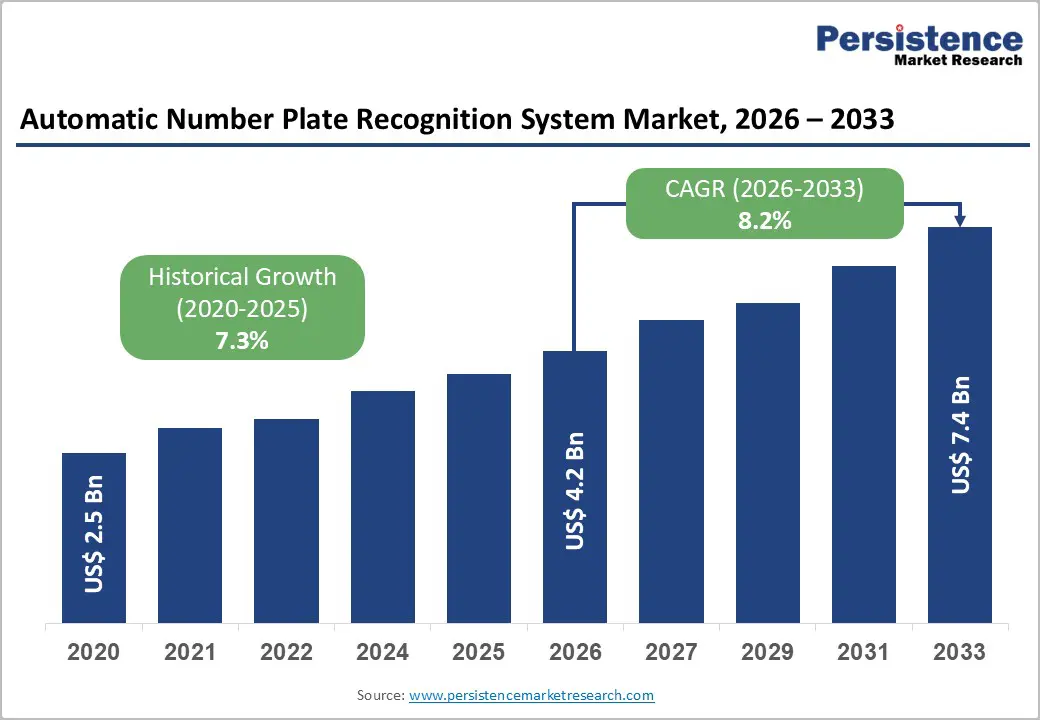
The global automatic number plate recognition system market size was valued at US$ 4.2 billion in 2026 and is projected to reach US$ 7.3 billion by 2033, growing at a CAGR of 8.2% between 2026 and 2033. The market is primarily driven by escalating urbanization and traffic congestion in metropolitan areas worldwide, coupled with increasing government investments in intelligent transportation systems and smart city initiatives. Law enforcement agencies continue to expand their adoption of ANPR technology for crime prevention and vehicle tracking.
Key Market Highlights
Market Highlights
- Leading Region: North America dominates the automatic number plate recognition system market with approximately 38% global share, driven by extensive law enforcement adoption, advanced technology infrastructure, and substantial government investments in intelligent transportation systems and smart city initiatives across major metropolitan areas.
- Fastest growing region: Asia-Pacific emerges as the fastest-growing region with a projected 10.8% CAGR through 2033, fueled by rapid urbanization, escalating vehicle ownership, government-led smart city development programs, and increasing investments in intelligent transportation infrastructure across China, India, and ASEAN nations.
- Dominant segment: Fixed ANPR Systems dominate, commanding 58% market share due to superior accuracy, robust performance in adverse weather, enhanced imaging technology, and comprehensive coverage for large-scale traffic management and law enforcement applications.
- Fastest growing segment: The software segment represents the fastest-growing component category with a projected 10.6% CAGR through 2033, driven by escalating adoption of cloud-based solutions, AI-powered analytics, and advanced optical character recognition technologies for data-driven traffic management and automation.
- Key market opportunity: Traffic Management constitutes the primary application segment, capturing 43% market share, leveraging ANPR technology for real-time violation detection, electronic fine generation, congestion mitigation, and intelligent signal control in support of smart city infrastructure development.
| Key Insights | Details |
|---|---|
|
Automatic Number Plate Recognition System Market Size (2026E) |
US$ 4.2 Bn |
|
Market Value Forecast (2033F) |
US$ 7.3 Bn |
|
Projected Growth (CAGR 2026 to 2033) |
8.2% |
|
Historical Market Growth (CAGR 2020 to 2024) |
7.3% |
Market Dynamics
Market Growth Drivers
Increasing Urban Traffic Congestion and Smart City Initiatives
Rapid urbanization across developing economies, particularly in the Asia-Pacific region, is significantly contributing to traffic congestion in major metropolitan areas. Governments in cities such as Delhi, Mumbai, Shanghai, and Bangkok are implementing advanced intelligent transportation systems (ITS) that integrate ANPR technology as a core component for real-time traffic monitoring and enforcement. According to global urbanization data, approximately 55% of the world's population currently resides in urban areas, and this figure is expected to reach 68% by 2050, intensifying demand for sophisticated traffic management solutions. ANPR systems enable authorities to monitor vehicle movements, automatically detect traffic violations, and generate electronic fines (e-challans) without manual intervention. The integration of ANPR with artificial intelligence (AI) and machine learning algorithms enhances the accuracy of traffic enforcement, with modern systems achieving recognition rates exceeding 95% under various environmental conditions. This technological advancement is transforming traffic management from reactive to proactive, allowing cities to optimize signal timings and reduce congestion-related delays by up to 30%, as demonstrated by successful implementations in select jurisdictions.
Rising Vehicle Theft and Law Enforcement Security Needs
The escalating global vehicle theft crisis has become a critical driver of ANPR adoption among law enforcement agencies. According to international crime prevention statistics, approximately 71% of law enforcement departments in the United States have integrated ANPR systems into their patrol vehicles and fixed infrastructure to track stolen vehicles, identify wanted offenders, and reconstruct crime scenes with precision. ANPR technology enables real-time scanning of vehicle license plates against national crime databases, allowing officers to locate stolen vehicles within hours rather than days. The UK operates one of the world's largest ANPR networks, with approximately 8,000 cameras that capture 25 million records daily and store this data for up to two years in centralized databases accessible to law enforcement authorities. In the United States, the integration of ANPR systems with predictive policing strategies has proven effective in identifying wanted felons and missing persons, with companies like Flock Safety reporting that their ANPR technology assists in solving over 600-700 crimes daily, representing approximately 3% of all reported crimes in the country. This demonstrated effectiveness in crime prevention and investigation is encouraging additional investments from government agencies and commercial security firms globally.
Market Restraints
Data Privacy Concerns and Regulatory Compliance Challenges
The implementation of ANPR technology has generated significant concerns regarding personal data protection and surveillance practices, particularly in Europe, where the General Data Protection Regulation (GDPR) imposes stringent requirements on data collection and storage. Organizations violating GDPR face penalties of up to €20 million or 4% of global annual revenue, whichever is higher, creating substantial compliance costs for ANPR system providers and operators. License plate information is classified as highly sensitive personal data under GDPR, requiring encryption, secure storage, and limited-access protocols, which add complexity and expense to system implementation.
Privacy advocacy organizations, including the American Civil Liberties Union (ACLU), have raised concerns about mass surveillance enabled by ANPR networks, citing risks of unauthorized tracking of citizens' movements and potential misuse of accumulated data. Different jurisdictions maintain varying legal frameworks governing ANPR deployment, creating a fragmented compliance landscape that complicates the rollout of standardized solutions across multiple regions.
High Initial Capital Investment and Implementation Complexity
The deployment of comprehensive ANPR systems requires substantial upfront capital investment, encompassing specialized cameras, software licensing, backend infrastructure, and integration with existing transportation management systems. Fixed ANPR systems require permanent installation at strategic locations, including toll booths, border crossings, city entry points, and major traffic intersections, with hardware costs varying significantly based on specifications and detection range. The complexity of integrating ANPR technology with legacy traffic management systems, especially in older cities with fragmented infrastructure, necessitates extensive system redesign and reconfiguration, which extends implementation timelines and increases the total cost of ownership. Additionally, the requirement for continuous software updates to accommodate new license plate designs, evolving character recognition standards, and changing regulatory requirements represents an ongoing operational expense that smaller municipalities and developing nations' governments find challenging to sustain economically.
Market Opportunities
Artificial Intelligence and Machine Learning Integration for Enhanced Accuracy
The convergence of artificial intelligence (AI), machine learning, and deep learning technologies with ANPR systems represents a significant growth opportunity, as these advanced algorithms dramatically improve recognition accuracy and expand operational capabilities. Modern AI-powered ANPR systems employ convolutional neural networks (CNNs) and optical character recognition (OCR) techniques that can recognize license plates across more than 160 countries, with varied font styles, color combinations, and customized designs, even when plates are partially obscured or damaged. The integration of machine learning algorithms enables ANPR systems to continuously learn from real-world data and adapt to diverse environmental conditions, including poor lighting, rain, fog, and high-speed vehicle movement, achieving accuracy improvements of 5-10% compared to traditional algorithmic approaches. Adaptive Recognition introduced its Carmen Cloud platform in October 2024, a cloud-based ANPR solution that includes the innovative Transport API for railway, container, and commercial vehicle code recognition, expanding application possibilities beyond traditional vehicle plate recognition.
Expansion of Smart Parking and Access Control Applications
Smart parking management represents an emerging high-growth opportunity for ANPR technology adoption, driven by severe parking space shortages in dense urban centers and the growing demand for friction-free access control solutions. ANPR-based parking systems enable automated vehicle entry and exit without manual ticket validation, with drivers simply entering their license plate numbers at payment kiosks or through mobile applications, significantly reducing transaction times and improving customer experience. Modern smart parking systems integrate ANPR cameras with real-time occupancy sensors, digital signage, and centralized video management systems to guide drivers to vacant spaces, thereby reducing circulating traffic associated with parking searches by up to 30% in well-implemented systems. Private sector adoption is accelerating in data centers, financial institutions, hospitals, manufacturing facilities, and research installations where controlled access, comprehensive monitoring, and enhanced security are critical operational requirements. The parking management segment is expected to experience particularly robust growth as commercial property owners and operators recognize the operational efficiencies and revenue-enhancement opportunities enabled by pay-by-plate ANPR solutions.
Category-wise Insights
Product Type Analysis
Fixed ANPR Systems represent the dominant segment in the Automatic Number Plate Recognition System market, commanding approximately 58% of market share in 2026. Fixed systems are permanently installed at strategic locations including toll collection plazas, border crossings, city entry points, highway checkpoints, and high-traffic intersections, providing continuous round-the-clock surveillance and vehicle identification capabilities. The superiority of fixed systems stems from their enhanced accuracy under varying environmental conditions, robust performance in adverse weather, and integration with intelligent transportation management infrastructure. Modern fixed ANPR systems utilize advanced imaging technologies including high-resolution infrared cameras, rapid-processing units, and AI-powered plate recognition algorithms that achieve real-time performance even during periods of peak traffic volume. The reliability and comprehensive coverage offered by fixed ANPR systems make them the preferred choice for large-scale traffic management applications, law enforcement operations, and critical infrastructure protection.
Component Analysis
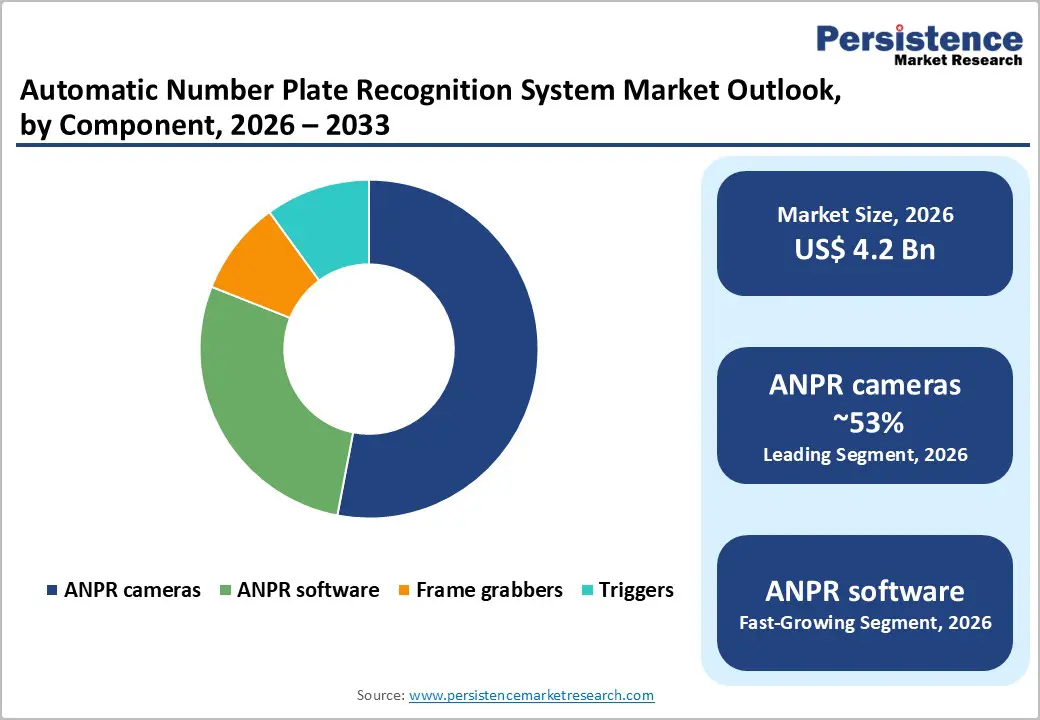
ANPR Cameras dominate the hardware component segment, accounting for approximately 53% of the hardware component market share, serving as the foundational technology that captures vehicle license plate information. ANPR cameras are engineered with specialized features, including infrared illumination for night vision, high-definition sensors for clear plate detection, long-range detection up to 30 meters, and weatherproof designs with IP67 or IP68 ratings for durability in harsh environments. The software component segment is projected to grow at the fastest rate, expanding at approximately 10.6% CAGR through 2033, as organizations increasingly require sophisticated optical character recognition (OCR) technology, cloud-based processing platforms, and AI-driven analytics for comprehensive vehicle data management. Modern ANPR software leverages deep learning frameworks such as TensorFlow and the OpenCV library to efficiently process image data, recognize characters with higher accuracy, and integrate seamlessly with existing transportation management systems.
Applications Analysis
Traffic Management emerges as the leading application segment, capturing approximately 43% of the global ANPR market share in 2026, driven by intensifying urban congestion and government mandates for intelligent transportation systems. ANPR technology enables real-time detection of traffic violations, including speeding, red-light violations, and restricted lane use, and automatically generates electronic fines to enhance compliance without requiring police officer intervention. Municipalities worldwide are deploying ANPR systems as core components of integrated command and control centers that monitor traffic flow across entire city networks, optimize signal timing dynamically based on vehicle density, and provide actionable intelligence for urban planning initiatives. Countries implementing advanced ANPR-based traffic enforcement have documented significant improvements in road safety metrics, with some jurisdictions achieving accident rate reductions exceeding 15% through enhanced compliance with traffic regulations. The integration of ANPR with variable message signs, real-time traffic information systems, and route optimization algorithms creates comprehensive intelligent transportation ecosystems that appeal to transportation authorities seeking data-driven solutions for congestion mitigation.
End-User Analysis
Government institutions represent the dominant end-user category, commanding approximately 55% of the global ANPR market share in 2026, reflecting substantial public sector investments in law enforcement capabilities, traffic management infrastructure, and national security initiatives. Government agencies, including federal, state, and local law enforcement departments, are investing heavily in ANPR deployment for crime prevention, stolen vehicle recovery, border surveillance, and counterterrorism operations. The United States Department of Homeland Security has mandated ANPR installation at critical infrastructure sites, including airports, seaports, embassies, military installations, and government buildings, as part of broader perimeter security and access control initiatives. Public sector adoption is further accelerated by government funding programs specifically targeting intelligent transportation system development and smart city infrastructure modernization across developing nations.
Regional Insights
North America Automatic Number Plate Recognition System Trends
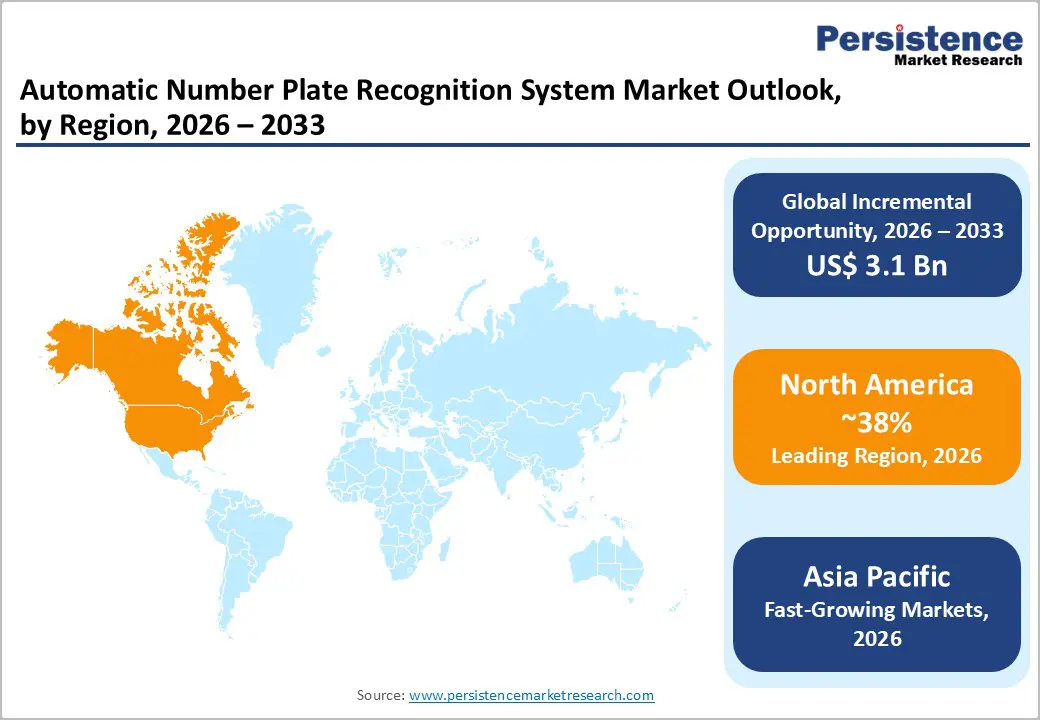
North America maintains market leadership with approximately 38% of global ANPR market share in 2026, primarily driven by extensive law enforcement adoption, advanced technology infrastructure, and substantial government investments in intelligent transportation systems. The United States has emerged as the world's largest ANPR market, with widespread deployment across federal, state, and local law enforcement agencies utilizing the technology for vehicle identification, crime investigation, and public safety enhancement.
The North American electronic toll collection market is experiencing significant growth, with automated tolling systems increasingly incorporating ANPR technology alongside RFID and video-based systems to reduce congestion and improve revenue assurance. Transportation agencies across major metropolitan areas, including New York, Boston, Los Angeles, and Chicago, are deploying multi-modal tolling solutions that leverage ANPR accuracy for violation enforcement, with some implementations achieving 15% improvements in processing efficiency and revenue collection integrity.
Europe Automatic Number Plate Recognition System Trends
Europe represents a mature ANPR market characterized by sophisticated regulatory frameworks, extensive government deployment, and growing emphasis on data privacy compliance. The United Kingdom operates one of the world's most comprehensive ANPR networks, with approximately 8,000 cameras deployed across the national infrastructure, capturing 25-30 million records daily and storing this data in centralized databases accessible to authorized law enforcement authorities. GDPR compliance has become a critical market dynamic in Europe, with solution providers investing substantially in encryption technologies, data anonymization protocols, and secure cloud infrastructure to meet stringent privacy requirements.
Germany, France, Spain, and the United Kingdom have implemented nationally standardized ANPR infrastructure supporting both traffic law enforcement and crime investigation activities. These countries have documented substantial public safety benefits from ANPR deployment, including enhanced capacity to investigate organized crime, prevent terrorism, and recover stolen vehicles. The European ANPR market is benefiting from harmonized regulatory frameworks and increasing adoption by commercial operators for parking management, access control at secure facilities, and fleet tracking applications.
Asia Pacific Automatic Number Plate Recognition System Trends
Asia-Pacific is emerging as the fastest-growing ANPR market region, with a projected CAGR of approximately 10.8% through 2033, driven by rapid urbanization, rising vehicle ownership, and government-led smart city initiatives. China is experiencing an unprecedented ANPR deployment as a cornerstone of its smart city infrastructure programs, with major metropolitan areas installing thousands of cameras for traffic management, public safety enhancement, and integrated surveillance. The rapid urbanization of China's population, coupled with vehicle ownership rates growing at approximately 15% annually in major cities, is creating sustained demand for advanced traffic management solutions incorporating ANPR technology.
India represents a substantial growth opportunity, with the government actively promoting smart city projects under the Smart Cities Mission, which targets the development of intelligent transportation systems in 100 cities nationwide. Major metropolitan areas including Delhi, Mumbai, Bengaluru, Hyderabad, and Chennai are implementing ANPR-based traffic management systems to address severe congestion and enforce traffic regulations. The Indian government's recent announcement in July 2026 regarding the integration of ANPR technology into the Delhi Police e-Beat Book mobile application demonstrates accelerating adoption momentum.
Competitive Landscape
The Automatic Number Plate Recognition System market exhibits a fragmented competitive structure with numerous regional and international players competing across various application segments and geographic markets. Leading companies, including Kapsch TrafficCom, Siemens, Conduent Inc., HikVision, Genetec Inc., Axis Communications, and Bosch Security Systems, maintain significant market presence through established distribution networks, technological innovation, and comprehensive product portfolios.
Market consolidation is gradually occurring as larger conglomerates acquire specialized ANPR technology providers to expand capabilities and geographic reach. Key competitive strategies include continuous investment in AI and machine learning technologies to improve recognition accuracy, development of cloud-based SaaS solutions to reduce customer capital expenditure, and strategic partnerships with transportation authorities and smart city developers.
Key Market Developments
- In July 2026, Adaptive Recognition Inc. expanded its Einar camera family with the Einar Super Tele, a long-range ANPR+MMR camera capable of recognizing vehicle make, color, model, category, body type, and generation. Designed for modern, infrastructure-sensitive environments, it delivers powerful performance while supporting seamless, frictionless operations.
- In February 2026, Kapsch TrafficCom AG, a major player in tolling systems across North America, launched its latest automatic number plate recognition engine. This advanced technology is designed to deliver enhanced performance, greater versatility, and improved cost efficiency, establishing a new standard in license plate recognition.
Companies Covered in Automatic Number Plate Recognition System Market
- Kapsch TrafficCom
- Siemens
- Conduent Inc.
- HikVision
- Q-Free ASA
- Genetec Inc
- Axis communication
- Nedap
- ARH Incorporation
- Bosch security systems
- Other Key Players
Frequently Asked Questions
The global Automatic Number Plate Recognition System market was valued at US$ 4.2 billion in 2026 and is projected to reach US$ 7.3 billion by 2033, expanding at a CAGR of 8.2% during the forecast period.
The primary demand drivers for the ANPR market include increasing urban traffic congestion necessitating sophisticated management solutions, rising vehicle theft rates driving law enforcement adoption, expanding government smart city initiatives globally, growing requirements for automated toll collection systems.
Fixed ANPR Systems dominate the market with approximately 58% market share, owing to their superior accuracy, continuous surveillance capabilities, robust performance in adverse weather conditions, and extensive deployment at toll plazas, border crossings, city entry points, and high-traffic intersections for comprehensive traffic management and law enforcement applications.
North America currently leads the ANPR market with approximately 38% global market share, driven by extensive law enforcement adoption across 71% of U.S. police departments, advanced technology infrastructure, substantial government investments in intelligent transportation systems, and deployment of sophisticated ANPR networks for crime prevention, vehicle tracking, and traffic management.
Key market players in the ANPR market include Kapsch TrafficCom, Siemens, Conduent Inc. and HikVision.


