ID: PMRREP30453| 275 Pages | 8 Jan 2026 | Format: PDF, Excel, PPT* | Healthcare

The global Dental Fiberglass Posts market size is expected to be valued at US$ 94.5 million in 2026 and projected to reach US$ 141.4 million by 2033, growing at a CAGR of 5.9% between 2026 and 2033.
Increasing prevalence of endodontic treatments, driven by rising dental caries and trauma cases, alongside the shift toward aesthetic and minimally invasive restorative dentistry, fuels demand for biocompatible fiber posts that preserve natural tooth structure. Tapered posts dominate due to their biomechanical advantages in stress distribution, while innovations in glass and hybrid fibers enhance compatibility with composite cores and all-ceramic crowns. Aging populations and expanding dental clinics in North America, Europe, and the Asia Pacific further bolster procedure volumes and the adoption of prefabricated systems.
| Key Insights | Details |
|---|---|
|
Dental Fiberglass Posts Market Size (2026E) |
US$ 94.5 million |
|
Market Value Forecast (2033F) |
US$ 141.4 million |
|
Projected Growth CAGR (2026-2033) |
5.9% |
|
Historical Market Growth (2020-2025) |
5.1% |
Rising demand for aesthetic and minimally invasive endodontic restorations
The preference for aesthetic, metal-free restorations in endodontically treated teeth is a key growth driver for dental fiberglass posts, as these systems offer superior translucency and a modulus of elasticity that matches dentin. Clinical studies demonstrate that glass fiber posts achieve survival rates exceeding 90% over 5 years in anterior restorations, outperforming cast metal posts in fracture resistance and aesthetics. With global emphasis on cosmetic dentistry, posts that integrate seamlessly with resin composites and ceramic crowns enable minimally invasive core build-ups, preserving more tooth structure. This aligns with evolving standards from organizations such as the American Dental Association (ADA), which promote fiber-reinforced systems for predictable outcomes in both single-rooted and multi-rooted teeth.
An aging population and increasing endodontic procedure volumes
Demographic shifts toward older populations are accelerating the need for endodontic treatment, as age-related tooth wear, caries, and root canal treatments necessitate reliable post-core restorations. The World Health Organization (WHO) notes that over 2 billion people worldwide suffer from untreated dental caries, with endodontic interventions rising correspondingly in restorative workflows. Fiber posts excel at distributing occlusal forces evenly, reducing catastrophic root fractures compared to rigid metal alternatives, and in vitro tests show up to 30% higher fracture resistance in fiber systems. This reliability supports broader adoption in clinics focused on longevity and patient retention, particularly as digital dentistry enhances precise post placement and customization.
Technical challenges in bonding and placement precision
Achieving optimal adhesion between fiber posts and resin cements remains challenging, with clinical failure rates linked to debonding reaching 10–15% in some studies, attributed to inconsistencies in surface silanization or moisture contamination during placement. Parallel posts, in particular, demand meticulous canal preparation to avoid stress concentrations, increasing procedural complexity for general practitioners. These factors contribute to variable long-term success, particularly in posterior teeth under high occlusal loads, where fiber posts may underperform compared to customized cast systems.
Higher costs relative to traditional metal posts
Fiber posts command premium pricing, often 2–3 times that of prefabricated metal alternatives, straining budgets in cost-sensitive markets and public health systems. While offering aesthetic and biomechanical benefits, the upfront investment in compatible adhesives, obturation materials, and clinician training offsets savings from reduced re-treatments. Reimbursement limitations in some regions further deter adoption, especially among smaller dental labs and clinics that prioritize cost-effective solutions for high-volume restorative cases.
Hybrid and bioactive fiber post innovations
Advancements in hybrid fiber compositions blending glass and carbon for enhanced strength-to-weight ratios present a compelling opportunity, particularly for high-load posterior restorations. Emerging bioactive coatings promote peri-cervical dentin remineralization, with preliminary studies showing improved marginal integrity and reduced microleakage. As CAD/CAM integration allows custom-milled hybrid posts, manufacturers can target premium segments like hospitals and research institutions seeking next-generation systems with modulus values closer to dentin (18–20 GPa). This positions hybrid fibers as the fastest-growing material, capitalizing on demand for durable, aesthetic solutions in aging demographics undergoing complex rehabilitations.
Expansion into emerging dental markets and digital workflows
The surge in dental clinics across the Asia Pacific and Latin America, coupled with the adoption of digital dentistry, is driving growth for prefabricated and combination posts. With over 1 million new dental professionals entering practice annually in these regions, scalable fiber post kits support minimally invasive techniques like horizontal root fracture management. Companies integrating posts with intraoral scanners and 3D-printed cores can differentiate through workflow efficiency, reducing chair time by 20–30%. Policy shifts toward universal dental coverage in countries like India and Brazil further amplify procedural demand, favoring versatile combination posts that adapt to diverse canal anatomies.
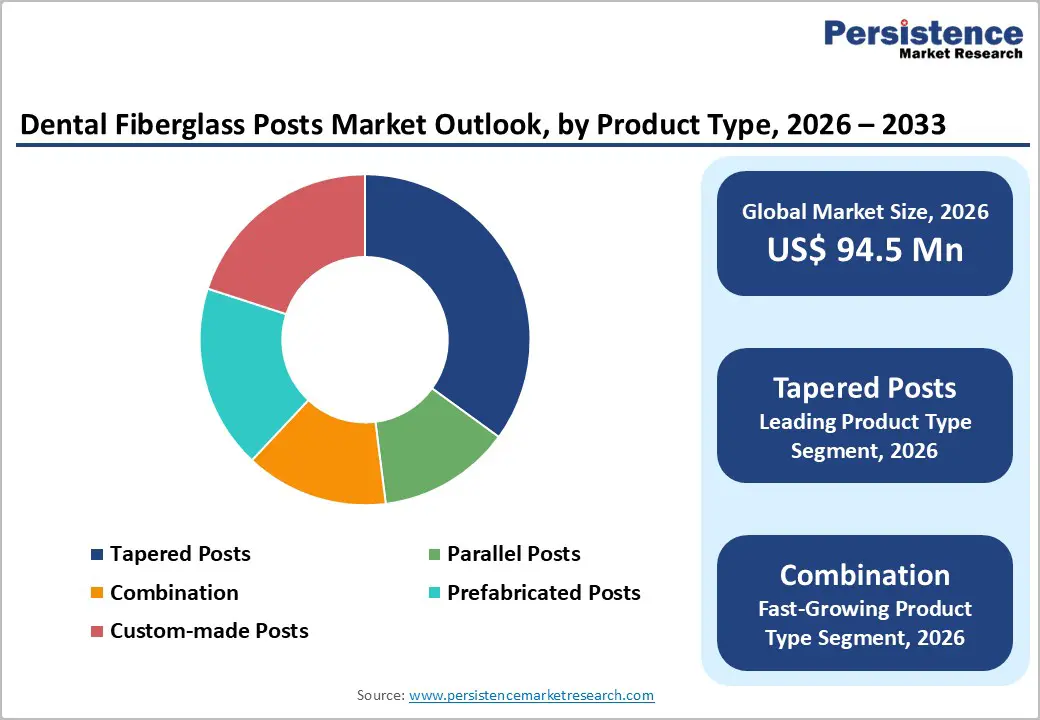
Tapered Posts lead the product type category with approximately 35% market share in 2025, favored for their anatomical conformity and optimal stress distribution in tapered root canals. Clinical evaluations confirm that tapered designs preserve more dentin during preparation while minimizing wedging forces, achieving a 95% success rate at 12 months in anterior restorations. Their compatibility with rotary instrumentation and obturation systems streamlines workflows, making them the go-to for routine endodontics in dental clinics. Leading manufacturers such as 3M ESPE, Ivoclar Vivadent AG, and Dentsply Sirona Inc. offer translucent tapered posts that blend aesthetically with all-ceramic crowns, reinforcing their dominance in cosmetic-driven markets.
Glass Fiber dominates the material segment, holding an estimated 65% share in 2025, owing to its dentin-like elastic modulus (18–22 GPa) and excellent light transmission, which support aesthetic harmony. Prospective studies report glass fiber posts outperforming carbon variants in fracture resistance, with higher survival rates in load-bearing anterior teeth restored with porcelain-fused-to-metal crowns. The material's radiolucency facilitates periapical assessment, while silane-treated surfaces ensure reliable bonding to dual-cure resins. Hybrid Fiber emerges as the fastest-growing, combining glass's aesthetics with carbon's rigidity for posterior applications, supported by innovations from Coltene Holding AG and VOCO GmbH.
Dental Clinics represent the leading end-user segment, commanding about 55% market share in 2025, driven by high volumes of restorative procedures in private practices. With millions of endodontically treated teeth annually, clinics prioritize prefabricated glass fiber posts for their ease of inventory and immediate chairside use. Hospitals and academic institutions follow, focusing on complex cases, but dental clinics' shift to digital workflows accelerates the tapering and combination post-adoption. Dental Labs are the fastest-growing end-user, as CAD/CAM enables custom-milled posts for high-end prosthetics, aligning with rising demand for personalized restorations.
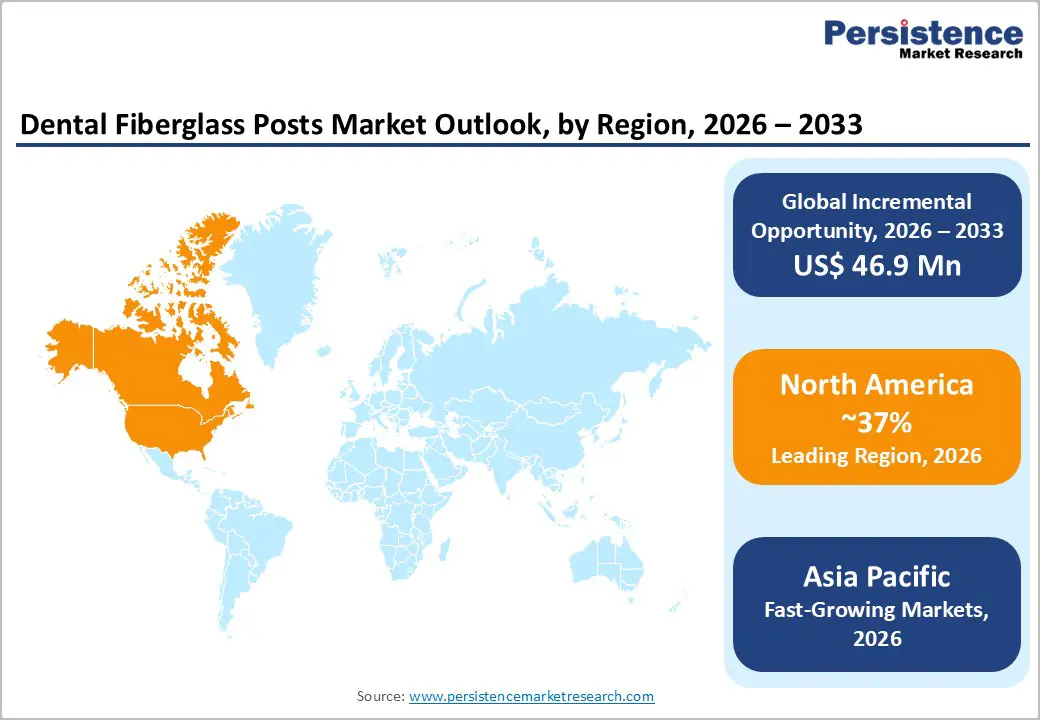
North America remains the leading region in the dental fiberglass posts market, commanding the largest share of global demand thanks to highly advanced dental care infrastructure, strong patient awareness of aesthetic and metal-free restorative options, and widespread adoption of cutting-edge dental materials and techniques. The U.S. market, which accounts for the majority of regional sales, is driven by an aging population requiring more endodontic and cosmetic procedures, robust dental insurance coverage, and the rapid adoption of digital dentistry solutions such as CAD/CAM-assisted placements. Canada and Mexico are also contributing steadily to growth. Continued innovation by key manufacturers, favorable reimbursement environments, and rising preference for minimally invasive, durable restorations are central to sustained market expansion in North America.
Asia Pacific is emerging rapidly as a key growth region in the dental fiberglass Posts market, driven by several structural and demand-side trends. Rapid expansion of dental care infrastructure and rising disposable incomes in countries like China, India, Japan, and Southeast Asian nations are boosting access to advanced restorative dentistry, including fiberglass post solutions. Growing awareness of dental aesthetics and minimally invasive treatments is increasing patient demand, while the region’s expanding middle-class population and rising dental tourism are further accelerating uptake. Adoption of digital dentistry technologies such as CAD/CAM is improving clinical outcomes and fueling preference for fiberglass posts over metal alternatives. Affordable treatment costs and supportive healthcare initiatives are also encouraging more clinics to offer modern restorative options. Overall, Asia Pacific is not only growing faster than many mature markets but is also shaping future demand through innovation and volume-led expansion.
The competitive landscape of the dental fiberglass posts market is shaped by intense rivalry and innovation. Established players compete on product quality, mechanical performance, and aesthetic appeal, while smaller specialists focus on niche, high-end solutions. Companies invest heavily in R&D, new material formulations, and advanced manufacturing technologies to differentiate offerings and meet evolving clinical needs. Strategic partnerships, expanded distribution networks, and collaborations with dental clinics and research institutions help brands strengthen their presence and reach.
The global Dental Fiberglass Posts market is forecasted to reach US$ 94.5 million in 2026, propelled by aesthetic dentistry trends and rising endodontic procedures.
Key demand driver is the shift to metal-free, aesthetic restorations, with glass fiber posts offering 90%+ survival rates and dentin-like properties in endodontically treated teeth.
North America leads with 37% share in 2025, supported by U.S. clinics' adoption, FDA approvals, and innovations from 3M ESPE and Dentsply Sirona.
Hybrid bioactive fibers for digital workflows in Asia Pacific labs and hospitals, improving strength and integration in complex posterior restorations.
Key players include 3M ESPE, Ivoclar Vivadent AG, Dentsply Sirona Inc., Coltene Holding AG, VOCO GmbH, Ultradent Products Inc., and Danaher Corporation.
| Report Attribute | Details |
|---|---|
|
Historical Data/Actuals |
2020 – 2025 |
|
Forecast Period |
2026 – 2033 |
|
Market Analysis Units |
Value: US$ Mn, Volume: As Applicable |
|
Geographical Coverage |
|
|
Segmental Coverage |
|
|
Competitive Analysis |
|
|
Report Highlights |
|
Product Type
Material
End User
Regions
Delivery Timelines
For more information on this report and its delivery timelines please get in touch with our sales team.
About Author