




- Medical Devices
- Asia Pacific Dental Crowns and Bridges Market
Asia Pacific Dental Crowns and Bridges Market Size, Share, and Growth Forecast 2026 - 2033
Asia Pacific Dental Crowns and Bridges Market by Product (Crowns, Bridges), Material (Ceramics, Porcelain-Fused-to-Metal (PFM), Metals & Metal Alloys, Resin-based materials), End-user, Country Analysis, 2026 - 2033

Asia Pacific Dental Crowns and Bridges Market Size and Trend Analysis
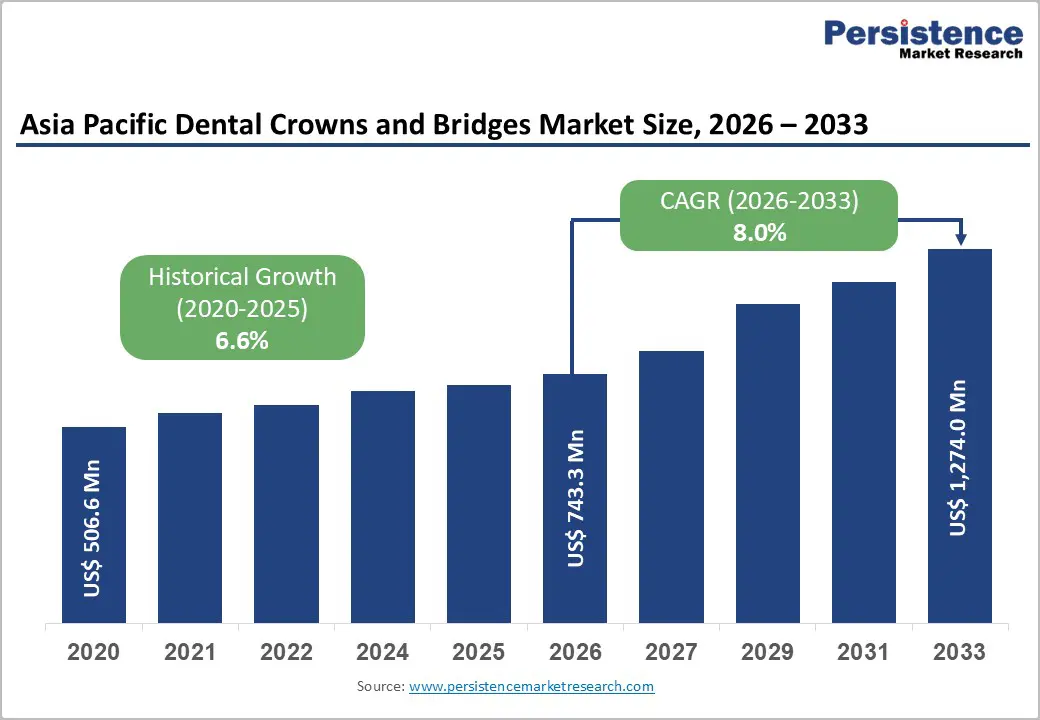
The Asia Pacific dental crowns and bridges market size is expected to be valued at US$ 743.3 million in 2026 and projected to reach US$ 1,274.0 million by 2033, growing at a CAGR of 8.0% between 2026 and 2033.
The rapid rise in digital dentistry is transforming the Asia Pacific dental crowns and bridges market. Computer-Aided Design and Computer-Aided Manufacturing (CAD/CAM) technology is primarily driving constant innovation in the market. The unique approach streamlines the design and manufacturing of dental restorations, offering unparalleled precision, speed, and efficiency. Traditionally, crafting crowns and bridges required labour-intensive processes and multiple patient visits.
CAD/CAM technology, however, enables same-day restorations by integrating digital impressions, virtual design, and automated milling or 3D printing. This not only reduces turnaround times but also enhances patient satisfaction by minimizing the number of clinic visits.
Key Industry Highlights:
- China is expected to remain the largest market in Asia Pacific Dental Crowns and Bridges due to its ageing population, increasing oral health awareness, and expanding policy support for restorative dental procedures.
- India is projected to be the fastest-growing market, supported by high caries prevalence, expanding private dental clinics, rising disposable income, and strong dental tourism for affordable crowns and bridges.
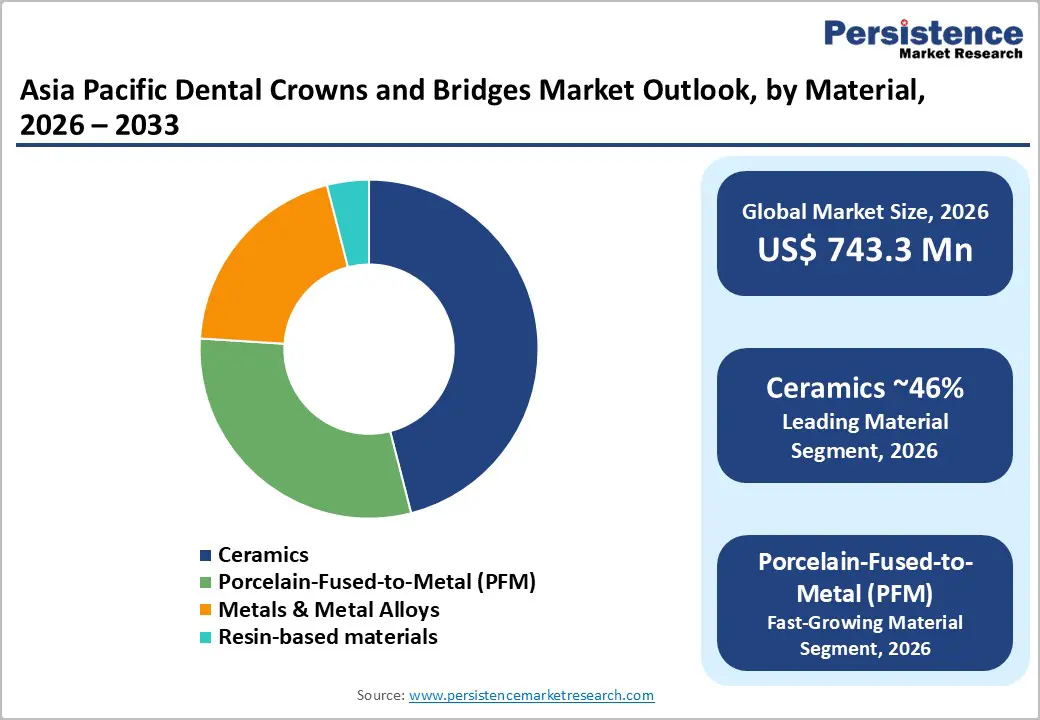
- Ceramics dominate the material segment as patients prefer metal-free, tooth-colored restorations, while advances in zirconia and lithium disilicate improve durability, aesthetics, and long-term clinical performance.
- Dental clinics represent the leading end-user segment, driven by accessibility, specialized prosthodontic services, and increasing adoption of CAD/CAM technologies enabling faster and customized crown and bridge treatments.
- Key opportunities lie in expanding digital dentistry platforms, improving insurance coverage, and developing affordable ceramic crown and bridge solutions for underserved middle-income and ageing populations across Asia Pacific.
| Key Insights | Details |
|---|---|
|
Asia Pacific Dental Crowns and Bridges Market Size (2026E) |
US$ 743.3 million |
|
Market Value Forecast (2033F) |
US$ 1,274.0 million |
|
Projected Growth CAGR (2026–2033) |
8.0% |
|
Historical Market Growth (2020–2025) |
6.6% |
Market Dynamics
Drivers - Rising Burden of Oral Diseases and Edentulism
The Asia Pacific region faces a substantial and growing burden of untreated dental caries, periodontal disease, and tooth loss, directly supporting demand for crowns and bridges as definitive restorative solutions. The WHO South-East Asia Region alone reported around 900 million cases of untreated dental caries, severe periodontal disease, and edentulism in 2019, while the Western Pacific Region has more than 800 million people living with oral diseases. Global burden of disease analyses show that edentulism and severe periodontitis remain highly prevalent among older adults, especially in middle age. income countries where access to early care is limited. As tooth loss is the final pathway of cumulative disease, the need for fixed prosthetic rehabilitation through crowns and bridges is expected to rise in line with this underlying oral disease load.
Growing Trend for Aesthetic Dentistry to Support Growth
Increasing adoption of aesthetic dentistry is significantly augmenting demand for dental crowns and bridges in the Asia Pacific. As societal standards evolve, there is a growing emphasis on physical appearance, particularly among younger populations who are more conscious of their smiles and facial aesthetics.
The rapid shift is driving surging demand for natural-looking dental restorations that blend seamlessly with natural teeth. It is further driving demand for materials such as zirconia and lithium disilicate, which offer superior aesthetics and durability. Growing awareness of the long-term benefits of aesthetic solutions is prompting patients to opt for high-quality, durable artificial dental crowns. These not only improve appearance but also function effectively for years.
Restraints - High Treatment Costs and Affordability Gaps
High treatment costs for dental crowns and bridges present a significant barrier to widespread adoption, particularly in developing countries across the Asia Pacific. The cost of artificial tooth caps encompasses several factors, including the price of high-quality materials such as porcelain, zirconia, and metal alloys, which can be prohibitively expensive for several patients.
The procedures involved require skilled labor and specialized dental equipment, further driving up the total cost. In nations with lower average incomes, such as India, Indonesia, and the Philippines, this expense is often beyond the reach of the general population, limiting access to essential dental restorative treatments.
Opportunities - Expansion of Digital Dentistry, CAD/CAM, and Chairside Workflows
The rapid diffusion of CAD/CAM systems, intraoral scanners, and 3D printing in the Asia Pacific is reshaping the economics and clinical appeal of crown and bridge procedures. Digital impressions and automated milling enable same-day or single-visit restorations, reducing patient inconvenience and chair time while allowing laboratories to scale production efficiently. Persistence Market Research highlights digital dentistry as a key growth driver for crowns and bridges in Japan, South Korea, and China, where clinics are increasingly investing in in-house milling units and high-performance ceramic blocks. Vendors that bundle materials, software, and equipment and offer training for mid-sized dental clinics across India, China, and ASEAN can capture significant incremental volume as practices shift from analogue workflows to digitally driven prosthetic planning and fabrication.
Category-wise Analysis
Product Insights
Within the Asia Pacific Dental Crowns and Bridges market, single-tooth crowns represent the leading product category, reflecting the high prevalence of localized tooth decay, fractures, and endodontically treated teeth that can be preserved rather than extracted. Clinical and epidemiological studies in emerging economies such as India indicate that partial edentulism and compromised single teeth are far more common than complete tooth loss, especially in adults aged 45–64, which structurally favours crown placement over multi-unit bridges. Crowns are also widely used in conjunction with dental implants for single-tooth replacement, a segment benefiting from falling implant prices and growing middle-class purchasing power in China, Thailand, and India. As patients increasingly seek minimally invasive and aesthetic restorations, the versatility of crowns in both tooth and implant-supported indications underpins their continued dominance in procedure volumes across the region.
Material Analysis
By material, ceramics form the leading segment, accounting for about 46% of the Asia Pacific Dental Crowns and Bridges market in 2025, supported by their superior aesthetics, biocompatibility, and improved mechanical performance. The shift from traditional metal-based prostheses toward metal-free or high-translucency ceramic systems mirrors broader cosmetic dentistry trends, especially among urban, higher-income populations in Japan, South Korea, China, and Australia. Advances in high-strength zirconia and lithium disilicate ceramics allow clinicians to fabricate anterior and posterior crowns and short-span bridges that combine lifelike translucency with long-term durability, making them suitable for a wide range of indications. As patients become more aware of the aesthetic limitations and potential hypersensitivity associated with visible metal margins, ceramic and hybrid ceramic systems are expected to deepen their share at the expense of conventional metal alloys, even in cost-sensitive markets.
End User Analysis
Among end users, dental clinics constitute the leading channel for crowns and bridges in the Asia Pacific, leveraging their accessibility, procedural focus, and growing adoption of digital technologies. Persistence Market Research estimates that dental clinics account for approximately 28.9% of regional revenues, ahead of hospitals and academic centres, reflecting their role as the first point of contact for most restorative treatments. Private clinic chains and corporate dental networks have expanded rapidly in countries such as India, China, and Vietnam, bringing CAD/CAM-enabled crown and bridge services into tier-2 cities and affluent peri-urban locations. Clinics are also better positioned to bundle crowns and bridges with preventive care, orthodontics, and implantology, creating integrated treatment journeys that appeal to increasingly quality and convenience-oriented consumers.
Regional Insights
China Dental Crowns and Bridges Market Trends and Insights
China represents the largest national market within the Asia Pacific dental crowns and bridges, supported by its large population, rising middle-class incomes, and increasing awareness of oral health. Studies of older adults indicate that approximately one in four people aged 60+ in China are edentulous, but around two-thirds have been rehabilitated, often through prosthetic solutions such as crowns and bridges. At the same time, dental care remains underinsured, with more than 85% of dental expenditures historically paid out of pocket, although recent health reforms aim to extend coverage to basic restorative procedures.
Policy initiatives are beginning to shift crowns and bridges from luxury services toward more affordable care. In the adjacent implant segment, centralized procurement by the National Healthcare Security Administration (NHSA) has cut average single-implant costs by more than 50%, catalyzing volume growth and indirectly supporting demand for implant-supported crowns. The inclusion of oral health goals in the Healthy China 2030 blueprint and ongoing pilot expansions of dental benefits within social medical insurance are expected to gradually reduce financial barriers and drive broader uptake of fixed prosthodontics among older and middle-income Chinese patients.
Japan Dental Crowns and Bridges Market Trends and Insights
In Japan, demographic structure is the dominant driver of demand, as the country has the world’s highest proportion of older citizens. Official statistics show that people aged 65 and over accounted for about 29–29.3% of the total population in 2023–2024, with more than 10% aged 80+, and projections indicating further ageing in the coming decades. These demographics translate into high prevalence of tooth wear, root caries, and multi-surface restorations, for which crowns and fixed bridges are the standard of care within Japan’s well-developed dental system.
Japan’s universal health insurance system covers many basic dental procedures, but patients often self-pay for premium ceramic materials or implant-supported crowns to achieve better aesthetics and function. The country is also at the forefront of digital dentistry innovation, with early adoption of CAD/CAM blocks, chairside milling, and AI-assisted diagnostic tools in university and private clinics. Growing interest in minimally invasive and cosmetic dentistry among working-age adults, combined with public campaigns on oral health and cancer screening, supports steady procedural growth in crowns and bridges, even as the overall population declines.
India Dental Crowns and Bridges Market Trends and Insights
India is emerging as the fastest-growing market for dental crowns and bridges in Asia Pacific, underpinned by a large young population that is rapidly ageing, high unmet oral-health needs, and expanding private dental infrastructure. Meta-analyses estimate that around 51% of Indian adults have some form of periodontal disease, while surveys of adults aged 45+ show partial edentulism rates exceeding 60%, indicating a large pool of candidates for restorative care. The WHO South-East Asia Region reports hundreds of millions of untreated caries and severe periodontal disease cases, many of which are concentrated in populous countries like India. These clinical realities, combined with rising disposable incomes in urban centres, are fuelling strong growth in demand for functional and aesthetic crowns and bridges.
India is also a key hub for dental tourism, offering crowns, bridges, and implant restorations at a fraction of the cost in North America and Western Europe, supported by an English-speaking workforce and improving clinical quality. Corporate clinic chains and organized dental networks are proliferating in major cities, bringing advanced prosthodontic services and CAD/CAM workflows to a broader middle-class base. Ongoing discussions about integrating oral health into national non-communicable disease programmes and expanding insurance coverage for older adults could further accelerate the shift from extraction-based care to restorative dentistry, positioning India as a key growth engine within the regional crowns and bridges market.
Competitive Landscape
The competitive landscape of the Asia Pacific dental crowns and bridges market is moderately consolidated, with global dental technology companies competing alongside regional manufacturers and dental laboratories. Major players focus on expanding product portfolios, particularly ceramic and zirconia restorations, while investing in digital dentistry technologies such as CAD/CAM systems to improve precision and treatment efficiency. Strategic collaborations with dental clinics and laboratories, regional distribution expansion, and localized manufacturing are common strategies to strengthen market presence. Companies are also increasing R&D investments to develop durable, aesthetic materials and cost-effective solutions tailored to the rapidly growing patient population across emerging Asia Pacific markets.
Key Developments:
- April 2024, Zimmer Holdings, Inc., based in the U.S., completed the acquisition of Biomet in a transaction valued at around US$ 13.35 Bn. It included both cash and stock, as well as the assumption of net debt.
- In May 2025, Glidewell introduced Fusion with BruxZir™ Zirconia, an advanced bilayered dental restoration developed to closely replicate the natural appearance and strength of real teeth.
Companies Covered in Asia Pacific Dental Crowns and Bridges Market
- Dentsply Sirona
- Nobel Biocare Services AG (Envista)
- Institut Straumann AG
- Zimmer Biomet
- DentiumUSA
- 3M
- Osstem Implant
- BioHorizons
- GC International AG
- Kuraray Noritake Dental Inc.
- COLTENE Group
- Others
Frequently Asked Questions
The Asia Pacific dental crowns and bridges market is expected to reach around US$ 743.3 million in 2026.
High untreated dental caries, periodontal disease, ageing populations, growing oral health awareness, and increased adoption of aesthetic, functional crowns and bridges drive market demand.
China leads the Asia Pacific market due to ageing population, expanding middle class, higher restorative procedure volumes, and improving insurance and policy support.
Digital dentistry adoption, including CAD/CAM, intraoral scanning, and 3D printing, offers faster, affordable, aesthetic crowns and bridges in emerging APAC markets.
Leading companies include Dentsply Sirona, Nobel Biocare, Straumann, Zimmer Biomet, Dentium, 3M, Osstem, BioHorizons, GC, Kuraray Noritake, COLTENE, Ivoclar, Shofu, and regional manufacturers.


