




- Medical Devices
- Europe Dental Caries Detectors Market
Europe Dental Caries Detectors Market Size, Share, and Growth Forecast, 2026 - 2033
Europe Dental Caries Detectors Market by Product (Laser Fluorescent Caries Detector, Fiber Optic Trans-illumination Caries Detector, Digital, Intraoral Wand, Single Lens Reflex), End-user (Solo Practices, DSO Practices), and Country Analysis for 2026 - 2033

Europe Dental Caries Detectors Market Size and Trends Analysis
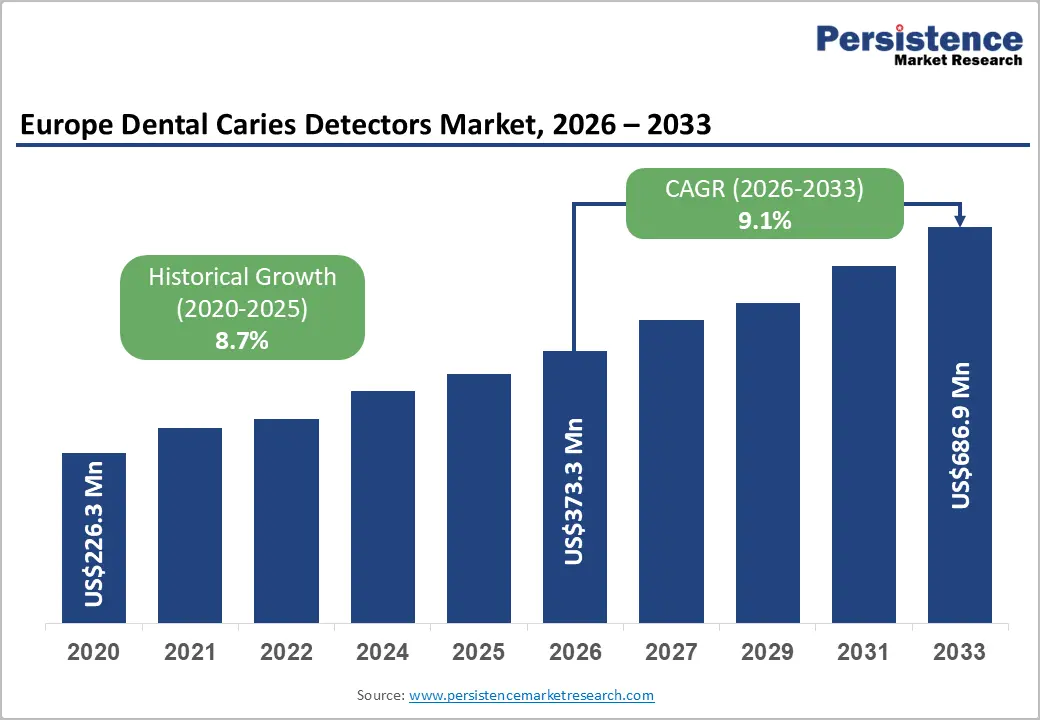
Europe dental caries detectors market size is likely to be valued at US$373.3 million in 2026 and is expected to reach US$686.9 million by 2033, growing at a CAGR of 9.1% during the forecast period from 2026 to 2033, driven by the increasing focus on preventive dentistry, early diagnosis of tooth decay, and adoption of advanced non-invasive diagnostic technologies.
Dental professionals across Europe are increasingly utilizing laser fluorescence and trans-illumination systems to improve diagnostic accuracy and reduce reliance on conventional radiographic methods. According to the World Health Organization (WHO) European Region, oral diseases affected 50.1% of adults in Europe in 2024, the highest prevalence among all WHO regions. Growing awareness of oral health, rising dental care expenditures, and the integration of digital and AI-assisted diagnostic solutions are supporting market expansion.
Key Industry Highlights:
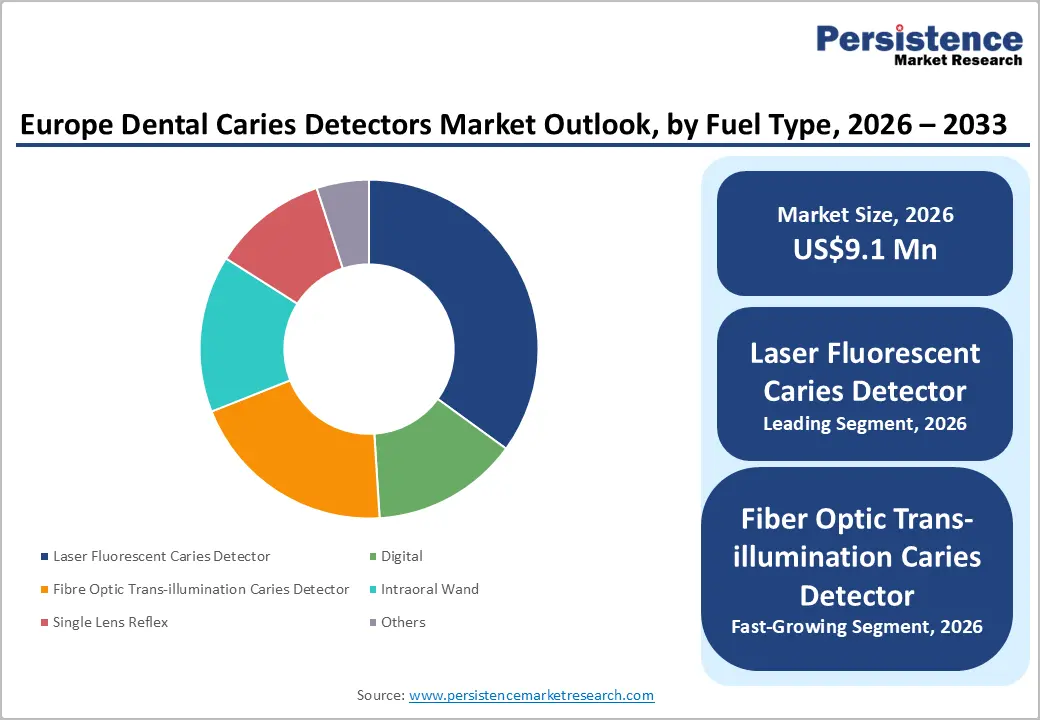
- Leading Product Type: Laser fluorescent caries detectors are projected to represent the leading product type in 2026, accounting for 54% of the revenue share, driven by their high diagnostic accuracy and widespread clinical adoption.
- Leading End-user: Solo practices are anticipated to be the leading end-user type, accounting for over 70% of the revenue share in 2026, supported by the large presence of independent dental clinics across Europe.
- Key Opportunity: The growing shift toward preventive dentistry and the increasing integration of AI-enabled, non-invasive diagnostic technologies across European dental practices present a significant opportunity for the Europe dental caries detectors market.
DRO Analysis
Driver - Technological Advancements in Dental Diagnostics
Modern caries detection systems utilize laser fluorescence, fiber-optic trans-illumination, digital imaging, and artificial intelligence to identify tooth decay at much earlier stages than conventional visual examinations. These technologies improve diagnostic accuracy, reduce false negatives, and help clinicians detect hidden lesions that may not be visible on traditional radiographs. Growing investments in digital dentistry across Europe have accelerated the adoption of advanced diagnostic devices in dental clinics.
The increasing demand for minimally invasive dentistry is encouraging practitioners to adopt advanced caries detection technologies that support preventive treatment approaches. AI-powered systems can analyze dental images in real time, helping dentists make more consistent and evidence-based clinical decisions. Enhanced patient awareness regarding oral health and the benefits of early disease detection has also strengthened demand for technologically advanced diagnostic tools.
Manufacturers continue introducing innovative products with improved sensitivity and user-friendly interfaces, supporting broader adoption across dental practices. The ongoing digital transformation of European healthcare systems, coupled with increasing integration of digital dentistry solutions, is strengthening the use of advanced diagnostic technologies for early and accurate caries detection.
Restraint - Limited Integration into Public Healthcare Systems
Limited integration of advanced dental caries detection technologies into public healthcare systems remains a significant restraint for the Europe dental caries detectors market. Many publicly funded dental programs continue to rely on traditional diagnostic methods due to budget constraints and established clinical protocols. The acquisition and maintenance costs associated with advanced detection devices can create financial barriers for government-funded clinics and community healthcare centers. In several European countries, reimbursement frameworks for innovative dental diagnostic technologies remain limited, reducing incentives for widespread adoption.
The absence of standardized guidelines supporting the routine use of advanced caries detection devices across public dental services restricts market growth. Healthcare administrators often prioritize essential treatment services over investments in new diagnostic equipment, particularly in regions facing resource limitations. Training requirements and the need for workflow adjustments may also discourage implementation in large public healthcare networks. While technological benefits are widely recognized, adoption rates vary considerably between countries depending on funding availability and healthcare policies.
Opportunity - Growing Focus on Preventive Dentistry and Emerging Markets
Dental professionals increasingly focus on identifying oral diseases at their earliest stages to minimize invasive procedures and reduce long-term treatment costs. Advanced caries detection technologies support this preventive approach by enabling accurate diagnosis before significant tooth damage occurs. Rising public awareness of oral health, supported by educational campaigns and preventive care initiatives, is encouraging more frequent dental checkups across Europe.
Emerging healthcare markets within Central and Eastern Europe offer additional growth opportunities as investments in dental infrastructure continue to increase. Expanding private dental networks and growing demand for modern dental services are supporting the adoption of advanced diagnostic technologies in these regions. Improvements in healthcare spending, digitalization initiatives, and access to innovative dental equipment are strengthening market potential.
Manufacturers are increasingly targeting underserved markets with cost-effective and technologically advanced solutions tailored to local needs. The growing emphasis on preventive dentistry across Europe, combined with increasing adoption of non-invasive diagnostic technologies, is strengthening the utilization of advanced caries detection systems in dental clinics and oral healthcare facilities.
Category-wise Analysis
Product Type Insights
Laser fluorescence caries detectors are projected to dominate the Europe dental caries detectors market, accounting for approximately 54% of total revenue in 2026. Their strong market position is driven by their ability to identify early-stage carious lesions with high sensitivity and provide instant diagnostic feedback during routine dental examinations. A prominent example is the KaVo DIAGNOdent, which employs laser fluorescence technology to help dental professionals detect concealed tooth decay and monitor the progression of lesions over time.
Fiber optic trans-illumination caries detectors are expected to be the fastest-growing segment, driven by rising demand for radiation-free diagnostic technologies in dentistry. These devices utilize light transmission technology to detect enamel and dentin lesions without exposing patients to ionizing radiation, making them particularly well-suited for pediatric patients and those requiring regular dental monitoring. A notable example is the DIAGNOcam, which uses digital trans-illumination technology to visualize carious lesions without the need for X-ray imaging.
End-user Insights
Solo practices are projected to lead the market, capturing around 70% of the revenue share in 2026, supported by the strong presence of independent dental clinics throughout the region. These practices often prioritize personalized patient care and possess greater flexibility when adopting innovative diagnostic technologies that improve treatment outcomes. The growing emphasis on preventive dentistry has encouraged solo practitioners to invest in advanced caries detection systems that facilitate early diagnosis and minimally invasive intervention. For instance, the adoption of DEXIS CariVu™ by numerous private dental practices across Europe.
DSO (dental service organization) practices are likely to be the fastest-growing end-user. These organizations manage multiple clinic locations and increasingly invest in standardized diagnostic technologies to improve operational efficiency and clinical consistency. The centralized purchasing capabilities of DSOs allow them to implement advanced caries detection systems across large networks, accelerating technology adoption compared with smaller independent facilities. A notable example includes the adoption of advanced digital diagnostic technologies by Colosseum Dental Group, one of Europe's largest dental service organizations operating more than 620 clinics across 11 countries.
Country Insights
Germany Dental Caries Detectors Market Trends
Germany is anticipated to be the leading region, accounting for a 32% share in 2026, supported by its large dental care infrastructure, high healthcare expenditure, and widespread adoption of advanced dental technologies. The country has a strong focus on preventive oral healthcare, encouraging dental professionals to utilize early diagnostic tools such as laser fluorescence and trans-illumination systems. Increasing digitalization of dental clinics and growing patient awareness regarding minimally invasive dentistry are supporting market growth.
Technological innovation remains a major trend across Germany's dental sector. Dental practices are increasingly adopting digital workflows that integrate imaging, diagnostics, and treatment planning into a unified system. For example, KaVo Dental, whose DIAGNOdent technology continues to be widely utilized for early caries detection in clinical settings. The growing utilization of non-invasive diagnostic tools reflects the broader transition toward preventive dentistry and evidence-based patient care.
U.K. Dental Caries Detectors Market Trends
The U.K. is likely to be the fastest-growing region in 2026, driven by increasing awareness of preventive oral healthcare and growing adoption of digital dentistry solutions. Dental professionals are placing greater emphasis on identifying carious lesions at an early stage to reduce the need for extensive restorative procedures. This trend has increased the use of advanced caries detection technologies, particularly those offering improved diagnostic accuracy and enhanced patient comfort.
Artificial intelligence and digital diagnostics are becoming increasingly important within the U.K. dental sector. Dental practices are adopting technologies that assist clinicians in identifying lesions more consistently and efficiently while improving treatment planning. For instance, VideaHealth, whose AI-powered diagnostic platform supports caries identification through advanced image analysis. The growing integration of AI into dental workflows highlights the market's shift toward data-driven diagnostics and preventive care.
France Dental Caries Detectors Market Trends
France is witnessing steady growth in the dental caries detectors market in 2026, supported by preventive dentistry gaining greater importance within the country's oral healthcare system. Dental professionals are increasingly utilizing non-invasive diagnostic tools to improve early detection and reduce the progression of tooth decay. The expansion of digital dental practices, combined with increasing patient awareness regarding oral health, is encouraging investment in modern diagnostic equipment.
The France market is also benefiting from advancements in digital imaging and trans-illumination technologies that support radiation-free diagnosis. Dental clinics are increasingly seeking solutions that enhance workflow efficiency while maintaining high standards of patient care. A notable example includes Acteon Group, which provides advanced dental imaging and diagnostic solutions widely used across European dental practices. The company's focus on innovative imaging technologies reflects broader market trends toward digital dentistry and minimally invasive treatment approaches.
Competitive Landscape
The Europe dental caries detectors market exhibits a moderately fragmented structure, driven by the presence of established dental technology manufacturers, specialized diagnostic device developers, and emerging digital dentistry innovators. Market competition is shaped by continuous advancements in early caries detection technologies, increasing adoption of preventive dentistry, and growing demand for non-invasive diagnostic solutions.
With key leaders, including KaVo Dental, DEXIS, Canary System, Planmeca, and Acteon Group, the competitive landscape remains highly innovation-focused. These players compete through product innovation, technological advancements, digital imaging integration, artificial intelligence-enabled diagnostic capabilities, strategic partnerships, distributor network expansion, and clinician training initiatives.
Key Industry Developments:
- In February 2026, researchers from the Melbourne Infant Study reported that intra-oral scanners equipped with fluorescence technology showed strong potential for detecting dental caries in children. The study evaluated 216 five-year-old children and found that 3D scans obtained using the 3Shape TRIOS 4 scanner demonstrated high diagnostic agreement with conventional visual examinations.
- In March 2025, Align Technology launched Align X-ray Insights across the European Union and the United Kingdom, an AI-powered computer-aided detection software designed to automatically analyze 2D dental radiographs.
Companies Covered in Europe Dental Caries Detectors Market
- KaVo Dental
- DEXIS
- Planmeca
- Acteon Group
- The Canary System
Frequently Asked Questions
The Europe dental caries detectors market is projected to reach US$373.3 million in 2026.
Increasing adoption of advanced non-invasive diagnostic technologies and growing emphasis on preventive dentistry drive the Europe dental caries detectors market.
The Europe dental caries detectors market is expected to grow at a CAGR of 9.1% from 2026 to 2033.
Expanding preventive oral healthcare programs and rising adoption of AI-enabled dental diagnostic solutions create significant market opportunities across Europe.
Canary System, Planmeca PlanScan, Dexis CariVu™, and KaVo DIAGNOdent are the leading players.


