




- Medical Devices
- Ultrasonic Skin Care Devices Market
Ultrasonic Skin Care Devices Market Size, Share, Growth, and Regional Forecast, 2026 - 2033
Ultrasonic Skin Care Devices Market by Product (Table-top Devices, and Handheld Devices), by Application (Body Contouring, Skin Tightening, Skin Rejuvenation, and Others) by End-user (Hospitals, Aesthetic Clinics, Spa and Salon, and Home Care Settings), and Regional Analysis from 2026 - 2033

Ultrasonic Skin Care Devices Market Share and Trends Analysis
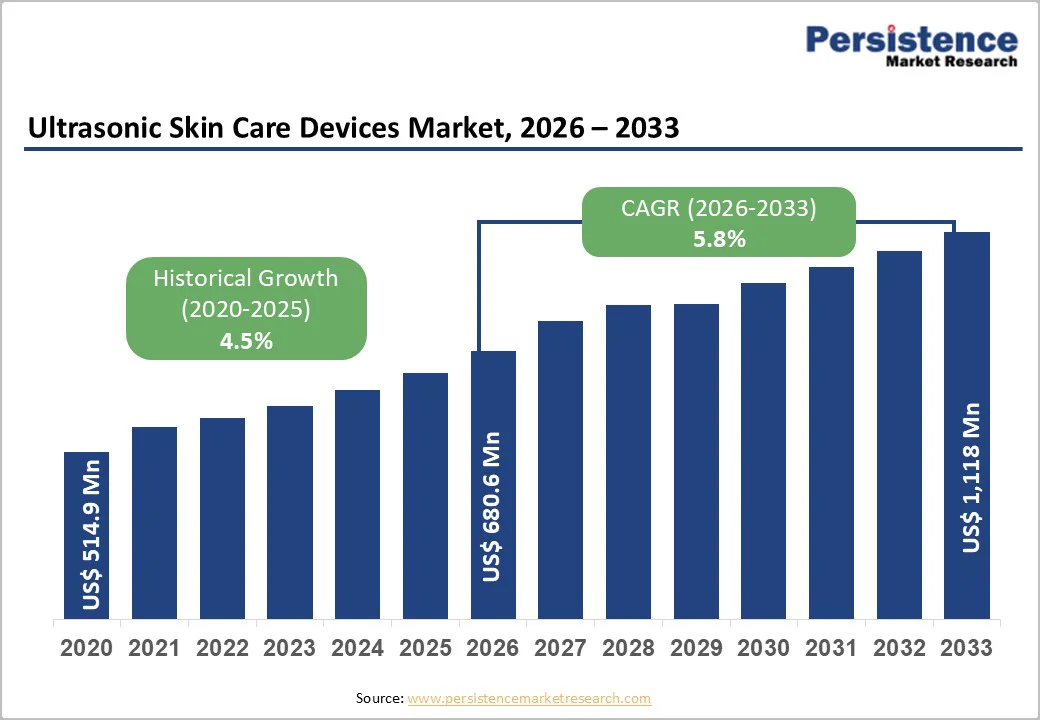
The global ultrasonic skin care devices market size is estimated to grow from US$ 680.6 million in 2026 to US$ 1,118 million by 2033. The market is projected to record a CAGR of 5.8% from 2026 to 2033. Global demand for ultrasonic skin care devices is rising rapidly, driven by growing interest in non-invasive beauty solutions, increasing awareness of anti-aging skincare, and the shift toward advanced at-home treatment technologies.
The expansion of professional aesthetic services, higher consumer spending on premium beauty tools, and the popularity of multifunction devices combining ultrasound with LED or microcurrent are accelerating market momentum. Continuous improvements in device design, wireless connectivity, smart skin analysis, and enhanced sonophoresis performance are improving treatment outcomes and user experience. Additionally, strong e-commerce penetration, rising influence of beauty-tech brands, and growing acceptance of at-home aesthetic routines further contribute to market growth.
Key Industry Highlights:
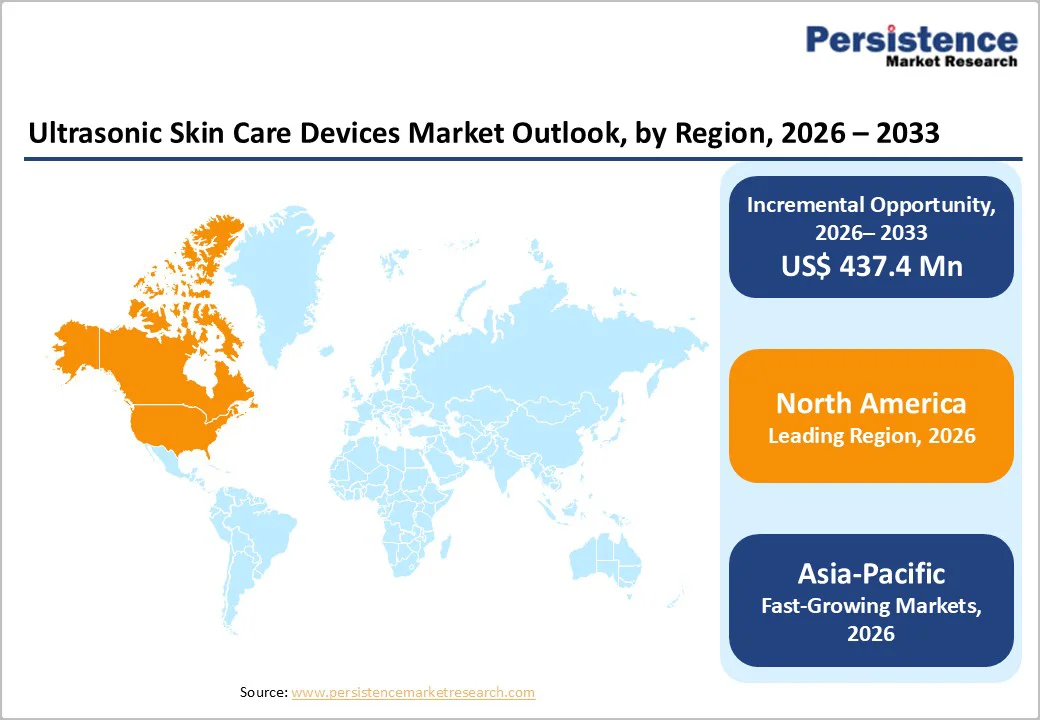
- Leading Region: North America holds the largest share at 46.8%, supported by strong demand for high-end beauty technologies, widespread use of at-home ultrasonic tools, a mature aesthetic services sector, and rapid adoption of connected skincare devices.
- Fastest-Growing Region: Asia Pacific is expanding at the fastest pace, driven by a tech-savvy consumer base, growing interest in non-invasive skincare routines, a strong beauty culture, and the presence of major original equipment manufacturer (OEM) & original design manufacturer (ODM) manufacturers, enabling low-cost, innovative device supply.
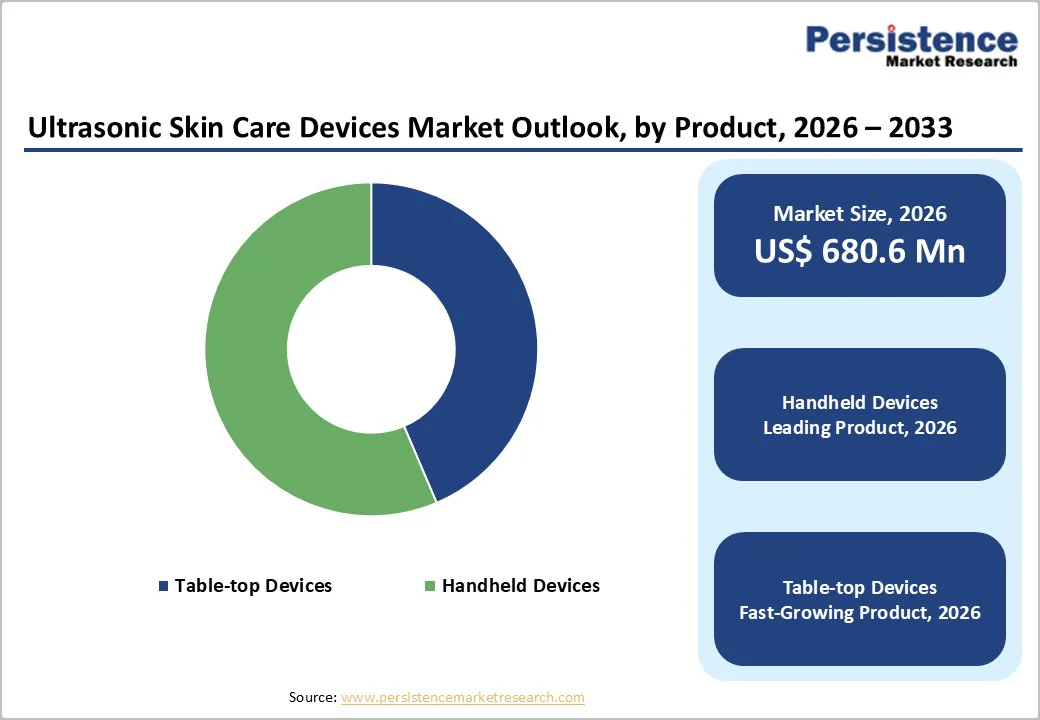
- Leading Product Segment: Handheld devices lead the category due to their portability, ease of use, lower price point, and strong consumer adoption for convenient daily skincare solutions.
- Fastest-Growing Product Segment: Tabletop systems are expanding fastest as aesthetic clinics and spas increasingly invest in professional-grade ultrasonic platforms that offer stronger performance and customizable treatment settings.
- Leading Application Segment: Skin rejuvenation dominates the market, driven by high demand for texture refinement, radiance enhancement, and anti-aging benefits, making it the most widely sought application across home and professional settings.
- Fastest-Growing Application Segment: Body contouring is scaling rapidly as consumers seek non-surgical methods to improve firmness, smoothness, and body aesthetics, supported by rising adoption of advanced ultrasound-based shaping technologies.
| Key Insights | Details |
|---|---|
|
Ultrasonic Skin Care Devices Market Size (2026E) |
US$ 1.7 Mn |
|
Market Value Forecast (2033F) |
US$2.8 Mn |
|
Projected Growth (CAGR 2026 to 2033) |
5.2% |
|
Historical Market Growth (CAGR 2020 to 2025) |
4.0% |
Market Dynamics
Driver - Growing Demand for Non-Invasive Aesthetic Care and Technological Advancements
Rising consumer inclination toward non-invasive, low-downtime aesthetic treatments is driving the ultrasonic skincare device market. For instance, in June 2025, the International Society of Aesthetic Plastic Surgery (ISAPS) highlighted at its Olympiad World Congress in Singapore that over 20.5 million non-surgical cosmetic procedures were performed worldwide in 2024, highlighting the strong global shift toward minimally invasive solutions. This growing preference is reshaping expectations for safe, comfortable, and technology-driven skincare tools, boosting demand for ultrasonic devices known for their gentle, non-surgical rejuvenation benefits, enhanced skin smoothness, and suitability for consistent at-home use.
Rapid technological advancements, particularly miniaturization and multifunctional platform integration, are expanding product capabilities and improving user experience. Compact, ergonomic designs make devices easier to use and more portable, while multifunction systems combine cleansing, lifting, exfoliation, and serum infusion in a single unit. These innovations enhance treatment effectiveness, increase consumer confidence, and broaden the appeal of ultrasonic devices across both professional and home-care settings.
Restraints - Heightened Regulatory Scrutiny and Limited Clinical Validation across Multiple Aesthetic Indications
Regulatory oversight for energy-based aesthetic devices is becoming increasingly stringent, particularly regarding safety, thermal exposure limits, and long-term skin effects. Ultrasonic skincare devices often face additional evaluation due to mixed or limited clinical validation across different indications, which can slow product approvals and restrict claims manufacturers can make. This heightened scrutiny requires companies to invest more in clinical studies, documentation, and compliance, thereby increasing development timelines and costs and restraining market growth.
Furthermore, ultrasonic devices compete directly with well-established modalities such as lasers and radiofrequency (RF) systems, which have stronger clinical evidence, widespread practitioner familiarity, and broader treatment versatility. These competing technologies often dominate clinic-based procedures, making it challenging for ultrasonic platforms to differentiate on the basis of efficacy. The maturity, trust, and proven outcomes associated with laser and RF solutions intensify competitive pressure, especially in premium markets where consumers seek results-backed treatments.
Opportunity - AI-Powered Personalization and Connected Skincare Ecosystems
AI-driven personalization and app-connected skincare ecosystems are driving market growth and creating opportunities in the ultrasonic skincare device market. Smart algorithms that analyze skin conditions, track progress, and tailor treatment intensity are increasing user confidence and long-term engagement. Connected devices that sync with mobile apps enable guided routines, usage reminders, and data-based recommendations, creating a more interactive and results-oriented experience. These capabilities not only enhance convenience.
Moreover, med-spas and professional aesthetic centers are increasingly integrating ultrasonic technologies to offer safer, quicker, and more affordable alternatives to invasive procedures. This expansion is further fueled by social media influencers and beauty creators who frequently showcase at-home ultrasonic treatments, boosting awareness and accelerating consumer purchase decisions. The combined impact of professional validation and digital-first promotion is propelling the market growth.
Category-wise Analysis
By Product Insights
The handheld devices segment is projected to dominate the global ultrasonic skin care devices market in 2026, accounting for 56.4% of revenue. The segment’s strong performance is driven primarily by the rising popularity of compact, easy-to-use tools that enable consumers to perform regular skincare treatments at home without clinical visits. Handheld ultrasonic devices offer convenience, affordability, and portability while delivering benefits such as improved cleansing, enhanced product absorption, and visible anti-aging results. Their widespread availability through online platforms, beauty retailers, and direct-to-consumer brands further accelerates adoption. In addition, continuous advancements in battery life, ergonomic design, and integration with technologies such as app-based skin tracking have made handheld devices the preferred choice for everyday skincare routines, particularly among younger, tech-savvy consumers seeking non-invasive beauty solutions.
By Application Insights
The skin rejuvenation segment is projected to dominate the global ultrasonic skin care devices market in 2026, accounting for 41.8% of revenue. This is due to rising consumer demand for non-invasive solutions that improve overall skin texture, radiance, and tone without requiring clinical procedures or downtime. Ultrasonic devices are widely used to enhance collagen production, boost microcirculation, support deeper product penetration, and reduce fine lines, making them highly appealing for routine skincare. The segment also benefits from the increasing popularity of multifunctional home-use devices that combine ultrasound with LED therapy or microcurrent, offering spa-like results at home. Growing awareness of anti-aging benefits, strong marketing by beauty-tech brands, and the influence of social media trends further boost the market growth.
By End-user Insights
The aesthetic clinics segment is projected to dominate the global ultrasonic skin care devices market in 2026, accounting for a revenue share 52.8%. This is driven by the growing preference for professional-grade treatments that deliver faster, more visible results compared to standard home-use devices. Clinics offer higher-intensity ultrasonic technologies for lifting, firming, deep cleansing, and enhanced product penetration, which attracts consumers seeking medically supervised or dermatologist-recommended procedures. Rising demand for customized treatment plans, combination therapies using ultrasound with LED or microcurrent, and premium anti-aging solutions further strengthens clinic adoption. Additionally, increasing awareness of safe, non-invasive aesthetic procedures, coupled with clinics’ ability to invest in advanced equipment with superior precision and treatment consistency.
Region-wise Insights
North America Ultrasonic Skin Care Devices Market Trends
The North America market is expected to dominate globally with a value share of 46.8% in 2026, with the U.S. leading the region due to its strong consumer willingness to invest in premium, technology-driven skincare solutions and the widespread adoption of non-invasive beauty devices. The U.S. has a highly developed aesthetic ecosystem supported by dermatology clinics, med-spas, and professional skincare providers, which accelerates awareness and acceptance of ultrasonic cleansing, lifting, and anti-aging technologies. High disposable incomes, a culture of early skincare adoption, and strong demand for at-home beauty tools further reinforce market leadership.
The region also benefits from extensive availability of advanced ultrasonic devices through major retail chains, professional distributors, and e-commerce platforms. The presence of leading beauty-tech companies, ongoing product innovation, and frequent feature enhancements such as app connectivity, AI-enabled skin diagnostics, and hybrid devices combining ultrasound with LED or microcurrent continue to fuel growth. The region’s focus on safety-tested, FDA-compliant devices enhances consumer trust and encourages higher spending on premium categories.
Europe Ultrasonic Skin Care Devices Market Trends
The European market is expected to grow steadily, driven by the region’s strong consumer preference for high-quality, science-backed skincare solutions and increasing adoption of non-invasive beauty technologies. Countries such as Germany, the U.K., France, Italy, and the Nordics are witnessing rising interest in ultrasonic cleansing, lifting, and anti-aging devices as consumers shift toward advanced home-use tools that replicate professional spa results. The presence of well-established dermatology clinics, aesthetic centers, and premium beauty retailers further supports product awareness and acceptance of technology.
European consumers also show a high willingness to invest in devices that offer safety certifications, clinical validation, and long-term skin health benefits, factors that push brands to prioritize medical-grade engineering and CE-compliant designs. In addition, the region’s growing aging population and increasing focus on preventive skincare are boosting the uptake of ultrasonic technologies aimed at improving firmness, texture, and transdermal absorption.
Asia Pacific Ultrasonic Skin Care Devices Market Trends
Asia Pacific is expected to register a relatively higher CAGR of around 7.8% between 2026 and 2033, driven by rapid urbanization, rising disposable incomes, and strong consumer interest in non-invasive beauty technologies. Countries such as China, South Korea, Japan, and India are witnessing a surge in demand for advanced at-home skin treatment devices as younger consumers increasingly prioritize preventive skincare and anti-aging routines. The region also benefits from a large, tech-savvy population that actively adopts smart beauty tools, integrating app connectivity, AI-based skin analysis, and personalized treatment settings.
Growing awareness of ultrasonic cleansing and lifting solutions, supported by aggressive marketing from global and domestic brands, is further accelerating product penetration. Additionally, Asia Pacific’s well-established beauty manufacturing ecosystem, especially in China and South Korea, enables cost-efficient production, faster product launches, and extensive original equipment manufacturer (OEM) & original design manufacturer (ODM) capabilities.
Competitive Landscape
The global ultrasonic skin care devices market is highly competitive, with brands such as Alma Lasers, Cynosure Lutronic, Solta Medical Inc., Cutera, Inc., and Candela Corporation. These companies capitalize on wide retail reach, differentiated consumer-focused designs, and continuous upgrades in ultrasound cleansing and firming technologies. The shift toward compact, travel-friendly devices and multifunctional platforms is intensifying rivalry across both professional and at-home segments.
Manufacturers are advancing toward smart, app-linked systems, improved transdermal delivery performance, and hybrid solutions combining ultrasound with LED or microcurrent. Industry strategies increasingly emphasize portfolio diversification, influencer-driven marketing, and expansion into high-growth consumer beauty markets in Asia-Pacific and North America, where demand for convenient, non-invasive skincare tools continues to accelerate.
Key Industry Developments:
- In October 2025, Cynosure Lutronic introduced the eCO2 3D, a next-generation fractional CO2 laser system positioned as one of the most versatile resurfacing platforms in aesthetics. Building on the established eCO2 Plus technology, the new device enhances power, precision, and treatment customization, setting a higher benchmark for advanced skin resurfacing.
- In March 2025, Alma Lasers introduced the latest generation of its award-winning Alma Harmony aesthetics platform, marking a major upgrade in its 20-year product lineage. The new system features a modernized design and enhanced intelligent capabilities, expanding treatment versatility and improving user experience.
- In February 2025, Cynosure Lutronic entered into a multi-country distribution partnership with Amico Aesthetics, a prominent provider of advanced medical technologies across the Middle East. The agreement strengthens Cynosure Lutronic’s regional footprint and supports broader access to its aesthetic device portfolio in high-growth markets.
- In January 2024, Cynosure and Hahn & Company, the recent acquirer of Lutronic, announced a definitive merger agreement to combine Cynosure and Lutronic into a unified entity.
- Both companies are leading global providers of energy-based aesthetic treatment systems, and the transaction aims to strengthen their collective technology portfolio and market presence.
Companies Covered in Ultrasonic Skin Care Devices Market
- Alma Lasers
- Cynosure Lutronic
- Solta Medical Inc.
- Cutera, Inc.
- Candela Corporation.
- Canfield Scientific, Inc.
- Aesthetics Biomedical.
- AESTHETIC SCIENCE, LLC.
- Fotona
- Alvi Prague
- Hapilin
- OSANO
- Others
Frequently Asked Questions
The global ultrasonic skin care devices market is projected to be valued at US$ 680.6 Mn in 2026.
Growing preference for non-invasive skin treatments, rapid adoption of at-home beauty devices, continuous technological innovation, and rising aesthetic awareness are driving the global ultrasonic skin care devices market.
The global ultrasonic skin care devices market is poised to witness a CAGR of 5.8% between 2026 and 2033.
AI-enhanced ultrasonic platforms, rising at-home aesthetic adoption and growth of multifunctional devices integrating LED/microcurrent are creating opportunities in the market.
Alma Lasers, Cynosure Lutronic, Solta Medical Inc., Cutera, Inc., and Candela Corporation. are some of the key players in the ultrasonic skin care devices market.


