




- Industrial Machinery
- Precision Rewinding Machine Market
Precision Rewinding Machine Market Size, Share, and Growth Forecast 2026 - 2033
Precision Rewinding Machine Market by Product type (Less than 1000mm width, 1000 – 2000 mm width and Above 2000 mm width), by Applications (Plastic Film, Paper, Foils, Laminates and Others), and Regional Analysis for 2026 – 2033

Precision Rewinding Machine Market Share and Trends Analysis
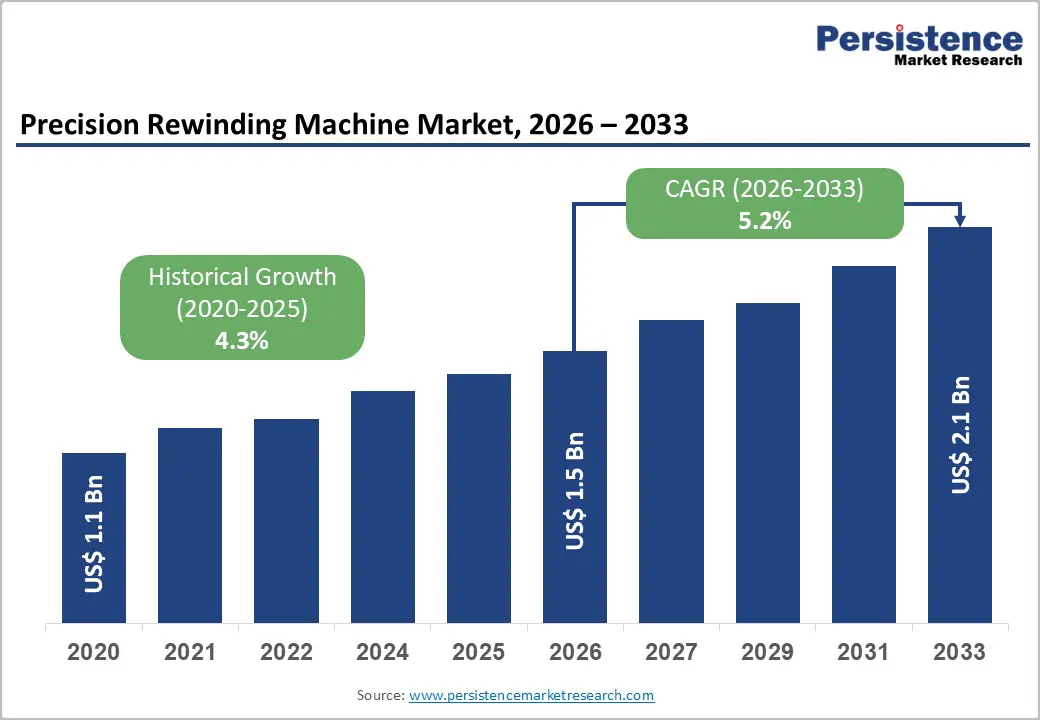
The global Precision Rewinding Machine Market size was valued at US$ 1.3 Bn in 2026 and is projected to reach US$ 1.9 Bn by 2033, growing at a CAGR of 5.2% between 2026 and 2033. Growth in the Precision Rewinding Machine Market is underpinned by the rapid expansion of flexible packaging, labeling, and specialty films across food, pharmaceutical, and industrial applications. Slitter-rewinder and precision rewinding systems are essential for converting large “parent” rolls of plastic film, paper, foils, and laminates into narrow rolls with tight winding tolerances and consistent tension, directly influencing print quality and downstream process efficiency.
Key Market Highlights
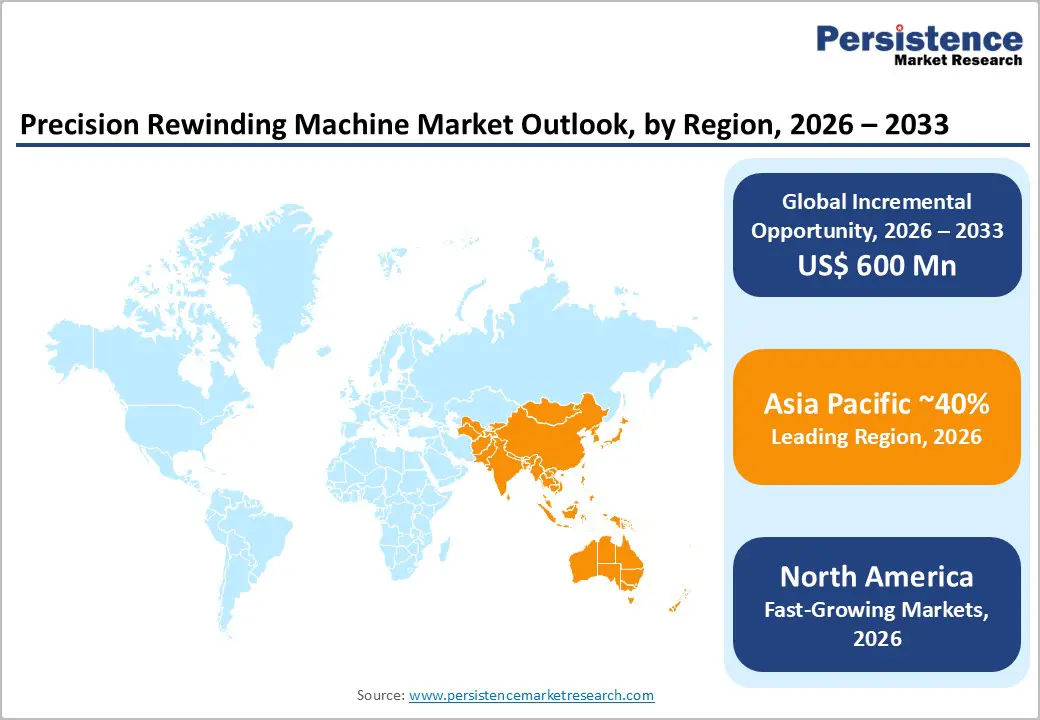
- Asia Pacific leads the Precision Rewinding Machine Market in production and consumption, driven by rapid growth of flexible packaging and label converting in China, India, and ASEAN economies.
- Asia Pacific is also the fastest-growing region, with double-digit growth in flexible packaging in markets like India, triggering strong investments in new slitter-rewinder lines and automation upgrades.
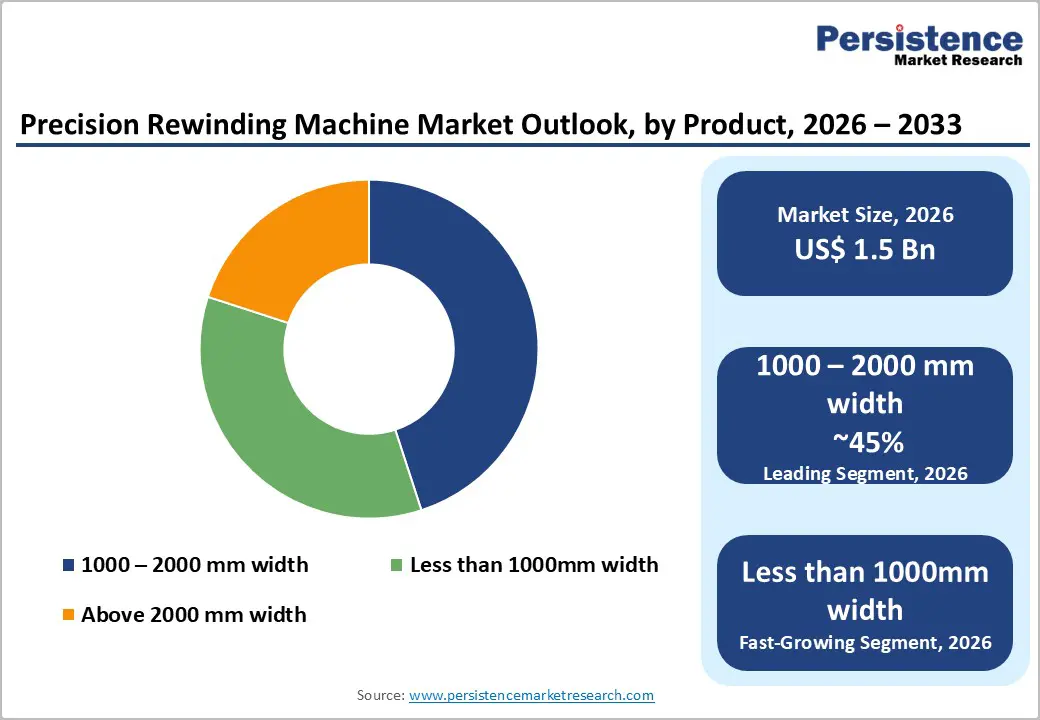
- Mid-width (1000–2000 mm) rewinding machines dominate by product type, holding roughly 45% share due to their suitability for mainstream film and laminate converting lines in packaging plants.
- Plastic film applications are the fastest-growing segment, accounting for about 50% of machine demand as brand owners shift towards flexible packaging formats for food, beverages, and e-commerce.
- A key opportunity lies in smart, sustainable rewinding solutions, integrating servo automation, remote monitoring, and advanced tension control to efficiently process recycled films, bio-based materials, and ultra-thin specialty webs.
| Key Insights | Details |
|---|---|
| Freeze Protection Cables Market Size (2026E) | US$ 1.3 Bn |
| Market Value Forecast (2033F) | US$ 1.9 Bn |
| Projected Growth (CAGR 2026 to 2033) | 5.2% |
| Historical Market Growth (CAGR 2020 to 2024) | 4.3% |
Market Dynamics
Market Growth Drivers
Expansion of Flexible Packaging and Specialty Films
A major growth drive for the Precision Rewinding Machine Market is the rapid expansion of flexible packaging and specialty film usage worldwide. Slitter-rewinder equipment is the backbone of film converting operations, cutting wide rolls of BOPP, PET, PE, and aluminum foil into narrow rolls for pouches, labels, and multilayer laminates. In Europe, demand for flexible films from PE and PP reached around 11 million tons in 2020, representing approximately 42% of total PE/PP demand in the region, and is expected to grow at about 2.4% CAGR between 2020 and 2026. The broader flexible plastic packaging sector continues to expand because of its light weight, design flexibility, and suitability for e-commerce and convenience foods. Every new film extrusion line or laminator installed adds downstream demand for precision rewinding machinery capable of managing higher speeds (up to 400–500 m/min) and very narrow slit widths (down to 5–10 mm) with tight thickness and tension control.
Quality and Productivity Requirements in High-Value Applications
In parallel, brand owners and regulators are tightening quality requirements for packaging and industrial films, driving converters to upgrade to high-performance rewinding systems. For example, precision slitter rewinders used for aluminum foil and polyester film tapes routinely achieve cutting precision of ±0.2 mm at speeds of 400–500 m/min, supported by multiple servo motors for web transport and winding. Such capabilities are critical in markets like battery foils, capacitor films, holographic foils, and printed electronics where edge quality, density, and roll geometry directly affect product performance. In addition, the growth of paper drinking straws, driven by plastic reduction policies, requires slit widths as low as 5 mm, again relying on precision slitting and rewinding equipment. As converters pursue higher overall equipment effectiveness and reduced waste, they increasingly favor machines with automatic tension control, closed-loop web guiding, and recipe-based job settings, aligning with broader industrial automation trends and digitalization strategies.
Market Restraints
High Capital Investment and Skill Requirements
Precision rewinding machines represent a significant capital investment, particularly high-speed servo-driven systems with advanced control electronics and web handling modules. Small and mid-size converters, especially in emerging markets, may struggle to justify the cost of state-of-the-art machines when existing mechanical slitters still operate, albeit with lower productivity. In addition, precision rewinding equipment requires skilled operators and maintenance technicians familiar with web tension dynamics, blade selection, and automation systems, creating a skills barrier. Insufficient training can lead to sub-optimal machine utilization, higher waste rates, and longer changeover times, which in turn limit the return on investment.
Volatility in Raw Material and End-Use Demand
Demand for precision rewinding machines is tightly linked to capital spending cycles in flexible packaging, label printing, and specialty materials. Volatility in raw material prices, particularly for polymers and aluminum, can delay investment decisions in new film lines and downstream converting equipment. Economic slowdowns and shifts in consumer spending patterns may also lead brand owners to postpone packaging format changes or capacity expansions. In such periods, converters may stretch the life of existing slitter-rewinders rather than purchasing new machines, creating cyclical softness in the equipment market.
Market Opportunities
Automation, Industry 4.0, and Remote Monitoring
A major opportunity lies in integrating Industry 4.0 capabilities into precision rewinding machines. Modern slitter-rewinder platforms increasingly feature servo drives, PLC-based controls, and human-machine interfaces that can connect to plant networks and cloud platforms. By adding sensor packages to monitor web tension, vibration, knife wear, and roll hardness, machine builders can enable predictive maintenance and automated quality assurance. Remote monitoring allows OEMs and converters to track uptime, energy consumption, and defect rates in real time, supporting continuous improvement and service-based business models. Integration with upstream extrusion and downstream printing or laminating lines can create fully synchronized, closed-loop converting cells that automatically adjust speed and tension based on process conditions. This type of high-automation solution aligns closely with the trend toward smart factories not only in packaging but also in related sectors such as chemicals, where the Construction Chemicals Market also reflects increasing automation and quality control requirements in materials processing.
Sustainability, Recycling, and New Materials
The global shift toward sustainability presents another high-growth opportunity for the Precision Rewinding Machine Market. Circular economy initiatives in Europe and other regions are increasing the volume of recycled films and multi-material laminates entering converting lines . Processing recycled webs2026often with variable thickness, stiffness, or surface quality2026requires more sophisticated tension control, edge sensing, and defect detection to maintain product quality, favoring advanced precision machines. In addition, new bio-based and compostable films derived from materials like PLA or cellulose introduce different mechanical behaviors that must be handled carefully during slitting and rewinding. Converters adopting paper-based solutions to replace plastic, such as paper straws and paper-foil laminates, also rely on fine-tolerance slitters that can manage grammages from 20–30 gsm up to heavy laminates. Machine builders that develop dedicated solutions for recycling lines, mono-material structures, and low-gauge sustainable films can position themselves as partners in the transition to greener packaging and industrial materials.
Category-wise Insights
Product Type Analysis
By product type, machines designed for webs of 1000–2000 mm width represent the leading segment of the Precision Rewinding Machine Market, accounting for an estimated 45% share. This range aligns with many standard film extrusion, coating, and laminating lines used in flexible packaging and labels tock production, allowing converters to process a wide variety of substrates without excessive changeovers. Equipment in this class often balances compact footprint with high throughput, reaching speeds of 300–500 m/min while maintaining tight slitting precision, making them attractive to mid-size and large converters. Machines for webs below 1000 mm width, with roughly 30% share, are widely used for narrow-web label stock, specialty tapes, and niche applications where flexibility and frequent job changes are key . Systems for above 2000 mm width, estimated at 25% share, serve high-capacity film and foil lines, including those producing packaging films, metallized foils, and industrial laminates; these machines typically require robust frames and advanced tension systems to handle larger roll diameters and loads.
Application Analysis
Across applications, plastic film represents the dominant usage segment, accounting for approximately 50% of precision rewinding machine demand. Flexible films made from PE, PP, PET, and other polymers form the basis for stand-up pouches, wraps, and many other packaging formats that are steadily gaining share versus rigid packaging. Slitter-rewinders tailored for plastic film often need to accommodate thickness ranges from about 12–180 µm, working speeds above 400 m/min, and narrow slit widths for applications like hot-stamping foils and holographic films . The paper segment, including release liners, specialty papers, and paper-based packaging, holds around 25% share; demand is rising due to substitution of plastic by paper straws, bags, and wrapping materials, with machines capable of slitting to widths below 5 mm for straw applications. Foils (aluminum and other metals) account for roughly 10% share, used in insulation, capacitors, and food packaging where precision in roll density and edge quality is critical. Laminates2026multi-layer structures combining film, foil, and paper2026represent about 10% share, while other materials such as non-wovens, label stock, and technical textiles fill the remaining 5%, all requiring specialized web handling and slitting solutions.
Regional Insights
North America Precision Rewinding Machine Market Trends
In North America, the Precision Rewinding Machine Market benefits from a sizable base of flexible packaging converters, label printers, and specialty materials producers. The International Energy Agency notes that electricity and energy demand growth in 2024 was partly driven by extreme weather and data center expansion in advanced economies, which in turn supports increased consumption of packaged foods, e-commerce goods, and electronics requiring high-quality packaging films. The United States hosts numerous film extruders and converters serving food, pharmaceutical, and industrial markets, many of which operate under stringent quality and traceability standards such as FDA food-contact regulations and GMP guidelines. These requirements favor precision rewinding systems with robust documentation, recipe management, and defect inspection capabilities.
Technological leadership in automation, servo drives, and digital controls further shapes the region’s equipment market. Converters increasingly integrate slitter-rewinders with centralized data systems and manufacturing execution software, enabling remote diagnostics and performance benchmarking across multiple plants. Local presence of global manufacturers2026such as ABB, Eaton, General Electric, and Legr and 2026alongside specialized machine builders and integrators support adoption of advanced automation components in rewinding machines. In addition, sustainability initiatives and state-level extended producer responsibility (EPR) regulations encourage recycled content and recyclable film structures, driving demand for machinery capable of processing variable-quality recycled webs with stable tension and minimal waste.
Europe Precision Rewinding Machine Market Trends
Europe’s Precision Rewinding Machine Market is closely linked to its advanced flexible film and specialty packaging industries and strong regulatory framework. The Circular Plastics NL study indicates that in 2020 the combined PE and PP converter demand for flexible films in EU27+3 was about 11 million tons, with flexible films representing roughly 42% of PE/PP demand. Demand for flexible films in Europe is expected to grow at about 2.4% CAGR between 2020 and 2026, supported by applications in food packaging, agriculture, and industrial sectors. Converters in countries such as Germany, Italy, France, and Spain invest in sophisticated slitter-rewinders to meet requirements for high-barrier laminates, pharmaceutical blister lidding, and high-quality printed packaging.
European Union regulations on recyclability, food contact safety, and worker protection are among the strictest globally, encouraging the use of high-precision equipment that minimizes dust generation, controls web tension to avoid film damage, and facilitates traceability. Equipment suppliers often design machines in compliance with CE and EN standards, including guards and safety systems suited to European norms. The region also leads in recycling infrastructure and innovations in mono-material and bio-based films; processing these new materials effectively requires flexible machines that can adjust to different modulus and friction properties.
Asia Pacific Precision Rewinding Machine Market Trends
Asia Pacific is both the largest and fastest-growing region for flexible packaging production, making it a critical market for precision rewinding machinery. Countries such as China, India, Indonesia, Vietnam, and Thailand have become major hubs for film extrusion, printing, and converting, supplying domestic and export markets. Studies indicate that Asia Pacific holds the largest share of the flexible global packaging market and is expected to grow faster than mature regions due to urbanization, rising disposable incomes, and the expansion of organized retail and e-commerce. For instance, the India flexible packaging market alone was valued at around US$ 4.6 Bn in 2024 and is projected to reach about US$ 13.2 Bn by 2033, growing at roughly 12.4% CAGR. Such growth translates directly into rising demand for slitter-rewinders used for plastic film, paper, and foil converting.
The region also hosts many machine builders specialized in slitting and rewinding systems, particularly in China and India, where companies manufacture machines ranging from narrow-web units to fully automatic wide-web precision lines. Competitive pricing from regional OEMs encourages smaller converters to automate their rewinding operations, while international brands seek higher-end machines with advanced servo control and automation. At the same time, environmental regulations and import-export dynamics are pushing producers toward higher quality and sustainability standards, which favors precision equipment capable of handling thin-gauge films and recycled materials without compromising quality.
Competitive Landscape
Market Structure Analysis
The Precision Rewinding Machine Market is moderately fragmented, with a mix of global automation and electrical engineering firms2026such as ABB, Eaton, General Electric, Larsen & Toubro, and Legrand2026supplying drives, controls, and electrical systems, and specialized OEMs designing and assembling slitter-rewinder machines for film, paper, and foil applications. Many machine builders operate regionally in Europe, China, and India, offering customized configurations tailored to local substrate mixes and production scales. Key competitive differentiators include web width and speed capability, cutting accuracy, automation level, ease of setup and changeover, integration with upstream/downstream equipment, and after-ales service.
Key Market Developments
- In June 2025, Binbao Machinery enhanced its aluminum foil and polyester film composite slitter-rewinder (SLB series) with cutting precision of ±0.2 mm and speed up to 400–500 m/min, optimized for narrow 8–20 mm rolls for packaging and industrial tape applications.
- In December 2024, MTED introduced an upgraded slitter-rewinder platform capable of processing various plastic films and paper at speeds above 500 m/min, targeting flexible packaging converters seeking higher throughput and automation.
Companies Covered in Precision Rewinding Machine Market
- Atlas Converting Equipment
- Kampf
- ASHE Converting Equipment
- GOEBEL IMS
- Euromac
- Parkinson Technologies
- Pasquato
- Universal Converting Equipment
- Parkland International
- SOMA Engineering
- Others Key Players
Frequently Asked Questions
The global Precision Rewinding Machine Market is projected to reach about US$ 1.9 Bn by 2033, up from approximately US$ 1.3 Bn in 2026, reflecting a forecast CAGR of 5.2% and historical growth of 4.3%
Major drivers include expansion of flexible packaging and specialty films, rising quality requirements in applications such as battery foils and holographic films, and the need to increase productivity and reduce waste through high‑speed, automated slitting and rewinding systems.
Machines handling 1000–2000 mm web widths lead the market with an estimated 45% share, as this range matches many standard extrusion and laminating lines and offers an optimal balance of throughput, flexibility, and footprint.
Asia Pacific is expected to dominate and grow fastest, supported by strong expansion of flexible packaging, label converting, and specialty film production in China, India, and ASEAN countries, along with competitive regional machine manufacturing capabilities.
Prominent participants include automation and electrical leaders ABB, Eaton, General Electric, Larsen & Toubro, and Legrand.


