




- Marine
- Personal Watercraft Market
Personal Watercraft Market Size, Share, and Growth Forecast, 2025 - 2032
Personal Watercraft Market By Product Type (One seat, Two seat, Others), Engine Displacement (Below 800 CC, Others), End-user (Sports, Recreational, Luxury), Sales Channel (Hypermarkets/Supermarkets, Others), and Regional Analysis for 2025 - 2032

Personal Watercraft Market Size and Trends Analysis
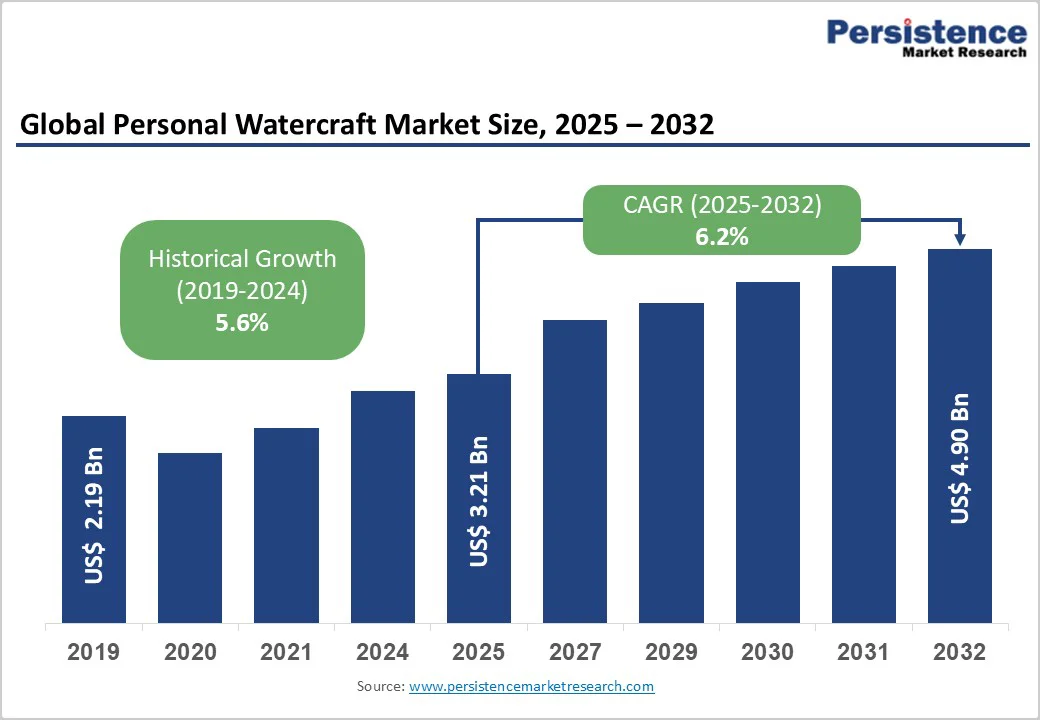
The global personal watercraft market size is likely to be valued at US$3.21 billion in 2025. It is expected to reach US$4.90 billion by 2032, growing at a CAGR of 6.2% from 2025 to 2032, driven by increasing adventure tourism, expanding coastal recreational infrastructure, and the proliferation of rental services that make personal watercraft accessible to broader consumer segments.
Key Industry Highlights
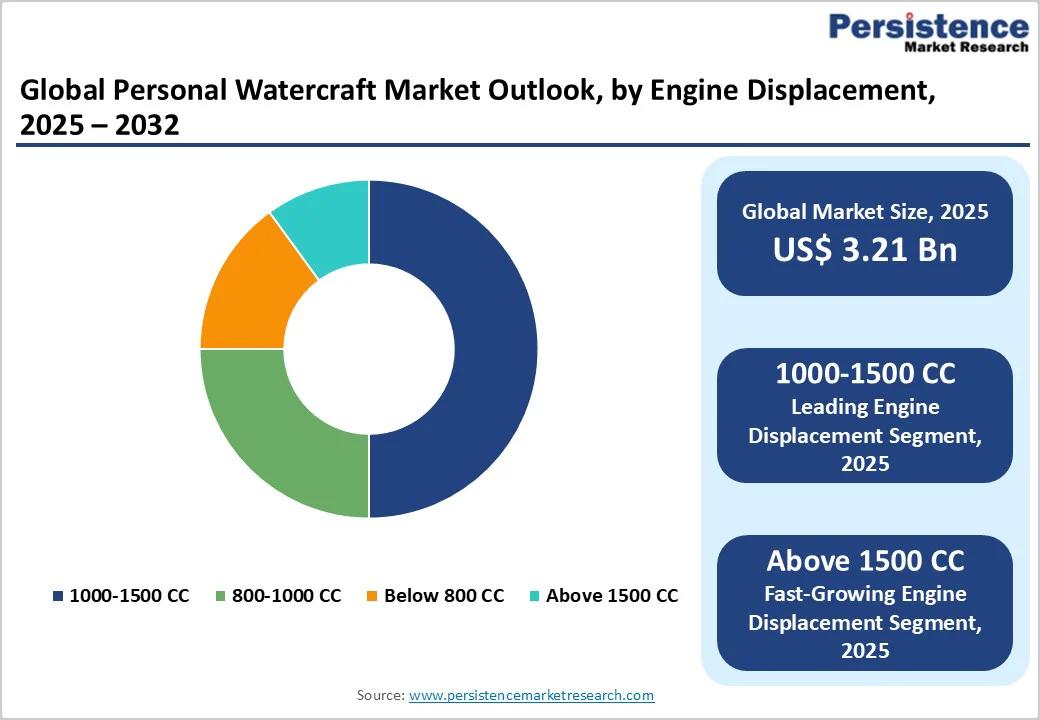
- Engine Displacement Dynamics: The mid-range 1000-1500 CC segment represents the market’s performance sweet spot, accounting for 40% of the market share due to its balance of power, efficiency, and affordability. High-performance 1500+ CC models cater to premium customers seeking enhanced speed, torque, and advanced handling capabilities.
- End-user Market Dynamics: Recreational applications lead the market with a 45% share (US$1.44 Billion), supported by increasing participation in leisure water sports and family-oriented marine tourism. The commercial rental segment is expanding rapidly, fueled by coastal tourism growth, flexible access models, and rising consumer preference for experiences over ownership.
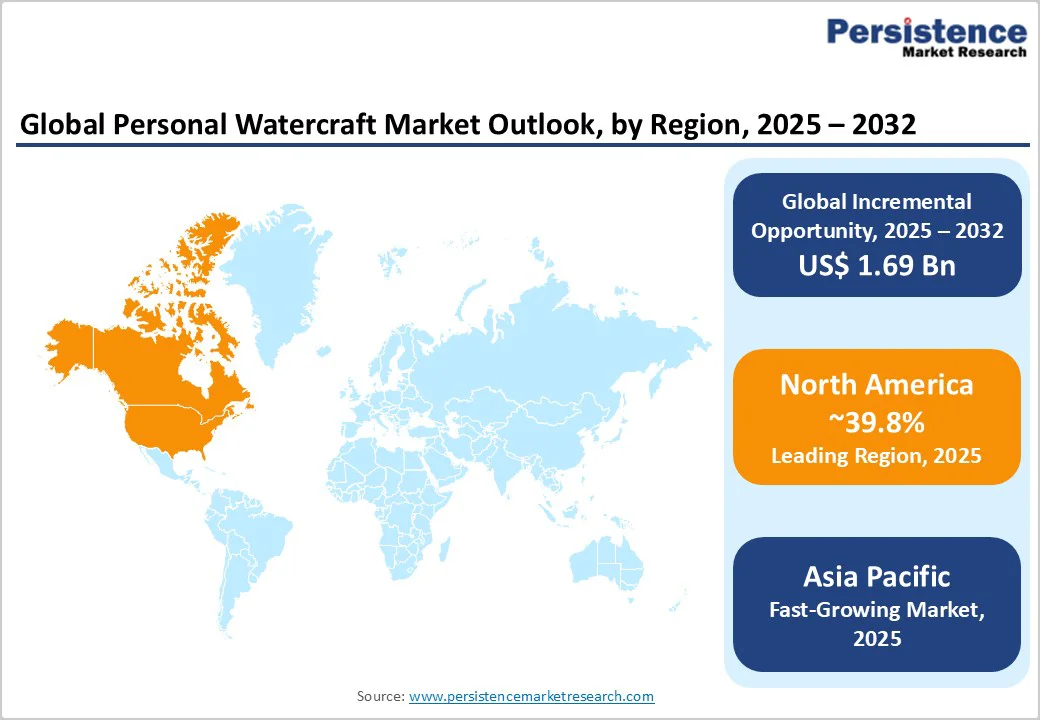
- Regional Growth Patterns: North America remains the leading regional market with a 39.8% global share (US$1.28 billion), driven by mature boating infrastructure and high recreational participation. Asia Pacific is emerging as the fastest-growing region, underpinned by robust tourism development in China, India, and Southeast Asia, as well as expanding water sports infrastructure.
- Strategic Market Developments: Manufacturers are accelerating innovation through platforms such as Yamaha’s CrossWave modular series and Sea-Doo’s fishing-oriented models, signaling a strategic shift toward multi-functional and lifestyle-oriented PWCs designed for touring, fishing, and adventure recreation.
| Key Insights | Details |
|---|---|
| Personal Watercraft Market Size (2025E) | US$3.21 Bn |
| Market Value Forecast (2032F) | US$4.9 Bn |
| Projected Growth (CAGR 2025 to 2032) | 6.2% |
| Historical Market Growth (CAGR 2019 to 2024) | 5.6% |
Market Factors - Growth, Barriers, and Opportunity Analysis
Growth Analysis - Rising Popularity of Water Sports and Leisure Activities
The personal watercraft market has experienced a significant surge in popularity due to the rising demand for water sports and leisure activities. The thrill and excitement offered by personal watercraft, such as jet skis, have captured the interest of adventure enthusiasts and leisure seekers alike. This high-powered watercraft provides a thrilling experience, enabling individuals to navigate lakes, rivers, and coastal waters with speed and agility.
More people are engaging in these activities as they seek stimulating water-based experiences. The accessibility and ease of use of personal watercraft have contributed to their increasing demand. With user-friendly controls and intuitive handling, the players are offering highly reliable and appealingly built products to attract consumers toward increased adoption.
Technological Advancements and Product Innovation
Continuous innovation in personal watercraft design, including enhanced engine efficiency, improved safety features, and advanced hull materials, is attracting new consumer segments and driving replacement purchases. Manufacturers are integrating smart technologies, IoT connectivity, and AI-driven safety systems into modern PWC designs, creating differentiated premium products.
The introduction of electric personal watercraft represents transformative innovation, with the electric PWC market valued at US$146 Million in 2024 and projected to reach US$832 Million by 2033, addressing environmental concerns and regulatory pressures.
Advanced features, including GPS navigation, digital displays, improved stability systems, and modular designs that blur lines between traditional PWCs and boats, are expanding use cases beyond pure recreation. Yamaha's 2026 CrossWave, a 13-foot modular PWC designed for four passengers with fishing and touring capabilities, exemplifies the industry's evolution toward versatile, multifunctional platforms.
Barrier Analysis - High Maintenance and Repair Costs of Personal Watercraft
The high maintenance and repair costs associated with personal watercraft have been a significant hindrance to the market growth of these recreational water vehicles. PWCs are complex machines that require regular and meticulous maintenance to ensure their optimal performance and safety. This includes routine servicing, engine checks, hull inspections, and specialized maintenance tasks.
PWCs are prone to various mechanical failures, such as engine malfunctions, electrical issues, and hull damage from collisions or rough water conditions; thus, the prices of these major parts are quite high. As a result, the market growth of personal watercraft has been hindered by these factors.
Opportunity Analysis - Collaborations and Partnerships between Watercraft Manufacturers and Tour Operators
Collaborations and partnerships between watercraft manufacturers and tour operators have significantly propelled the market worldwide. By joining forces, these two entities have created a mutually beneficial relationship that taps into the growing demand for unique water-based experiences.
This collaboration enables tour operators to differentiate their offerings in a competitive market while generating additional revenue streams. Together, watercraft manufacturers and tour operators have tapped into the growing interest in water-based recreational activities, driving the market.
Diversification into Niche Applications and Specialized Segments
The development of specialized personal watercraft for fishing, touring, and multi-functional applications expands addressable markets beyond traditional recreational users. Sea-Doo's fishing-focused personal watercraft models demonstrate market potential, with New Zealand experiencing nearly 50% of personal watercraft sales equipped for fishing, indicating substantial untapped demand in mature markets. Luxury and performance segments targeting affluent consumers seeking premium features command higher price points and margins.
Military and law enforcement applications for rescue operations and patrol duties represent specialized but stable demand sources. The evolution toward modular platforms that accommodate diverse activities via accessory ecosystems creates recurring revenue opportunities through aftermarket sales.
Category-wise Analysis
End-user Insights
The personal watercraft market is experiencing strong growth driven by the rising preference for personal watercraft in recreational activities, where this segment currently holds 45% of the market share. Their popularity stems from the ease of operation, which requires minimal training compared to larger boats, and from their ability to deliver a highly engaging, adrenaline-filled experience on the water.
Personal watercraft are also valued for their versatility, supporting activities such as cruising, water skiing, wakeboarding, and exploring coastal or inland waterways. This broad functionality makes them appealing to a wide spectrum of recreational users. Consequently, the extensive use of personal watercraft for leisure and adventure-oriented activities significantly contributes to the market’s overall revenue growth.
Product Type Insights
Two-seat models accounted for 48% of the global market in 2025 and are projected to grow at a high CAGR through 2032. These configurations are favored for recreational riding, paired use, and light performance activities, offering a strong balance of maneuverability, storage, and affordability.
In 2025, two-seat formats were widely adopted across both recreational and performance lineups due to their versatility and cost efficiency. Usage remained concentrated around lakeside properties, private marinas, and rental hubs, where short-distance and day-use activities dominate.
OEMs continued refining hull designs, control systems, and lightweight materials to elevate performance and comfort. The segment also saw rising demand in tourism-driven markets, where two-seat models form the backbone of commercial fleets for guided tours and rental operations.
Regional Insights
North America Personal Watercraft Market Trends
North America dominates the personal watercraft market with 39.8% market share in 2025, representing approximately US$1.28 Billion in market value. The U.S. alone accounts for over 62% of North American demand, driven by a well-established recreational boating culture, extensive coastlines, and numerous inland waterways.
The region benefits from high disposable incomes, strong outdoor recreation traditions, and widespread water sports participation. Major manufacturers, including BRP (Sea-Doo), Yamaha (WaveRunner), and Kawasaki (Jet Ski), maintain headquarters and extensive dealership networks, ensuring product availability and robust customer support.
The U.S. Coast Guard defines personal watercraft regulations, establishes safety standards and operational requirements, creates standardized compliance frameworks, and facilitates market development. Increasing personal watercraft sales in the U.S. grew approximately 10% in 2023, according to the National Marine Manufacturers Association (NMMA), indicating robust consumer demand despite market maturity.
Government and private-sector investments in water tourism infrastructure, including marina development and improvements to waterway access, support sustained market growth. Professional competitions such as P1 AquaX are organized across the U.S., attracting participants and spectators, promoting industry visibility, and driving consumer interest.
Europe Personal Watercraft Market Trends
Europe represents approximately 13-15% of global market share with a market value of €420.30 Million (US$463 Million) in 2024, projected to reach €603.05 Million (US$656 Million) by 2032. Germany leads regional demand with €75.32 million (US$82 million) market value in 2024, followed by the U.K., France, Italy, and Spain.
The region's market is characterized by a strong water sports culture, particularly in coastal areas and countries with extensive lake systems. European nations, including Spain, Italy, France, Greece, Malta, and Croatia, encourage watercraft activities due to high tourism volumes and established marine recreation infrastructure.
European Union regulatory frameworks establish standardized safety, emissions, and environmental protection requirements across member states, facilitating market access while imposing compliance obligations. The growing emphasis on sustainable recreational products and ecological protection drives demand for electric and hybrid personal watercraft in environmentally sensitive waterways.
The region leads global adoption of ultra-low emission technologies and renewable energy integration for charging infrastructure. Annual P1 AquaX competitions organized across Europe maintain professional water sports visibility and enthusiast engagement.
Asia Pacific Personal Watercraft Market Trends
Asia Pacific exhibits the fastest regional growth, driven by rising disposable incomes in emerging economies and expanding coastal tourism infrastructure. China leads regional demand, with a significant market share, supported by massive middle-class expansion and government investments in recreational infrastructure.
India demonstrates substantial growth potential with a high CAGR, driven by coastal tourism expansion and increasing participation in water-based leisure activities. Japan and Australia represent mature regional markets with established water sports cultures and high per-capita PWC adoption rates.
Asian governments recognize water sports as profitable drivers of tourism and implement supportive policies, including infrastructure investments and regulatory frameworks that promote recreational waterway development. Southeast Asian nations, including Thailand, Vietnam, the Philippines, and Indonesia, leverage extensive coastlines and tropical climates to develop marine tourism industries incorporating personal watercraft activities.
Australia's extensive coastline, pristine beaches, and strong marine tourism industry drive sustained demand, with destinations such as the Great Barrier Reef and Gold Coast attracting domestic and international water sports enthusiasts.
Competitive Landscape
The global personal watercraft market is characterized by the presence of many manufacturers taking several initiatives to expand their businesses. They strategically focus on creating innovative and technologically advanced products that meet the needs of end consumers. This includes developing new technologies in personal watercraft for watersports and recreational activities.
The market structure supports both volume-oriented strategies targeting mainstream recreational users and premium differentiation approaches focusing on performance enthusiasts and luxury segments. Regional specialists and emerging electric PWC manufacturers create fragmented competition in niche segments, particularly for specialized applications and sustainable alternatives.
Key Industry Developments
- In July 2025, Taiga Motors Inc., a Canadian manufacturer of electric powersports vehicles, announced a strategic partnership with Aqua superPower, the world’s leading marine fast-charging network provider. The collaboration aims to accelerate the electrification of marine transportation by combining Taiga’s innovative electric watercraft with Aqua superPower’s expanding global charging infrastructure.
- In April 2025, Yamaha Motor Co., Ltd. announced that its subsidiary, Yamaha Motor Australia Pty Ltd., had signed a purchase agreement with subsidiaries of BRP Inc., Canada, to acquire 100% of the shares of Telwater Pty Ltd., an Australian aluminum boat manufacturer. The completion of the acquisition remains subject to the necessary regulatory approvals, including competition law clearances and related permits.
Companies Covered in Personal Watercraft Market
- Polaris Industries
- BRP Inc.
- Yamaha Motors Co., Ltd.
- Kawasaki Motors Corp.
- Honda Motors. Co., Ltd.
- Sea-Doo
- Lampuga
- Arctic Cat Inc.
- Meyer Bootswerft
- SLVH s.r.o.
- Castoldi S.r.L.
- Cayago AG
Frequently Asked Questions
The personal watercraft market is set to reach US$3.21 Billion in 2025.
Growing consumer interest in marine leisure activities such as jet skiing, wakeboarding, and water racing is driving a strong demand for personal watercraft globally.
The personal watercraft market is estimated to rise at a CAGR of 6.2% through 2032.
The global push for sustainability is creating strong opportunities for electric and hybrid PWCs. Improvements in battery density, charging infrastructure, and lightweight materials are enabling manufacturers to develop more efficient, eco-friendly models.
Polaris Industries, BRP Inc., Yamaha Motors Co., Ltd., and Kawasaki Motors Corp. are a few leading players.


