




- Retail
- Personalized Stationery Market
Personalized Stationery Market Size, Share, and Growth Forecast, 2026 – 2033
Personalized Stationery Market by Product type (Storage & Filling Products, Paper-Based Products, Drawing & Writing Instruments, Accessories, Bags, Others), Application (Educational Institutes, Corporate Offices, Personal Use, Hospitals, Others), and Regional Analysis for 2026–2033

Personalized Stationery Market Share and Trends Analysis
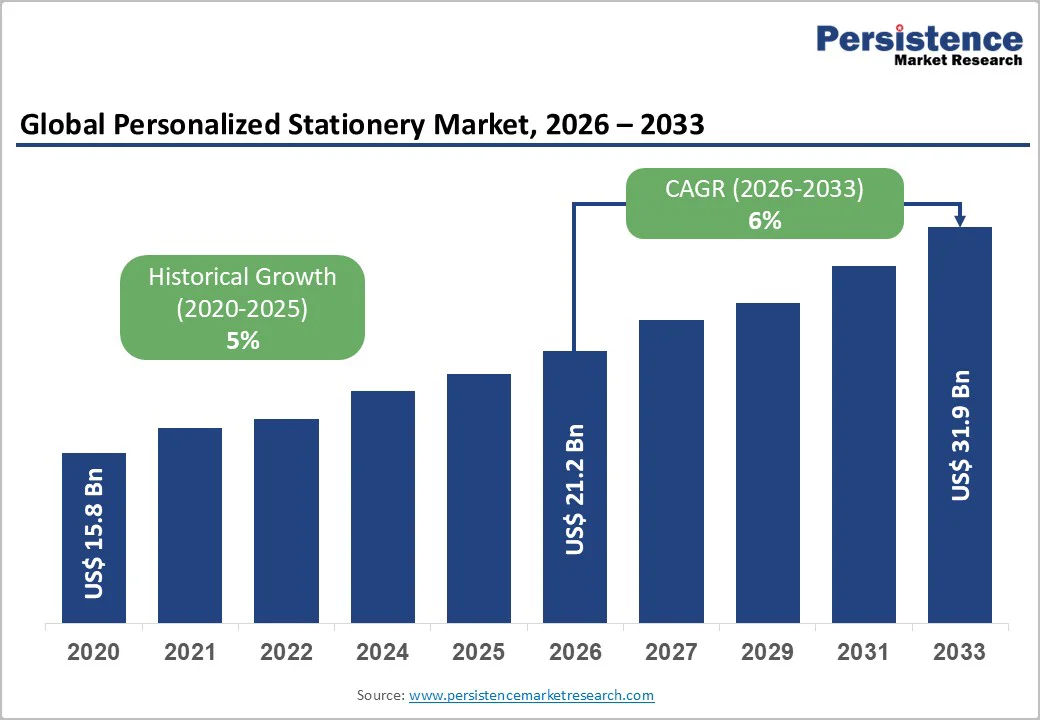
The global personalized stationery market size is likely to be valued at US$21.2 billion in 2026, and is projected to reach US$31.9 billion by 2033, growing at a CAGR of 6% during the forecast period 2026-2033. Rising consumer preference for customization, increasing corporate adoption of bespoke stationery, and expansion of online retail and e-commerce channels are the foremost factors driving market growth. The demand for custom notebooks, personalized planners, and custom writing instruments is supported by a growing middle-class population, especially in emerging markets, and a rising gifting and personalization culture globally. These trends are underpinned by improved access to digital-printing technologies and supply-chain efficiencies, enabling small-volume custom orders.
Key Industry Highlights
- Dominant Product Type: Paper-based products are expected to lead with approximately 38% market share in 2026.
- Fastest-Growing Product Type: Customized writing instruments are projected to grow the fastest with about 7% CAGR from 2026 to 2033.
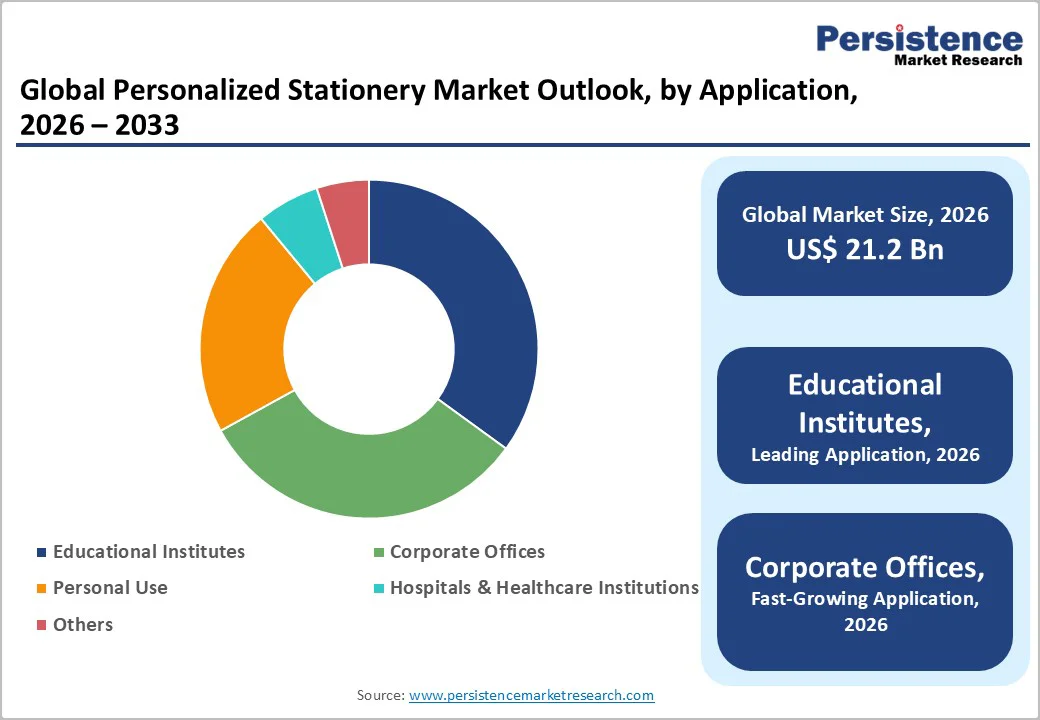
- Leading Application: Educational institutions are expected to dominate with around 35% market share in 2026.
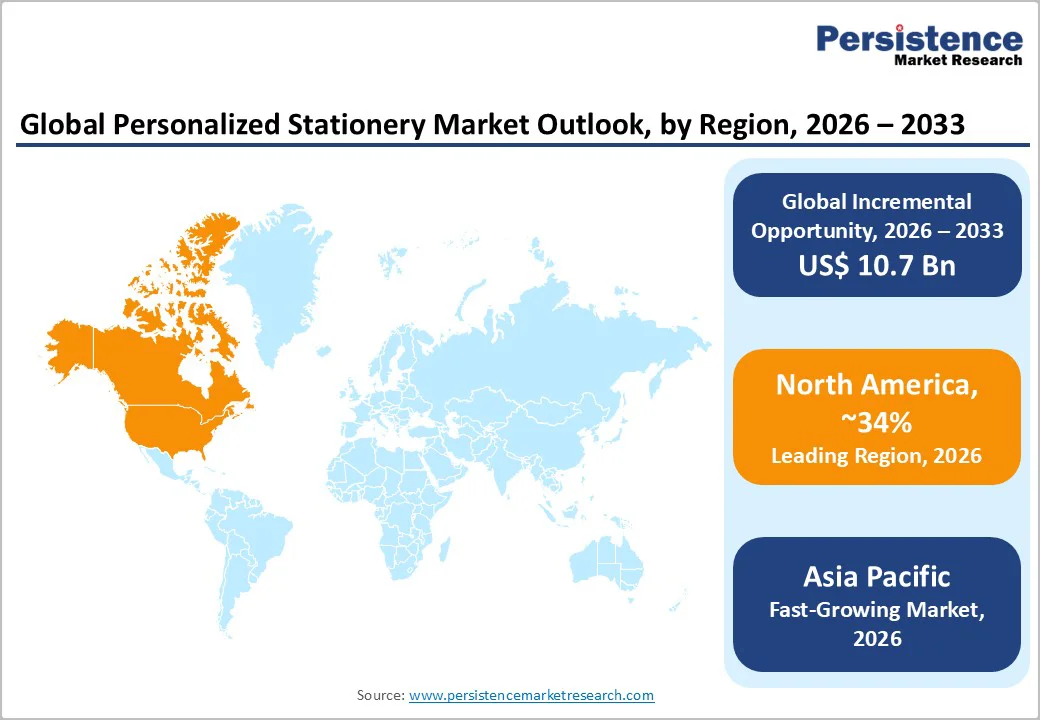
- Leading Region: North America is projected to lead with an estimated 34% market share in 2026.
- Fastest-Growing Regional Market: Asia Pacific is expected to exhibit the highest growth potential with around 7.2% CAGR during the 2026-2033 forecast period.
- Key Market Driver: Growth is driven by rising consumer preference for personalized products and the expansion of online customization platforms.
| Key Insights | Details |
|---|---|
| Personalized Stationery Market Size (2026E) | US$ 21.2 Bn |
| Market Value Forecast (2033F) | US$ 31.9 Bn |
| Projected Growth (CAGR 2025 to 2032) | 6.0 % |
| Historical Market Growth (CAGR 2020 to 2025) | 5.0 % |
Market Factors- Growth, Barriers, and Opportunity Analysis
Rising Demand for Personalized Stationery Driven by Consumer and Institutional Needs
Increasing preference for unique, customized products is driving strong demand for personalized stationery, including notebooks, diaries, planners, cards, and writing instruments. This shift is especially visible among younger and urban consumers who view stationery as a form of self-expression, gifting, and professional identity. Digital design tools are reinforcing this trend, illustrated by Office Depot’s expansion of print services with Canva, which allows small businesses to easily design and print custom materials such as flyers and posters. This integration demonstrates how user-friendly design platforms are making personalization more accessible across retail and online channels.
Corporate and institutional adoption also continues to fuel the personalized stationery market growth. Organizations and educational institutions are increasingly procuring custom stationery for branding, client communication, and student engagement. Fulfillment speed has become an important differentiator, as it highlights order delivery readiness and enhances the convenience of customized purchases. Combined with advances in digital printing and e-commerce, these developments support high-volume as well as small-batch production, expanding market outreach and creating sustainable growth opportunities for manufacturers and retailers.
Supply Chain Challenges and Digital Substitution Impacting Growth
The personalized stationery market faces constraints from raw material price volatility and supply chain disruptions. Dependence on materials such as paper, cardboard, plastics, and metals exposes manufacturers to cost fluctuations that can particularly affect smaller players. Interruptions in global supply chains may delay production and increase costs, making low-volume custom orders less feasible. As a result, retail prices may rise, limiting affordability and potentially reducing consumer demand in price-sensitive markets. These structural challenges can hinder market expansion despite growing interest in customization.
The shift toward digital tools and paperless alternatives poses another headwind. Organizations, educational institutions, and professional users are increasingly adopting note-taking apps and digital planners, reducing reliance on traditional stationery. This trend can limit demand for customized notebooks, diaries, and planners, particularly in corporate and institutional segments. As a result, supply chain constraints and digital substitution create a dual challenge, restraining market growth and requiring manufacturers to adapt strategies for production efficiency and value-added offerings.
New Prospects in Developing Economies, Sustainability, and Digital Integration
The personalized stationery market presents strong growth potential in the developing markets of Asia Pacific, supported by rising disposable incomes, expanding middle-class populations, urbanization, and the growth of educational institutions. As personalization increasingly becomes a marker of quality and status, demand continues to rise across students, professionals, and gifting segments. Even capturing a modest share of this expanding base can meaningfully boost global sales, especially for brands that adapt product mixes, pricing, and distribution models to regional needs.
Sustainability and hybrid digital-analog innovation further unlock new opportunities. Eco-friendly products, such as recycled notebooks, biodegradable accessories, and refillable writing instruments, are gaining traction, illustrated by Pilot Corporation’s release of the “FriXion Ball+” pen in January 2025, made with over 82% recycled plastic components and positioned as the first eco-designed erasable pen in its range. Alongside this trend, the integration of digital features, smart notebooks, QR-enabled planners, and hybrid paper-digital systems enables brands to engage premium and tech-forward users.
Category-wise Analysis
Product Type Insights
Paper-based products, such as notebooks, planners, and diaries, are expected to lead the market with roughly 38% of the personalized stationery market revenue share in 2026.These products dominate due to their broad appeal and adaptability for customization. Features such as custom covers, monograms, and bespoke layouts make them highly desirable for both personal use and institutional purchases. Their compatibility with small-batch digital printing ensures efficient production and cost management for custom orders.
The customized writing instruments, including pens, pencils, markers, and personalized storage, are predicted to be the fastest-growing segment at 7% CAGR from 2026 to 2033. A massive demand for premium, gift-worthy items and corporate gifting initiatives is propelling this segment. High-margin opportunities and easier differentiation make this segment attractive for manufacturers. As personalization becomes more accessible through digital printing and online platforms, these products are expected to expand faster than traditional paper-based lines, capturing increasing consumer and corporate attention.
Application Insights
Educational institutions are expected to command an estimated 35% revenue share in 2026. Schools, colleges, and universities drive large-volume demand for personalized notebooks, planners, and writing instruments, often through bulk procurement for students and institutional events. Branded or customized stationery, such as school-logo notebooks and planners, strengthens institutional identity and ensures recurring orders, forming a stable revenue base for market players.
Corporate adoption is accelerating as organizations increasingly use personalized stationery for branding, client engagement, and corporate gifting. As a result, corporate use is likely to be the fastest-growing segment at about 6.8% CAGR between 2026 and 2033. Custom diaries, pens, cards, and planners serve as effective promotional tools and reinforce corporate identity. Rising awareness of stationery as a cost-effective branding method, combined with increasing demand for bespoke gift items, fuels the segment’s rapid growth. The corporate segment is expected to continue expanding, offering strong revenue potential for manufacturers focusing on high-quality, customizable products.
Regional Insights
North America Personalized Stationery Market Trends
North America is expected to remain the leading region, accounting for around 34% of the personalized stationery market share in 2026, supported by high disposable incomes, a strong culture of personalization, and an advanced e-commerce ecosystem. The region’s mature corporate gifting environment fuels the demand for personalized stationery products, especially among professionals and students. Robust intellectual property protection encourages design-driven product innovation, while sustainability policies push brands to adopt environmentally conscious materials. These factors collectively reinforce the region’s leadership position and sustain high consumer willingness to invest in premium stationery.
Competition is intense, with global and boutique brands offering premium, design-focused products. Companies invest heavily in digital printing, online customization tools, and limited-edition collaborations to differentiate in a crowded market. Growth is further supported by the increasing popularity of bespoke planners and branded corporate sets. Regional investment trends emphasize premiumization, sustainability, and partnerships with designers or influencers to enhance product appeal and maintain market leadership across corporate and consumer segments.
Europe Personalized Stationery Market Trends
Europe is projected to hold 30% of the global market share in 2026, driven by strong gifting traditions, design-conscious consumers, and a growing shift toward sustainable stationery. The demand for custom cards, personalized accessories, and custom diaries is reinforced by consumer preference for aesthetic, high-quality designs. European Union (EU)-wide environmental regulations encourage the use of recycled paper and eco-friendly materials, strengthening demand for premium sustainable products. As bulk institutional procurement grows slowly, manufacturers increasingly focus on personalized, design-led offerings that appeal to a sophisticated consumer base.
The Europe market remains fragmented, with global brands competing alongside artisanal producers specializing in craftsmanship, limited editions, and sustainable production. Digital printing technology and online customization platforms support the efficient delivery of bespoke products tailored to diverse regional tastes. Investment opportunities center on eco-certified manufacturing, premium product lines, and integrated customization solutions. These factors combine to position Europe as a stable, high-value region with strong long-term prospects for premium personalized stationery.
Asia Pacific Personalized Stationery Market Trends
Asia Pacific is expected to be the fastest-growing regional market for personalized stationery, projected to expand at an estimated 8% CAGR between 2026 and 2033, fueled by rising disposable incomes, rapid urbanization, and a growing middle-class population. China, India, Japan, and ASEAN nations are exhibiting an increasing appetite for personalized notebooks, customized pens, and even bags. The regional market benefits from a strong demand for essential stationery from educational institutions and rising corporate adoption for branding and gifting. Lower manufacturing costs and strong local supply chains for paper and printing provide competitive advantages for scaling customized stationery production.
Regulatory momentum toward eco-friendly practices pushes manufacturers to adopt recycled materials and reduce environmental impact, aligning with global sustainability trends. The competitive landscape includes a mix of local producers leveraging cost efficiencies and international brands establishing regional hubs. Investments focus on digital printing, small-batch customization, and culturally tailored designs. With a vast population base, even modest increases in per-capita adoption translate into significant volume growth, positioning Asia Pacific as the primary engine for future market expansion.
Competitive Landscape
The global personalized stationery market structure features moderate fragmentation, comprising a blend of established stationery brands, boutique design studios, digital-first customization platforms, and niche premium makers. Leading players strengthen their presence through diverse product portfolios, including customized notebooks, planners, writing instruments, invitations, and gifting sets. Their competitive edge stems from digital printing capabilities, design flexibility, and strong e-commerce ecosystems that support rapid personalization and on-demand production. Companies increasingly invest in premium materials, sustainable substrates, and advanced finishing techniques to meet rising consumer expectations. The shift toward gifting-driven purchases and aesthetic-driven personalization continues to enhance brand differentiation.
Regional and local creators play a crucial role by offering culturally tailored designs, faster delivery, and price-competitive customization. Many emerging players leverage online marketplaces, social media branding, and small-batch crafting to build loyal consumer bases. Sustainability is becoming a major competitive factor, with brands integrating recycled papers, eco-inks, and responsibly sourced materials. Corporate gifting and event-based personalization are expanding revenue streams, pushing companies to enhance B2B customization platforms and bulk-order capabilities.
Key Industry Developments
- In December 2025, Hunter Price International finalized a multi-territory licensing agreement with The LEGO Group to develop exclusive LEGO-themed stationery collections, including activity sets, coloring books, notebooks, journals, calendars, creative supplies, and reusable tote bags, targeting Europe, Australia, and New Zealand.
- In November 2025, Cello World secured zero-royalty rights to the 'Cello' brand for stationery and writing instruments from promoter group entity CPIW, which acquired it from BIC Group, and plans INR 50 crores of investment in manufacturing infrastructure. The company anticipates INR 200 crores in revenue from Cello and Unomax brands in 2026.
- In October 2025, Montblanc launched a luxury collaboration with Ferrari featuring limited-edition writing instruments and leather goods inspired by the brand's racing heritage, blending precision craftsmanship with automotive elegance. The collection highlights premium materials such as carbon fiber accents and Scuderia Ferrari motifs, targeting collectors seeking exclusive status symbols.
Companies Covered in Personalized Stationery Market
- Vistaprint
- Shutterfly
- Minted
- Hallmark Cards, Inc.
- Canon U.S.A., Inc.
- Kokuyo Co., Ltd.
- Mitsubishi Pencil Co., Ltd.
- Faber-Castell AG
- Pilot Corporation
Frequently Asked Questions
The global personalized stationery market is projected to reach US$ 21.2 billion in 2026.
Growth is supported by rising corporate gifting, increasing preference for custom-designed notebooks and planners, and strong demand from students and young professionals seeking aesthetic and functional stationery.
The market is poised to witness a CAGR of 6% from 2026 to 2033.
Highly attractive opportunities lie in eco-friendly customized stationery, premium gifting sets, digital-on-demand printing, and personalized products for corporate branding and events.
Hallmark, Staples, Faber-Castell, and Paper Source are few of the key players in the market.


